
Image: Comparison of Five Hop Varieties and Their Aroma Profiles
Published: September 28, 2026 at 3:40:29 PM UTC
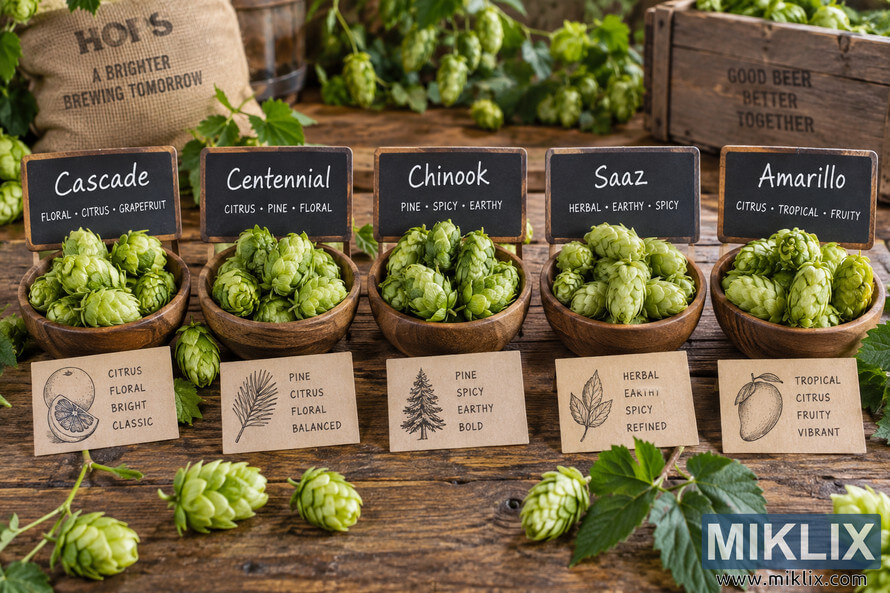
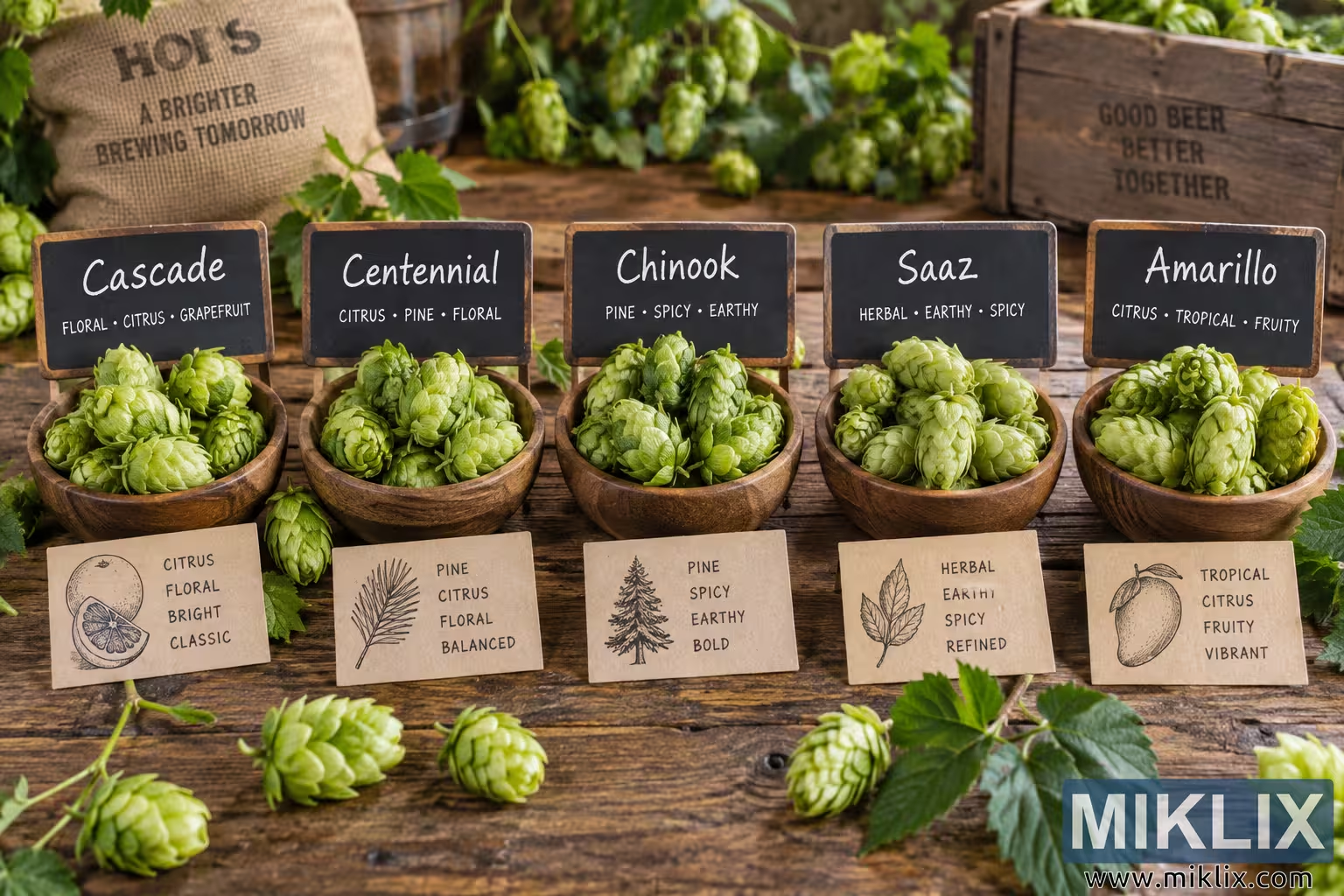
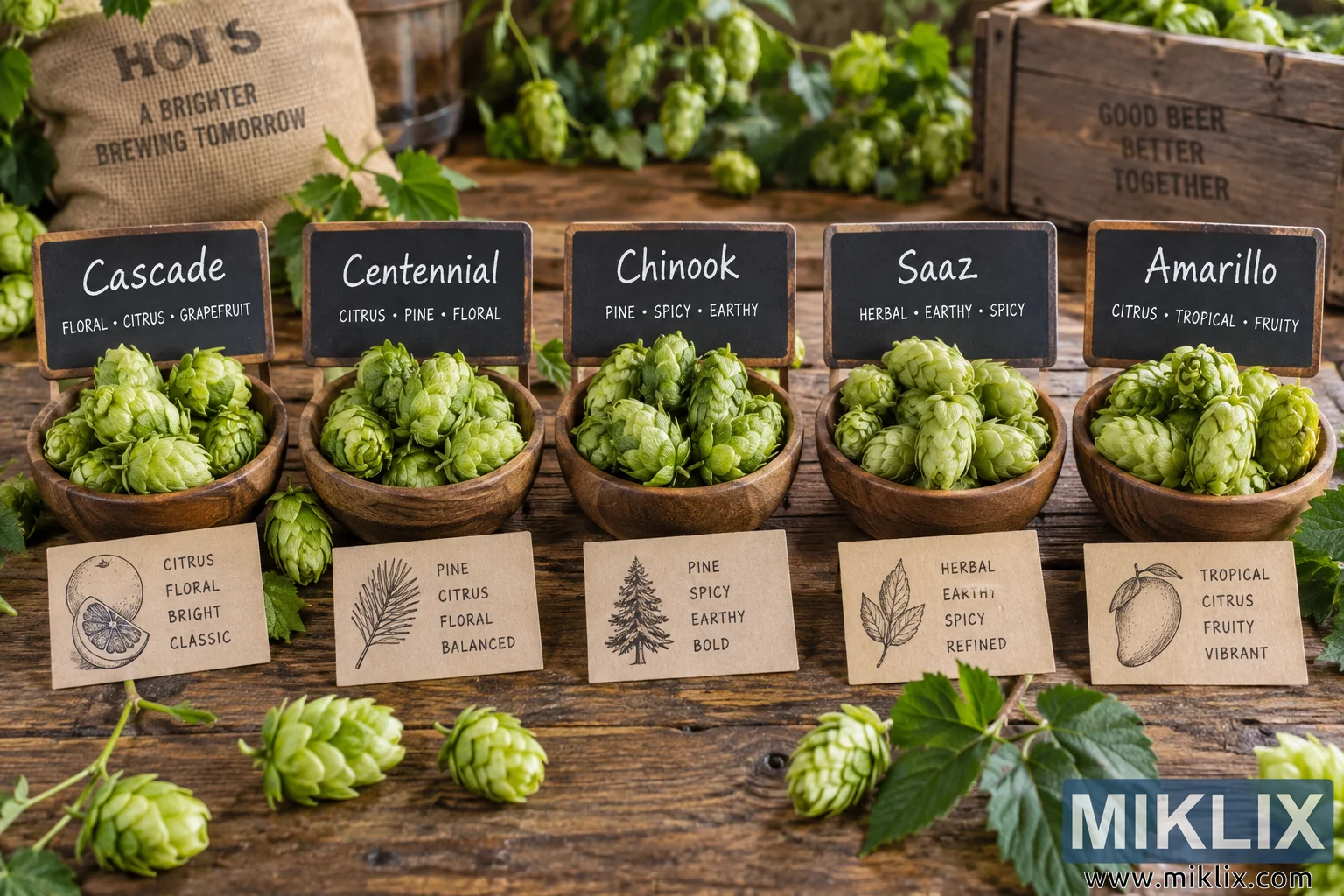
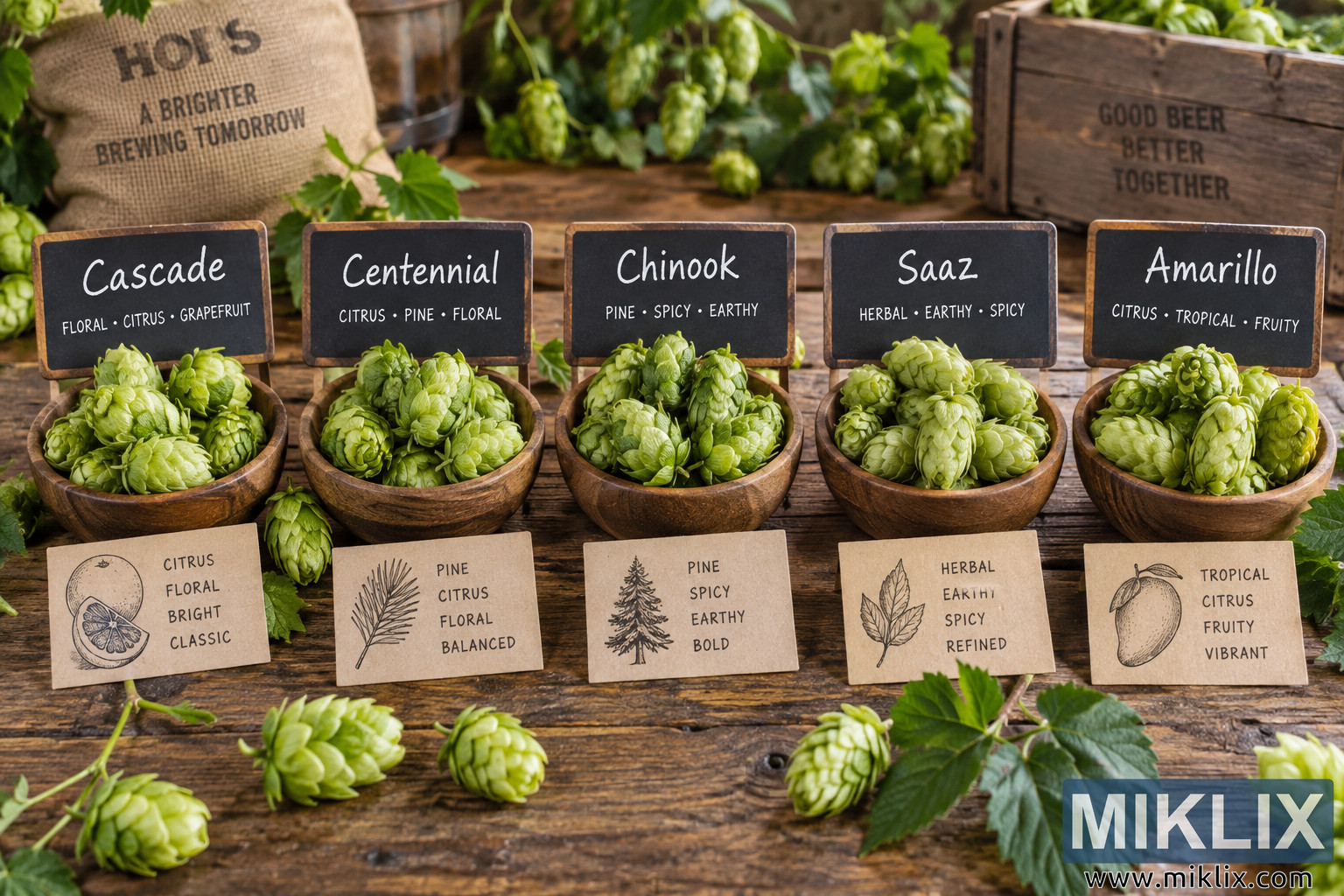
Rustic visual comparison of Cascade, Centennial, Chinook, Saaz, and Amarillo hops, showing fresh cones and their characteristic citrus, floral, pine, herbal, spicy, earthy, and tropical aroma profiles.
Available versions of this image
The image files available for download below are less compressed and higher resolution - and as a result of that, higher quality - than the images embedded in articles and pages on this website, which are more optimized for file size in order to reduce bandwidth consumption.
Regular size (1,536 x 1,024)
Large size (3,072 x 2,048)
Very large size (4,608 x 3,072)
Extra large size (6,144 x 4,096)
Comically large size (1,048,576 x 699,051)
- Still uploading... ;-)
Image description
A wide, landscape-oriented still-life photograph presents a carefully arranged comparison of five different hop varieties on a rustic wooden table. The composition has the welcoming atmosphere of a small craft brewery, hop farm, or educational tasting display, with warm natural lighting, rich wooden textures, fresh green hop cones, leafy vines, burlap, and simple handwritten-style signs. Five round wooden bowls form the central row of the image. Each bowl is filled generously with fresh green hop cones and is accompanied by a small black chalkboard identifying a hop variety and summarizing its characteristic aroma profile. From left to right, the varieties are Cascade, Centennial, Chinook, Saaz, and Amarillo.
On the far left, the Cascade display contains a bowl overflowing with pale to medium green hop cones. Behind it, a dark chalkboard sign bears the handwritten name “Cascade,” followed by the descriptors “Floral • Citrus • Grapefruit.” A kraft-paper tasting card positioned in front of the bowl reinforces this aromatic character with an illustrated citrus fruit and the words “Citrus,” “Floral,” “Bright,” and “Classic.” The combination suggests a fresh, lively hop profile with prominent citrus and floral qualities.
Next to Cascade is Centennial. Its wooden bowl contains another abundant collection of fresh hops, while the chalkboard behind it identifies the variety as “Centennial” and lists “Citrus • Pine • Floral.” The accompanying kraft card features a botanical pine-needle illustration and the descriptors “Pine,” “Citrus,” “Floral,” and “Balanced.” The arrangement visually emphasizes the variety’s mixture of bright citrus character, evergreen-like notes, and floral qualities.
At the center of the photograph is Chinook. The bowl is densely packed with green hop cones of slightly varied sizes, giving the display an organic, freshly harvested appearance. Its black sign reads “Chinook,” with “Pine • Spicy • Earthy” underneath. The tasting card in front shows a stylized evergreen tree and lists “Pine,” “Spicy,” “Earthy,” and “Bold.” Its central position and strong descriptive vocabulary give this variety a robust visual identity, suggesting a more assertive, resinous, spicy, and earthy aromatic character than the varieties immediately surrounding it.
To the right of Chinook is Saaz. A wooden bowl filled with lighter green hop cones sits beneath a chalkboard labeled “Saaz,” followed by “Herbal • Earthy • Spicy.” The corresponding kraft card contains a detailed leaf illustration and the descriptors “Herbal,” “Earthy,” “Spicy,” and “Refined.” The presentation communicates a traditional, delicate, herbaceous character while maintaining the same consistent comparison format used throughout the display.
The fifth bowl, positioned at the far right, represents Amarillo. Its chalkboard identifies “Amarillo” and describes the variety as “Citrus • Tropical • Fruity.” The tasting card in front features a hand-drawn fruit illustration and the words “Tropical,” “Citrus,” “Fruity,” and “Vibrant.” Together, these elements suggest an especially expressive fruit-forward aroma profile, contrasting clearly with the pine, spice, earth, and herbal characteristics emphasized in some of the neighboring hop varieties.
The foreground is intentionally informal and natural. Several loose hop cones are scattered across the weathered wooden tabletop, accompanied by sections of green hop vine and broad serrated leaves. These elements extend toward the lower edge of the frame and make the scene feel like an active hop-sorting or tasting table rather than a sterile studio display. The table itself has pronounced grain, knots, scratches, and tonal variation, adding tactile warmth and reinforcing the agricultural character of the subject.
The background continues the hop and brewing theme while remaining softly secondary to the five main samples. On the upper left is a large burlap sack with printed decorative wording about hops and brewing. Behind and between the signs are abundant green hop vines and cones, creating a lush backdrop suggestive of freshly harvested plants. A wooden container or barrel is partially visible toward the rear, while a dark wooden crate occupies the upper-right portion of the composition and carries decorative beer-related wording. These background props are generic and serve purely as atmospheric elements rather than representing an actual commercial brand.
Lighting comes from a soft, warm direction and highlights the layered scales of the hop cones, the grain of the wooden bowls, and the fibers of the kraft paper and burlap. The shallow-to-moderate depth of field keeps the five labeled varieties and their tasting cards clear while allowing the background greenery and brewery-inspired props to become slightly softer. The dominant colors are natural greens, warm browns, tan kraft paper, muted beige burlap, and charcoal black chalkboards with white lettering. This restrained earthy palette makes the vivid green hops the strongest visual element.
Overall, the image functions as both an attractive rustic still life and an educational visual comparison of hop varieties. Its symmetrical row of five samples makes it easy to scan from left to right and compare the stated aromatic characteristics of Cascade, Centennial, Chinook, Saaz, and Amarillo. The bowls, chalkboards, illustrated tasting cards, scattered hop cones, and surrounding foliage communicate freshness and agricultural provenance, while the wood, burlap, and handcrafted signage evoke small-batch brewing culture. The result is a detailed, approachable visual representation of how different hop varieties can be associated with distinctly different aroma families, ranging from floral and grapefruit-like citrus through pine, spice, earth, herbs, tropical fruit, and other fruity characteristics.
The image is related to: Hops in Beer Brewing: Falconer's Flight