
Image: Side-by-Side Comparison of Five Hop Cone Varieties
Published: September 29, 2026 at 3:34:08 PM UTC
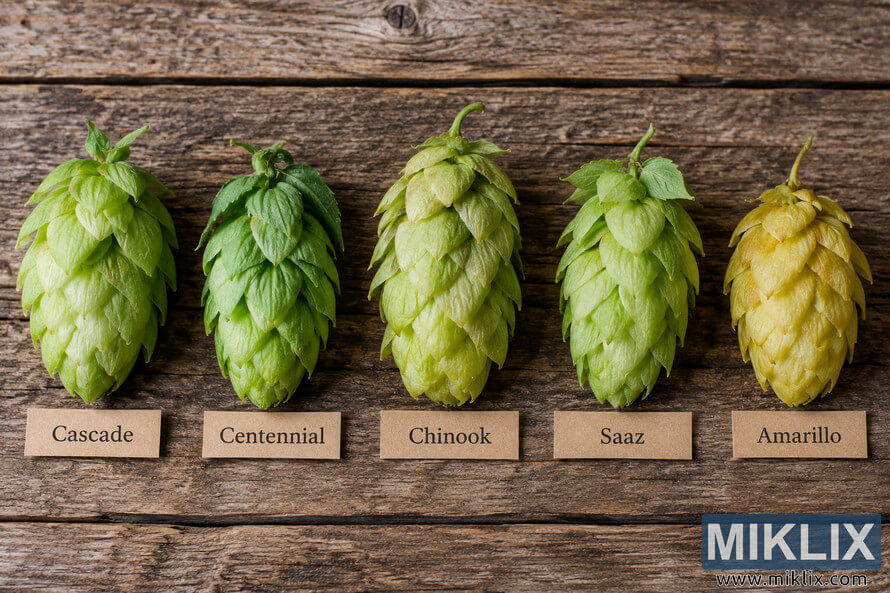
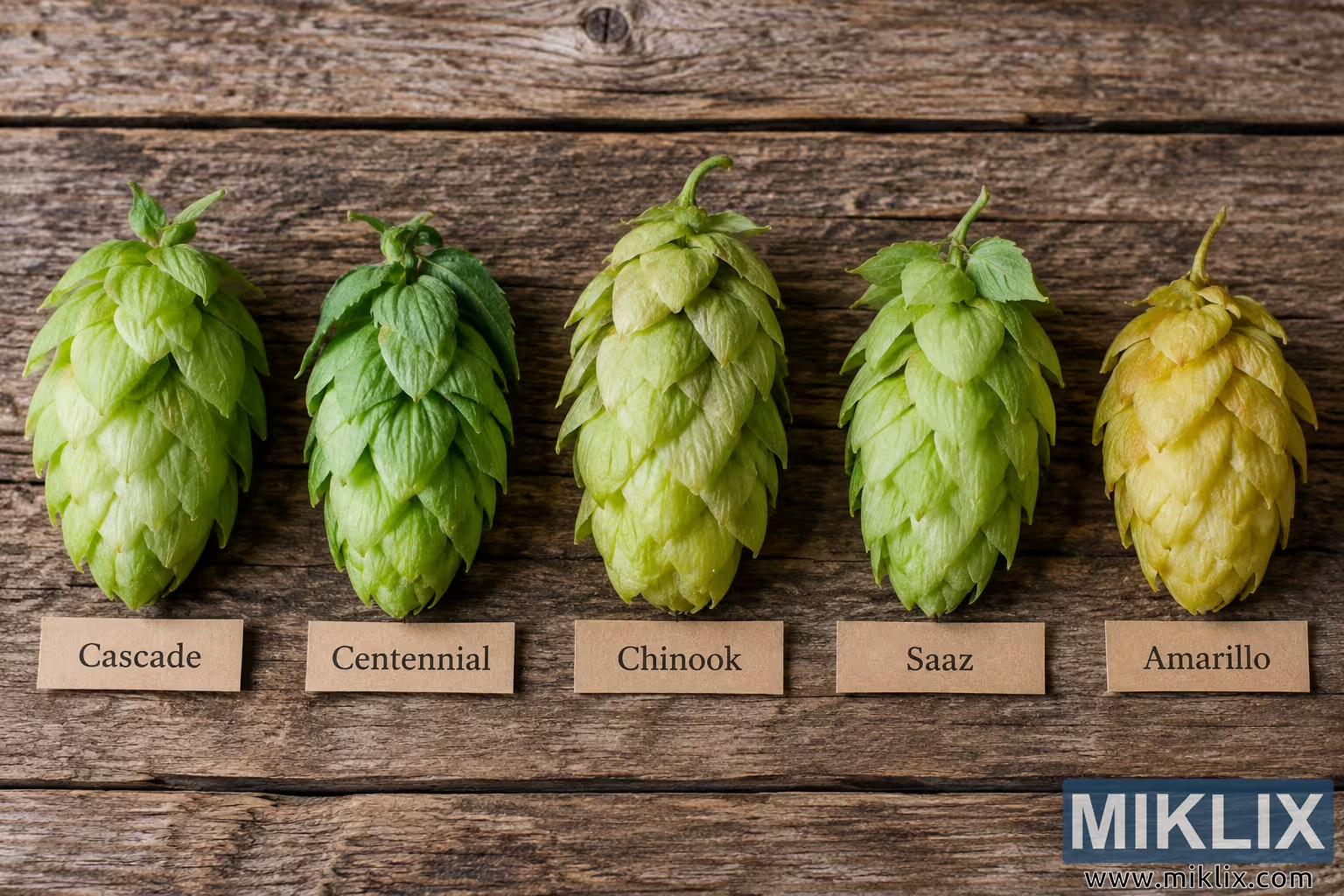
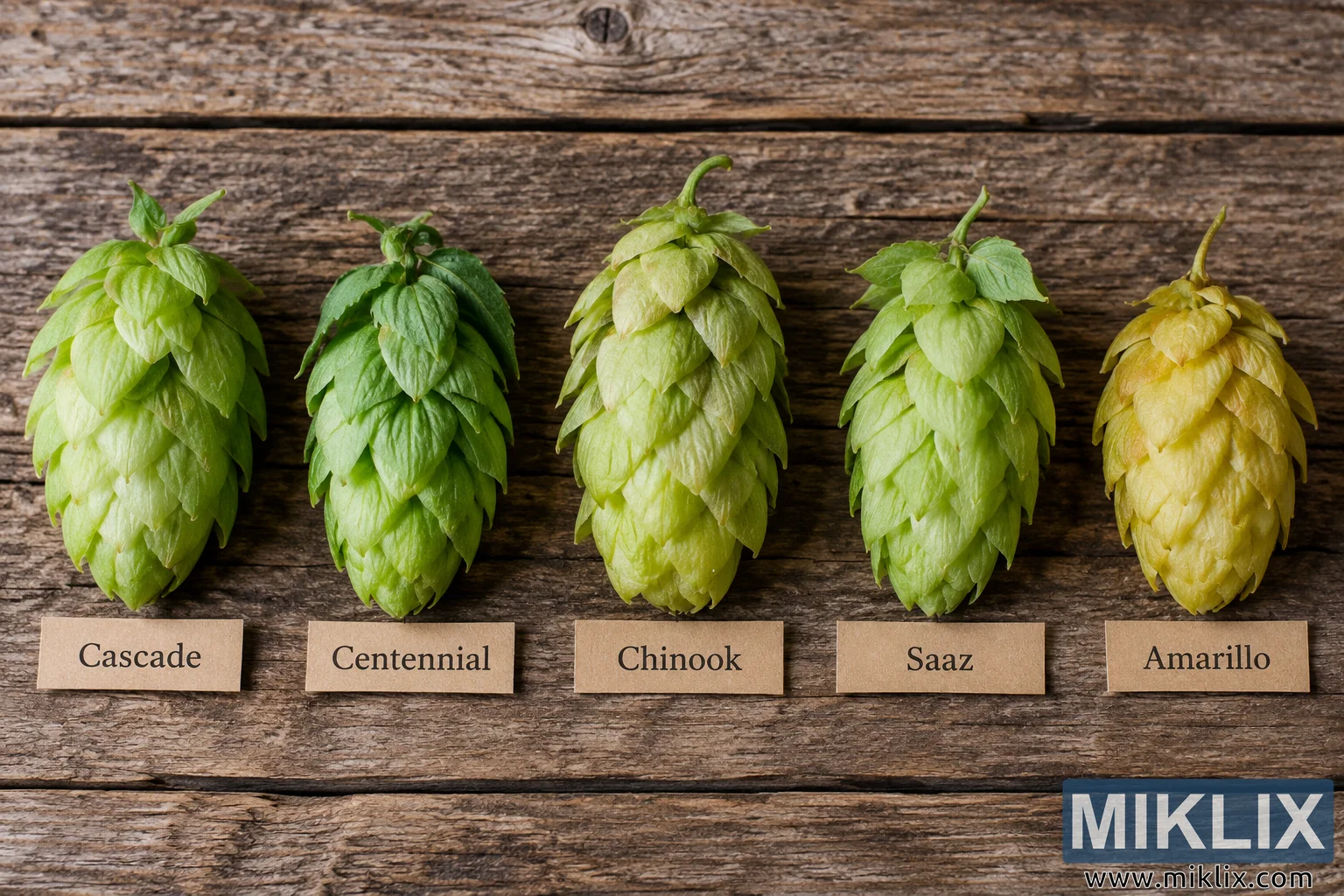
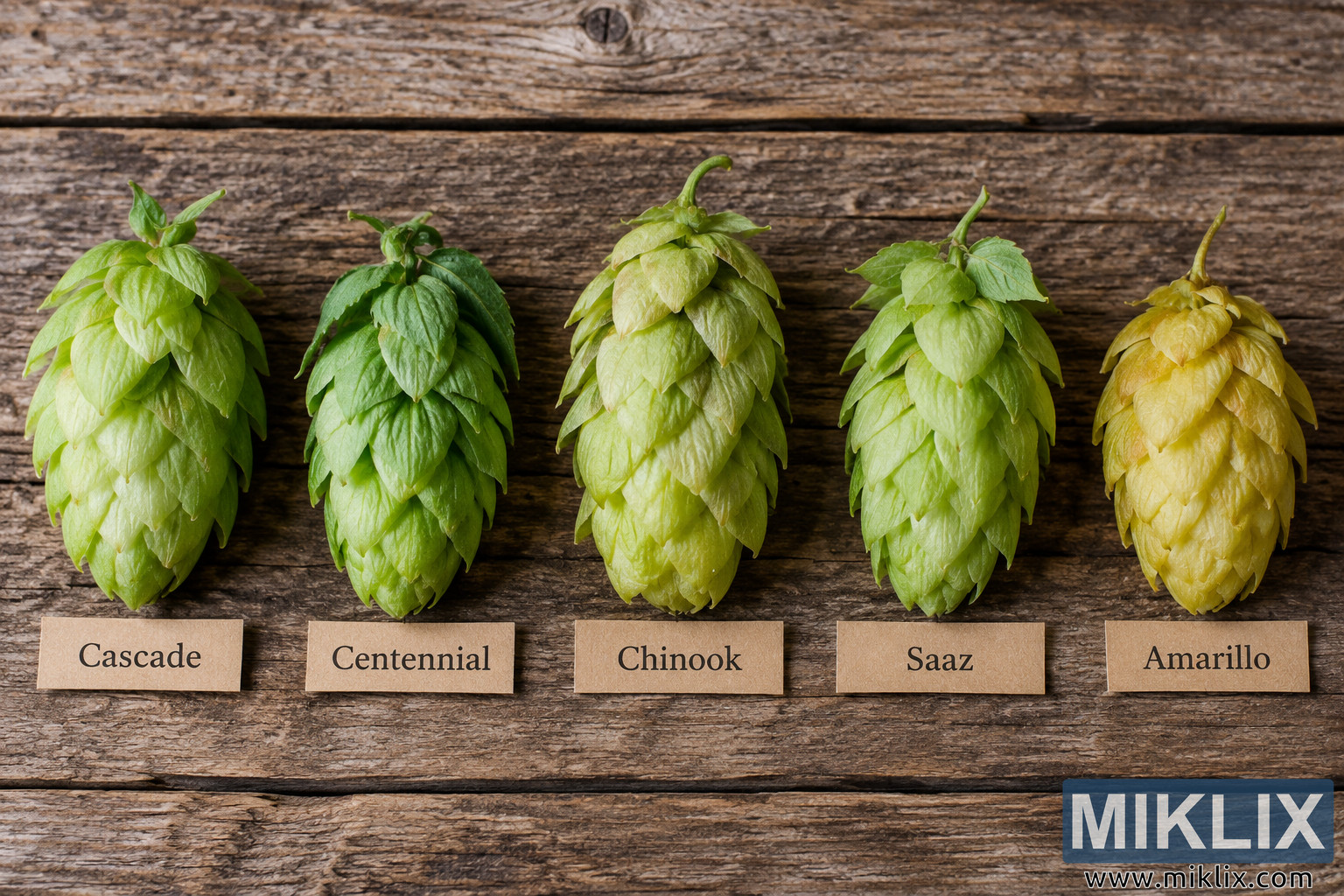
High-resolution top-down comparison of Cascade, Centennial, Chinook, Saaz, and Amarillo hop cones arranged side by side on rustic wood with clearly labeled variety cards.
Available versions of this image
The image files available for download below are less compressed and higher resolution - and as a result of that, higher quality - than the images embedded in articles and pages on this website, which are more optimized for file size in order to reduce bandwidth consumption.
Regular size (1,536 x 1,024)
Large size (3,072 x 2,048)
Very large size (4,608 x 3,072)
Extra large size (6,144 x 4,096)
Comically large size (1,048,576 x 699,051)
- Still uploading... ;-)
Image description
A high-resolution landscape photograph presents five individual hop cones arranged side by side in a straight horizontal row on a rustic wooden surface. The composition is photographed from directly above, creating a clean, top-down flat-lay perspective that makes it easy to compare the appearance of each hop cone. The background consists of broad, weathered wooden planks in warm brown and gray-brown tones. Their prominent grain, knots, cracks, darker seams, and irregular texture give the scene a natural agricultural character while providing strong visual contrast with the fresh green and yellow-green hop cones. The five cones are evenly spaced across the frame and occupy most of the central area of the photograph. Each cone is positioned vertically, with its narrow stem or tip pointing toward the upper edge of the image and its broader, rounded end pointing downward. Small rectangular kraft-paper labels are placed directly beneath the cones, identifying the displayed varieties from left to right as Cascade, Centennial, Chinook, Saaz, and Amarillo. The labels use a simple dark serif typeface and have an understated handmade or botanical-reference appearance that complements the rustic wood. The Cascade hop cone on the far left is large, plump, and predominantly bright green. Its overlapping bracts are broad and clearly defined, with lighter highlights along their raised surfaces and subtle variations from pale lime green to richer green. The cone has a full, rounded silhouette that gradually narrows toward the top, where several small leafy bracts extend around a short stem. Next to it, the Centennial cone is slightly narrower and noticeably darker in color. It has a deeper medium-to-dark green appearance, especially around its upper and central bracts, giving it stronger tonal contrast than the Cascade cone. Its layered scales appear somewhat tighter and more compact, and the top includes a small cluster of darker green plant material surrounding the stem. At the center of the composition is the Chinook hop cone. It is large and elongated, with a pale yellow-green to lime-green coloration. The Chinook cone has broad, overlapping bracts that create a substantial, slightly tapered form. Its comparatively light color makes it stand out against both the dark wooden background and the darker Centennial cone beside it. A curved green stem rises from its top, adding a small organic asymmetry to the otherwise orderly arrangement. To the right of Chinook is the Saaz hop cone, which is medium-sized and fresh green in appearance. It has a somewhat softer, rounded form and a series of clearly visible overlapping bracts. The cone's coloration falls between the darker Centennial and the paler Chinook, producing a balanced medium green with lighter highlights. A slender stem and a few pointed leafy structures emerge from the top. The Amarillo cone on the far right is the most visually distinct in terms of color. Rather than the fresh green shades of the other four examples, it appears golden yellow to yellow-green, with subtle olive and pale amber tones in some of its overlapping bracts. The warm coloration creates an immediate contrast with the surrounding green cones. Its shape remains recognizably similar to the others: elongated and gently tapered, with many layered, papery bracts forming the characteristic hop-cone structure. A narrow stem projects upward from the top. Soft, directional lighting reveals the delicate veins, wrinkles, folds, and slightly translucent quality of the hop bracts. Highlights emphasize the raised surfaces while gentle shadows form beneath overlapping scales, giving each cone a convincing three-dimensional appearance. Shadows are also visible on the wooden surface around and beneath the cones and labels, reinforcing the impression that these are physical botanical specimens carefully arranged for comparison. The photograph has a natural, realistic aesthetic rather than a diagrammatic or highly stylized appearance. Its symmetrical horizontal organization and consistent viewing angle make differences in size, shape, density, and coloration readily visible. The overall scene resembles an educational botanical comparison, brewing reference photograph, or agricultural variety guide. No commercial logos, product packaging, or actual brand identities are visible. The only text in the image consists of the generic variety names Cascade, Centennial, Chinook, Saaz, and Amarillo on individual kraft-paper cards. The combination of fresh botanical subjects, weathered timber, restrained typography, and straightforward overhead photography produces a warm, informative image focused entirely on the visual characteristics of different hop cone varieties.
The image is related to: Hops in Beer Brewing: Goldings (NZ)