
Image: Green Bullet Hops Added to a Fermenter for Dry Hopping
Published: October 1, 2026 at 4:38:59 PM UTC
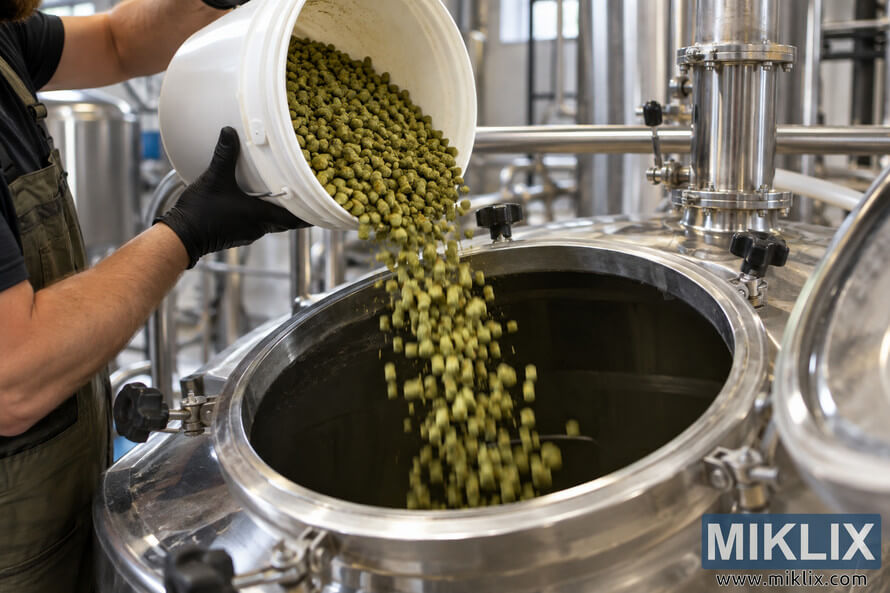
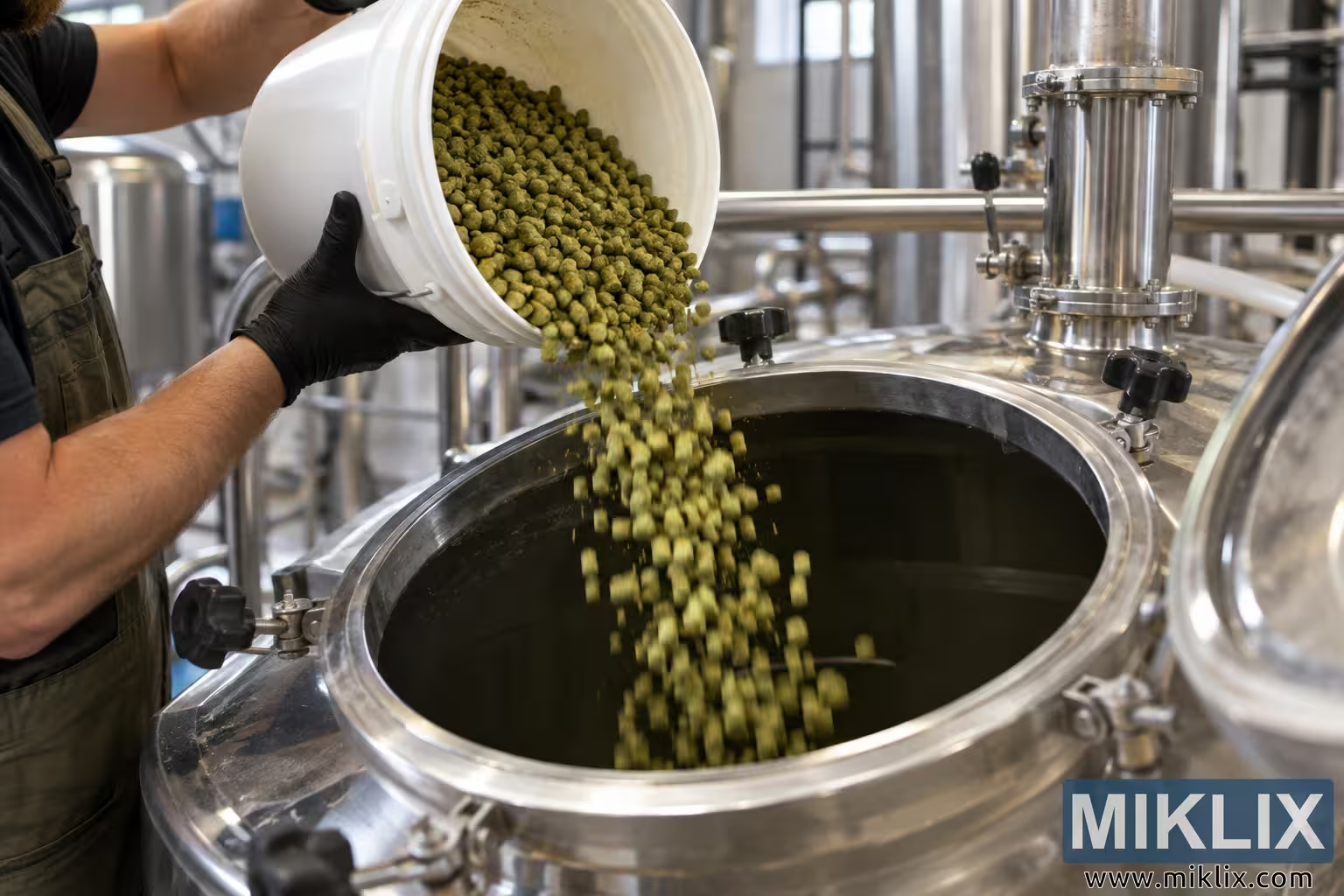
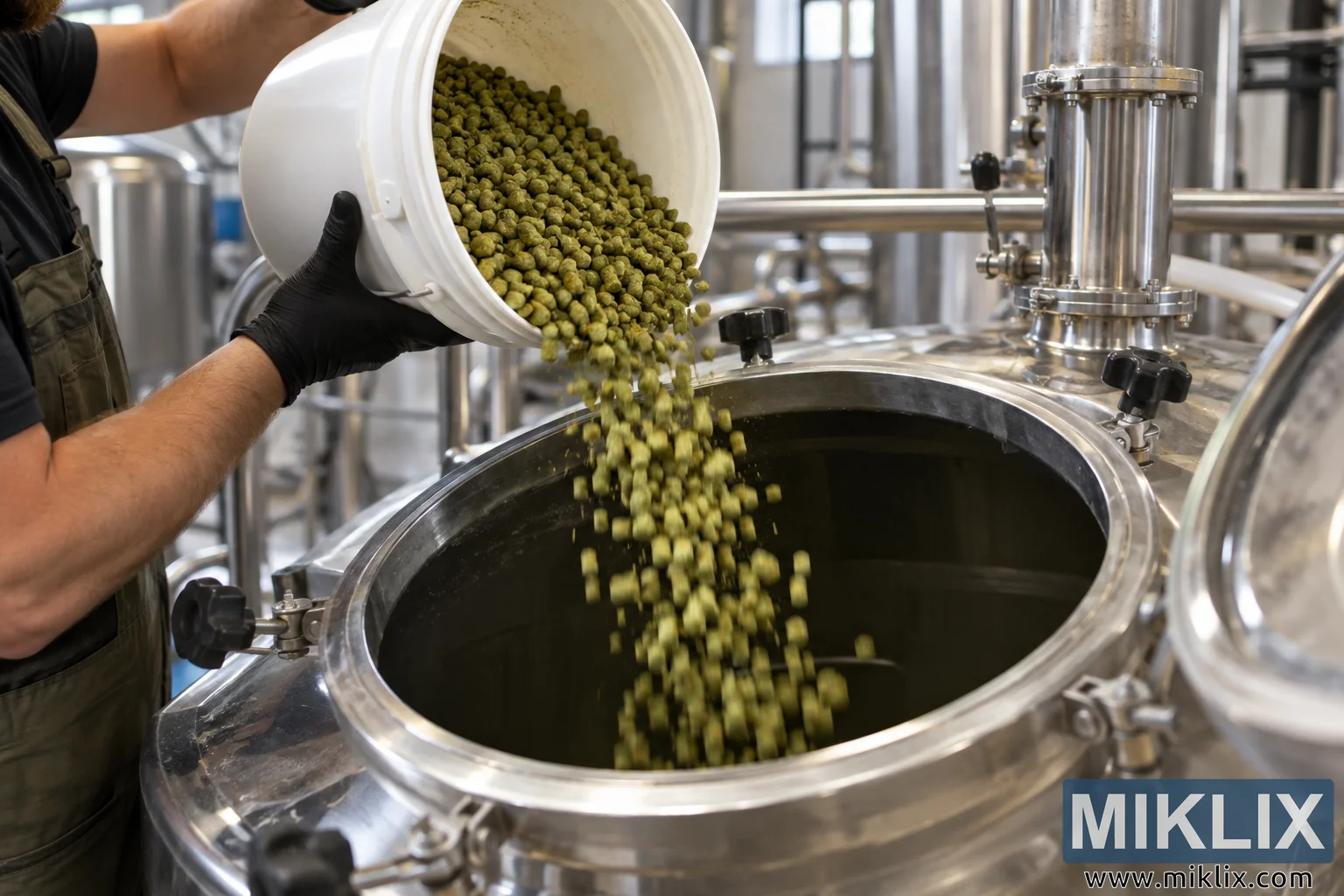
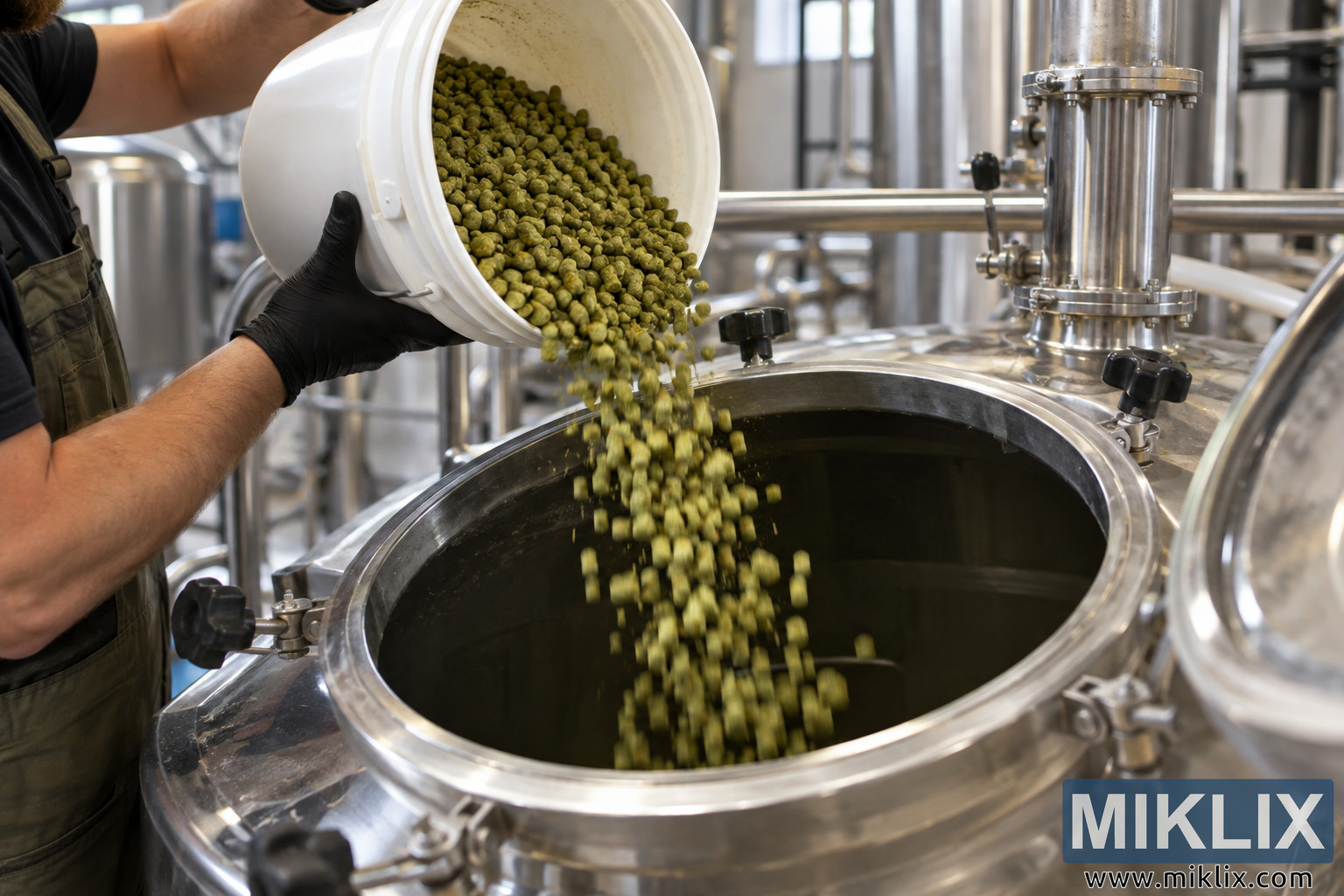
Green Bullet hop pellets being poured into an open stainless-steel fermenter during dry hopping, captured in a clean, modern brewery production setting.
Available versions of this image
The image files available for download below are less compressed and higher resolution - and as a result of that, higher quality - than the images embedded in articles and pages on this website, which are more optimized for file size in order to reduce bandwidth consumption.
Regular size (1,536 x 1,024)
Large size (3,072 x 2,048)
Very large size (4,608 x 3,072)
Extra large size (6,144 x 4,096)
Comically large size (1,048,576 x 699,051)
- Still uploading... ;-)
Image description
A high-resolution, landscape-oriented photograph depicts the process of adding green hop pellets to a stainless-steel fermenter during dry hopping in a modern brewery. The composition is dominated by a large, polished stainless-steel fermentation vessel positioned across the foreground and center of the frame. Its broad circular opening is uncovered, revealing a dark interior that contrasts strongly with the reflective metallic rim surrounding it. From the upper left portion of the image, a brewery worker is tipping a large, plain white plastic bucket toward the open fermenter. The bucket contains a substantial quantity of compact green hop pellets, representing Green Bullet hops, and the pellets are visibly pouring from the container in a dense stream. Individual pellets can be seen at different stages of their fall, with some remaining sharply defined near the bucket and others showing subtle motion blur as they descend toward the vessel. This creates a convincing sense of movement and captures the dry-hopping process at the precise moment the hops are being introduced into the fermenter.
Only part of the brewery worker is visible, keeping the visual emphasis on the ingredients and brewing equipment rather than on the individual. The worker appears at the left edge of the frame and wears a dark short-sleeved shirt, practical dark green or olive work overalls, and black protective gloves. One gloved hand supports the lower portion of the white bucket while the worker's other arm controls the tilt of the container. The posture suggests careful handling of a relatively heavy quantity of hop pellets. No logos, labels, trademarks, or recognizable commercial branding are visible on the worker's clothing, bucket, fermenter, or surrounding equipment.
The hop pellets themselves provide the primary natural color in the scene. They range from muted olive green to brighter yellow-green tones and have the characteristic compact, cylindrical appearance of processed brewing hops. The large number of pellets visible inside the bucket makes the ingredient immediately identifiable as an important addition rather than a decorative element. As they leave the bucket, the pellets form an irregular cascade through the middle of the composition. Some pieces separate from the main stream and appear suspended momentarily in the air, adding texture and visual energy. The falling hops lead the viewer's eye directly into the dark opening of the fermenter, clearly communicating that this is a dry-hopping operation.
The fermenter has a clean, professional industrial appearance. Its circular hatch is framed by a thick stainless-steel rim with a smooth reflective finish. Several black adjustment knobs, clamps, fittings, and mechanical connections are positioned around the opening. The vessel's exterior reflects the brewery environment in soft, distorted highlights. On the right side, the open metal lid is partially visible, extending beyond the edge of the frame and reinforcing the impression that the tank has just been opened specifically for the hop addition. Above and behind the hatch is a vertical stainless-steel assembly featuring cylindrical sections, flanges, bolts, and transparent or polished components associated with professional brewery equipment.
The background establishes the setting as a functioning production brewery. Additional stainless-steel tanks, vertical pipes, horizontal pipework, fittings, structural elements, and pieces of processing equipment extend through the softly focused space. Large windows or bright openings allow neutral daylight to enter the facility, producing highlights along the polished metal surfaces. The relatively shallow depth of field keeps these background details recognizable without allowing them to compete with the central action. The overall environment appears orderly, hygienic, and purpose-built for beverage production, with smooth stainless-steel surfaces and interconnected processing hardware typical of a commercial or craft brewing facility.
Lighting is bright and naturalistic, combining soft ambient illumination with reflections from the metal equipment. Highlights along the fermenter's rim emphasize its curved shape, while the darker interior creates visual depth. The white bucket stands out clearly against the more neutral metallic background, and the green hops provide a strong visual focal point. The worker's black gloves also create useful contrast against both the pale bucket and the worker's skin. Fine details in the stainless steel, hop pellets, gloves, fittings, and bucket contribute to the realistic photographic quality of the scene.
The image is composed from a close, slightly elevated viewpoint that allows the viewer to see both inside the bucket and through the open hatch of the fermenter. This angle makes the brewing action immediately understandable without requiring explanatory labels or text. The diagonal orientation of the tilted bucket and the vertical cascade of pellets create a dynamic visual path from the upper left toward the lower center of the frame. Meanwhile, the broad circular fermenter opening anchors the composition and occupies much of the lower half of the image. The combination of a close working perspective, visible industrial surroundings, and suspended hop pellets gives the photograph a documentary quality, as though it were captured during an actual brewing procedure.
Conceptually, the photograph illustrates dry hopping: the addition of hops to beer during or after fermentation to contribute hop aroma and flavor. In this scene, Green Bullet hops are represented by the green pellets being poured directly into the open fermentation vessel. The photograph focuses entirely on the physical brewing process rather than on packaging, finished beer, marketing, or branding. There are no bottles, cans, glasses, product labels, signs, written words, or company identifiers in view. Instead, the image communicates craftsmanship and production through the interaction between the brewer, the raw hop ingredient, and professional stainless-steel equipment. The result is a clean, detailed, realistic brewery photograph centered on the moment Green Bullet hop pellets are added to a fermenter for dry hopping.
The image is related to: Hops in Beer Brewing: Green Bullet