
Image: Fermenter Batch Size Scaling from 1 Gallon to 10 Gallons
Published: October 1, 2026 at 4:38:59 PM UTC
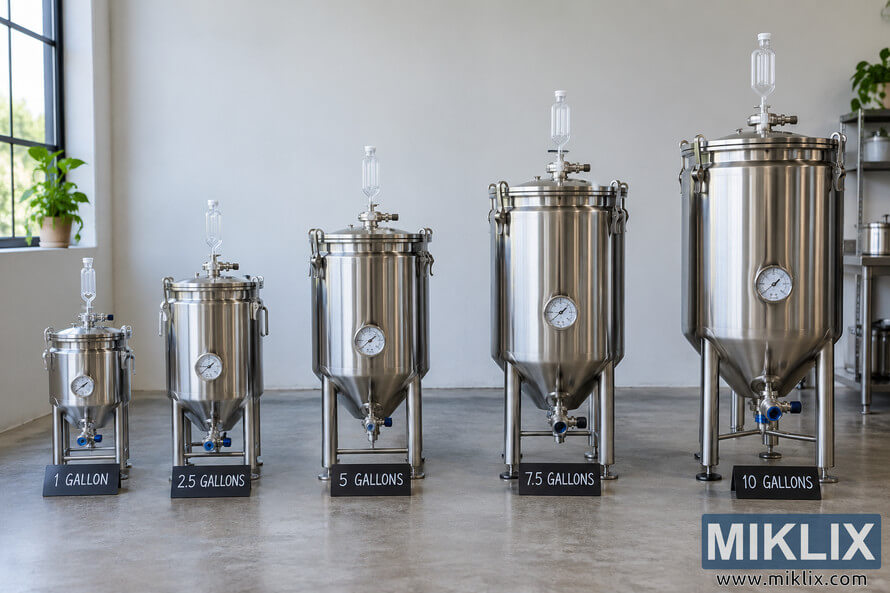
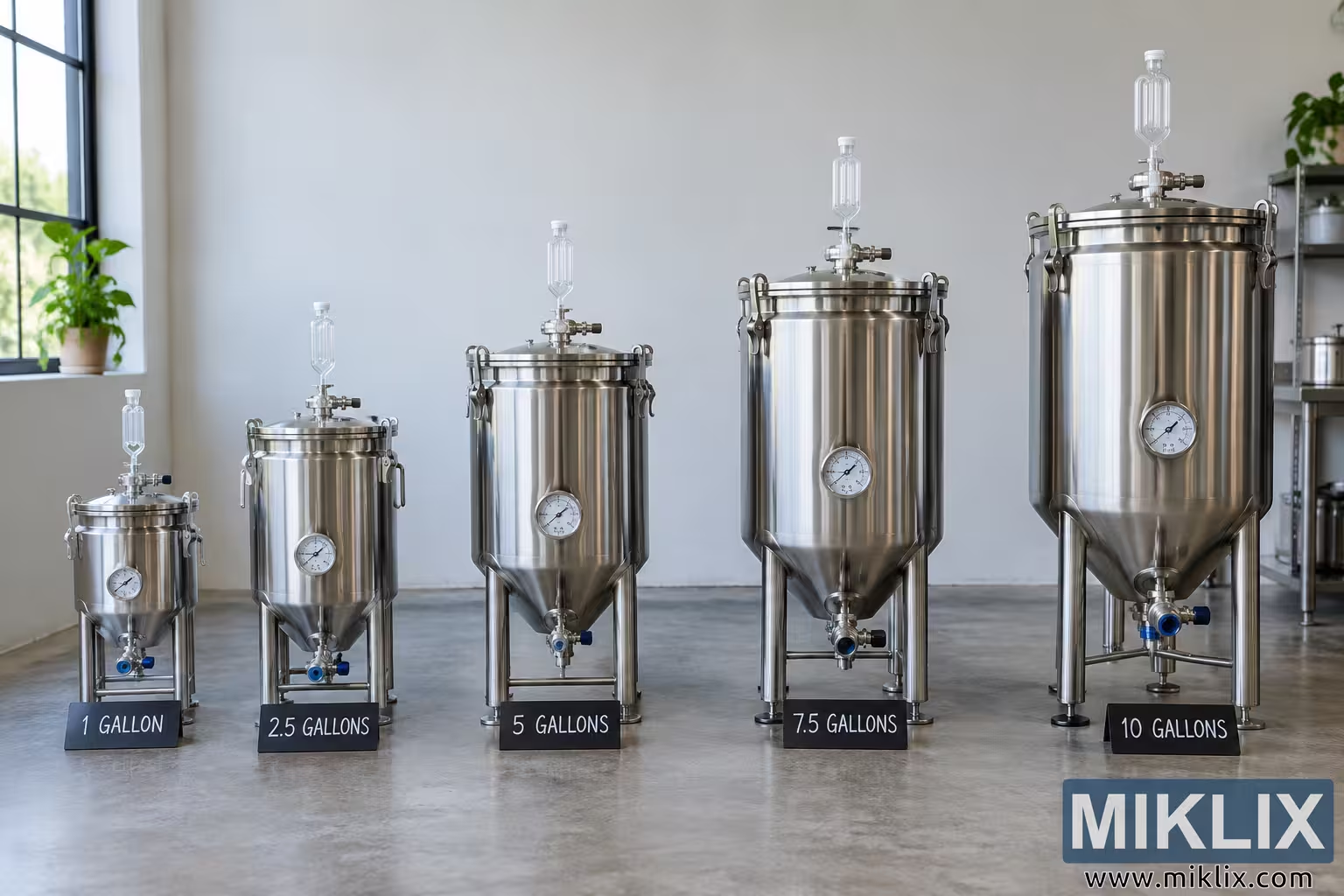
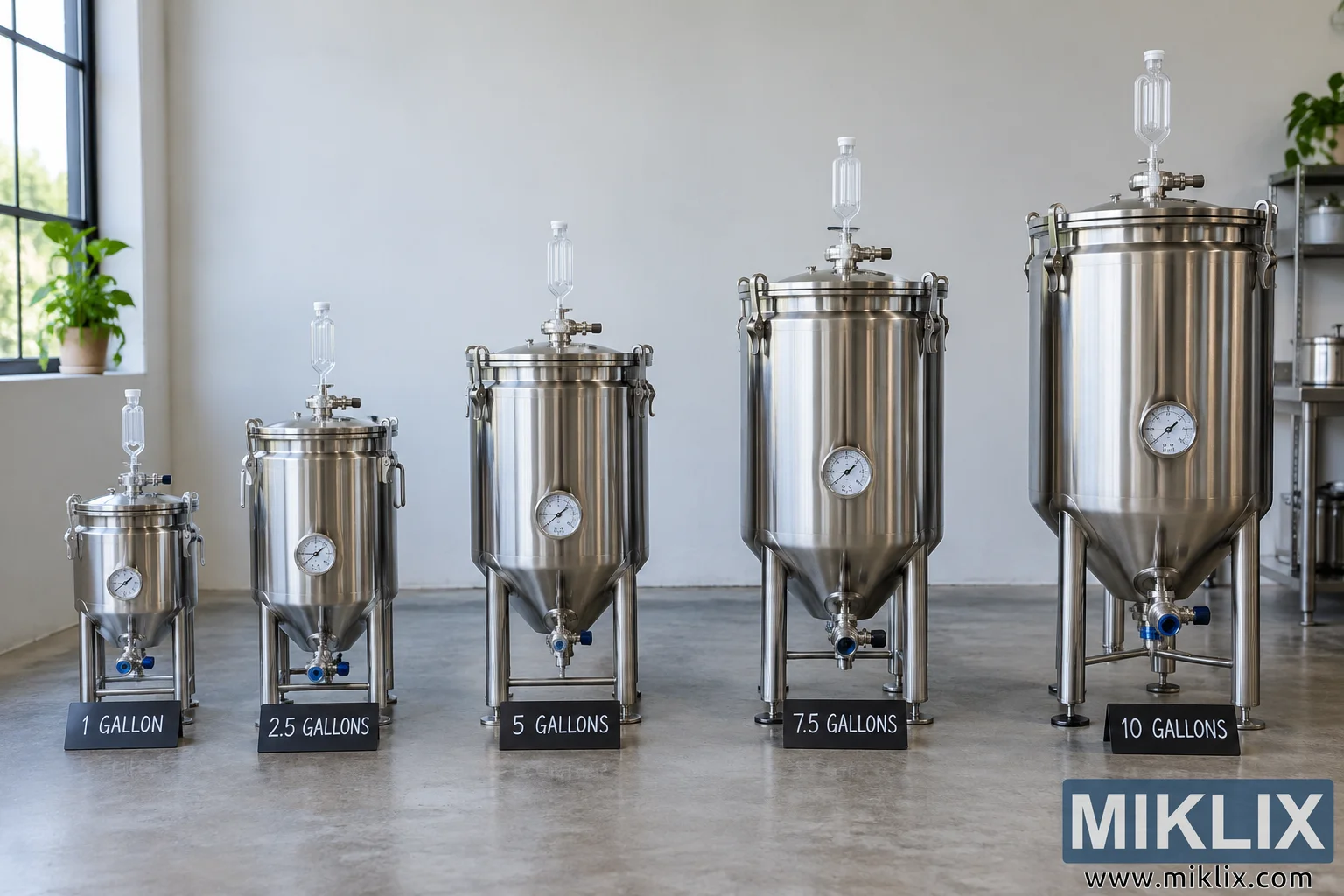
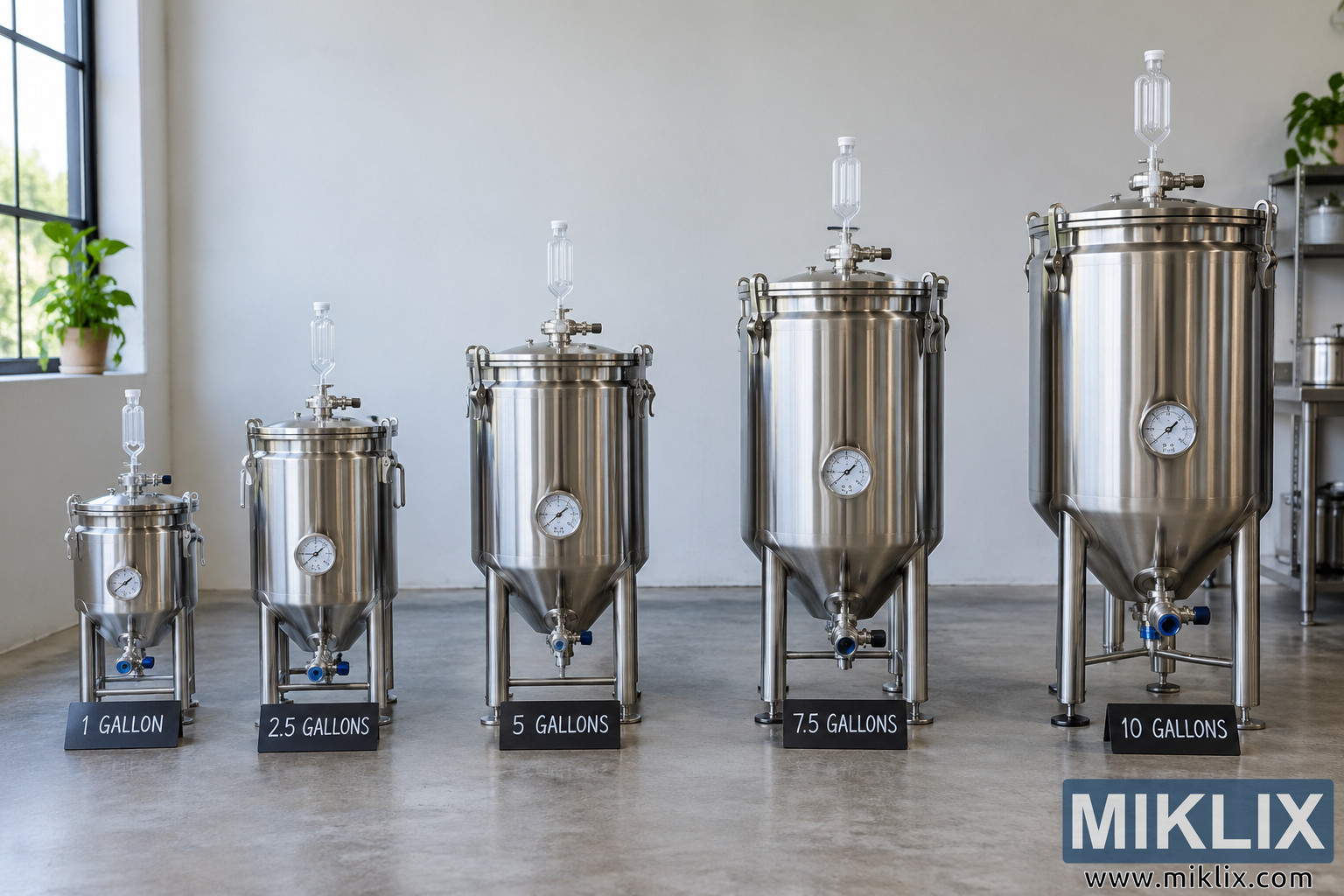
Landscape image of five unbranded stainless-steel fermenters increasing in capacity from 1 to 10 gallons, illustrating fermentation batch-size scaling in a clean laboratory setting.
Available versions of this image
The image files available for download below are less compressed and higher resolution - and as a result of that, higher quality - than the images embedded in articles and pages on this website, which are more optimized for file size in order to reduce bandwidth consumption.
Regular size (1,536 x 1,024)
Large size (3,072 x 2,048)
Very large size (4,608 x 3,072)
Extra large size (6,144 x 4,096)
Comically large size (1,048,576 x 699,051)
- Still uploading... ;-)
Image description
A wide, landscape-oriented photograph presents a clean, bright, laboratory-like fermentation workspace containing five stainless-steel fermenters arranged in a single row from smallest to largest. The vessels visually demonstrate the concept of scaling fermentation batch sizes, beginning with a compact 1-gallon fermenter on the far left and progressing through 2.5-gallon, 5-gallon, and 7.5-gallon vessels to a substantially larger 10-gallon fermenter on the far right. The orderly progression in physical dimensions makes the relationship between batch volume and equipment size immediately understandable. Each fermenter stands independently on a sturdy stainless-steel support frame with multiple vertical legs and horizontal braces. The cylindrical vessels transition into conical lower sections, creating the recognizable profile of small-scale professional fermentation equipment. At the lowest point of each cone is a valve or outlet assembly, suggesting a practical means of draining, sampling, transferring, or removing sediment from the contents. Small blue components are visible around several of these lower fittings, adding subtle visual detail to the otherwise predominantly silver equipment. Each fermenter also has a circular analog gauge mounted on the front of the vessel. The gauges have pale faces, dark markings, and dark indicator needles, reinforcing the technical and process-oriented character of the scene. The polished stainless-steel surfaces reflect the surrounding room and available light, producing soft vertical highlights and subtle variations in metallic tone. The vessels are fitted with removable lids secured by multiple metal clamps positioned around their upper rims. Above the lids are small fittings and transparent fermentation airlocks. These clear airlocks rise vertically from the top of each vessel and help visually identify the equipment as fermentation vessels rather than ordinary storage tanks. Their relative heights also contribute to the increasingly tall silhouette of the equipment as the batch size grows from left to right. In front of every fermenter is a small dark rectangular sign placed directly on the concrete floor. White handwritten-style lettering identifies the nominal batch capacity of each vessel. Reading from left to right, the signs state '1 GALLON', '2.5 GALLONS', '5 GALLONS', '7.5 GALLONS', and '10 GALLONS'. These labels make the scaling sequence explicit and allow the viewer to compare the physical footprint and height associated with each increasing capacity. The smallest 1-gallon unit is short and narrow, occupying relatively little floor space. The 2.5-gallon unit is noticeably taller and broader, while the centrally positioned 5-gallon fermenter establishes a clear midpoint in the progression. The 7.5-gallon vessel increases significantly in both height and diameter, and the 10-gallon fermenter dominates the right side of the composition with the largest cylindrical body, broadest conical section, and tallest overall profile. Despite these differences in scale, all five vessels share a consistent design language, making the image read as a controlled comparison rather than a collection of unrelated equipment. The background is intentionally restrained so that attention remains on the fermenters. A smooth, pale gray wall extends across most of the image and provides a neutral backdrop for the reflective stainless steel. On the far left is a large black-framed window divided into rectangular panes. Daylight enters through the window and softly illuminates the room, creating natural highlights on the vessels without harsh shadows. Green foliage is visible outside the window, while a leafy potted plant sits near the interior window area, introducing a small organic element into the otherwise industrial setting. On the far right, a metal shelving or work area is partially visible. It holds additional stainless-steel containers and equipment, suggesting that the room is an active laboratory, pilot-production space, test kitchen, brewery, fermentation workshop, or small-scale process-development environment. Another green plant appears near the upper-right corner, visually balancing the greenery on the opposite side of the frame. The floor is smooth gray concrete with mild reflections beneath the fermenters and their support structures. The subdued floor and wall tones contrast with the bright metallic equipment and help emphasize the progression in vessel size. The composition is highly symmetrical in concept while remaining visually natural: the five fermenters are evenly spaced, aligned along a common floor plane, and presented from a straight-on viewing angle. Their increasing dimensions form an ascending visual rhythm from left to right. The photograph communicates process scalability in a direct and accessible way, illustrating how fermentation equipment can grow in physical size as production moves from a very small 1-gallon experimental batch toward a 10-gallon batch. It could represent the progression from initial recipe testing and research-scale fermentation through increasingly larger pilot batches. No people are present, allowing the equipment itself to remain the sole subject. There are no visible commercial logos, trademarks, branded labels, or recognizable brand identities on the fermenters or surrounding equipment. Overall, the image has a clean, professional, educational aesthetic, combining realistic industrial details with an uncluttered presentation. The polished tanks, transparent airlocks, front-mounted gauges, conical bottoms, outlet valves, capacity signs, and steadily increasing dimensions work together to provide an immediate visual explanation of fermentation batch-size scaling from 1 gallon through 10 gallons.
The image is related to: Hops in Beer Brewing: Green Bullet