
Image: Fuggle Hop Heritage and Modern Green Bullet Development
Published: October 1, 2026 at 4:38:59 PM UTC
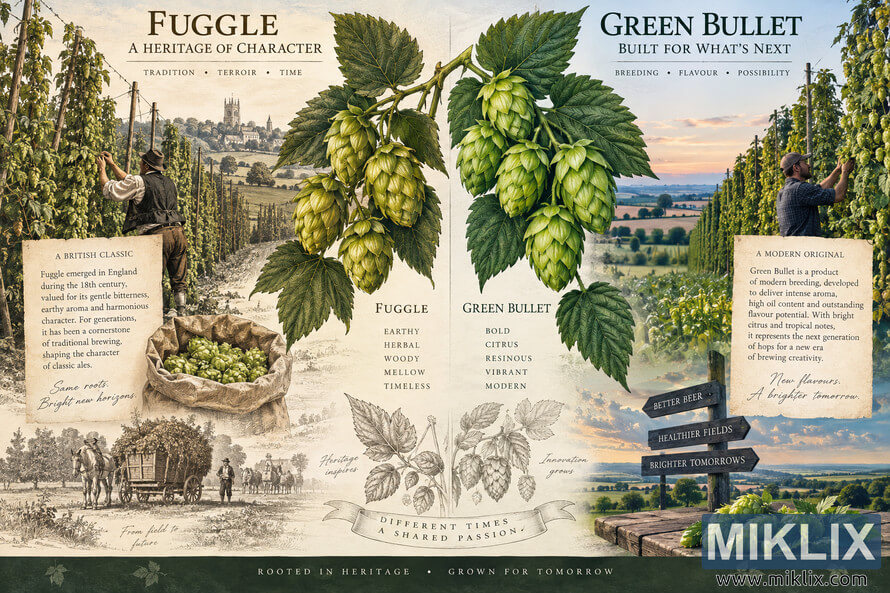
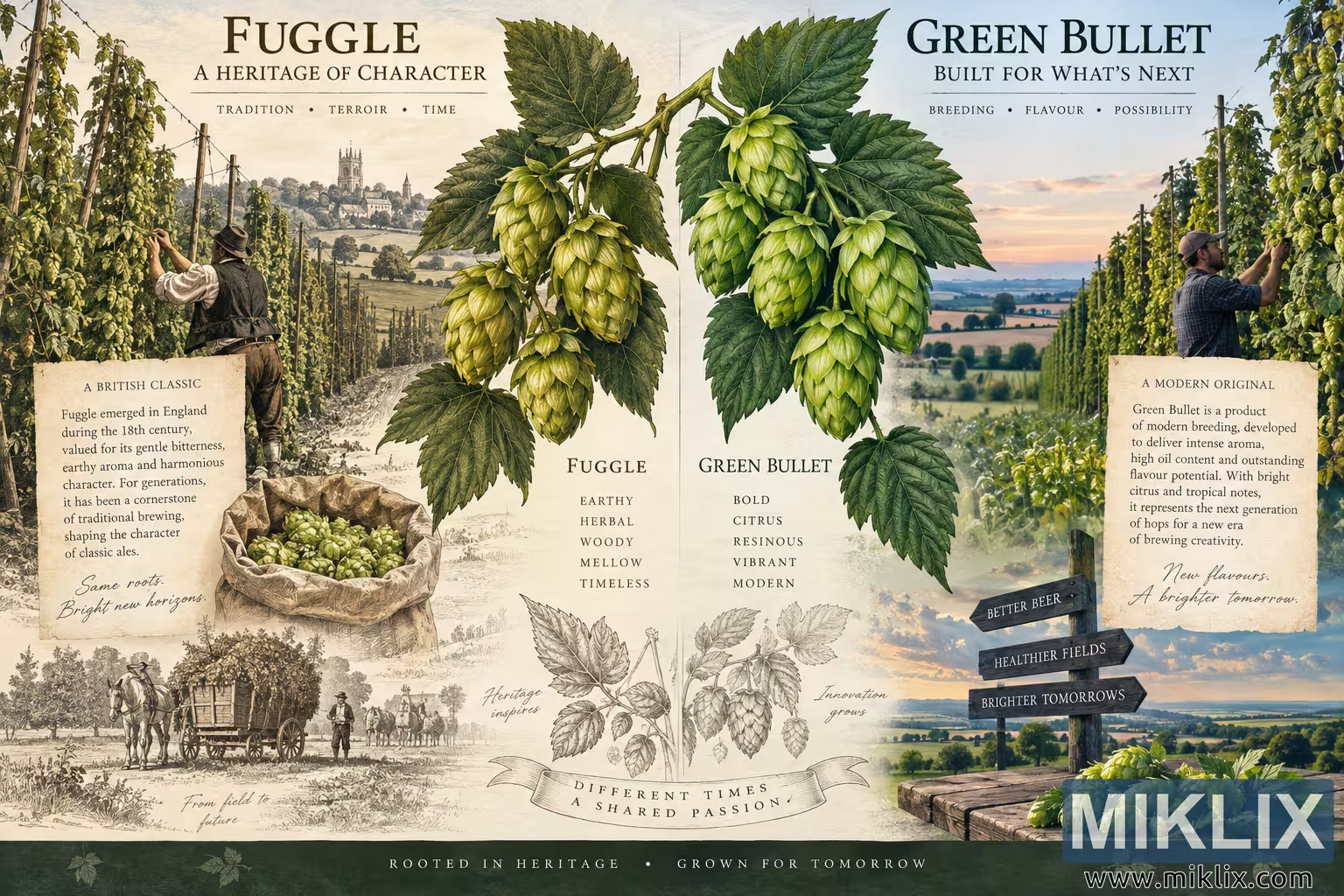
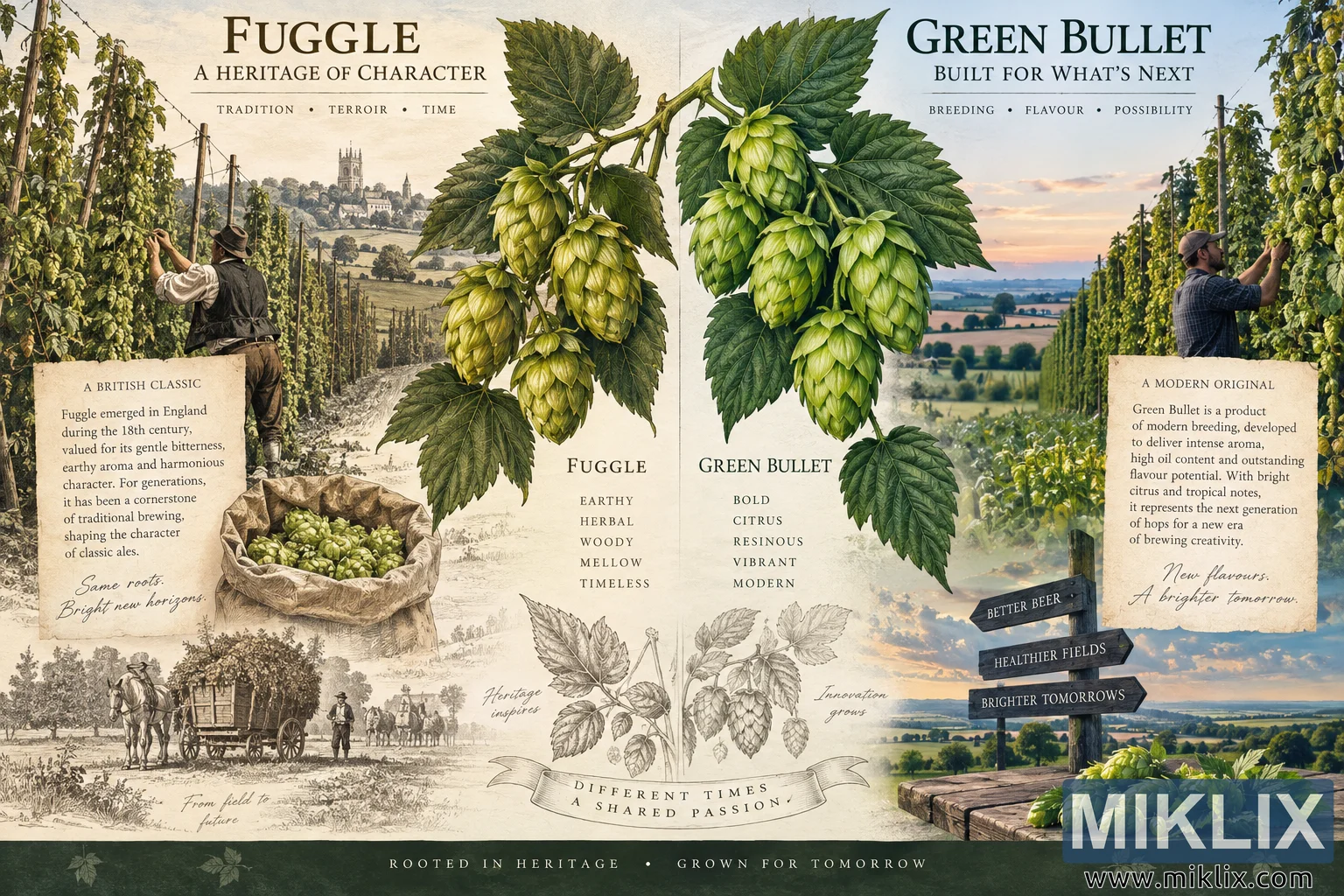
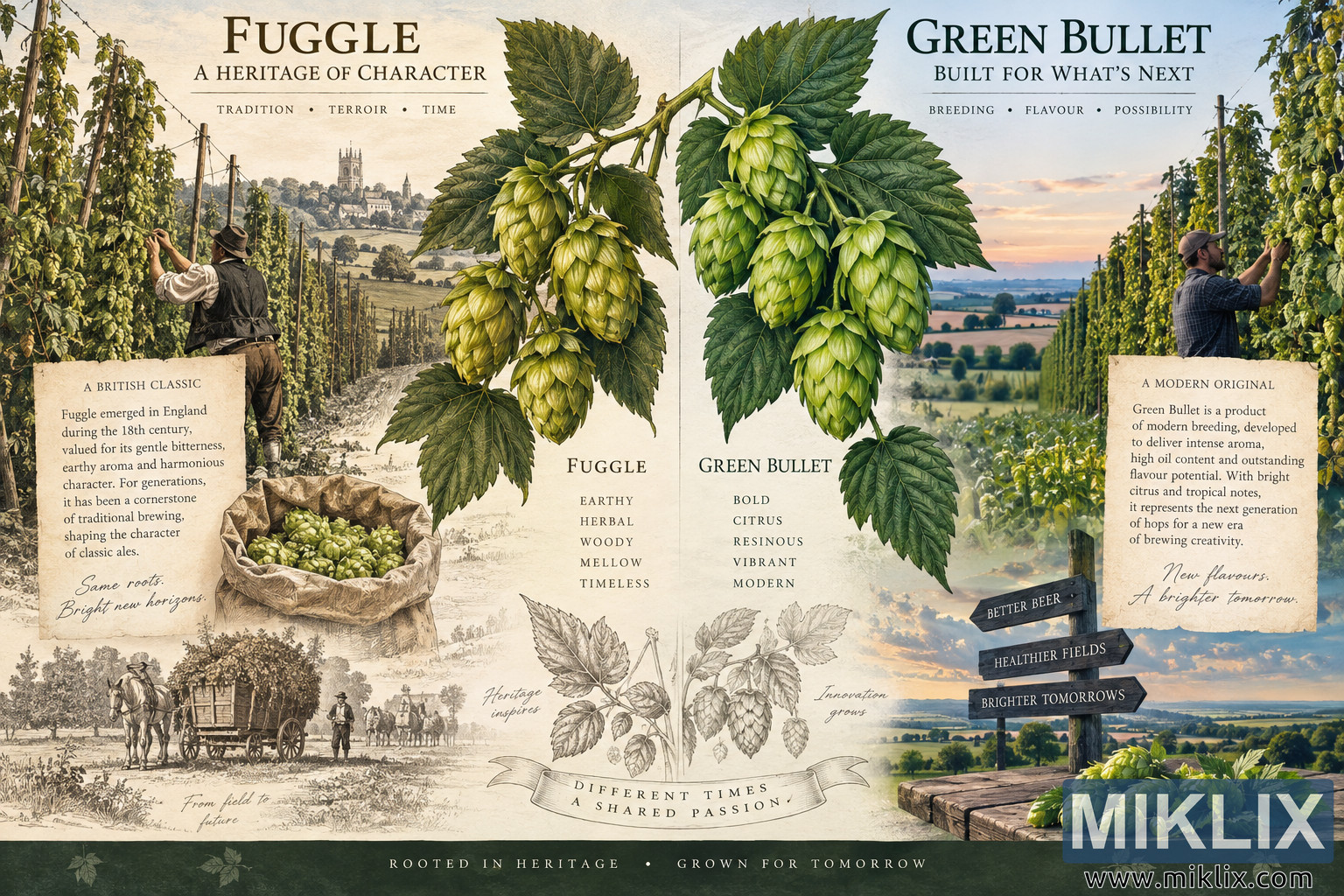
Historic botanical-style illustration exploring Fuggle hop heritage and modern Green Bullet development through traditional and contemporary hop-growing imagery.
Available versions of this image
The image files available for download below are less compressed and higher resolution - and as a result of that, higher quality - than the images embedded in articles and pages on this website, which are more optimized for file size in order to reduce bandwidth consumption.
Regular size (1,536 x 1,024)
Large size (3,072 x 2,048)
Very large size (4,608 x 3,072)
Extra large size (6,144 x 4,096)
Comically large size (1,048,576 x 699,051)
- Still uploading... ;-)
Image description
A wide landscape-format illustration presents a visual journey from the historic heritage of Fuggle hops on the left to the modern development and cultivation of Green Bullet hops on the right. Designed in the style of a vintage botanical and agricultural poster, the composition combines detailed botanical drawings, pastoral landscapes, hop-growing scenes, aged paper textures, archival-style engravings, and more contemporary agricultural imagery. The result creates a clear visual contrast between tradition and innovation while connecting both hop varieties through their shared agricultural heritage.
The left half of the image is devoted to Fuggle and uses warm cream, sepia, muted green, brown, and parchment tones to evoke nineteenth-century botanical prints and historic agricultural illustrations. At the top, the large serif heading 'FUGGLE' is accompanied by the phrase 'A HERITAGE OF CHARACTER,' followed by the words 'TRADITION • TERROIR • TIME.' Behind the central botanical specimen is an expansive English-style rural landscape containing rolling fields, hedgerows, hop gardens, scattered trees, and a distant village dominated by a stone church or cathedral tower. The scenery has a softly aged, engraved appearance that reinforces the historical atmosphere.
Along the far left edge, tall rows of mature hop plants climb traditional support structures. A farm worker wearing period-inspired clothing and a brimmed hat reaches toward the vines, suggesting hand harvesting and the labor-intensive traditions associated with historic hop cultivation. Below this scene is a parchment-colored information panel titled 'A BRITISH CLASSIC.' It describes Fuggle as an English hop associated with gentle bitterness, earthy aroma, and traditional brewing character. A handwritten-style phrase near the bottom of the panel reads 'Same roots. Bright new horizons.' Nearby, a coarse burlap sack is filled with freshly harvested green hop cones, adding a tactile agricultural detail to the composition.
The dominant feature of the center-left area is a large, meticulously rendered Fuggle hop specimen. Multiple pale green hop cones hang from branching stems surrounded by broad, serrated, dark green leaves. The illustration resembles a hand-colored botanical plate, with carefully defined veins, layered cone bracts, natural irregularities, and subtle variations in green and yellow. Beneath the specimen, the label 'FUGGLE' appears above a vertical series of descriptive terms: 'EARTHY,' 'HERBAL,' 'WOODY,' 'MELLOW,' and 'TIMELESS.' These words visually reinforce the traditional, restrained character attributed to the hop within the poster's narrative.
The lower-left portion transitions even further into archival imagery. A horse-drawn agricultural wagon, workers, fields, and old-fashioned rural activity are depicted in monochrome engraving style. Fine botanical sketches and landscape drawings merge into the parchment background, creating the impression of an old agricultural archive or illustrated farming manual. Handwritten annotations such as 'Heritage inspires' and 'From field to future' strengthen the idea that historical cultivation provides the foundation for later hop development.
The right half focuses on Green Bullet and gradually shifts toward brighter greens, clearer photographic detail, blue sky, and warmer natural sunlight. At the top, the large heading 'GREEN BULLET' is paired with 'BUILT FOR WHAT'S NEXT,' followed by the words 'BREEDING • FLAVOUR • POSSIBILITY.' This side retains some of the visual language of the historic botanical poster but presents the agricultural landscape in a more vivid, contemporary manner. Long, orderly rows of tall hop plants stretch into the distance beneath an open sky, while rolling farmland and a broad horizon create a sense of modern agricultural scale and possibility.
A contemporary-looking farm worker stands among the hop rows on the far right, reaching upward to inspect or harvest mature cones. His modern clothing contrasts with the historically styled worker on the left, establishing a visual timeline between generations of hop cultivation. A parchment information panel titled 'A MODERN ORIGINAL' describes Green Bullet as the result of modern breeding, emphasizing intense aroma, high oil content, bright citrus and tropical characteristics, and new possibilities for brewing creativity. The handwritten phrase 'New flavours. A brighter tomorrow.' appears beneath the main text, emphasizing the forward-looking theme.
The central-right botanical specimen depicts Green Bullet with particularly large, fresh-looking hop cones and dense dark green foliage. The cones are luminous yellow-green, with crisp overlapping bracts and a vigorous, healthy appearance. Beneath the specimen, 'GREEN BULLET' is followed by the descriptors 'BOLD,' 'CITRUS,' 'RESINOUS,' 'VIBRANT,' and 'MODERN.' The arrangement deliberately mirrors the Fuggle specimen on the opposite side, allowing the viewer to compare the two varieties while understanding them as related parts of a broader hop-growing tradition.
Near the lower right, a rustic wooden signpost points toward phrases including 'BETTER BEER,' 'HEALTHIER FIELDS,' and 'BRIGHTER TOMORROWS.' Fresh hop cones and leaves are arranged on a weathered wooden surface in the foreground, illuminated by warm light. Beyond them, an expansive contemporary agricultural landscape stretches toward the horizon. The brighter atmosphere on this side creates a visual metaphor for development, experimentation, and the future of hop cultivation.
At the center bottom, monochrome botanical sketches bridge the two halves. Hop leaves, stems, and cones are drawn in the style of scientific plant studies, connecting the richly colored specimens above with the agricultural history below. A ribbon banner reads 'DIFFERENT TIMES A SHARED PASSION,' emphasizing continuity between historic and modern hop growing. Small handwritten phrases such as 'Innovation grows' reinforce the progression from heritage to development.
A dark green band runs across the entire bottom edge of the composition and contains the concluding statement 'ROOTED IN HERITAGE • GROWN FOR TOMORROW.' Decorative hop-leaf motifs appear subtly within the border. This final line summarizes the poster's central theme: the historic character represented by Fuggle is placed in dialogue with the modern breeding and agricultural development represented by Green Bullet. Although the two halves differ in period, palette, farming imagery, and visual atmosphere, they are unified by prominent botanical specimens, hop fields, harvesting imagery, and a shared emphasis on cultivation. The overall image is richly detailed, educational, nostalgic, and optimistic, presenting hop development as a continuum in which traditional agricultural knowledge and modern innovation coexist.
The image is related to: Hops in Beer Brewing: Green Bullet