
Image: Hop Analysis Certificate — Helga Variety Alpha Acid Analysis
Published: October 2, 2026 at 8:09:26 PM UTC
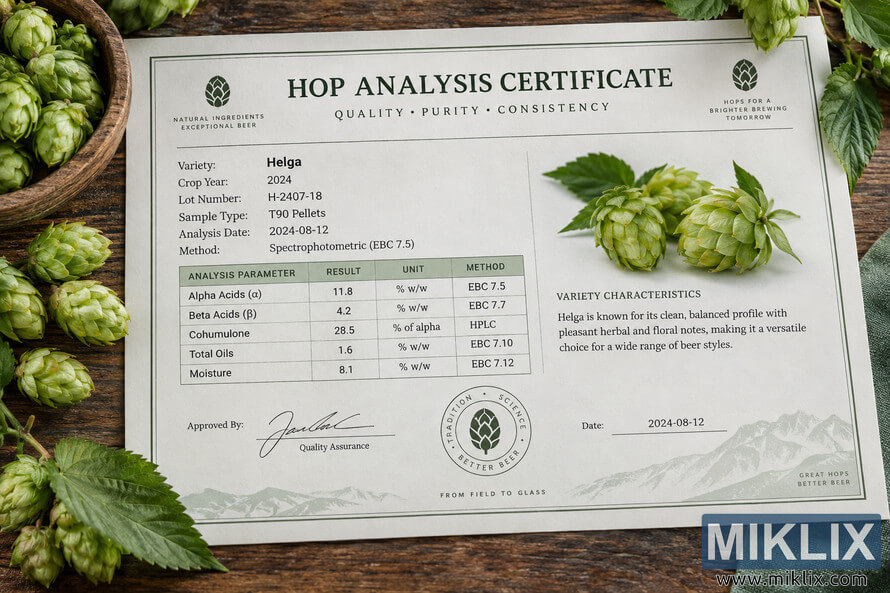
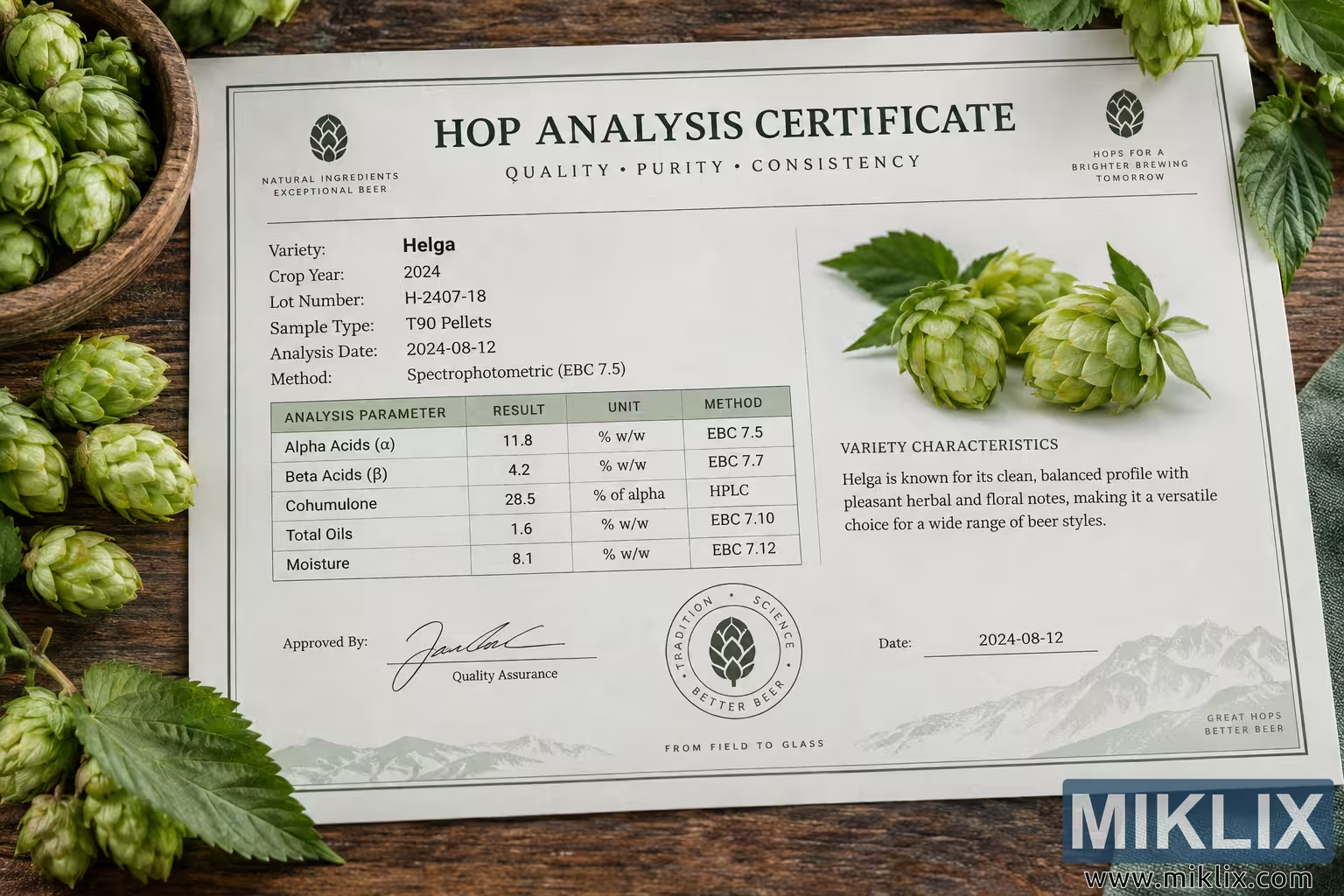
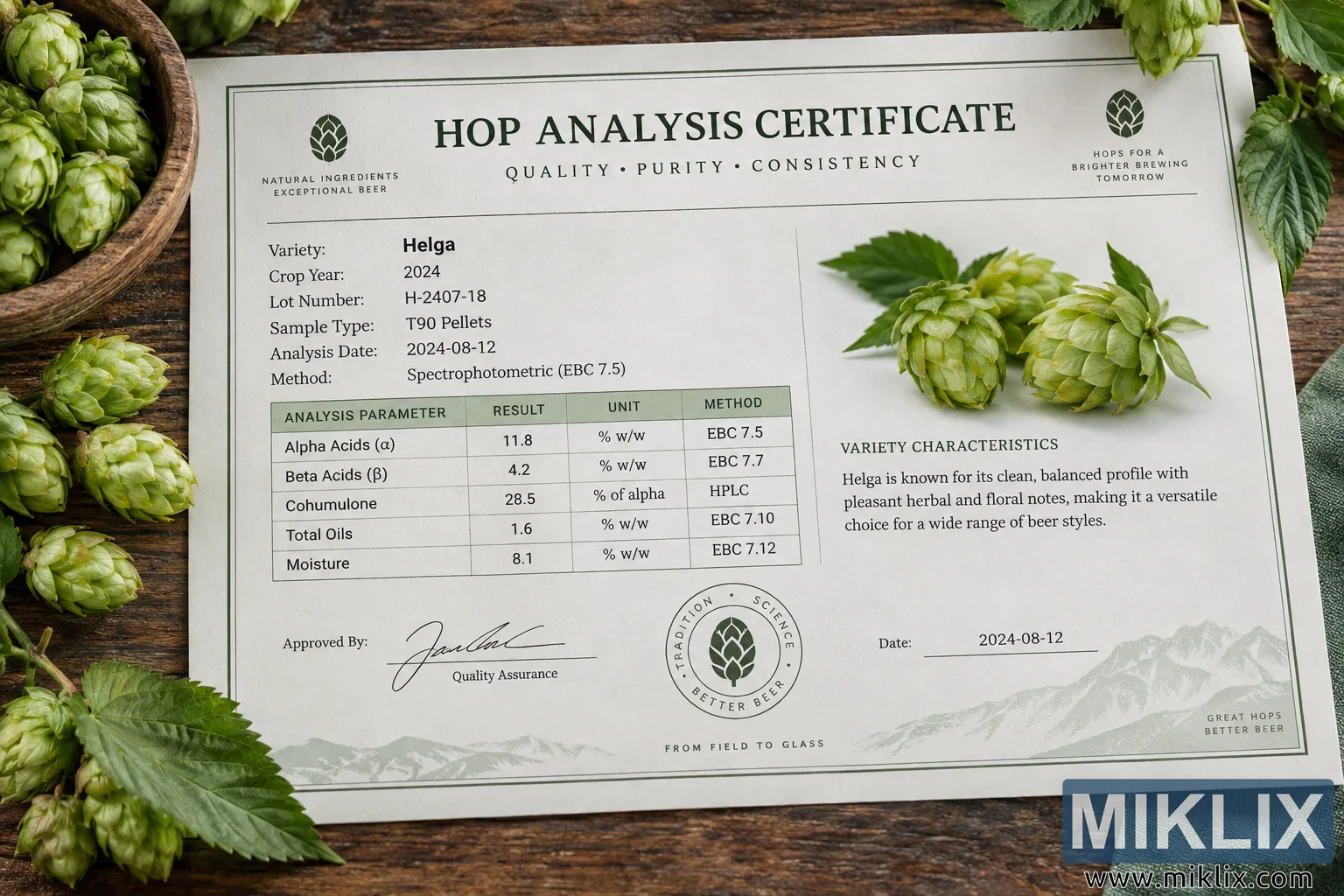
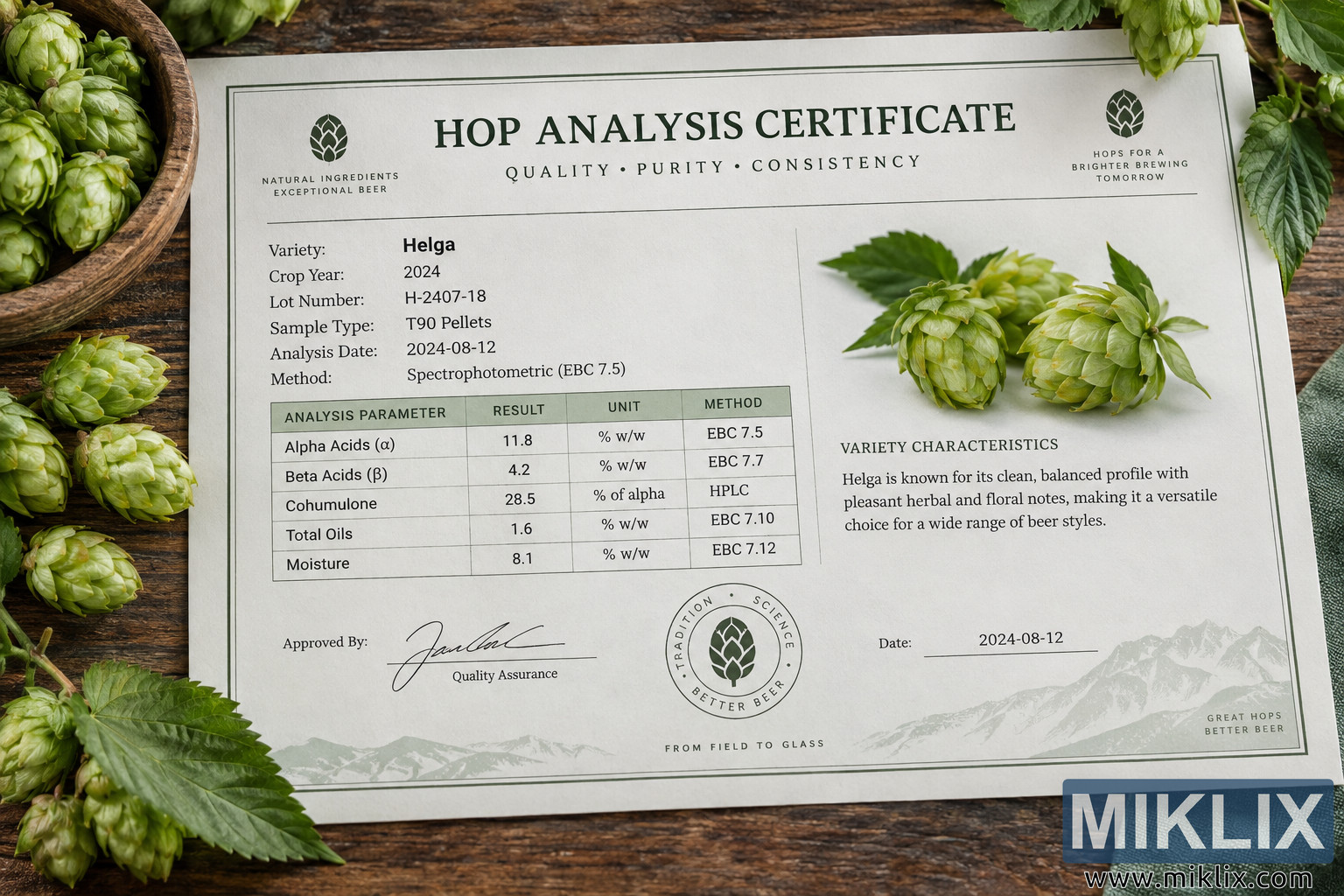
High-resolution landscape image of a Helga hop analysis certificate showing alpha acids at 11.8% w/w, with analytical results, fresh hop cones, leaves, and a rustic brewing-themed setting.
Available versions of this image
The image files available for download below are less compressed and higher resolution - and as a result of that, higher quality - than the images embedded in articles and pages on this website, which are more optimized for file size in order to reduce bandwidth consumption.
Regular size (1,536 x 1,024)
Large size (3,072 x 2,048)
Very large size (4,608 x 3,072)
Extra large size (6,144 x 4,096)
Comically large size (1,048,576 x 699,051)
- Still uploading... ;-)
Image description
The image is a high-resolution landscape-oriented photographic flat lay featuring a professional-looking hop analysis certificate for the Helga hop variety. The certificate occupies most of the composition and is positioned at a slight angle on a dark, weathered wooden tabletop. Fresh green hop cones, hop leaves, a rustic bowl filled with hop cones, and a folded green textile surround the document, creating a natural brewing and agricultural setting. Warm, soft directional light falls across the scene, revealing the texture of the paper, wood, leaves, hop cones, and fabric while giving the photograph a realistic, tactile appearance. The overall visual style combines laboratory documentation with traditional agricultural and brewing imagery, using restrained botanical green accents, cream paper, dark green typography, fine line borders, and subtle decorative elements. At the top of the document, a large centered heading reads “HOP ANALYSIS CERTIFICATE.” Small botanical-style hop emblems appear near the upper portions of the certificate, accompanied by understated decorative wording. Beneath the main heading is a concise quality-oriented line reading “QUALITY • PURITY • CONSISTENCY,” reinforcing the impression of a formal ingredient-quality document. The certificate identifies the variety as “Helga” and presents supporting sample information including a crop year of 2024, lot number H-2407-18, sample type T90 pellets, and an analysis date of 2024-08-12. The document also identifies a spectrophotometric analysis method and presents a structured results table. The central table is divided into columns for analysis parameter, result, unit, and method. The most visually prominent analytical result is the alpha-acid measurement, shown as 11.8% w/w. Additional listed measurements include beta acids at 4.2% w/w, cohumulone at 28.5% of alpha acids, total oils at 1.6% w/w, and moisture at 8.1% w/w. These values are presented as part of the visual design of the generated certificate rather than as an independently verified laboratory report. On the right-hand side of the document, several fresh hop cones are photographed or illustrated against the pale certificate background, providing a visual connection between the analytical information and the agricultural ingredient being analyzed. A section titled “VARIETY CHARACTERISTICS” contains descriptive prose portraying Helga as having a clean, balanced profile with pleasant herbal and floral notes and describing it as versatile for a range of beer styles. The lower portion of the certificate includes an “Approved By” area with a handwritten-style signature, a quality-assurance designation, a circular decorative seal featuring a stylized hop-cone motif, and a separate date field. Additional decorative wording includes “FROM FIELD TO GLASS,” while a small lower-right slogan reads “GREAT HOPS BETTER BEER.” Pale mountain-like line art runs along portions of the lower border, adding an agricultural landscape motif without overwhelming the technical appearance of the document. The paper has a slightly textured, off-white appearance and is surrounded by a thin double-line border in muted green. The typography is predominantly formal serif and clean document-style lettering, giving the certificate an established laboratory or quality-control aesthetic. The surrounding fresh hop material is vivid and three-dimensional, with tightly layered pale-green bracts, darker green leaves, and natural imperfections that contrast with the precise geometry of the certificate table. The wooden surface beneath everything has visible grain, knots, scratches, and variations in tone, giving the scene a handcrafted, farm-to-brewery character. A green cloth appears along the lower-right edge and subtly echoes the botanical color palette used in the certificate. The composition is carefully balanced: the document provides the main informational focal point, the hop cones frame its edges, and the natural tabletop creates visual depth around the rectangular paper. The lighting is bright enough to make the certificate text and numerical results readable while retaining gentle shadows around the paper edges and hop cones. The photograph has a realistic editorial-product-photography quality rather than the appearance of a digitally generated diagram, with shallow variations in focus and natural material textures. There are no people visible in the scene. There are also no recognizable commercial logos, trademarks, branded packaging, or actual company identities; the visual emblems and wording are generic decorative elements created for the image. The certificate therefore reads visually as a fictional or illustrative hop-quality document rather than an authentic laboratory certificate issued by a real organization. The landscape orientation provides ample horizontal space for the certificate, surrounding ingredients, and environmental context, while the high-resolution treatment emphasizes fine details such as paper fibers, printed lines, hop bracts, leaf veins, wood grain, fabric weave, and the edges of the document. Overall, the image communicates the concept of hop variety analysis, alpha-acid measurement, brewing-ingredient quality control, and agricultural provenance through a polished combination of scientific documentation and natural brewing imagery. The strongest informational focus is the Helga variety name and the alpha-acid result of 11.8% w/w, supported visually by the structured analytical table and the surrounding fresh hop cones.
The image is related to: Hops in Beer Brewing: Helga