
Hops in Beer Brewing: Hüller Bitterer
Published: March 15, 2026 at 7:18:16 PM UTC
Hüller Bitterer, a German bittering hop, emerged in the late 1960s and hit the market in 1978. Known internationally as HUB, it's also called Huller Bitterer. This hop was created from Northern Brewer, aiming to enhance bitterness in both lagers and ales.
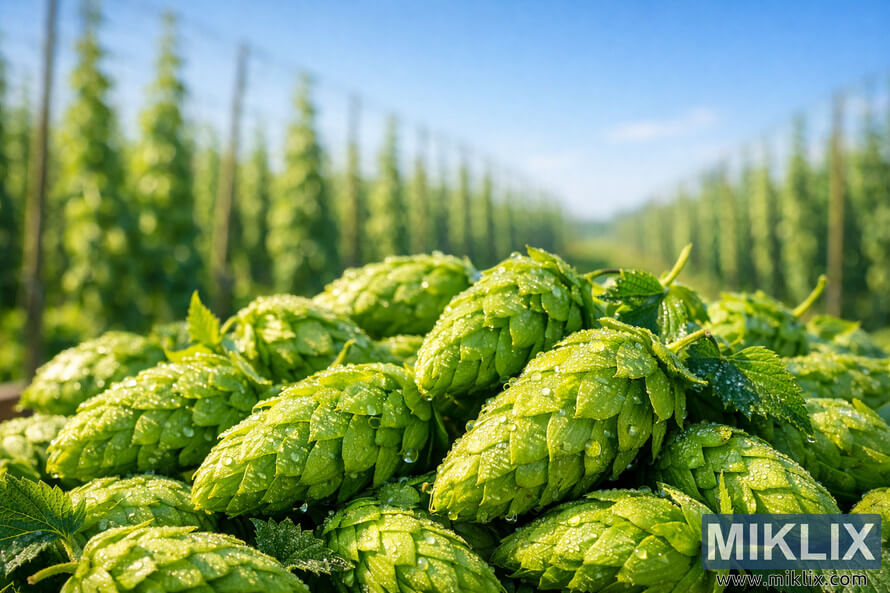
Click or tap the image for more information and higher resolutions.
The Hüller Bitterer hop profile is characterized by clean, firm bitterness and a modest aromatic contribution. This led many commercial brewers to prefer newer varieties like Perle over Hüller Bitterer. Despite this, its acreage has seen a decline in Germany, yet it remains accessible from various suppliers.
The availability of Hüller Bitterer can fluctuate, impacting its alpha acids and sensory behavior. This variation makes each batch unique. Despite these changes, brewers who value traditional German bittering hops continue to use Hüller Bitterer. They appreciate its consistent bittering and straightforward hop profile in classic styles.
Key Takeaways
- Hüller Bitterer (HUB) is a German bittering hop developed from Northern Brewer.
- Released commercially in 1978 after development in the late 1960s.
- Primarily used for bittering; aroma contribution is modest.
- Acreage has declined as varieties like Perle gained favor.
- Available from multiple suppliers; batch variation affects brewing hops performance.
Overview of Hüller Bitterer hops
Hüller Bitterer is a German hop, bred for clean bittering and superior field performance. It originated from the Hüll hop research center and the Hüll breeding program. This was to fulfill the needs of brewers and growers. It is known for being a hardy, reliable bittering hop, with a clear lineage. It's widely used in both lager and ale recipes.
Origin and breeder background
The cultivar was bred at the Hop Research Center in Hüll and released in 1978. It followed trials in the 1960s and 1970s. The Hüll breeding program aimed at agronomic improvements, creating the first wilt-resistant selection. This made the hop appealing to growers facing verticillium challenges.
Genetic lineage and parentage
Hüller Bitterer has roots in a well-known Northern Brewer descendant line. It was crossed with a verticillium wilt–resistant male to enhance field resilience. This parentage endows Hüller Bitterer with solid bittering traits. It also makes it suitable for modern brewing, with dual-use potential.
Common aliases and naming conventions
The variety is listed under several names in catalogs and trade lists. Common aliases include Hüller, Hueller, and Hueller Bitterer. It is often identified by the international code HUB or the cultivar ID 58/56/11. The use of alternate spellings reflects the German umlaut (ü → ue) in English-language materials.
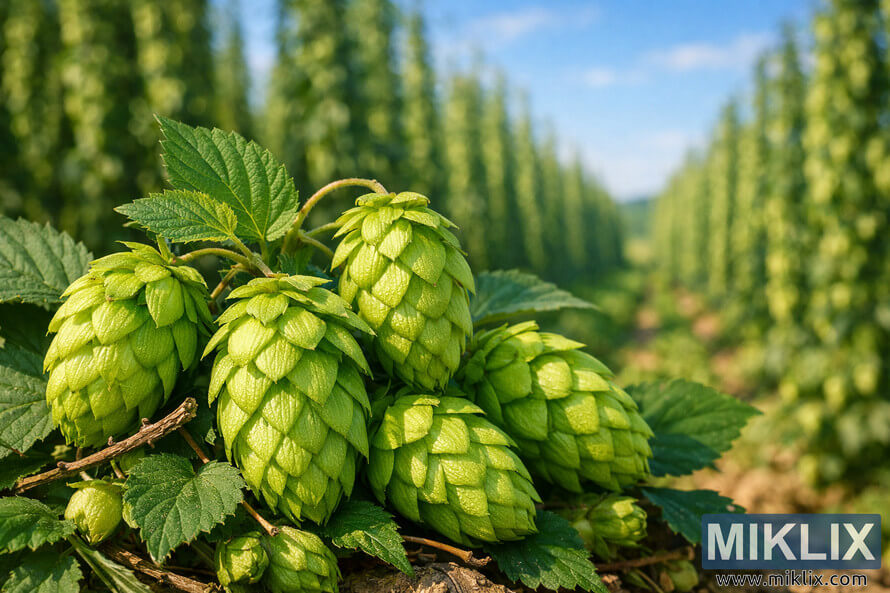
Click or tap the image for more information and higher resolutions.
Key brewing characteristics and purpose
Hüller Bitterer is a staple in brewhouses, known for its clean finish and reliable bittering. It's often added early in the kettle to establish a consistent bitterness. Although it can contribute to late hop layers, its main role is as a bittering hop in most recipes.
When scaling recipes, the alpha acids of Hüller Bitterer are crucial to consider. The alpha acid range can vary by year and source. Therefore, using the figures from the producer's lab is the most accurate method. This ensures predictable utilization of the hop's bitterness.
Understanding the beta acids in Hüller Bitterer is key to long-term flavor planning. Unlike alpha acids, beta acids do not isomerize but still impact the beer's bitterness over time. Lab reports often show beta acids in a range that keeps flavor changes minimal during normal cellaring.
The cohumulone percentage of Hüller Bitterer is typically in the upper twenties. This indicates a moderate, clean bitterness rather than a harsh or green taste. Brewers should compare this figure to judge the perceived hop bitterness across different varieties.
Below are quick reference points to guide formulation:
- Primary use: bittering hop for early additions and boil hops.
- Dual-purpose hop potential for modest late additions when a mild aroma contribution is desired.
- Alpha acids Hüller Bitterer: commonly 4.5–7%, some sources report 6–10%, so verify with supplier labs.
- Beta acids hop chemistry: typically near 4.5–5.5%, with some reports from 3.8–5.4%.
- Cohumulone percentage: roughly 26–31%, averaging about 28–28.5% for moderate perceived hop bitterness.
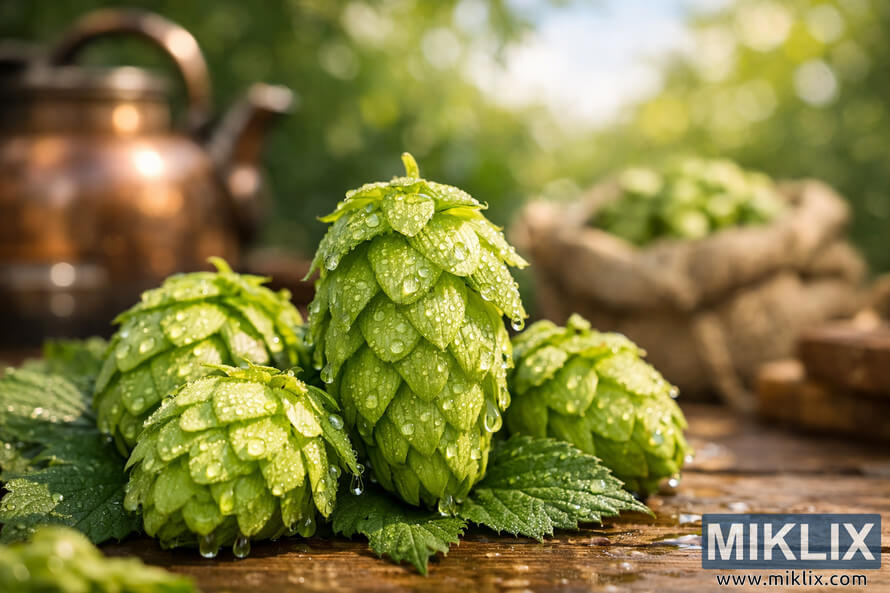
Click or tap the image for more information and higher resolutions.
Aroma and flavor profile
Hüller Bitterer boasts a subtle aromatic character, ideal for traditional lagers and classic ales. It's favored by brewers seeking dependable bitterness with a modest aromatic presence. The hop oil composition leans towards subtlety, avoiding bold, showy aromas.
Main oil composition and impacts
Total oils in Hüller Bitterer range from 0.6 to 2.2 mL per 100 g, often clustering around 1 to 1.5 mL. Myrcene and humulene are key to its character. Myrcene, making up 28–51% of oils, contributes resinous, citrus, and light fruity notes.
Humulene, present at 9–21%, offers a woody, noble, and mildly spicy foundation. Caryophyllene, at 5–8%, adds a peppery, woody, herbal touch. Farnesene, appearing in small amounts, brings faint green and floral notes. The remainder of β-pinene, linalool, geraniol, and selinene fine-tunes the aroma.
Sensory notes for brewers
Hüller Bitterer's taste includes light fruit, spice, floral hints, and a resinous undertone. Its clean and restrained sensory profile makes it perfect for bittering with minimal aroma impact.
When added late in the boil, whirlpool, or for dry hopping, it offers mild floral and spicy flavors. Extended boiling reduces volatile oils, emphasizing bittering. Early additions focus on bitterness, while later ones preserve delicate aromas.
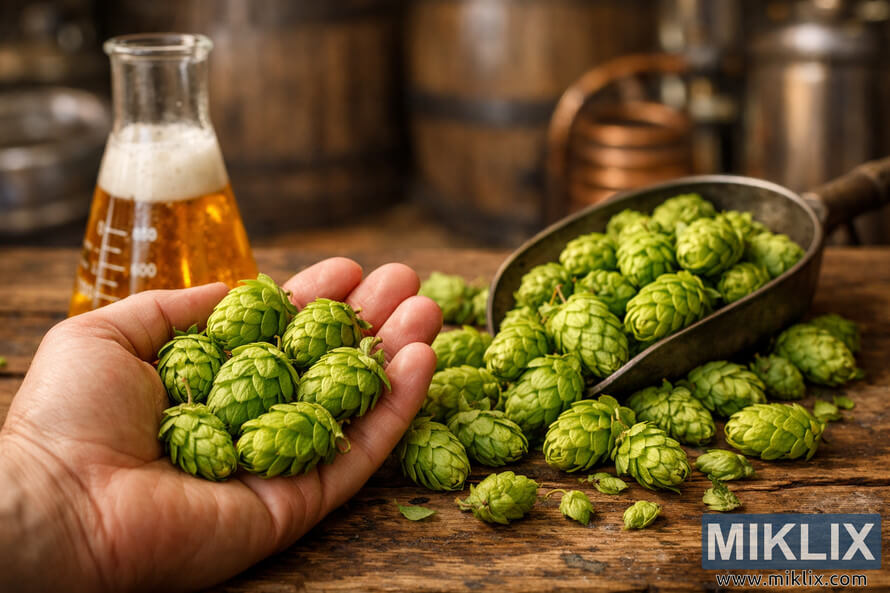
Click or tap the image for more information and higher resolutions.
Brewing values and practical usage
Hüller Bitterer excels as a straightforward bittering hop. Use batch-specific alpha acid figures for accurate alpha acid calculations when planning IBUs. Typical farm averages near 5.8%, with common ranges from 4.5–7%. Occasionally, samples reach up to 10%. Confirm lab reports before brew day to avoid over- or under-shooting target bitterness.
Bittering calculations and utilization
For IBU calculations Hüller Bitterer, input the measured alpha into your chosen formula. Standard boil-time utilization rates apply. Treat this hop as medium-alpha continental material. Use typical utilization tables for 60-, 30-, and 10-minute additions to estimate contributions.
If you follow Tinseth or Rager methods, adjust for wort gravity and kettle volume. Keep utilization rates steady for repeatable results. Small lab-to-lab alpha variance changes bitterness more than small shifts in utilization.
Recommended addition timings
- 60-minute bittering addition: primary use for predictable bitterness.
- 30–15 minute mid-boil: adds balance without heavy aroma lift.
- Whirlpool or late hop additions: restrained floral and spice; expect subtle impact from late hop additions compared with high-oil varieties.
Dry hopping is uncommon due to the modest aroma from late hop additions. Use it in lagers and amber ales for gentle spice and traditional bitterness. When formulating recipes, rely on alpha acid calculations and consistent hop addition timings to hit your target IBU range.
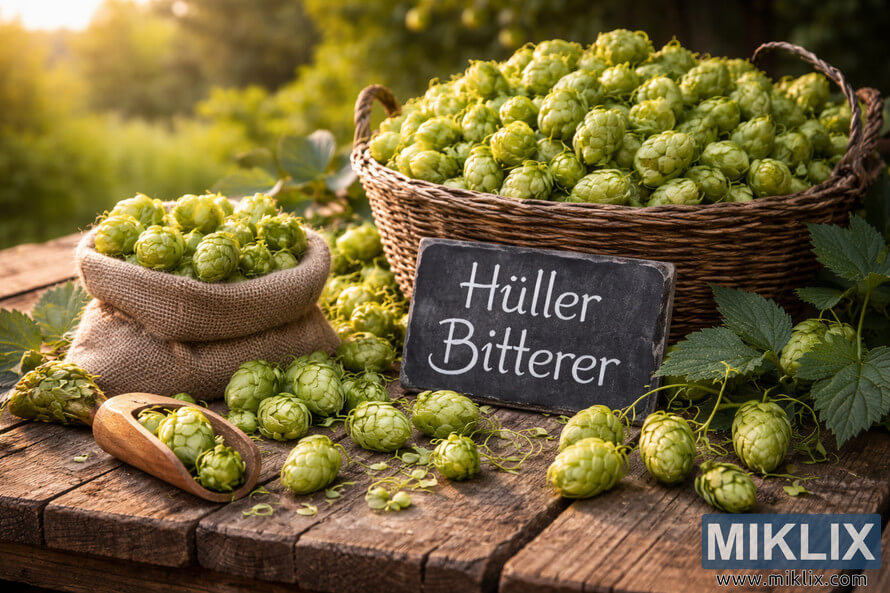
Click or tap the image for more information and higher resolutions.
Beer styles that suit Hüller Bitterer
Hüller Bitterer is ideal for beers that require a clean, firm bitterness. It complements mild spice and light fruity notes. This hop variety is versatile, suitable for both lagers and ales, from traditional German to British-influenced styles.
Traditional German recipes benefit from Hüller Bitterer’s restrained character. It's perfect for Dortmunder Export, Munich Helles, and Schwarzbier. Here, it keeps bitterness in check, preserves malt flavors, and adds a faint peppery or floral note.
In lighter German ales, Hüller Bitterer acts as a supporting bittering hop. It's great for regional specialty brews that need balance without a strong hop aroma. Small late additions keep the profile soft, while finishing additions can hint at gentle spice.
British-style ales benefit from Hüller Bitterer’s Northern Brewer comparison. It's suitable for ESB hops roles, offering balanced bitterness and mild resinous notes. Use it in best bitters, pale ales, and ESB to deliver steady bitterness and a modest herbal backbone.
- Great matches: Schwarzbier, Dortmunder, Munich Helles.
- Good for ales: ESB, best bitter, English-style ales needing subtle hop support.
- Brewing tip: emphasize early bittering additions and minimalist late hopping to keep tradition intact.
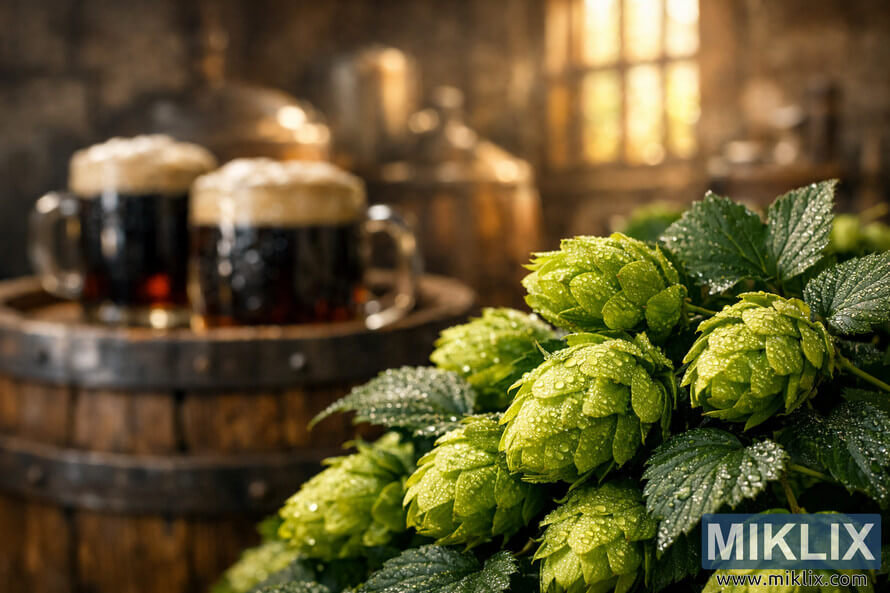
Click or tap the image for more information and higher resolutions.
Comparisons with similar hop varieties
Hüller Bitterer has its roots in Northern Brewer, sharing a clean, resinous bittering profile. Brewers often compare these varieties based on alpha acids, oil ratios, and storage stability. Below, we provide concise comparisons to aid in selecting the perfect hop for your recipe.
Comparison with Northern Brewer
The relationship between Hüller Bitterer and Northern Brewer is quite close. Both varieties inherit a firm, piney backbone from Northern Brewer, ideal for bittering. Northern Brewer can have higher alpha acids, depending on the strain. In contrast, Hüller Bitterer tends to show a milder reading on lab sheets.
Opt for Hüller Bitterer for a subtle, clean bitterness with a hint of resin. If you're aiming for higher IBUs without adding more hops, Northern Brewer lots might be more suitable.
Comparison with Perle and Hallertau
The debate between Perle and Hüller Bitterer is common, as Perle has largely taken Hüller Bitterer's place in the market. Perle offers higher alpha acids, better storage stability, and wider availability. This makes it a practical substitute in many recipes.
For those prioritizing aroma, consider Hallertau as a substitute for Hüller Bitterer. Hallertau adds softer noble and spicy notes that complement Hüller's delicate aroma in late additions.
- If aroma is key, use Hallertau-style hops in late or whirlpool additions.
- For bittering efficiency and shelf life, Perle is a better choice due to consistent alpha and handling.
- For preserving the original character, choose Hüller Bitterer for a softer bitterness than some Northern Brewer lots.
Substitutions and alternatives for brew day
When Hüller Bitterer is out of stock, find a substitute that matches its bittering role and subtle aroma. Brewers aim to balance alpha acid levels and flavor profiles. This ensures the final beer stays true to the recipe.
Best substitutes include Hallertau for aroma and Perle or Northern Brewer for bittering depth. Use Hallertau for a floral, restrained finish. Opt for Perle if you need a sturdier, more available hop with similar resinous notes. Northern Brewer is good for a grainy, spicy character.
- Hallertau substitute: use for late additions to enhance floral notes and reduce harsh bitterness.
- Perle alternative: choose for mid-to-early additions when a higher-alpha, robust bittering hop is acceptable.
- Northern Brewer: effective as a functional replacement when a resinous, spicy backbone is desired.
Recipe adjustment hop substitution requires careful IBU recalculation. Always perform alpha acid correction using lab-verified alpha values for the specific lot you buy.
- Determine target IBUs from the original recipe.
- Get the actual alpha acid percentage of your chosen substitute.
- Adjust weight so the calculated IBUs match the target, applying alpha acid correction for accuracy.
If switching to Hallertau, reduce late hop weight slightly for restrained bitterness with boosted aroma. For higher-alpha Perle or Northern Brewer, lower hop mass to maintain IBU level. Be aware of co-humulone shifts that can alter perceived bitterness.
Track aroma differences on brew day and note sensory outcomes. Record the exact alpha acid values and the recipe adjustment hop substitution for future batches.
Availability, purchasing, and formats
Finding Hüller Bitterer can be challenging, as its availability varies by season and market. Both small craft hop suppliers and larger hop stockists list this variety sporadically. Before purchasing, check the inventory notes for details on harvest year, pack size, and shipping zones.
In the U.S., buyers often turn to German specialty dealers or heritage hop stockists for Hüller Bitterer. These sources keep older varieties in rotation. Local homebrew shops and national hop suppliers may also carry limited lots. It's wise to inquire about expected restock dates and minimum order sizes from vendors.
Hops are typically sold in the standard formats brewers expect. You can usually choose between whole cone and pellet hops, depending on the supplier and the lot.
- Whole cone: traditional use for classic lagers and historical recipes.
- Pellet hops: easier storage and dosing for extract and all-grain batches.
Product descriptions should include alpha ranges and processing dates. Pellet hops may show different utilization than whole cone. Adjust your calculations accordingly when purchasing.
Lupulin powder availability is a notable limitation. Currently, Cryo-style concentrates like Cryo, Lupomax, or LupuLN2 are not produced for Hüller Bitterer. This affects options for high-impact late additions, whirlpool, and dry-hop concentration.
Without lupulin concentrates, rely on pellet hops or whole cone for late-hop character. Reach out to hop suppliers about reserve lots, split packs, or co-op buys for securing supply for larger projects.
Storage, shelf life, and stability
For brewers using Hüller Bitterer, proper hop storage is crucial. Cold, low-oxygen conditions slow down chemical breakdown. Even small changes in storage can significantly impact bittering power and aroma over months.
Alpha retention is a critical metric to monitor. Reports indicate Hüller Bitterer retains about 60–68% of its alpha acids after six months at 20°C (68°F). One source mentions roughly 60% retention at six months, while another reports 68% under the same conditions. These figures highlight the importance of tracking alpha retention for consistent IBUs.
Effective storage practices can minimize loss. Refrigeration or freezing, combined with vacuum sealing or nitrogen flushing, limits oxygen exposure. This approach enhances hop stability and slows down oxidation effects that degrade oils and acids.
Hop aging leads to flavor loss, particularly in hop oils. As oils oxidize, spicy and floral notes diminish, and off-aromas may emerge. The decline in alpha acids also reduces bittering potential. Brewers must adjust for both reduced bitterness and diminished aroma when using older hops.
Practical steps for brewers:
- Request current lab analysis from suppliers before purchasing or using older lots.
- Store pellets or cones in cold, oxygen-minimized conditions to maximize hop stability.
- Increase addition amounts or adjust timing if alpha retention is low to meet target IBUs.
Hüller Bitterer has seen a decline in acreage as varieties with stronger storage performance, like Perle, have gained popularity. This shift reflects a market preference for hops that resist oxidation effects and retain aroma longer under typical supply chains.
Growth, cultivation, and agronomic traits
Hüller Bitterer exhibits steady growth in commercial fields. Plants develop side arms ranging from about 12" to 28". Cone size is medium, and cone density falls near the moderate range. This affects picking speed and processing.
Yield of Hüller Bitterer varies by region and management. Estimates range from roughly 900–1700 lbs/acre. This translates to about 1150–1370 kg/hectare, or near 1020–1220 lbs/acre in some reports. Growers should expect variation based on soil fertility and trellis systems.
Hop maturity tends to be mid-season. In Germany, the harvest season typically begins in late August and runs into September. Monitoring hop maturity and cone feel helps time picking for optimal alpha acids and aroma retention.
- Growth rate: moderate to high, depending on training and site.
- Side arm length: commonly 12"–28".
- Cone characteristics: medium size, moderate density.
Resistance traits are notable for this cultivar. It was released with verticillium resistance, making verticillium resistance an important selling point for growers in affected regions. Some sources also note downy mildew resistance and powdery mildew resilience, which can reduce fungicide needs.
Wilt resistance improved field longevity and lowered replant pressure in trials. Still, susceptibility to certain local pests and site stresses appears in some records. Harvesting can be described as more difficult than with some modern, high-density varieties.
Field characteristics influence management choices. Good drainage and balanced fertility favor steady yields and help minimize disease pressure. Regular scouting during the harvest season reduces losses and preserves quality as hops approach full maturity.
Historical and commercial context
The tale of Hüller Bitterer begins in the 1960s, with its official debut in 1978. Growers lauded its resistance to wilt and clean bitterness, making it a staple for lagers and traditional German ales. It transitioned from field trials to commercial yards and breeding plots, marking a significant early phase in hop breeding.
Its adoption reached its peak as growers sought out hardier plants due to disease pressure and agronomy needs. The Hüll breeding program's legacy is deeply rooted in Hüller Bitterer, being the first wilt-resistant selection. This achievement set the stage for breeders to focus on disease tolerance and agronomic stability for future varieties.
However, a decline in hop acreage became apparent as growers sought varieties with better storage traits and broader commercial appeal. Many producers shifted their focus to Perle replacement candidates and other modern hops, offering higher yields or improved post-harvest performance.
- Commercial use: Once common in German regions, now smaller in scale due to market choices.
- Breeding role: Served as a reference parent for disease resistance and cultivation studies.
- Legacy: Continues to appear in discussions of hop improvement and agronomic benchmarks.
The Hüller Bitterer history holds significant value for historians of cultivation and brewers who appreciate provenance. Its impact on hop breeding history is evident when comparing disease-resistant lines that followed. Although less prominent today, it is still respected for the traits it introduced into modern breeding efforts.
Analytical data and lab figures
Lab reports for Hüller Bitterer shed light on brewing decisions. They reveal average values and ranges for bittering, aroma, and oil-driven character. This summary outlines the typical Hüller Bitterer lab data and measurements crucial for recipe planning.
Alpha acid ranges differ by source. Most reports indicate averages around 5.8% with a common range of 4.5–7%. Some catalogs suggest a broader range of 6.0–10.0%. Beta acid figures generally fall between 4.5–5.5%, with datasets showing 3.8–5.5% and an average of about 5%.
Co-humulone values significantly impact bitterness perception. Lab reports typically show co-humulone at 26–31%, with averages around 28–28.5%. Total oil content varies widely, commonly between 1–1.5 mL/100g. This range is crucial for assessing hop oil breakdown in aroma planning.
- Myrcene percentage: dominant at roughly 28–51%, average ~39.5%.
- Humulene breakdown: typically 9–21%, average near 15%.
- Caryophyllene follows at about 5–8%, average ~6.5%.
- Farnesene registers low, near 0–1%, average ~0.5%.
Sensory mapping links oil composition to flavor. Myrcene percentage is linked to citrus and resinous notes, especially in late additions or dry hops. Humulene breakdown contributes woody, noble spice tones to subtle aroma blends. Caryophyllene adds peppery, herbal edges, while farnesene provides faint green or floral hints.
Understanding Hüller Bitterer lab data is key to setting expectations for bitterness and aroma. Use alpha acid averages for IBUs, check beta acid figures for long-term stability, and consult hop oil breakdown for hop schedule and dry-hop treatments planning.
Recipe development tips and example applications
Start by treating Hüller Bitterer as a dependable, clean bittering hop. Use measured alpha acids for 60-minute kettle additions. This method ensures consistent bitterness while allowing malt character and subtle spice notes to shine through.
In lager hop formulation, keep late additions minimal. Aim for traditional German lagers, Schwarzbier, and other restrained styles. Here, a crisp backbone is essential. Use Hüller Bitterer at typical bittering rates, then rely on mash and fermentation to create balance.
For ale hop formulation, pair Hüller Bitterer with Munich or British malts for depth. Small late additions—5 to 10 minutes or a gentle whirlpool—can bring light floral or spicy lift without masking the clean bitterness. This technique suits ESB and German-style ales.
- Start bittering based on lab alpha value.
- Limit aroma additions to preserve malt focus.
- Adjust IBUs for perceived smoothness, not aggression.
When hop blending Hüller Bitterer, consider it the bittering anchor. Blend with Perle or Hallertau to add aroma while keeping the hop bitterness clear. Use a 70:30 or 60:40 split when you want more scent but still need Hüller’s restraint.
For experimental hop blends, try small late additions of citrus-forward hops like Citra or Amarillo in ales. Keep those additions modest; Hüller Bitterer will remain the foundation while the citrus hops add transient top notes.
- Base recipe: Pilsner or Vienna malt, Hüller Bitterer 60 min for target IBUs.
- Ale variant: Swap some pilsner malt for Munich, add 5-min Hüller or small whirlpool hop.
- Blend plan: Primary Hüller bittering, Perle or Hallertau for aroma, tiny cryo addition if concentrated late hop lift is needed.
Note the absence of lupulin powder for this variety. For concentrated late-hop effects, complement pellets with cryo products from reputable suppliers. This preserves clarity while enabling creative, experimental hop blends.
Where Hüller Bitterer shines and its limitations
Hüller Bitterer is prized for its reliable bittering profile, a key asset for brewers. It excels in lagers and balanced ales, offering a clean bitterness. This makes it ideal for recipes that require a solid backbone without overpowering aromatics.
When considering this variety, there are several points to keep in mind.
- Clean bittering and smooth finish
- It's best for recipes where a neutral, clean bitterness is preferred over bold citrus or pine notes.
- Dual-use potential
- Its moderate total oils allow for subtle late-hop complexity, enhancing malt-forward beers without overwhelming them.
- Wilt resistance advantage
- Hüller Bitterer has shown notable resistance to verticillium wilt, a trait that has benefited growers and influenced breeding.
Strengths for brewers
Hüller Bitterer is particularly suited for traditional German lagers, Schwarzbier, and balanced British-style ales. Its clean bitterness is perfect for bittering additions where clarity and restraint are crucial.
Its moderate oil content allows for gentle floral or herbal notes when added late. This subtle layering enhances the beer without overshadowing malt or yeast character.
Limitations and practical drawbacks
Modern brewing faces several challenges with Hüller Bitterer. Its acreage has declined, replaced by Perle and other varieties, leading to availability issues for brewers.
Storage limitations also pose a problem. Alpha retention drops to about 60–68% after six months in suboptimal storage. This variability in bittering power requires prompt handling and freezing of hops.
- No lupulin powder exists for this hop, limiting its use with modern concentrated techniques.
- Harvesting is more challenging compared to newer cultivars, adding labor difficulties for growers and suppliers.
Conclusion
Hüller Bitterer summary: This German hop, a cross between Northern Brewer, was introduced by Hüll in the 1970s. It's a dependable choice for clean bitterness. Its mid-range alpha acids and modest aromatic lift are perfect for traditional lagers and restrained ales. Its wilt resistance and stable agronomics made it popular, despite the shift to newer varieties.
For practical hop selection guidance, always check the current supplier lab figures before making your final calculations. Alpha and oil values can differ by batch. So, use the vendor certificate of analysis for bittering math. Store hops cold and vacuum-sealed to preserve alpha retention and prevent loss of delicate notes.
Brewing tips: Treat Hüller Bitterer as a straightforward bittering hop. Opt for Perle or Hallertau when you need more aroma or easier availability. When substituting for modern, citrus-forward hops, adjust late additions or blend in small amounts to maintain balance. Use this variety for a traditional, restrained bitterness rather than a bold aromatic statement.
FAQ
What is Hüller Bitterer and where did it come from?
Hüller Bitterer is a German hop cultivar developed by the Hop Research Center in Hüll. It was released commercially in 1978. Identified internationally by the code HUB (58/56/11), it was bred for clean bittering and improved agronomic traits, including verticillium wilt resistance.
What are the common aliases and spellings for Hüller Bitterer?
Common aliases include Hüller, Hüller Bitterer, Hueller Bitterer, and Hueller. Alternate spellings account for the German umlaut (ü → ue) in English-language listings. It is frequently catalogued under the international code HUB.
What is the genetic parentage of Hüller Bitterer?
Hüller Bitterer descends from Northern Brewer crossed with a verticillium wilt–resistant male. This lineage explains its clean, resinous bittering character and contributes to its occasional dual-use potential.
Is Hüller Bitterer primarily a bittering hop or an aroma hop?
Hüller Bitterer is primarily used as a bittering hop. Many sources classify it as bittering-first, though some list it as dual-purpose. Its low-to-moderate total oils mean late additions will impart only restrained floral and spicy notes.
What alpha and beta acid ranges should brewers expect?
Reported alpha acids vary by source. Common ranges are 4.5–7% with average values near 5.8%, while some datasets list 6–10%. Beta acids typically range about 3.8–5.5% (commonly 4.5–5.5%). Use grower- or supplier-specific lab figures when calculating IBUs.
How much co-humulone does Hüller Bitterer contain and why does it matter?
Co-humulone is reported between roughly 26–31%, commonly around 28–28.5%. Mid-range co-humulone suggests a moderate, relatively clean bitterness. Brewers sensitive to perceived harsh bitterness should compare co-humulone percentages when choosing or substituting hops.
What is the oil profile and what flavors/aromas does it contribute?
Total oils are typically 0.6–2.2 mL/100g, commonly 1–1.5 mL/100g. Major oil components include myrcene (~28–51%, avg ~39.5%), humulene (~9–21%, avg ~15%), caryophyllene (~5–8%, avg ~6.5%) and trace farnesene. These create resinous, citrus/fruity, woody, spicy and floral nuances, but volatile oils are largely driven off in long wort boils.
How should Hüller Bitterer be used in the kettle and how does it affect IBUs?
Use Hüller Bitterer primarily for early kettle additions (60 minutes) to deliver clean bitterness. Standard utilization tables apply for medium-alpha continental hops, but always base IBU math on the lot’s lab-verified alpha acid. Expect normal utilization; adjust weight if the supplier reports higher or lower alpha values.
Are late additions, whirlpool or dry-hop effective with Hüller Bitterer?
Late additions and whirlpool can give light floral and spicy notes, but the aroma impact is modest. Dry-hopping is uncommon due to limited aromatic intensity; if used, expect subtle enhancement suitable for lagers and restrained ales rather than bold aromatic American-style beers.
What beer styles suit Hüller Bitterer best?
Hüller Bitterer works well in traditional German lagers, Schwarzbier, and balanced ales like ESB where a clean, smooth bitterness and mild spice or floral nuance are desired. Its Northern Brewer heritage also suits some British-influenced ales seeking resinous, balanced bittering.
How does Hüller Bitterer compare to Northern Brewer, Perle, and Hallertau?
Northern Brewer is its genetic forebear and shares resinous, spicy bittering traits; Northern Brewer lots may be stronger or more assertive. Perle has largely replaced Hüller commercially due to better storage, availability and often higher alpha acids. Hallertau is a practical aromatic substitute when floral/spicy aroma is desired; recipes may need tweaks for alpha, co-humulone and oil differences.
What are recommended substitutes and substitution tips?
Common functional substitutes include Perle (for commercial availability and higher alpha) and Northern Brewer (for similar resinous character). Hallertau works as an aromatic swap. Adjust weights to match target IBUs using lab-verified alpha values and account for differences in co-humulone when assessing perceived bitterness.
Where can brewers buy Hüller Bitterer and in what formats?
Hüller Bitterer is available from multiple suppliers and online hop retailers, though less commonly than Perle or Hallertau. Vendors may offer whole cone and pellet formats depending on stock. There is no widely available lupulin powder (Cryo/LupuLN2/Lupomax) for Hüller Bitterer as of reported sources.
How stable is Hüller Bitterer in storage and what are best practices?
Reported alpha retention varies; sources list about 60–68% alpha retention after six months at 20°C (68°F). Best practice is cold, oxygen-reduced storage—refrigeration or freezer with vacuum sealing—to slow alpha and oil degradation. Always request recent lab analysis for older lots and adjust additions accordingly.
How do yield, maturity and field traits affect supply?
Yield estimates vary widely (approximately 900–1700 lbs/acre or ~1020–1220 lbs/acre in some sources). Maturity is mid-season with harvests typically late August into September in Germany. Hüller Bitterer was notable as the Hüll program’s first wilt-resistant variety; it shows verticillium wilt resistance and some tolerance to mildew, but harvest ease can be difficult and overall acreage has declined.
Why has Hüller Bitterer declined in commercial acreage?
Hüller Bitterer has been replaced in many commercial plantings by varieties such as Perle that offer better storage stability, higher alpha acids and improved commercial traits. Declining supply and easier-to-store modern varieties reduced its acreage despite acceptable brewing qualities.
What analytical figures should brewers request from suppliers?
Request lot-specific lab figures for alpha acids, beta acids, co-humulone percentage and total oil. Use those values for precise IBU calculations and recipe adjustments. Supplier harvest year and storage history are also important for predicting current bittering and aromatic performance.
How can brewers best use Hüller Bitterer in recipe development?
Use Hüller Bitterer as a primary early kettle bittering hop in lagers, Schwarzbier or balanced ales. Combine with Perle or Hallertau for added aroma while keeping Hüller for base bitterness. For experimental ales, small late additions can add subtle floral or spicy nuance; for concentrated late-hop character pair with cryo or high-oil hops since no Hüller lupulin powder is generally available.
What are the main strengths and limitations of Hüller Bitterer?
Strengths include clean, smooth bittering, wilt resistance from its Hüll breeding origin, and restrained aromatic complexity suitable for traditional styles. Limitations are declining availability, variable storage stability (not as good as some modern varieties), and modest late-aroma impact. These trade-offs make it a specialist choice rather than a universal replacement for modern high-alpha or cryo hops.
Further Reading
If you enjoyed this post, you may also like these suggestions:
- Hops in Beer Brewing: Precoce de Bourgogne
- Hops in Beer Brewing: Brewer's Gold
- Hops in Beer Brewing: Orbit