
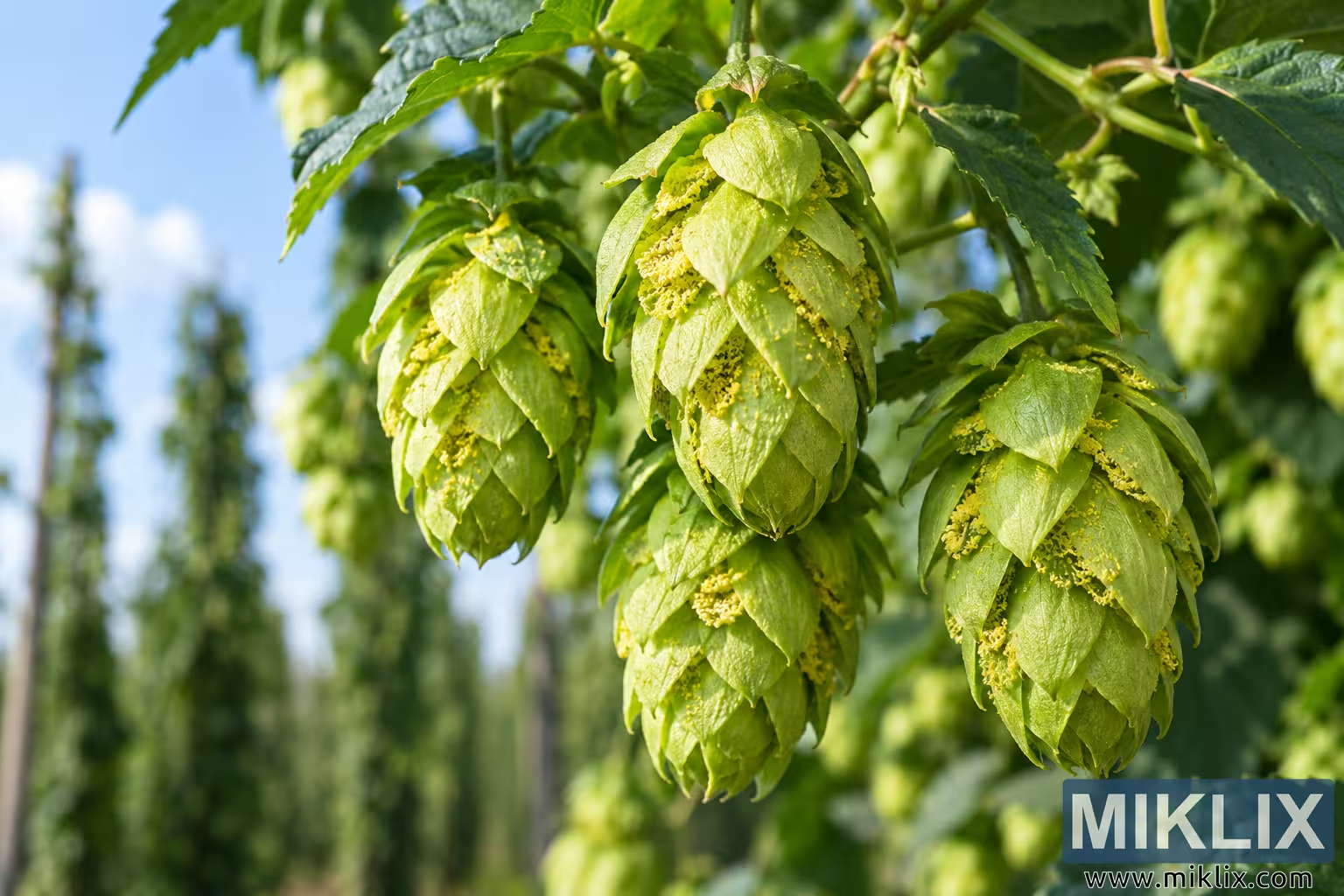
Image: Fresh Green Hop Cones with Golden Lupulin Glands
Published: October 4, 2026 at 2:24:05 PM UTC
Photorealistic close-up of fresh green hop cones growing on the vine, showing layered bracts and golden lupulin glands against a sunlit, softly blurred hop field.
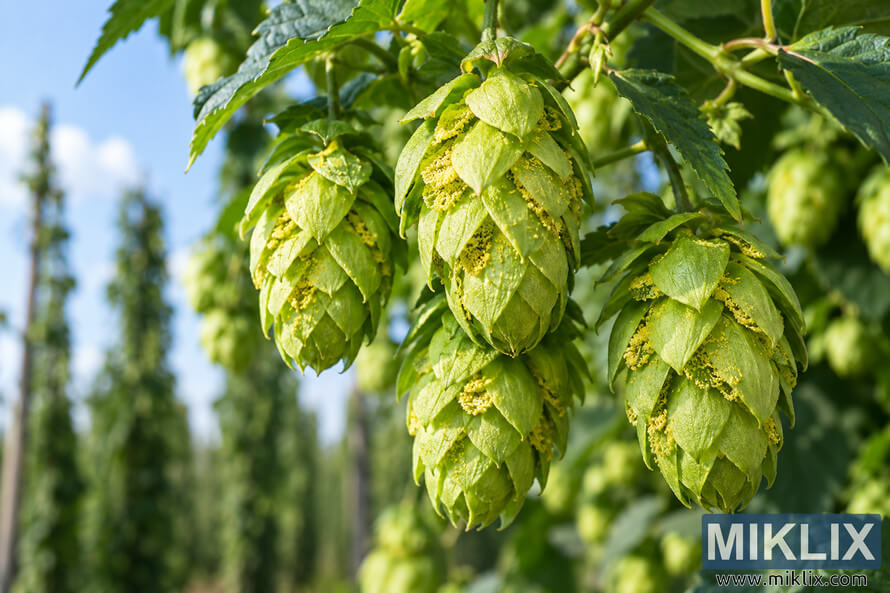
Available versions of this image
The image files available for download below are less compressed and higher resolution - and as a result of that, higher quality - than the images embedded in articles and pages on this website, which are more optimized for file size in order to reduce bandwidth consumption.
Regular size (1,536 x 1,024)
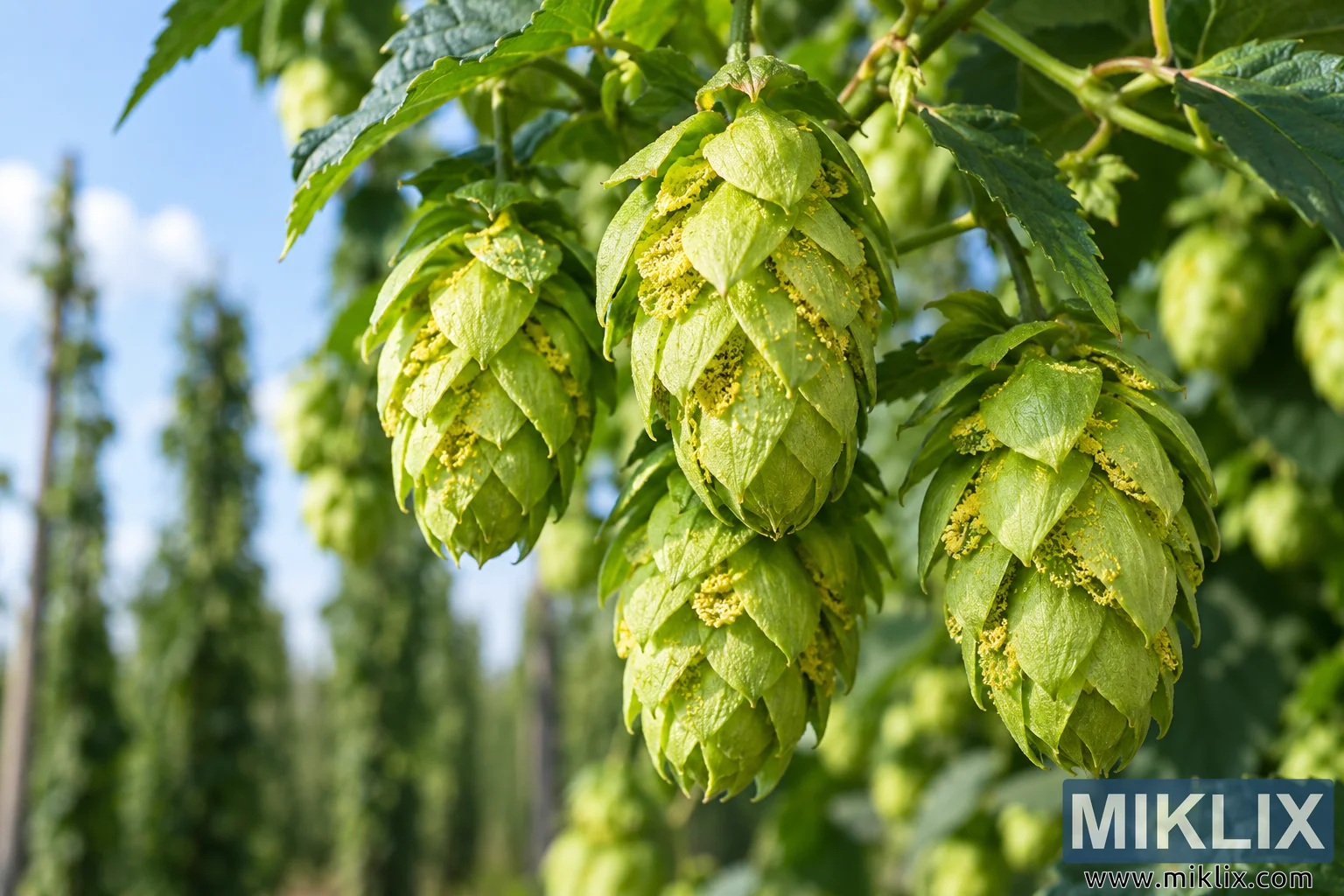
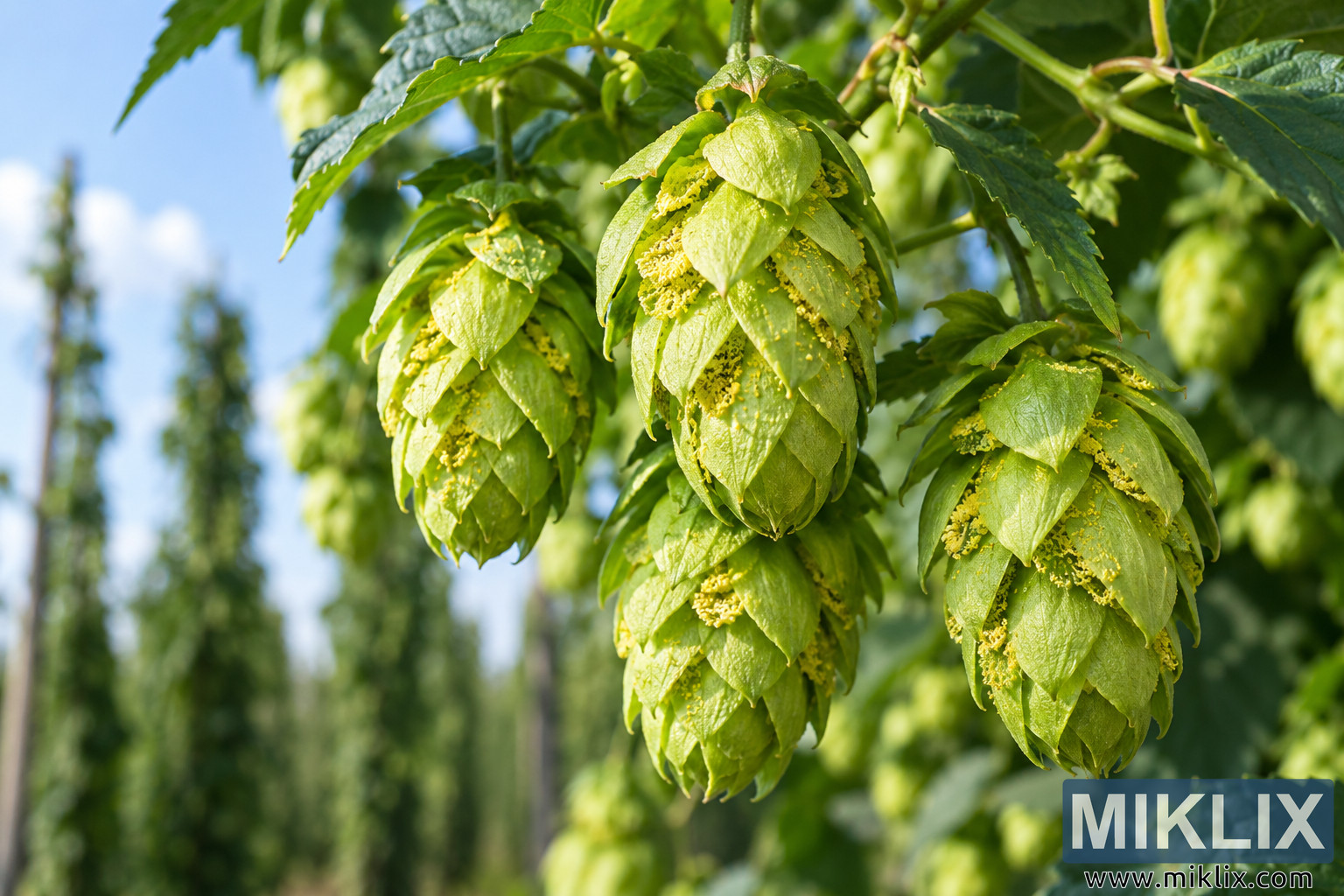
Large size (3,072 x 2,048)
Very large size (4,608 x 3,072)
Extra large size (6,144 x 4,096)
Comically large size (1,048,576 x 699,051)
- Still uploading... ;-)
Image description
A vivid, photorealistic landscape-oriented macro photograph presents a cluster of fresh hop cones growing naturally on the vine in bright outdoor sunlight. The composition is dominated by several large, mature hop cones hanging downward from twisting green stems in the foreground. Their overlapping, leaf-like bracts form the familiar layered structure of hop flowers, creating compact, tapered cones with richly textured surfaces. The hops display an especially vibrant spectrum of fresh greens, ranging from luminous yellow-green where direct sunlight strikes the bracts to deeper, cooler forest-green tones in the shaded folds. This variation in color gives the cones a convincing sense of volume and emphasizes their delicate botanical structure. The central hop cone is the strongest visual focal point. It hangs prominently near the upper middle of the frame and is rendered with exceptional clarity, allowing individual bracts, fine veins, gently curled edges, and subtle surface textures to be distinguished. Small golden-yellow deposits resembling lupulin glands are clearly visible between and across the bracts. These granular details provide a warm contrast against the surrounding green plant tissue and communicate the resinous, aromatic character associated with freshly developed hops. Similar yellow lupulin-like particles appear on the neighboring cones, particularly in the protected spaces where the overlapping bracts separate slightly. A second substantial cone hangs to the right, while additional cones occupy the left and lower central areas of the composition. Together they create a natural grouping rather than an artificially arranged botanical specimen. The cones vary slightly in size, orientation, illumination, and depth, reinforcing the impression that the photograph was captured directly in a thriving hop field. Some bracts project outward or curl gently at their pointed ends, introducing small irregularities characteristic of living plants. The surrounding foliage contributes additional layers of botanical detail. Broad green hop leaves with sharply serrated edges extend around and behind the cones, while slender stems and branching vines travel across the upper portion of the image. The leaves exhibit visible veins, textured surfaces, and subtle changes in tone created by sunlight and shadow. Several leaves near the top of the frame are partially cropped, making the vegetation feel abundant and suggesting that the visible cones belong to a much larger plant extending beyond the boundaries of the photograph. Strong natural daylight arrives primarily from the left and upper portions of the scene. It illuminates the exposed bracts with a warm, clear glow while leaving narrow recesses between the layers in soft shadow. This directional lighting reveals the dimensional construction of each cone and makes the yellow lupulin glands particularly noticeable. Highlights remain botanical and natural rather than glossy, preserving the slightly matte, papery quality of fresh hop bracts. The combination of bright sunlight and shaded creases creates strong micro-contrast without losing the fresh green appearance of the plant. The background is deliberately rendered with a shallow depth of field. Behind the sharply focused foreground cones, the hop field dissolves into soft green shapes and vertical forms. Tall, narrow silhouettes suggest additional hop plants growing along rows or supports, but they remain sufficiently blurred that they do not compete with the main subject. Toward the left side of the image, the vegetation opens to reveal a pale blue sky with soft white clouds. This patch of sky adds visual breathing room and provides a cool, airy contrast to the dense green foliage. The gradual blur of the background also conveys considerable depth, making the foreground cones appear close enough to inspect while suggesting an extensive cultivated hop garden stretching into the distance. The overall composition balances botanical abundance with clear subject isolation. Most of the sharpest visual information is concentrated across the center and right side, while the softer background and open sky on the left provide counterbalance. The hanging direction of the cones creates gentle vertical movement, and the curved stems overhead connect the different elements organically. No packaging, labels, logos, typography, commercial marks, people, tools, or manufactured objects appear anywhere in the scene. The image is entirely focused on the hops, their foliage, and the natural agricultural environment. Although the requested subject evokes a particular hop variety, the photograph itself contains no visible branding or identifying commercial text. The aesthetic is clean, fresh, agricultural, and highly realistic, with the visual language of professional botanical and ingredient photography. Fine detail in the foreground makes the image especially effective for communicating freshness and quality: individual bracts are distinct, their pointed tips and subtle wrinkles are visible, and the scattered golden lupulin glands introduce both texture and color variation. At the same time, the sunlit field and blue sky establish an outdoor harvest context rather than presenting the hops as an isolated studio specimen. The result is an inviting depiction of fresh hop cones at or near maturity, emphasizing their vibrant green color, layered morphology, resin-rich yellow glands, and connection to a healthy growing plant. The landscape framing gives the scene a spacious character and leaves enough environmental context to communicate that the hops are growing in a cultivated field. Visually, the image conveys freshness, aromatic intensity, summer sunlight, healthy plant growth, and the tactile complexity of newly developed hop flowers. It would be suitable for editorial or informational material concerning hops, brewing ingredients, hop cultivation, agriculture, botanical characteristics, harvesting, or flavor and aroma ingredients, while remaining completely free of visible brand references.
The image is related to: Hops in Beer Brewing: Jester