
Image: Traditional English Hop Garden with Mature Jester Hop Bines
Published: October 4, 2026 at 2:24:05 PM UTC
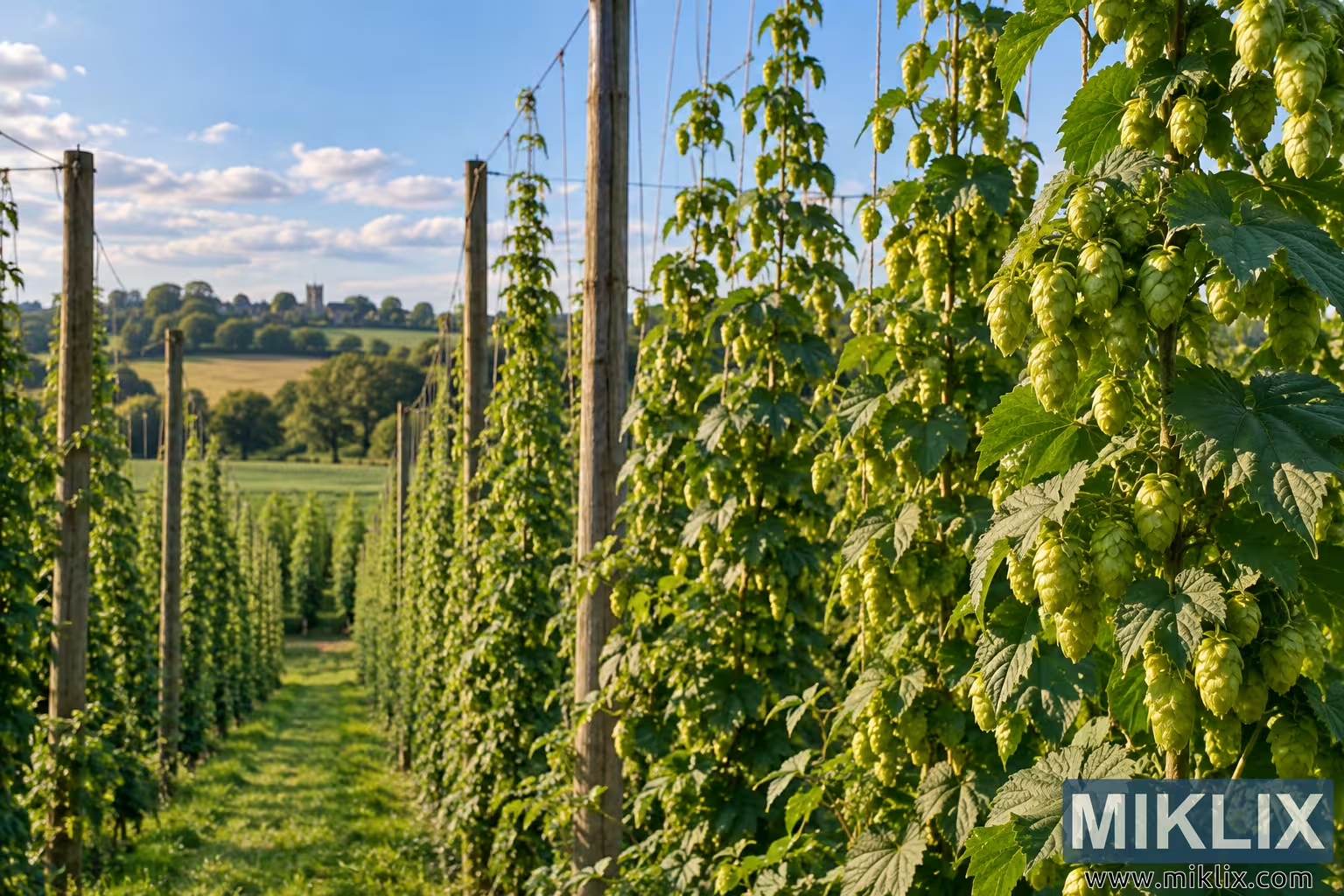
Photorealistic English hop garden with mature Jester hop bines, abundant green cones and traditional wirework, set against rolling countryside in warm late-afternoon sunlight.
Available versions of this image
The image files available for download below are less compressed and higher resolution - and as a result of that, higher quality - than the images embedded in articles and pages on this website, which are more optimized for file size in order to reduce bandwidth consumption.
Regular size (1,536 x 1,024)
Large size (3,072 x 2,048)
Very large size (4,608 x 3,072)
Extra large size (6,144 x 4,096)
Comically large size (1,048,576 x 699,051)
- Still uploading... ;-)
Image description
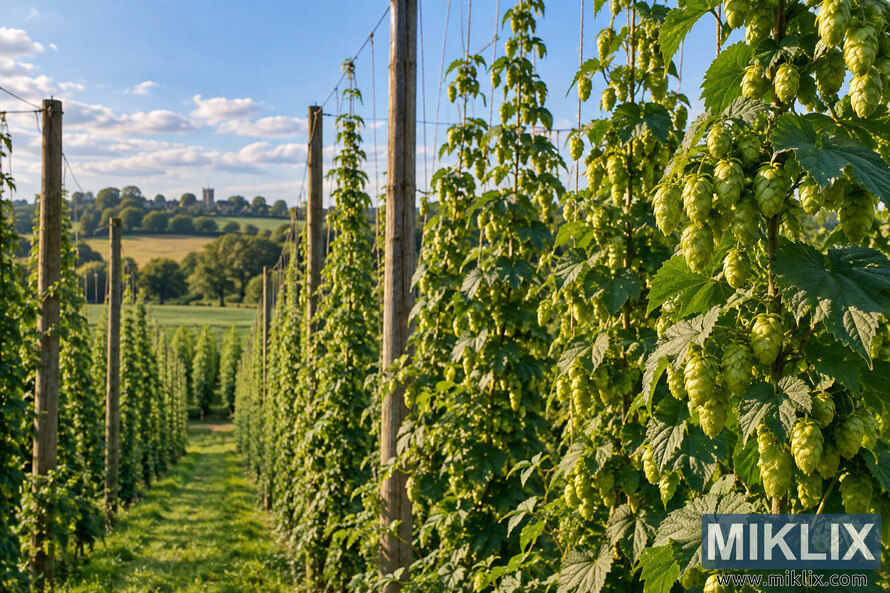
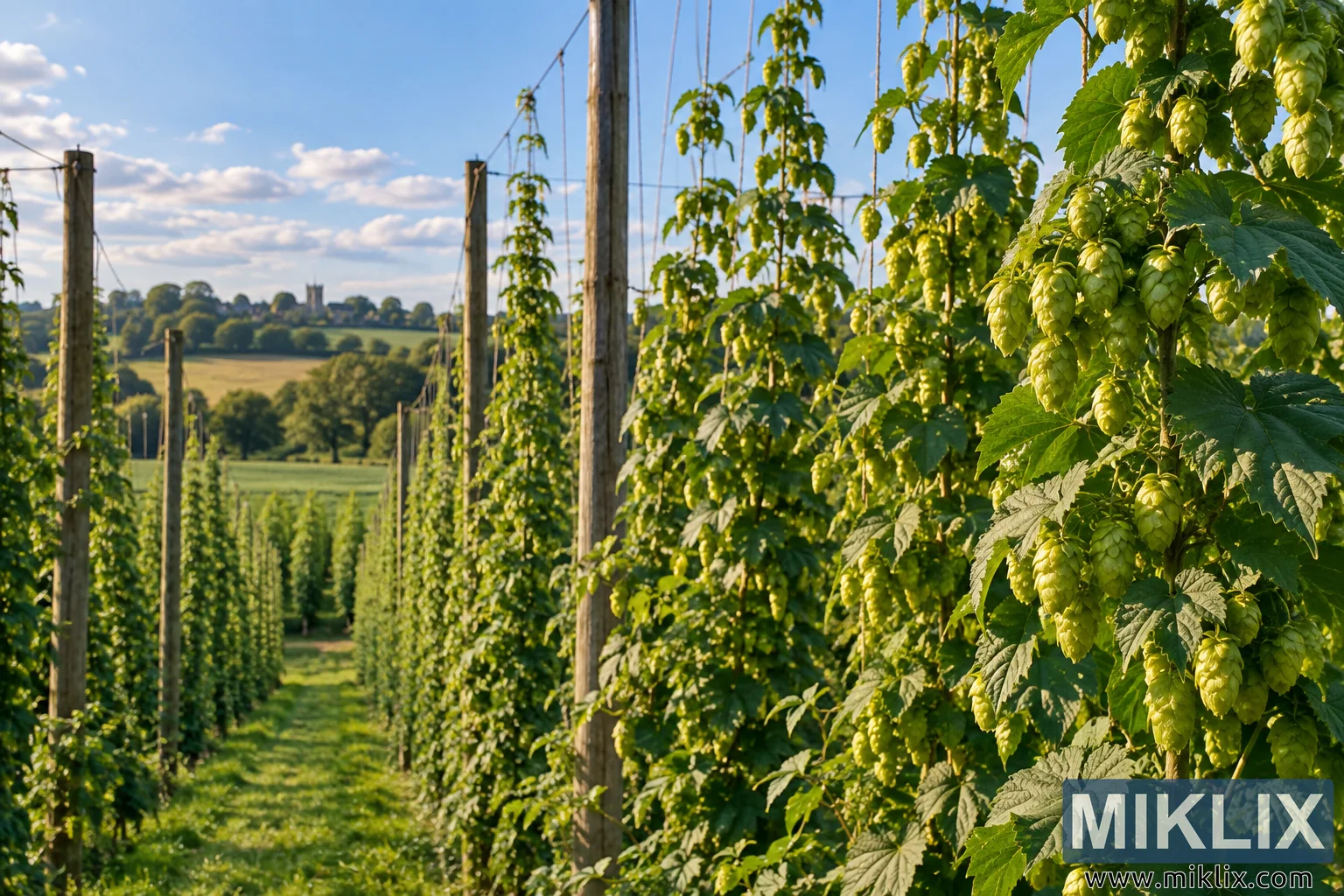
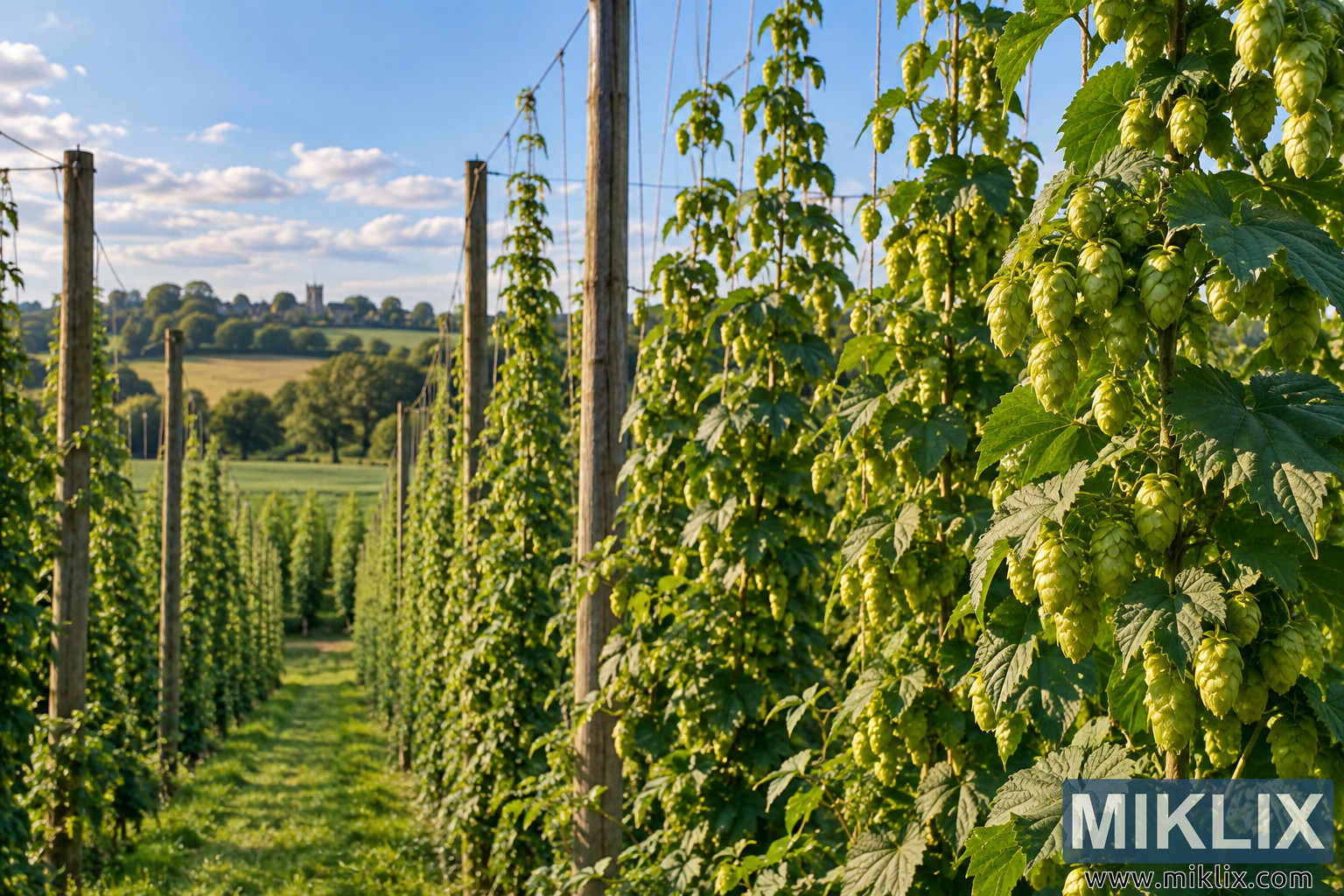
A wide, photorealistic landscape photograph depicts a traditional English hop garden in mature late-summer growth, viewed along one of the grassy passages running between the cultivated rows. The scene is dominated by tall hop bines trained vertically on an extensive traditional wirework system. Substantial weathered wooden poles rise at regular intervals throughout the garden, supporting horizontal wires high above the plants. From these wires, slender strings or training lines descend toward the ground, providing the structure around which the vigorous hop bines have climbed. The repeated poles, wires, and columns of foliage create strong vertical lines and a pronounced sense of perspective, leading the viewer from the foreground into the distance. On the right side of the image, a particularly lush hop bine occupies much of the foreground and provides the clearest botanical detail. Large, deeply lobed green leaves overlap one another in dense layers, while numerous mature hop cones hang beneath and between the leaves. The cones are pale yellow-green to fresh green in color and have the distinctive overlapping, papery bracts associated with ripe hops. Some appear individually while others form generous clusters, suggesting a productive crop approaching harvest. Warm sunlight reaches the cones from the side, illuminating their edges and emphasizing their layered texture. The leaves display a mixture of bright sunlit surfaces and deeper green areas in shadow, producing a convincing impression of depth within the dense vegetation. More hop plants continue along the row behind the foreground specimen. They climb high on their strings and form narrow towers of foliage, with additional clusters of cones visible throughout the plants. Parallel rows extend across the garden to the left and into the center of the composition. A narrow strip of closely cut or naturally low grass forms a pathway between the rows and begins near the bottom center of the frame before narrowing toward the middle distance. This pathway, together with the converging lines of poles and plants, draws the eye naturally through the hop garden. The traditional support structure is clearly visible. Tall timber posts have a functional agricultural appearance, with natural variations in tone, grain, and weathering rather than a polished or decorative finish. Thin overhead wires stretch between the posts, while vertical strings descend from the wirework to guide the individual bines. The construction gives the scene the characteristic height and ordered geometry of an established English hop yard while still allowing the plants themselves to appear abundant and organic. Beyond the cultivated rows, the landscape opens into gently rolling English countryside. Green fields and warmer, golden-brown areas of farmland create horizontal layers across the middle distance. Mature deciduous trees and hedgerows divide the fields and soften their boundaries, producing the enclosed patchwork appearance associated with rural agricultural landscapes in England. The terrain rises gradually toward the horizon, where a small settlement is partially visible among trees. A distant stone church tower or similarly proportioned historic rural building rises above the tree line toward the left-center of the background. Because it is far from the camera, it remains understated rather than becoming a dominant architectural subject, but it contributes to the distinctly English countryside atmosphere. The sky occupies the upper portion of the image and is a clear, natural blue scattered with small, soft white clouds. The clouds are widely spaced and allow strong sunlight to fall across the hop garden. The illumination appears to come from a relatively low angle, giving the photograph the warm character of late afternoon or early evening. Golden highlights touch the hop cones, leaf edges, wooden posts, and sections of grass, while the opposite sides of the vegetation fall into gentle shadow. The light is warm without appearing artificially saturated, and the overall palette remains strongly natural: rich greens dominate the hop plants and grass, muted brown and gray tones define the timber posts, yellow-green highlights distinguish the cones, and blue and white provide contrast in the sky. Depth of field is handled in a natural landscape-photography style. The foreground hop cones and leaves on the right are exceptionally crisp, revealing fine veins in the leaves, serrated edges, folds in the cone bracts, and subtle differences in color across the plant. The nearby posts and central rows also retain substantial detail, while the distant countryside, trees, and village become progressively softer. This creates spatial separation without making the background indistinct. The composition balances agricultural order with natural abundance. Repetition in the poles and rows communicates the deliberate structure of hop cultivation, whereas the thick foliage and hanging cones give the garden a vigorous, almost overflowing appearance. No people, vehicles, machinery, packaging, signs, logos, labels, or commercial branding are visible. The image therefore focuses entirely on the crop, its traditional growing system, and its rural setting. Although the scene represents a garden of Jester hops as specified in the image concept, there is no written variety identification or branding within the photograph; the variety is conveyed contextually through the requested subject rather than through visible text. The overall mood is peaceful, productive, and pastoral. It evokes an established English hop-growing landscape near harvest time, combining close botanical detail with a broad view of the countryside. The warm directional sunlight, mature hop cones, traditional tall wirework, grassy lanes, rolling fields, hedgerows, and distant village architecture collectively give the photograph a strong sense of place. Its landscape orientation emphasizes the breadth of the hop garden and surrounding farmland while still allowing the foreground crop to remain the principal visual subject.
The image is related to: Hops in Beer Brewing: Jester