
Image: Laboratory Analysis of Hop Alpha Acid Levels
Published: October 4, 2026 at 2:24:05 PM UTC
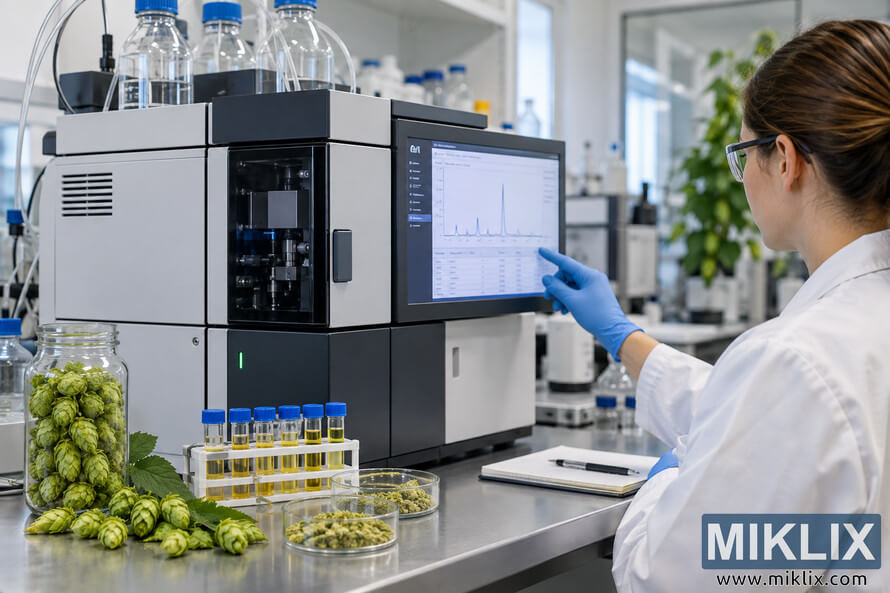
Photorealistic laboratory scene showing analytical equipment, prepared hop samples, green hop cones, and a technician reviewing chromatographic data during alpha acid testing.
Available versions of this image
The image files available for download below are less compressed and higher resolution - and as a result of that, higher quality - than the images embedded in articles and pages on this website, which are more optimized for file size in order to reduce bandwidth consumption.
Regular size (1,536 x 1,024)
Large size (3,072 x 2,048)
Very large size (4,608 x 3,072)
Extra large size (6,144 x 4,096)
Comically large size (1,048,576 x 699,051)
- Still uploading... ;-)
Image description
A wide, landscape-oriented photorealistic image shows a modern analytical laboratory where hop samples are being examined for their alpha acid content. The scene is bright, clean, and highly controlled, with the visual focus placed on a large piece of sophisticated laboratory analysis equipment positioned prominently on a stainless-steel workbench. The instrument has a modular, professional design with a combination of light gray, dark gray, and black exterior panels. Its appearance is consistent with high-performance liquid chromatography or similar analytical equipment commonly used for the quantitative analysis of chemical compounds in agricultural and brewing-related samples. No recognizable commercial branding is visible on the laboratory equipment or other objects in the scene.
On the right side of the image, a laboratory technician is shown operating the analytical system. She is viewed primarily from behind and from the side, allowing the viewer to see both her interaction with the equipment and the information displayed on its screen. Her brown hair is neatly pulled back into a practical bun or ponytail, helping maintain a clean laboratory working environment. She wears clear protective safety glasses, a white laboratory coat, and bright blue disposable laboratory gloves. Her clothing and protective equipment communicate a professional scientific setting and appropriate laboratory practice. Her posture is attentive and focused as she extends one gloved hand toward the instrument's integrated display. Her index finger points directly toward the analytical results, suggesting that she is reviewing, selecting, or interpreting data generated during the hop analysis.
The instrument's large color display contains a scientific analytical interface. A chromatogram-like graph occupies the upper portion of the screen, with several distinct peaks rising from a horizontal baseline. One particularly prominent peak is visible toward the center-right portion of the graph, while several smaller peaks appear elsewhere along the trace. Beneath the graph is a structured table containing rows and columns of analytical information. Although the individual values are not intended to be read as specific measurements, the overall presentation clearly conveys quantitative laboratory data. The screen therefore reinforces the idea that the hop material is undergoing chemical analysis, specifically an assessment associated with alpha acid levels. These compounds are particularly important when evaluating hops because their concentration is a key analytical property of hop material used in brewing applications.
The physical construction of the analytical instrument adds substantial technical detail to the scene. Multiple stacked modules form the main system, and transparent tubing runs between containers and different parts of the equipment. Several clear laboratory solvent or reagent bottles with blue screw caps are arranged above the instrument. The bottles contain transparent liquids and are connected to flexible tubing, suggesting a liquid-based analytical workflow. A dark inspection window or compartment on the front-left portion of the equipment reveals internal mechanical components. A small green status indicator glows on the lower section of the instrument, implying that the system is powered on and actively operating. Together, the bottles, tubing, modular components, sample-handling area, and chromatographic display create the visual impression of a functioning analytical laboratory system rather than a generic piece of scientific equipment.
Hop material is prominently displayed across the foreground, making the subject of the analysis immediately recognizable. On the left side of the stainless-steel work surface stands a clear glass jar filled with numerous whole green hop cones. Additional hop cones have been placed loosely on the bench in front of the jar. Their characteristic overlapping leafy bracts, compact cone shapes, and natural green coloration are clearly visible. Fresh green hop leaves and stems are mixed among the cones, providing an additional botanical element and connecting the laboratory analysis with the agricultural origin of the sample. The natural texture and irregular shapes of the plant material contrast visually with the smooth, precise surfaces of the laboratory equipment.
Closer to the center of the foreground is a white laboratory rack containing a row of small transparent sample vials or test tubes. Each vial is sealed with a blue cap and contains a yellow to golden liquid, suggesting that the hop samples have undergone extraction or preparation before instrumental analysis. The consistent liquid volumes and orderly arrangement of the vials communicate a controlled sample preparation procedure. Nearby, several shallow transparent laboratory dishes contain finely divided or ground hop material. The processed samples have a muted green to yellow-green appearance and visibly different texture from the intact hop cones. This progression from whole hop cones to crushed or ground material and finally to liquid samples visually communicates the stages that may be involved in preparing hops for quantitative chemical testing.
The stainless-steel laboratory bench extends across the lower portion of the image and reflects some of the surrounding objects, contributing to the clean and hygienic appearance of the workspace. To the right of the sample dishes, near the technician, an open laboratory notebook rests on the bench with a dark pen placed across it. The notebook suggests that observations, sample information, or analytical results may be recorded as part of the testing process. The arrangement feels purposeful rather than decorative: whole botanical material, processed hop samples, prepared liquid extracts, analytical instrumentation, digital data, and documentation are all represented within a single coherent laboratory workflow.
The background shows additional laboratory equipment, bottles, counters, cabinets, and structural elements rendered with a relatively shallow depth of field. These objects are softly blurred compared with the principal instrument, technician, and samples in the foreground, helping direct attention toward the analytical procedure. Large windows or bright glazed surfaces allow abundant natural-looking light into the room. A leafy green plant is also visible in the background near the technician, adding a subtle organic element without distracting from the scientific subject. The overall lighting is bright and neutral, producing crisp detail on the laboratory equipment, glass containers, stainless steel, hop cones, and protective clothing.
The composition combines scientific precision with recognizable brewing ingredients. The analytical equipment dominates the left and central sections of the frame, while the technician occupies the right side. Hop cones and prepared samples form a strong foreground layer that immediately establishes what is being tested. The technician's pointing gesture creates a visual connection between the physical hop samples and the chromatographic results displayed by the instrument. This makes the image suitable for illustrating laboratory quality control, hop chemistry, brewing science, agricultural analysis, raw-material testing, and the measurement of alpha acid levels in hops. The image communicates a technically advanced but realistic workflow in which hop samples are prepared, analyzed using laboratory instrumentation, and evaluated through quantitative data. Its clean professional appearance, detailed laboratory environment, clearly identifiable hop material, and absence of visible commercial branding make it appropriate for editorial, educational, scientific, agricultural, or brewing-industry contexts.
The image is related to: Hops in Beer Brewing: Jester