
Image: Comparison of Hop Varieties Featuring Jester
Published: October 4, 2026 at 2:24:05 PM UTC
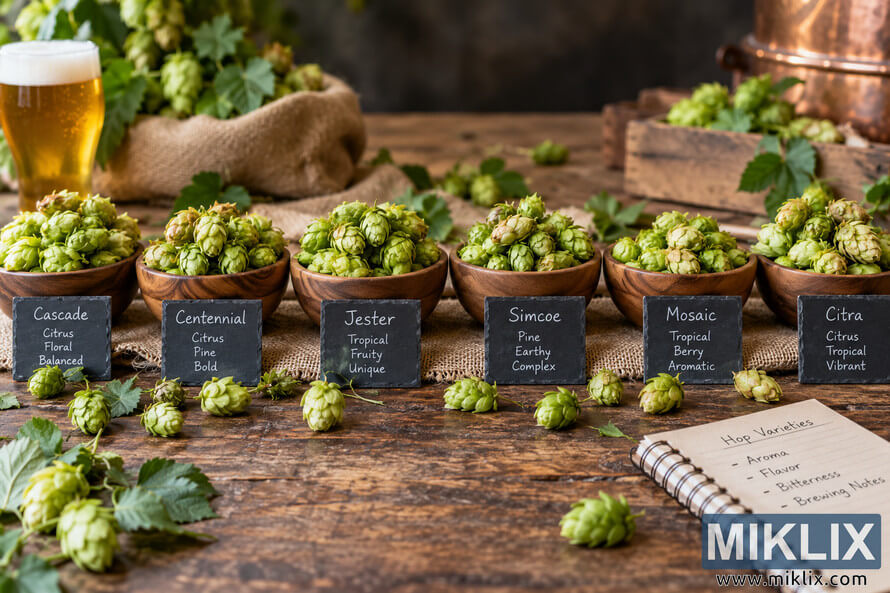
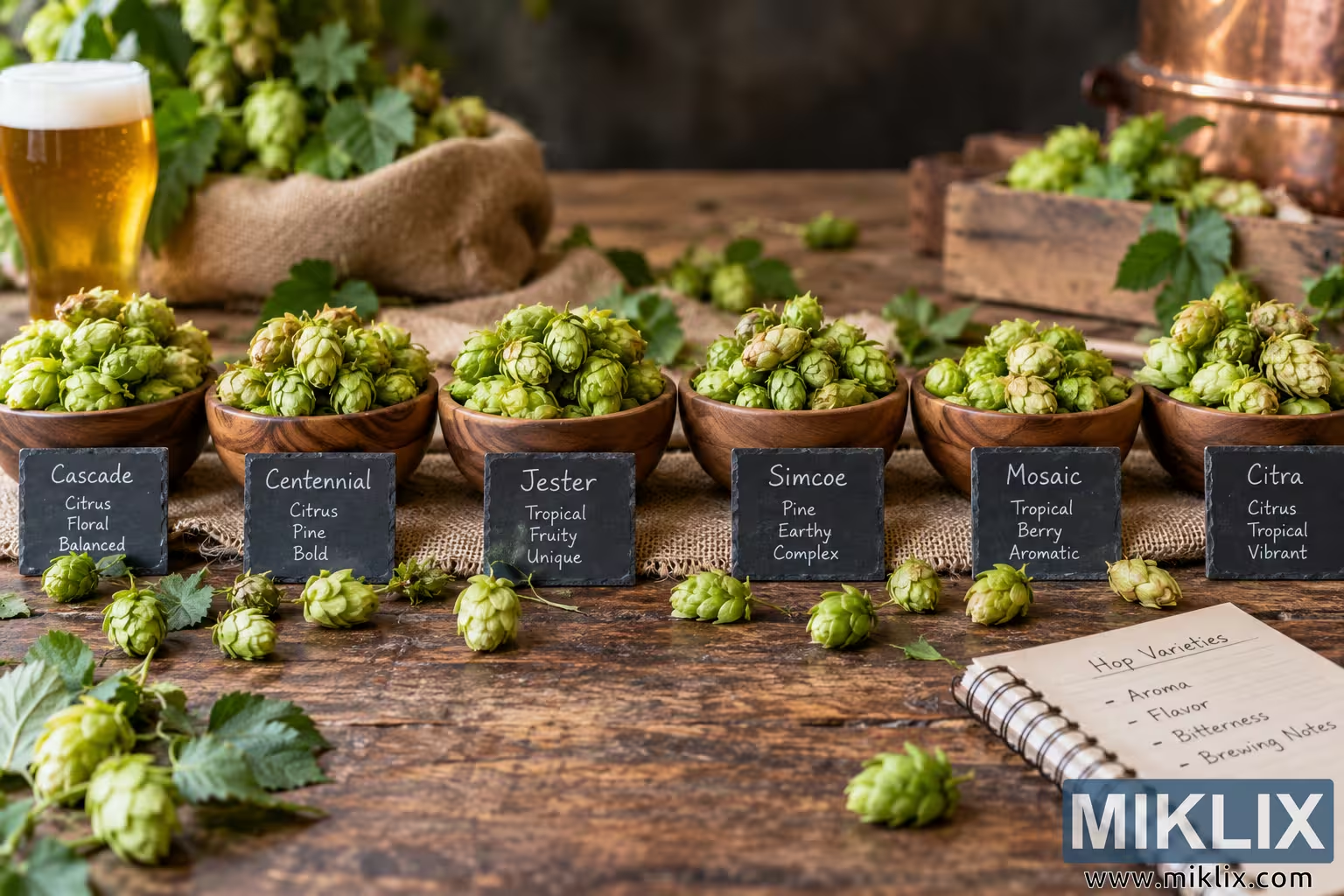
Rustic brewery still life comparing Cascade, Centennial, Jester, Simcoe, Mosaic, and Citra hops, with labeled bowls, tasting notes, fresh hops, and brewing details.
Available versions of this image
The image files available for download below are less compressed and higher resolution - and as a result of that, higher quality - than the images embedded in articles and pages on this website, which are more optimized for file size in order to reduce bandwidth consumption.
Regular size (1,536 x 1,024)
Large size (3,072 x 2,048)
Very large size (4,608 x 3,072)
Extra large size (6,144 x 4,096)
Comically large size (1,048,576 x 699,051)
- Still uploading... ;-)
Image description
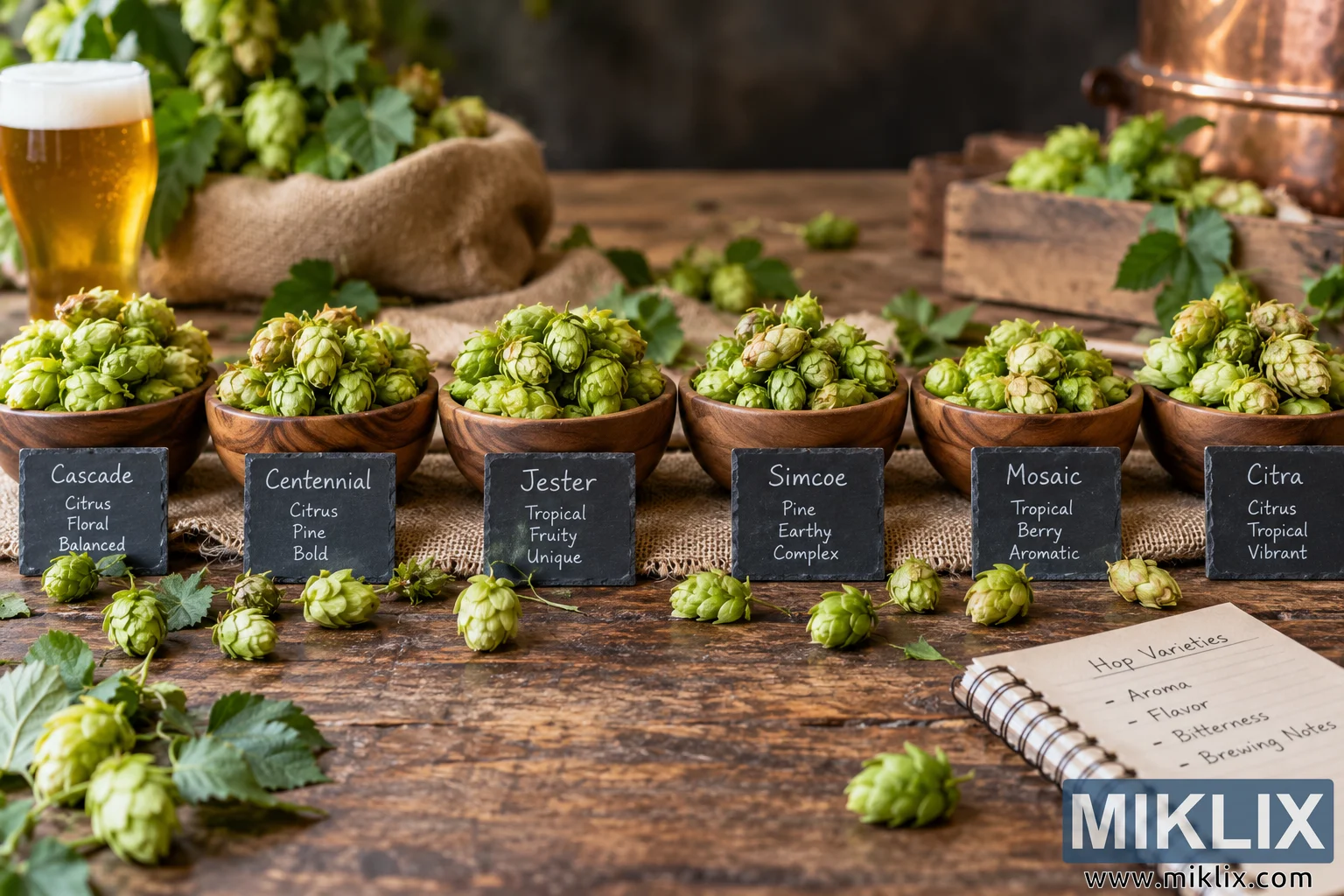
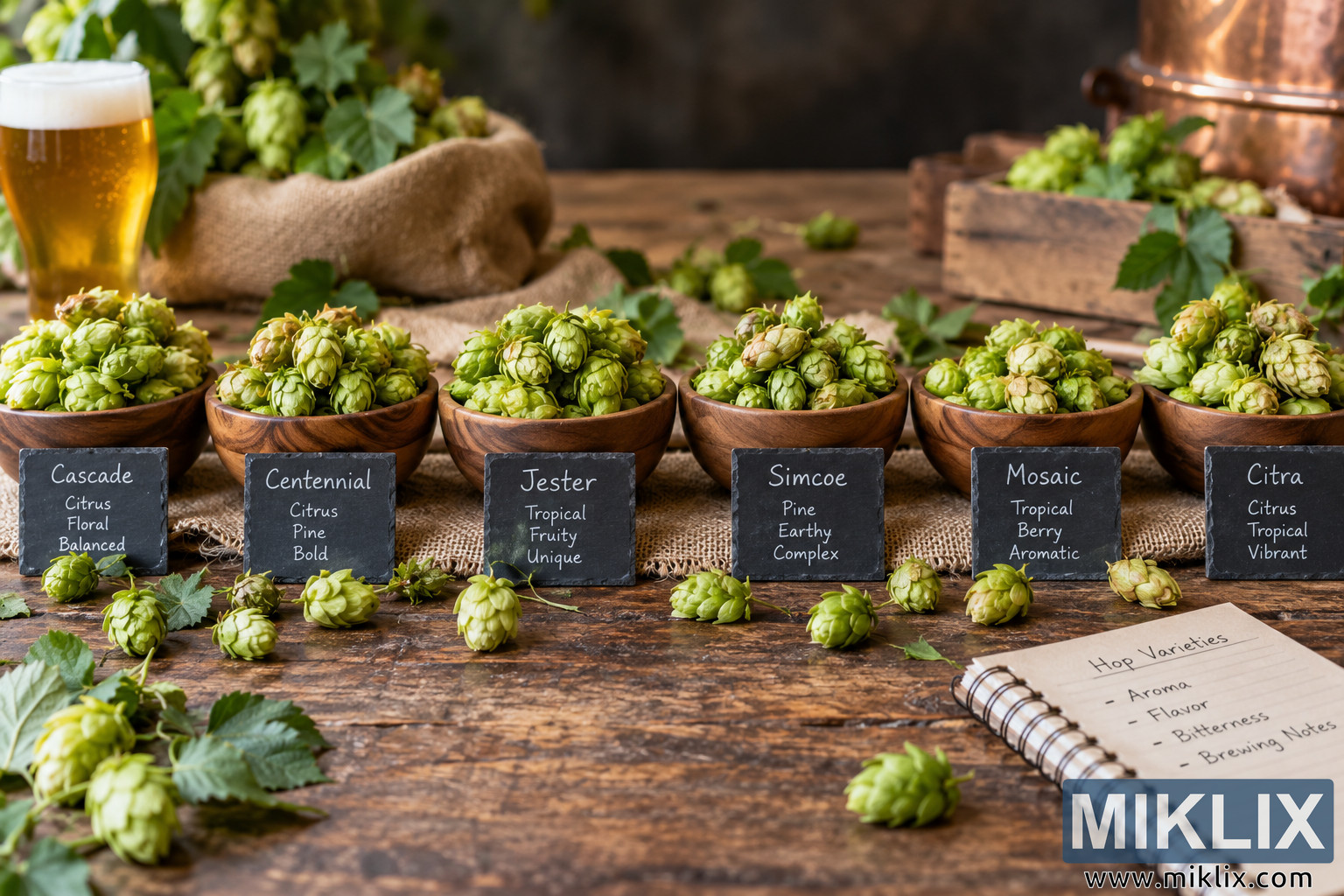
A wide, landscape-oriented still-life photograph presents a carefully arranged comparison of six different hop varieties on a rustic wooden table. The scene has the warm, inviting atmosphere of a traditional craft brewery or brewing workshop, with natural textures, earthy materials, and soft directional lighting contributing to an artisanal visual style. Across the center of the composition, six rounded wooden bowls are positioned in a nearly continuous horizontal row. Each bowl is generously filled with fresh green hop cones, allowing the viewer to compare the general appearance of the hops while reading the small identification boards placed directly in front of them. From left to right, the varieties are labeled Cascade, Centennial, Jester, Simcoe, Mosaic, and Citra. The inclusion of Jester near the center gives that variety a prominent position within the overall comparison.
The hop cones have a fresh botanical appearance, with overlapping pale-green to medium-green bracts forming their distinctive compact, layered shapes. Individual cones vary naturally in size, orientation, and tone, helping the arrangement feel organic rather than mechanically uniform. The rich brown wooden bowls contrast with the vivid greens of the plant material. A coarse strip of natural burlap fabric runs underneath the bowls, adding another warm, tactile element and separating the main comparison area from the dark, weathered tabletop beneath it.
Small rectangular black slate or chalkboard-style signs stand in front of each bowl. Their handwritten white lettering identifies each variety and summarizes several aroma or flavor characteristics. The Cascade sign reads 'Cascade' followed by 'Citrus', 'Floral', and 'Balanced'. Centennial is accompanied by 'Citrus', 'Pine', and 'Bold'. The centrally positioned Jester variety is described with the words 'Tropical', 'Fruity', and 'Unique'. Simcoe is paired with 'Pine', 'Earthy', and 'Complex'. Mosaic is characterized as 'Tropical', 'Berry', and 'Aromatic', while Citra is accompanied by 'Citrus', 'Tropical', and 'Vibrant'. These labels turn the still life into an accessible visual comparison, combining the physical appearance of the hops with concise sensory descriptors.
Several loose hop cones are scattered naturally across the foreground. Some sit individually on the bare wood, while others appear beside fresh green hop leaves and short sections of vine. These irregularly positioned botanical details soften the formal row of bowls and make the table resemble an active hop tasting or brewing workspace. The foreground is particularly detailed, revealing scratches, grain patterns, darker stains, and variations in the aged wooden surface. Toward the lower left corner, a larger cluster of green leaves and hop cones partially enters the frame, reinforcing the sense that freshly harvested plant material is spread around the work area.
In the lower-right portion of the image, an open spiral-bound notebook rests diagonally on the table. Its visible page is headed 'Hop Varieties' and contains a short handwritten list referring to aroma, flavor, bitterness, and brewing notes. The notebook suggests that someone may be documenting observations or comparing the brewing characteristics of the different hops, even though no person is visible anywhere in the photograph. Its pale paper provides a visual contrast against the dark brown tabletop, while the dark spiral binding and handwritten lettering complement the chalkboard labels used for the hop varieties.
The background contains additional brewing-related details but is rendered more softly than the main row of bowls, creating a convincing sense of depth. On the far left, a clear glass of golden beer stands behind the Cascade bowl. The beer has a bright amber-gold body and a substantial creamy white foam head. No logo, brand name, or commercial marking appears on the glass. Behind it is a large burlap sack overflowing with fresh hops and leafy vines. The folds of the coarse fabric and the abundant greenery contribute to the impression of freshly gathered ingredients ready for brewing.
On the right side of the background, a rustic wooden crate contains additional green hop cones and leaves. Behind and above the crate, part of a large copper-colored brewing vessel is visible. Its reflective metallic surface catches the warm illumination and introduces orange and bronze highlights into the otherwise green-and-brown palette. The vessel is generic and contains no visible branding or identifying commercial marks. The background gradually fades into dark, softly blurred tones, keeping attention focused on the hop varieties while still establishing a brewery-inspired environment.
Lighting is warm and directional, appearing to come primarily from the upper-left or left side of the scene. Highlights catch the layered surfaces of the hop cones, the rim and grain of each wooden bowl, the foam on the beer, and the metallic brewing equipment in the background. Shadows remain soft enough to preserve detail, creating a natural photographic appearance rather than a harsh studio look. The shallow depth of field keeps the central bowls, signs, hops, and much of the foreground sharply rendered while progressively softening the background elements.
The overall color palette is dominated by fresh botanical greens, warm brown wood, beige burlap, golden beer, creamy white foam, black slate, and subtle copper highlights. The landscape composition makes effective use of the horizontal row of six varieties, visually communicating comparison at a glance. Although all six bowls receive substantial attention, Jester occupies a particularly noticeable central location between Centennial and Simcoe. The photograph therefore works both as an atmospheric brewing still life and as an informative presentation of several hop varieties, emphasizing differences in named aroma and flavor profiles while maintaining a cohesive rustic craft-brewing aesthetic. There are no people, corporate logos, product packages, trademarks, or other explicit brand identifiers visible in the scene.
The image is related to: Hops in Beer Brewing: Jester