
Image: Close-Up of Green Hop Cones Showing Layered Cone Structure
Published: October 8, 2026 at 10:08:48 PM UTC
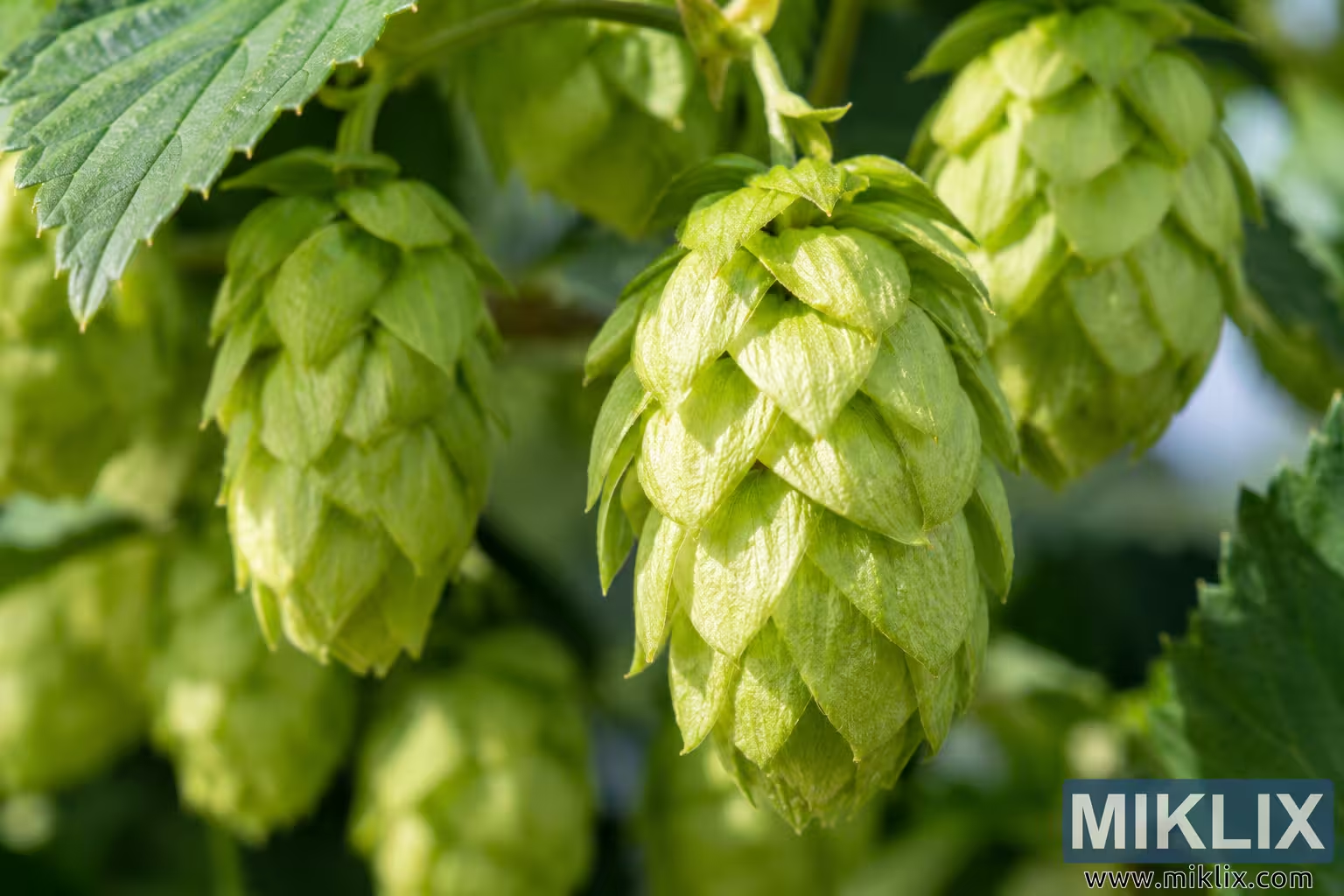
Detailed macro photograph of fresh green hop cones growing on the vine, highlighting the layered bracts, fine texture, cone structure, natural sunlight, and lush green foliage.
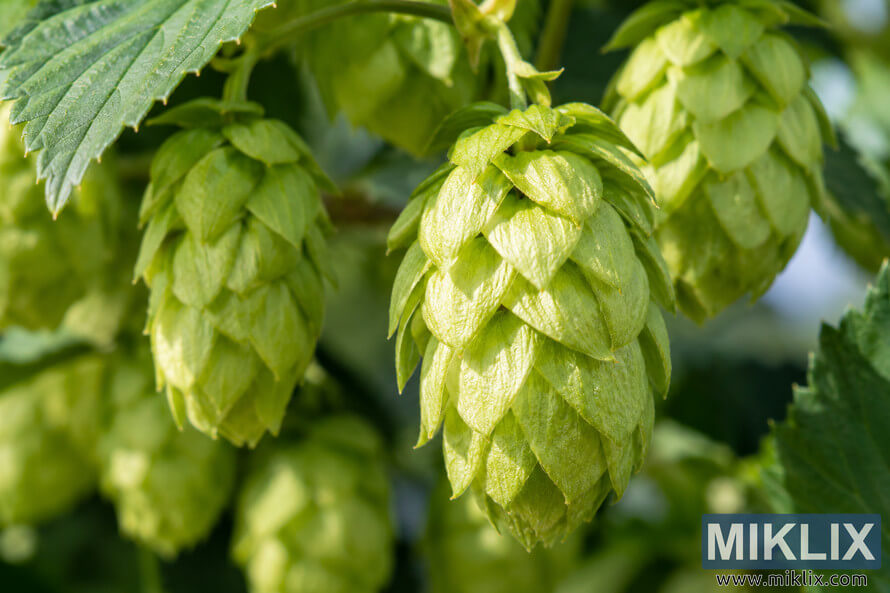
Available versions of this image
The image files available for download below are less compressed and higher resolution - and as a result of that, higher quality - than the images embedded in articles and pages on this website, which are more optimized for file size in order to reduce bandwidth consumption.
Regular size (1,536 x 1,024)
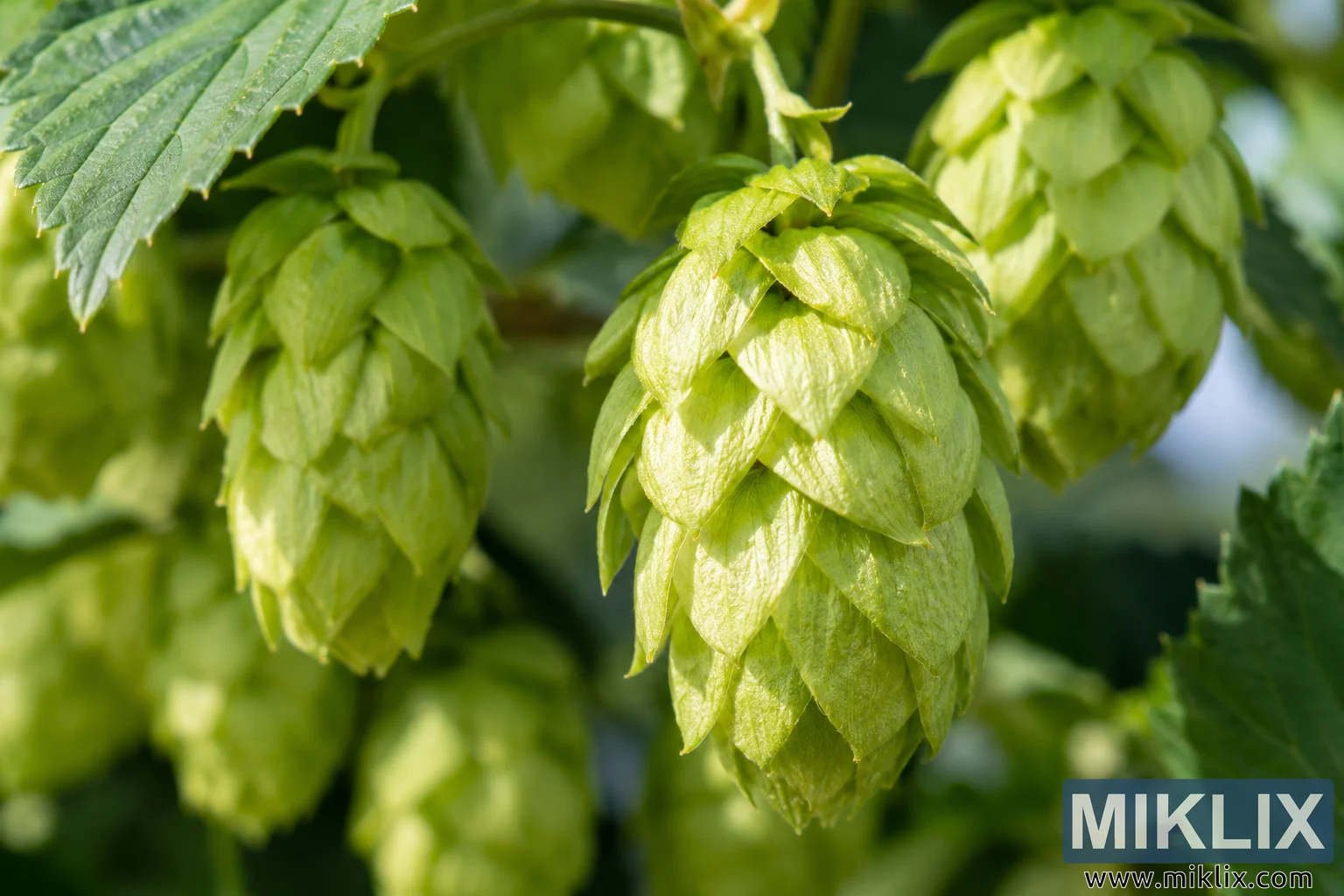
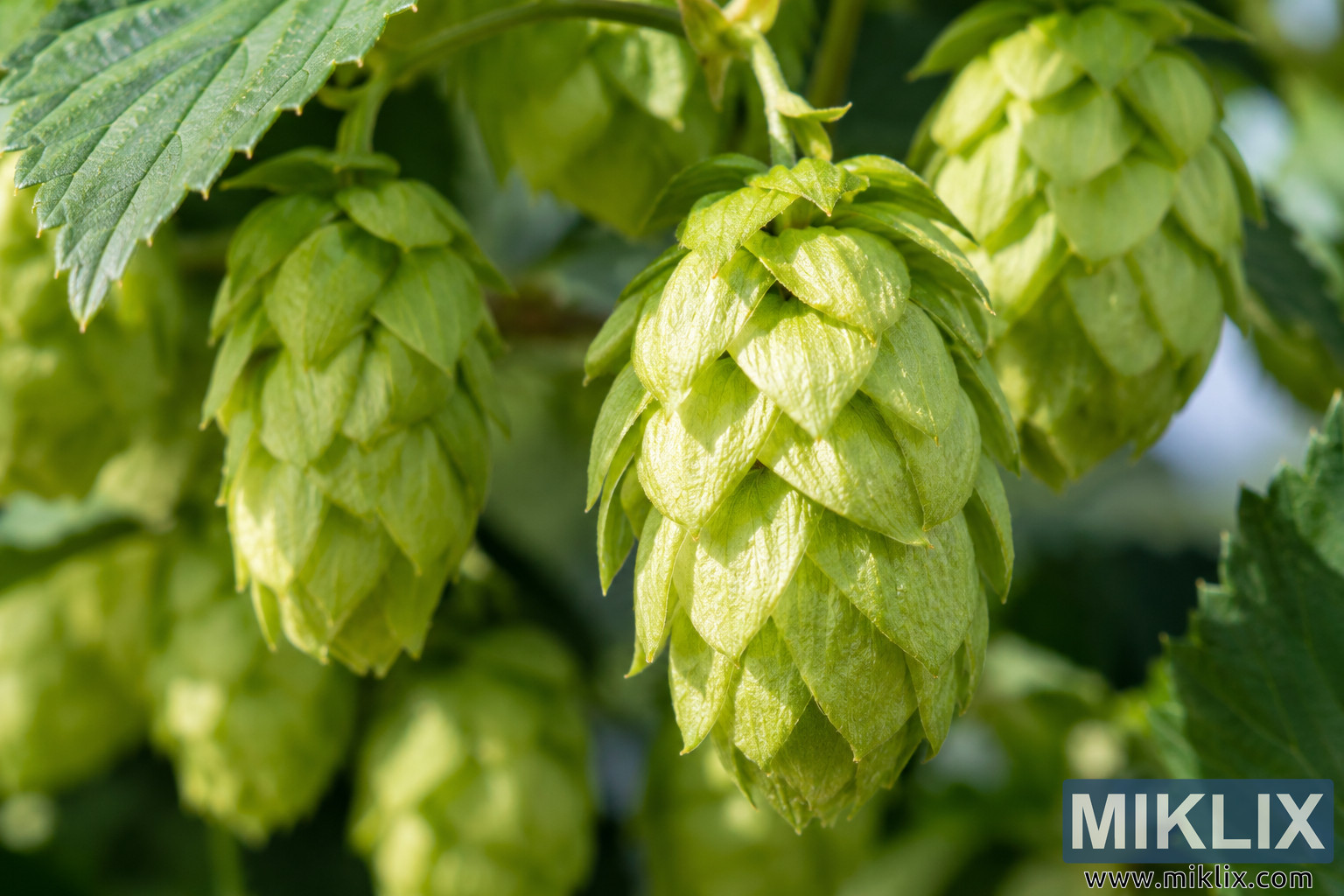
Large size (3,072 x 2,048)
Very large size (4,608 x 3,072)
Extra large size (6,144 x 4,096)
Comically large size (1,048,576 x 699,051)
- Still uploading... ;-)
Image description
A detailed landscape-oriented macro photograph presents a cluster of fresh green hop cones growing naturally on the plant, with the composition centered on one especially prominent cone in the foreground. The main hop cone occupies a large portion of the central and slightly right-of-center area of the image, making its characteristic structure immediately visible. It hangs downward from a slender green stem and is composed of numerous overlapping, leaf-like bracts arranged in dense layers. These bracts form the familiar tapered, roughly oval-to-conical silhouette of a mature hop flower. Each individual bract curves gently outward before narrowing toward a pointed tip, creating a repeating pattern that resembles overlapping scales. The close viewing distance reveals fine surface details, including delicate veins, subtle wrinkles, faint ridges, and variations in thickness across the translucent green plant tissue.
Bright natural sunlight falls across the central cone and illuminates many of its upper and outward-facing bracts. The strongest highlights appear as luminous yellow-green areas, particularly on the upper half of the cone, while the overlapping layers create narrow pockets of deeper green shadow beneath them. This combination of direct light and shade emphasizes the three-dimensional construction of the hop cone and clearly separates one bract from the next. Some bracts appear almost translucent where the sunlight passes through their thin surfaces, allowing their fine vein patterns to become more noticeable. Toward the lower portion of the cone, the layers gradually narrow and converge into a rounded, slightly pointed end. The overall appearance is fresh, healthy, and naturally textured rather than polished or artificial.
Several additional hop cones surround the main subject and provide botanical context. On the left side of the photograph, another substantial cone hangs vertically in the middle distance. It is still recognizable in structure, with overlapping green bracts and a tapered form, but it is softer and less detailed than the central cone because of the shallow depth of field. Farther toward the upper right is another large hop cone, partially framed by leaves and stems. Its pale green surface catches sunlight, although its details are more subdued and softly rendered. Additional blurred hop forms appear deeper in the background, including green cone-shaped silhouettes near the lower left and lower central portions of the frame. Their repetition establishes that the main cone is part of a vigorous hop plant rather than an isolated botanical specimen.
Large hop leaves and portions of the climbing plant frame the cones. A broad, serrated leaf enters prominently from the upper left corner, where its darker green surface shows visible veins and a slightly rough texture. The sharply toothed edge of this leaf contrasts with the smoother overlapping bracts of the hop cones. More foliage occupies the upper background and the right edge of the image, including a dark green leaf in the lower-right corner that is partially cropped by the frame. Curving stems and smaller pieces of foliage connect the cones visually and reinforce the impression of viewing the plant directly in a garden, hop yard, or other outdoor growing environment.
The photograph uses a shallow depth of field to isolate the foreground cone from its surroundings. The central hop cone is rendered with crisp detail, while objects progressively farther from the focal plane become softer. The background is transformed into a mixture of blurred green foliage, dark shadowed areas, and occasional pale blue or gray-blue patches that suggest open sky or distant surroundings visible through gaps in the plant. This soft bokeh prevents the background from competing with the subject and gives the photograph a strong sense of depth. The darkest blurred areas behind the main cone also provide tonal contrast, helping the brightly illuminated green bracts stand out clearly.
The lighting has the warm, direct quality of outdoor sunlight. Rather than illuminating the scene evenly, the light produces a natural pattern of bright highlights and deep green shadows. The central cone receives particularly strong illumination from above and from the left-front direction, revealing its layered architecture. Tiny differences in color are visible across the plant material, ranging from pale lime and yellow-green on the brightest surfaces to medium leafy green and rich forest green in shaded areas. The combination of sunlight, translucency, and fine botanical texture gives the hop cones a vivid, tactile appearance.
Compositionally, the image concentrates attention on the foreground cone while retaining enough surrounding vegetation to explain how hops grow. The principal cone hangs approximately vertically and serves as the dominant visual anchor. The secondary cone on the left and the softer cone in the upper right create visual balance around it, while leaves entering from the edges act as a natural frame. Repeated rounded and tapered hop shapes guide the eye through the photograph from foreground to background. Although multiple cones are visible, the selective focus creates an unmistakable hierarchy, with the central cone receiving the greatest sharpness, contrast, and visual emphasis.
The image is especially informative as a close botanical view because it clearly displays the external cone structure associated with hops. The overlapping bracts are easy to distinguish, and their layered arrangement demonstrates how the flower develops its compact cone-like form. Fine veins and slightly crinkled surfaces make individual bracts look thin and flexible, while their dense arrangement gives the entire cone substantial volume. No cone has been cut open, so the photograph focuses on external morphology rather than the internal lupulin glands or other interior structures. The subject remains attached to the living plant, giving the scene an agricultural and natural-history character rather than the appearance of harvested or processed hops.
There are no people, tools, containers, labels, logos, packaging, typography, or recognizable commercial brands anywhere in the scene. The visual content is entirely botanical and environmental. The landscape framing provides room for multiple cones and leaves around the primary subject while maintaining the intimacy of a macro photograph. Overall, the image is a bright, realistic close-up of green hop cones on the vine, emphasizing the layered cone structure, pointed overlapping bracts, fine plant textures, natural sunlight, and lush surrounding foliage. The sharply focused foreground cone provides a clear study of hop morphology, while the softly blurred cones and leaves behind it create depth and communicate the dense, vigorous growth of the plant.
The image is related to: Hops in Beer Brewing: Kohatu