
Image: Microscopic View of Golden Hop Lupulin Glands
Published: October 8, 2026 at 10:08:48 PM UTC
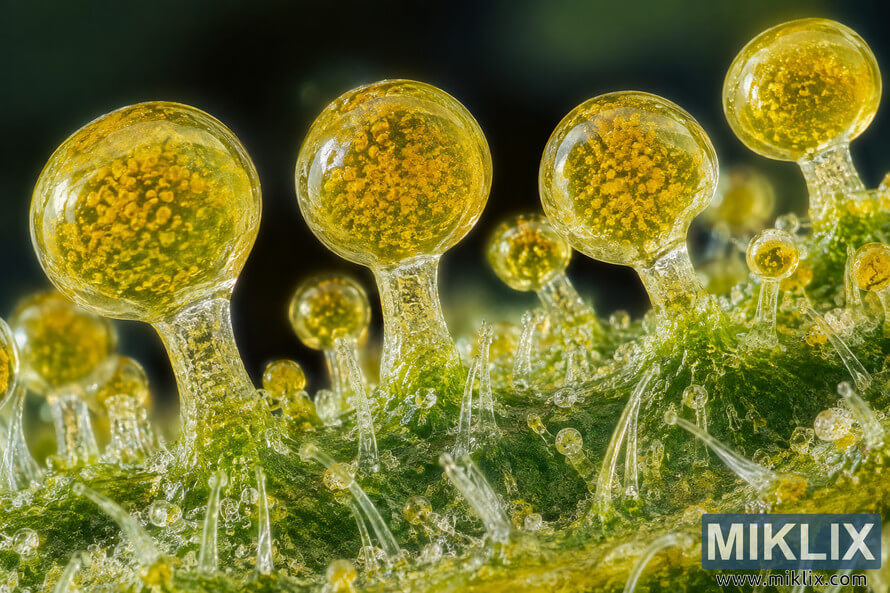
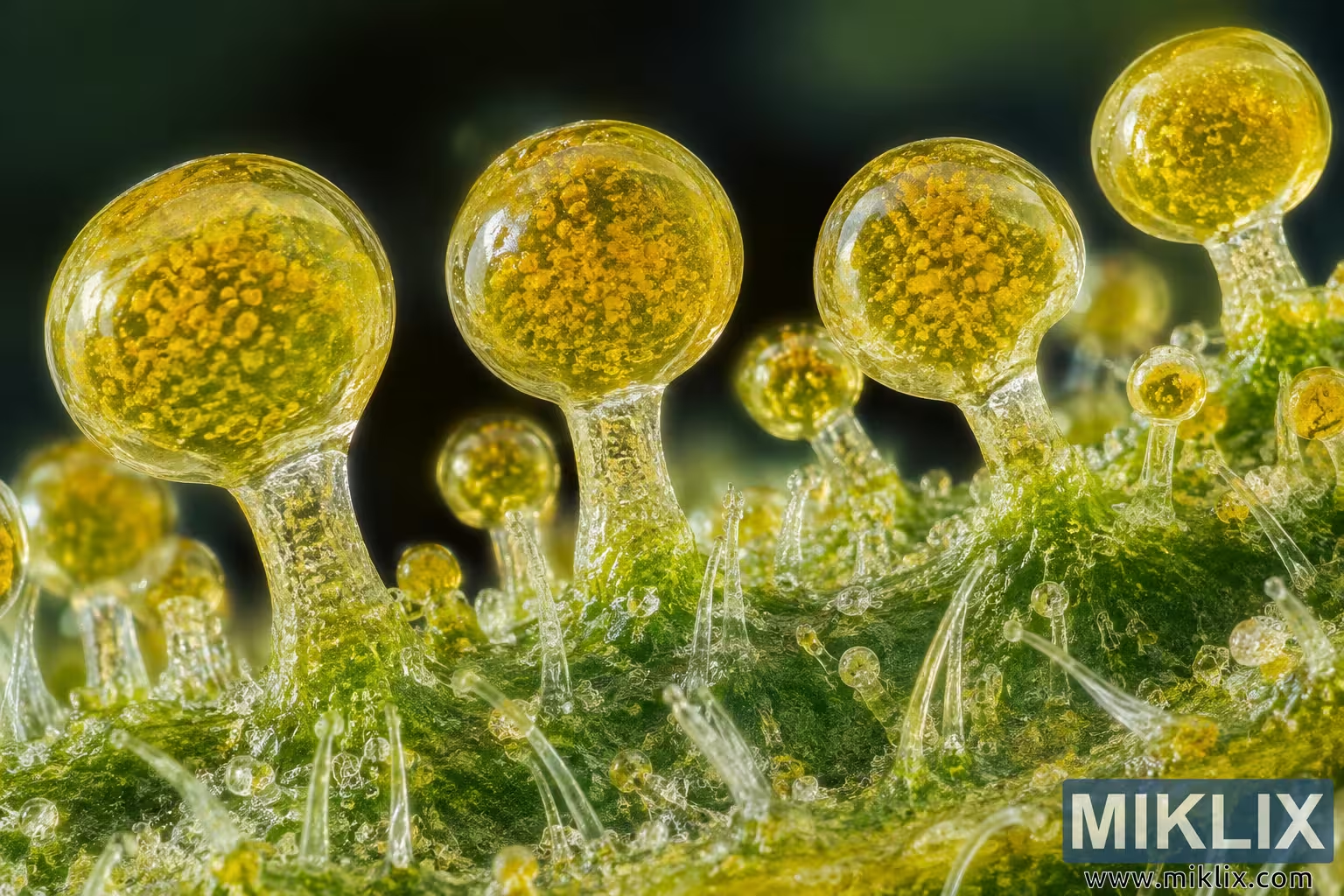
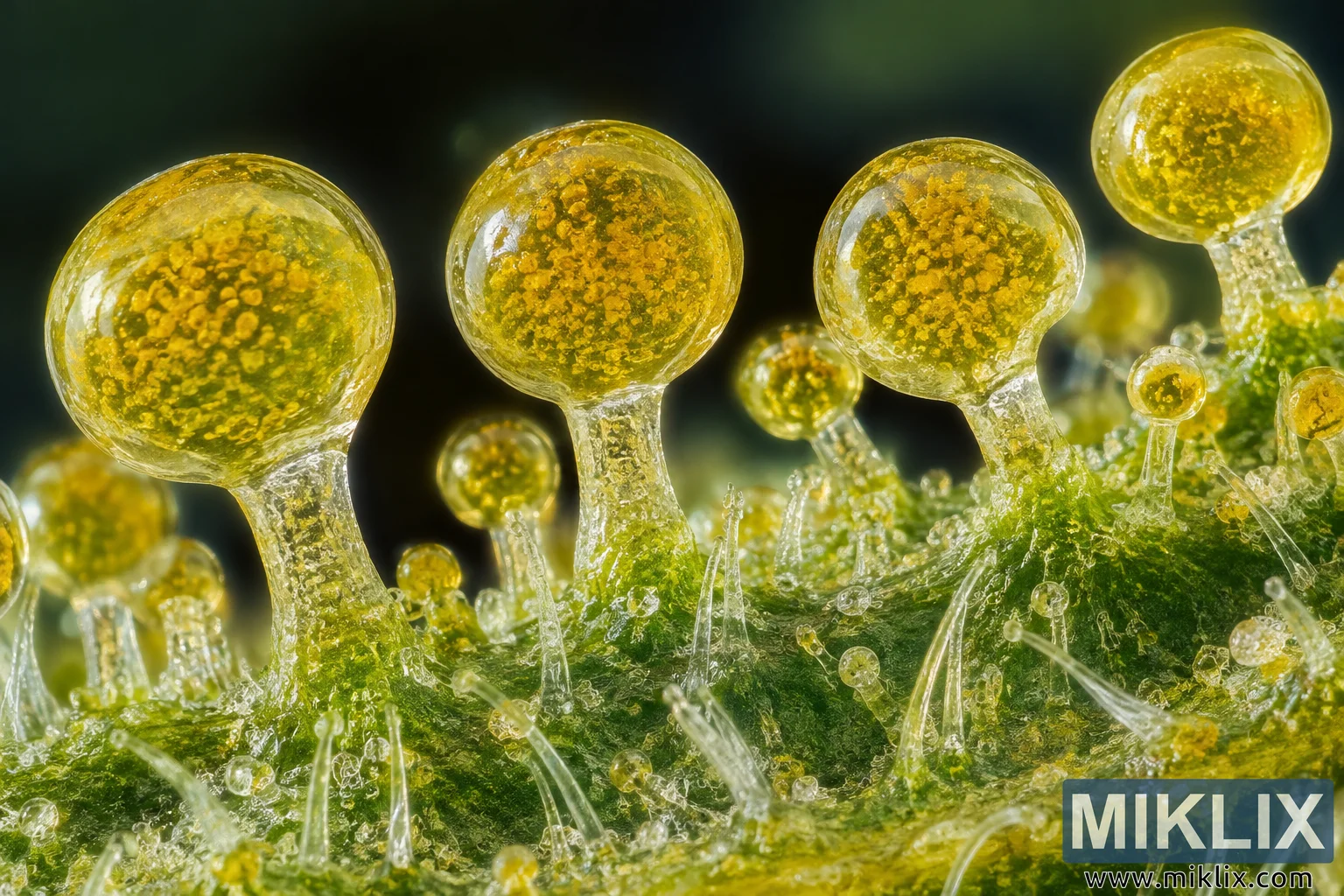
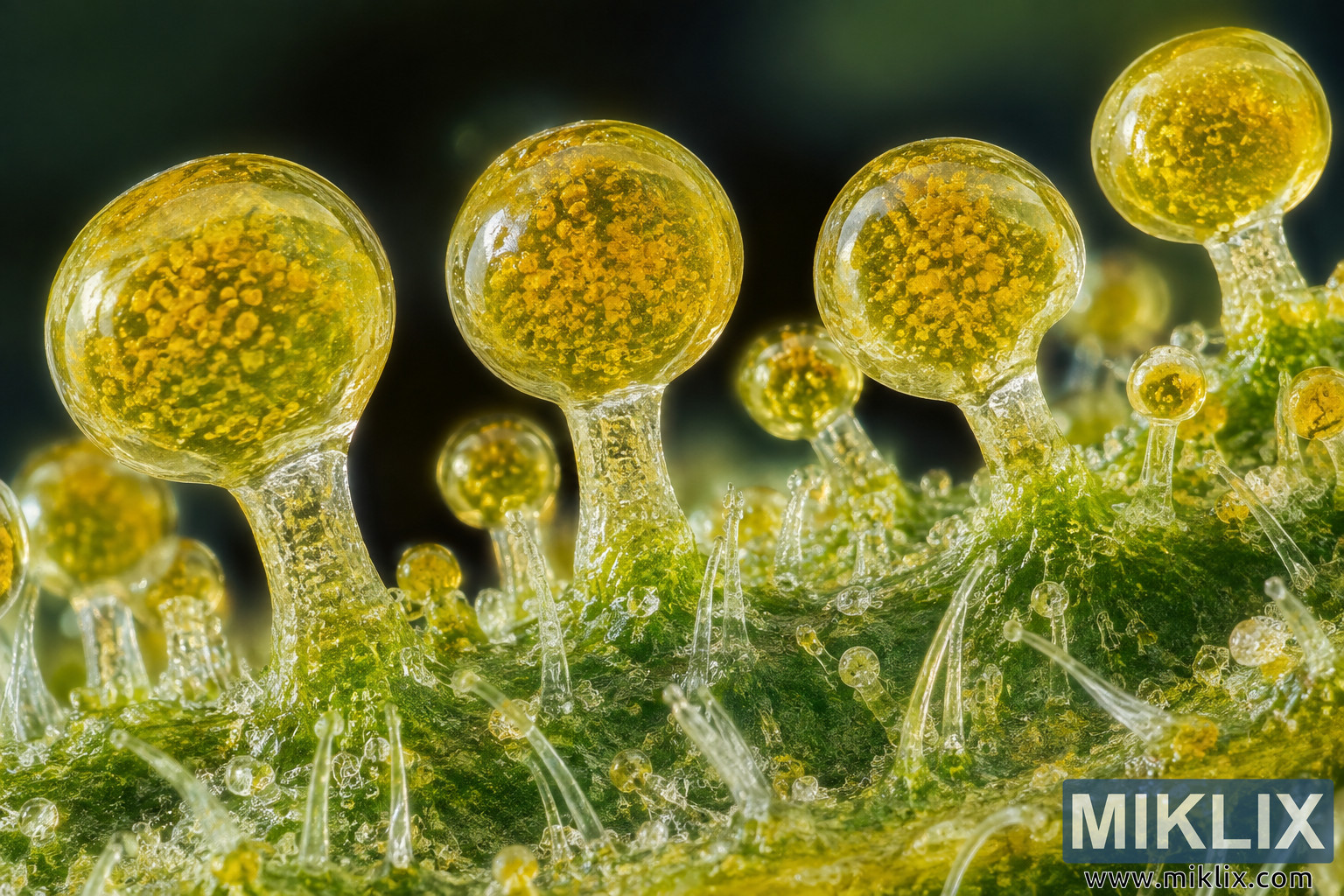
High-resolution macro view of hop lupulin glands, showing translucent stalks, golden resin-filled heads, fine plant hairs, granular textures, and a dark green background.
Available versions of this image
The image files available for download below are less compressed and higher resolution - and as a result of that, higher quality - than the images embedded in articles and pages on this website, which are more optimized for file size in order to reduce bandwidth consumption.
Regular size (1,536 x 1,024)
Large size (3,072 x 2,048)
Very large size (4,608 x 3,072)
Extra large size (6,144 x 4,096)
Comically large size (1,048,576 x 699,051)
- Still uploading... ;-)
Image description
A highly magnified, landscape-oriented macro image presents a microscopic-style view of hop lupulin glands rising from the textured surface of plant tissue. The composition is dominated by several large, translucent glandular structures with rounded, bulb-like heads supported by narrower, glassy stalks. These prominent glands occupy the foreground and middle of the frame, creating the impression of a miniature botanical landscape. Their spherical to slightly oval heads are filled with dense golden-yellow and amber material, suggesting the resinous contents associated with lupulin glands. Countless tiny particles, irregular granules, cloudy inclusions, and variations in density are visible within the heads, giving them a complex internal appearance rather than the smooth uniformity of simple droplets. The outer surfaces are glossy and partially transparent, with bright specular highlights tracing the curved contours and emphasizing their swollen, resin-filled character.
The largest gland appears toward the left side of the image, where a broad golden head rises on a thick translucent stalk. Its rounded surface catches strong highlights around the upper and side edges, while the interior contains a concentrated field of yellow-gold particles. Near the center is another prominent gland with a similarly bulbous head and a relatively straight, substantial stalk. Its internal resin appears rich and granular, with small golden fragments distributed throughout a translucent yellow-green matrix. A third major gland stands to the right of center, leaning slightly and displaying a broad head with bright reflective edges. In the upper-right corner, another large gland extends partly toward the boundary of the frame, adding depth and reinforcing the sense that many more glands continue beyond the visible area.
Between these dominant structures are numerous smaller glands at different stages of prominence. Some appear as tiny transparent spheres perched on extremely slender stems, while others are partially hidden behind the larger foreground forms. Several intermediate-sized glands recede into the background, becoming progressively softer and less defined as the depth of field falls away. This variation in scale and sharpness produces a convincing sense of depth. The sharply resolved foreground glands reveal minute surface irregularities and internal particles, whereas the more distant glands dissolve into soft yellow-green circles and organic shapes. The optical effect resembles extreme macro photography captured with a very shallow to moderate depth of field.
The lower portion of the image is occupied by a vivid green plant surface that serves as the base from which the glands emerge. This tissue is highly textured, uneven, and moist-looking, with ridges, folds, translucent patches, and small reflective areas. It is densely populated by fine hair-like structures and miniature glandular projections. Many of these hairs are clear or pale, tapering to sharp points and catching the light along their edges. Others terminate in tiny rounded heads, echoing the form of the much larger lupulin glands. The abundance of these minute structures makes the surface appear almost crystalline in places. Fine details suggest sticky resin, natural plant secretions, or moisture coating parts of the tissue and creating a glossy sheen.
The image uses a warm botanical palette dominated by luminous yellow, amber, chartreuse, olive green, and deep forest green. The golden contents of the glands contrast strongly with the darker green background, making the bulbous heads appear illuminated from within. Bright white highlights along the transparent surfaces enhance the impression of wetness, viscosity, and translucency. The green plant tissue below contains both saturated yellow-green regions and deeper shadowed areas, producing substantial tonal variation without distracting from the glands themselves.
Behind the subject, the background transitions into very dark green and near-black tones. It is heavily blurred, with broad, indistinct patches of green that suggest additional vegetation outside the narrow plane of focus. This dark backdrop isolates the luminous glands and gives the image a dramatic, almost laboratory-like presentation. There are no visible containers, instruments, labels, logos, text elements, or recognizable commercial brands. The entire visual field is devoted to the microscopic botanical subject.
Lighting is strong and directional enough to reveal the transparent and reflective qualities of the glands without flattening their three-dimensional forms. The brightest highlights appear as narrow white arcs and patches across the curved gland heads and along their stalks. The internal golden material remains clearly visible beneath these reflections, creating layered optical depth. Some stalks appear nearly colorless, while others pick up green and yellow hues from the surrounding plant tissue. Their transparent appearance makes them resemble delicate glass columns supporting globes of amber resin.
The horizontal composition distributes the major gland heads across the frame from left to right, while the irregular plant surface forms a continuous base along the bottom. The combination of oversized foreground glands, smaller intermediate structures, and blurred background forms creates a strong progression through space. Cropping at the edges implies that the photographed area is only a tiny portion of a much larger surface densely covered with similar structures. The extremely close viewpoint transforms the hop plant's minute glandular anatomy into an expansive scene, emphasizing patterns and textures that would normally be invisible to the unaided eye.
Overall, the image conveys an intensely detailed microscopic or extreme-macro interpretation of hop lupulin glands. The most visually important features are the translucent stalked glands, their rounded golden resin-filled heads, the granular material visible inside them, the glossy highlights on their surfaces, and the densely textured green plant tissue beneath. The contrast between the brilliant amber-yellow glands and the dark, softly blurred green background produces a dramatic scientific-botanical aesthetic. At the same time, the organic irregularity of the glands, hairs, resinous surfaces, and plant ridges preserves a natural appearance. The result is a richly detailed close-up that focuses attention on the tiny glandular structures responsible for storing the aromatic resinous compounds associated with hops.
The image is related to: Hops in Beer Brewing: Kohatu