
Image: Measuring Green Hops on a Digital Scale
Published: October 8, 2026 at 10:08:48 PM UTC
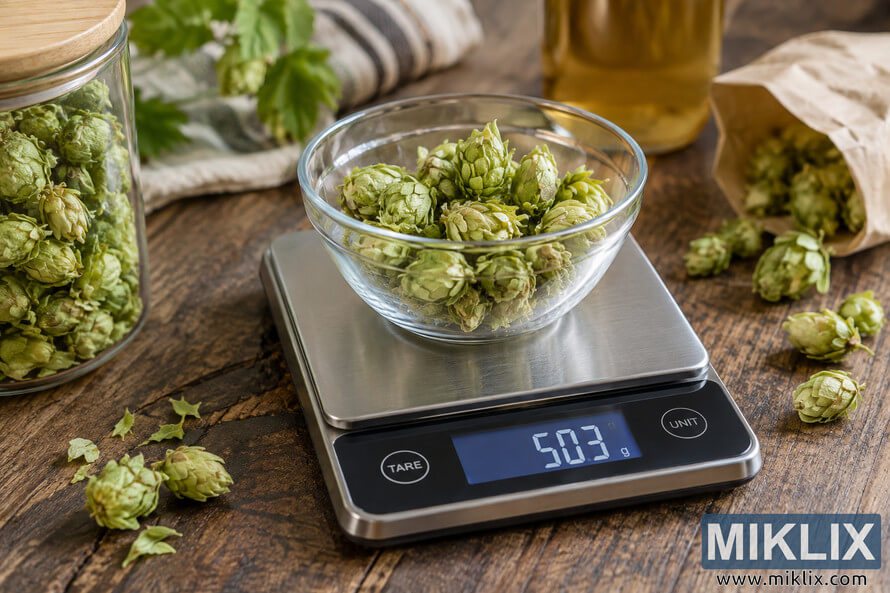
Close-up of green hop cones being measured in a glass bowl on a digital scale, surrounded by loose hops and rustic brewing ingredients on a wooden table.
Available versions of this image
The image files available for download below are less compressed and higher resolution - and as a result of that, higher quality - than the images embedded in articles and pages on this website, which are more optimized for file size in order to reduce bandwidth consumption.
Regular size (1,536 x 1,024)
Large size (3,072 x 2,048)
Very large size (4,608 x 3,072)
Extra large size (6,144 x 4,096)
Comically large size (1,048,576 x 699,051)
- Still uploading... ;-)
Image description
The image presents a detailed, photorealistic close-up of hops being measured on a digital kitchen scale in a warm, rustic setting. The composition is arranged horizontally in landscape orientation, with the digital scale occupying the central and lower portion of the frame. The scale has a clean, rectangular design with softly rounded corners, a brushed stainless-steel weighing platform, and a dark control panel along the front. Its illuminated digital display is clearly visible and shows a measurement of 50.3 g. Circular controls marked for tare and unit functions appear on either side of the display, giving the scale a practical and recognizable appearance without displaying any commercial branding or manufacturer logos. Resting directly on the stainless-steel platform is a transparent glass bowl filled with whole green hop cones. The bowl is positioned approximately in the center of the photograph and serves as the primary focal point together with the scale. Its clear glass walls catch highlights from the surrounding light, producing subtle reflections and refractions while still allowing the hops inside to remain clearly visible. The hop cones have a natural pale-to-medium green color with occasional yellow-green and slightly muted olive tones. Their overlapping, layered bracts create a distinctive textured surface. Individual cones vary in size, shape, orientation, and degree of openness, helping the contents of the bowl look organic rather than uniformly arranged. Several hop cones near the top rise above the others, creating depth and making their characteristic tapered forms especially easy to recognize. The rustic wooden tabletop underneath the scale provides a contrasting background. It is composed of dark brown, weathered boards with visible grain, cracks, knots, scratches, and variations in tone. These irregularities add a handcrafted, agricultural atmosphere that complements the natural brewing ingredient. A number of loose hop cones and small fragments of green plant material are scattered across the tabletop around the scale. In the lower-left foreground, several individual hops rest directly on the wood, accompanied by detached pieces of leafy material. More loose hops appear along the right side of the photograph, extending from the middle ground toward the foreground. Their placement gives the scene the appearance of an active ingredient-measuring process rather than a sterile product display. On the far left side of the image stands a large transparent glass storage jar filled almost completely with additional dried hop cones. The jar is partially cropped by the edge of the frame, which makes the scene feel larger than the visible composition. It is topped with a light-colored wooden lid. Through the clear glass, numerous compressed and overlapping hop cones can be seen, reinforcing the subject of brewing ingredients and suggesting that the portion on the scale has been taken from a larger supply. Behind this jar and slightly farther into the background are fresh-looking green leaves and stems. These botanical elements are somewhat softer in focus than the central bowl and contribute additional green tones to the scene. A folded striped kitchen or work cloth lies behind the central arrangement toward the upper-left and upper-middle area. Its muted neutral stripes and soft fabric texture contrast with the hard surfaces of the glass, steel, and wood. In the upper-right portion of the frame, an open brown paper pouch lies on its side. More hop cones are visible inside the opening, while several appear to have spilled onto the table immediately in front of it. The crumpled paper surface introduces another tactile material and suggests practical storage or handling of dried brewing ingredients. Behind the bowl and toward the upper center-right is a partially visible amber or golden-colored glass vessel containing a warm-toned liquid. It is deliberately placed in the background and is not the main subject. Its rich golden hue provides visual association with brewing while adding warmth to the otherwise green and brown palette. The vessel has no visible label or recognizable branding. Lighting throughout the image is soft and natural-looking, apparently entering from the upper-left or left-front direction. This creates gentle highlights on the brushed steel platform, transparent bowl, glass storage jar, and hop cones while producing soft shadows underneath the objects. The reflective metal surface of the scale subtly mirrors the bowl and surrounding tones without becoming overly glossy. The glass bowl has crisp highlights around its rim and curved sides, emphasizing its transparency. The overall color palette combines fresh botanical greens, earthy browns, neutral gray metal, transparent glass, and warm amber accents. Depth of field is moderately shallow: the digital scale, its illuminated reading, the bowl, and most of the central hops are rendered with strong clarity, while objects farther toward the back of the table become progressively softer. Despite this selective focus, the supporting objects remain identifiable and contribute meaningful context. The camera viewpoint is slightly elevated and angled downward toward the scale, allowing both the contents of the bowl and the digital measurement to be visible simultaneously. This perspective makes the act of measuring hops immediately understandable. The composition communicates careful weighing and preparation of hops, most likely as part of a home-brewing or small-scale craft-brewing process. No people or hands appear in the frame, so attention remains entirely on the ingredient, equipment, and surrounding preparation materials. There are no actual commercial brands, logos, product labels, advertisements, or other brand-identifying elements visible. Overall, the photograph has a warm, tactile, artisanal character while maintaining a clear documentary emphasis on the central action: a measured quantity of whole green hops sitting in a glass bowl on a digital scale.
The image is related to: Hops in Beer Brewing: Kohatu