
Image: Fresh Versus Degraded Hop Cones: Visual Quality Comparison
Published: October 8, 2026 at 10:08:48 PM UTC
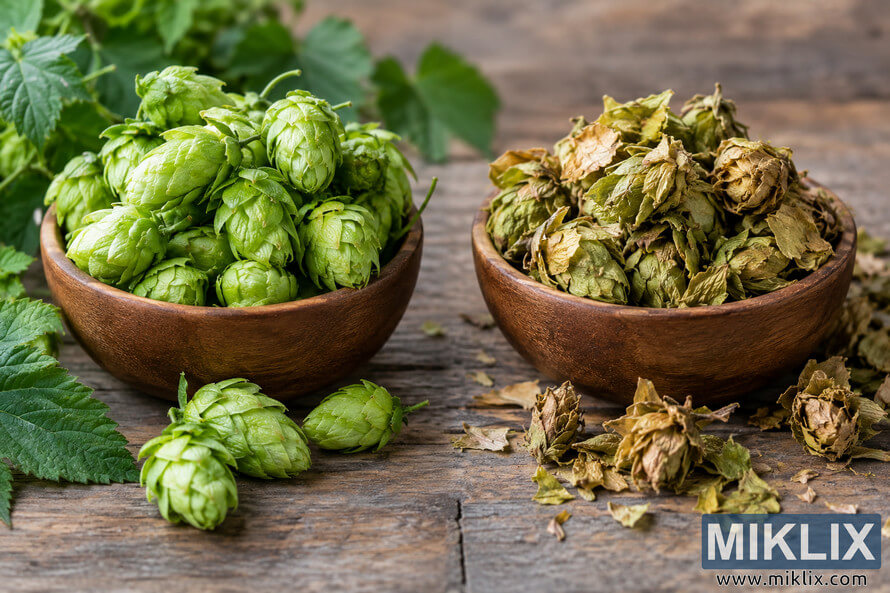
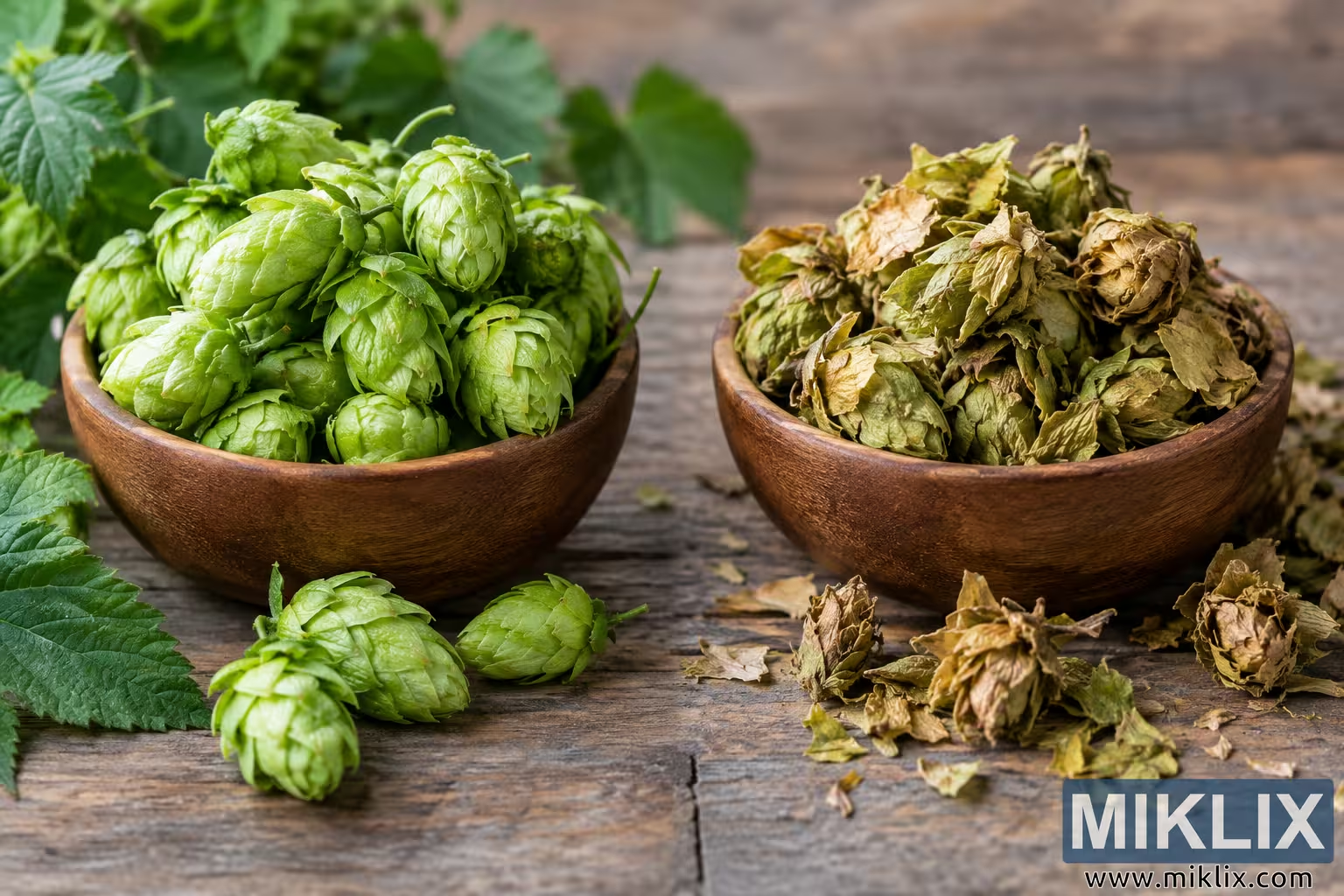
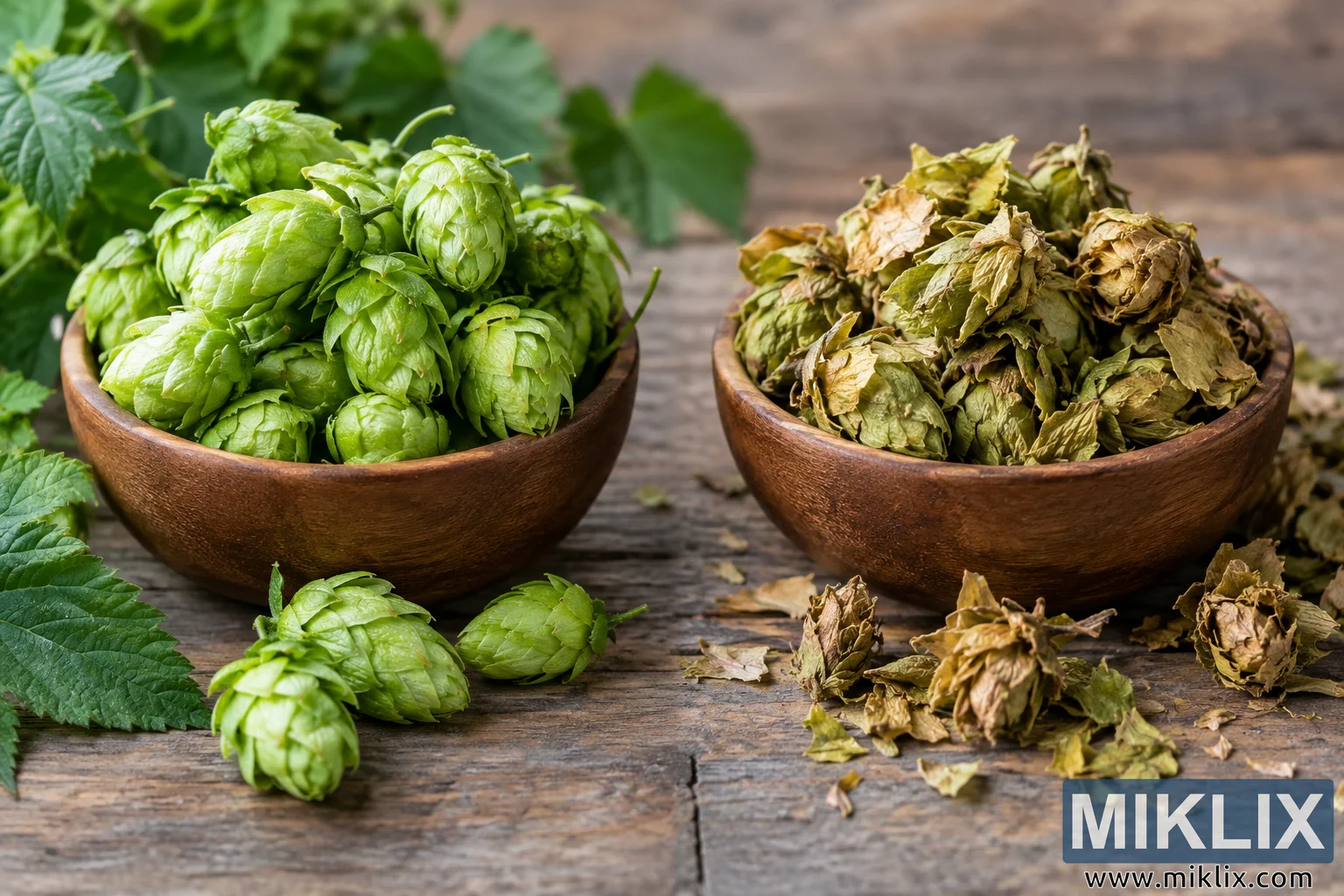
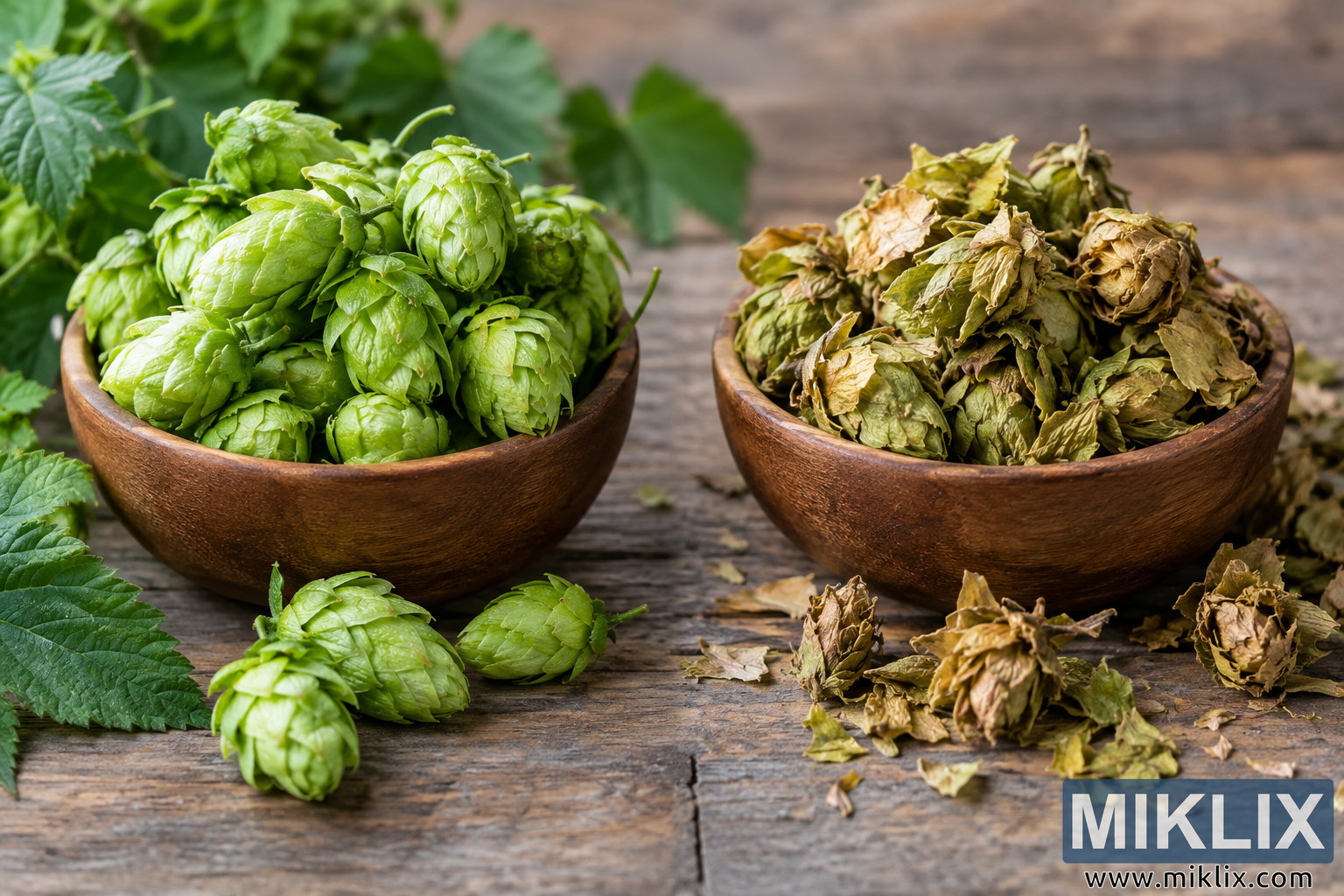
Compare fresh green hop cones with degraded, dry, brownish hops in a detailed side-by-side photograph illustrating changes in color, texture, moisture, and quality.
Available versions of this image
The image files available for download below are less compressed and higher resolution - and as a result of that, higher quality - than the images embedded in articles and pages on this website, which are more optimized for file size in order to reduce bandwidth consumption.
Regular size (1,536 x 1,024)
Large size (3,072 x 2,048)
Very large size (4,608 x 3,072)
Extra large size (6,144 x 4,096)
Comically large size (1,048,576 x 699,051)
- Still uploading... ;-)
Image description
The image presents a clear side-by-side comparison between fresh and degraded hop cones, arranged as a rustic still life on a weathered wooden table. The composition is divided naturally into two visual groups. On the left, a rounded wooden bowl is filled generously with fresh hop cones. These hops are vivid, saturated green and appear plump, healthy, and recently harvested. Their overlapping bracts are tightly layered, giving each cone a compact, structured appearance. The surfaces of the fresh hops look smooth and slightly glossy, with subtle highlights that suggest natural moisture and freshness. Tiny droplets or points of reflected light can be seen on some of the green surfaces, strengthening the impression that these hops have retained their moisture and vitality. Several individual fresh hop cones have been placed in front of the bowl on the tabletop, allowing their form and condition to be seen more closely. They maintain the same bright green color and intact structure as the hops piled inside the bowl.
Fresh green hop leaves surround the left-hand portion of the scene. Large leaves extend into the foreground from the lower-left edge, while additional foliage rises behind the bowl and creates a lush botanical backdrop. The leaves are richly colored, with visible veins, serrated edges, and natural variations in green. Together with the fresh cones, they establish an impression of a recently harvested plant and reinforce the visual association with freshness, quality, and healthy plant material. The greenery behind the bowl is softly out of focus in places, creating depth without distracting from the hops themselves.
On the right side of the image, a second wooden bowl contains visibly degraded hop cones. Although the two bowls are similar in shape, size, and warm brown wood tone, the condition of their contents is dramatically different. The degraded hops have lost the bright green appearance of the fresh cones and instead display dull olive, yellow-green, tan, ochre, and brown tones. Many of the cones look dry, brittle, and papery. Their bracts are curled, loosened, irregular, and in some cases partially separated from the cone. Rather than appearing compact and hydrated, these hops have a rough, faded, fragile appearance. Brown discoloration is particularly visible along edges and exposed surfaces, visually communicating aging, oxidation, drying, or general deterioration.
A number of degraded hop cones and loose fragments are scattered across the tabletop in front of and beside the right-hand bowl. Some cones remain recognizable but look shriveled and discolored, while others are surrounded by detached bracts and small pieces of dry plant material. The scattered debris adds to the impression that the degraded hops have become brittle enough to break apart easily. This contrasts strongly with the intact fresh cones on the left, where loose material is minimal and the individual hops retain their coherent shape. The degraded side therefore communicates not only a change in color but also a significant change in physical texture and structural integrity.
The two groups are photographed from approximately the same angle and under consistent lighting, making the comparison easy to understand at a glance. Soft natural-looking illumination enters the scene and produces gentle highlights on the fresh green hops while revealing the wrinkles, folds, dry edges, and rough surfaces of the degraded material. The wooden bowls provide a neutral and visually consistent container for both samples. Their warm brown color also complements the rustic setting without introducing any branding, labels, packaging, text, logos, or other commercial elements. The bowls sit on broad, aged wooden planks with clearly visible grain, seams, scratches, knots, and variations in tone. This textured surface contributes to an agricultural, handcrafted, harvest-oriented atmosphere.
The background is deliberately understated. Softly blurred green leaves appear mainly behind the fresh hops, while the upper portion of the scene transitions into muted brown wooden tones. The shallow depth of field keeps attention concentrated on the two bowls and the hop cones closest to the camera. The landscape-oriented framing gives both conditions approximately equal visual importance and leaves enough horizontal space for the viewer to compare them directly. The fresh hops occupy the left half of the frame, while the degraded hops occupy the right, producing an intuitive before-and-after or good-versus-deteriorated visual structure without requiring explanatory text.
The strongest contrast is the difference in color, moisture, and texture. The fresh hops are luminous green, full-bodied, compact, and visually supple. Their bracts lie closely against one another and form recognizable, well-defined cones. The degraded hops are faded and brownish, with irregular, curled, dry-looking bracts and visibly weakened structures. Loose fragments around the degraded sample further emphasize its brittle state. This makes the image suitable for illustrating topics such as hop quality, ingredient inspection, storage deterioration, oxidation, aging, freshness assessment, brewing ingredients, agricultural quality control, or the visual identification of damaged plant material.
No people, machinery, packaging, writing, labels, trademarks, logos, or recognizable commercial brands appear anywhere in the image. The entire scene is focused on the physical appearance of the plant material. Its visual language is photographic and realistic rather than diagrammatic: the distinction between fresh and degraded hops is communicated through the carefully controlled comparison of two natural samples rather than through arrows, captions, icons, or graphic overlays. The result is a straightforward educational comparison in which the viewer can immediately observe how healthy hop cones differ from degraded ones in color, shape, surface quality, dryness, and overall structural condition.
The image is related to: Hops in Beer Brewing: Kohatu