
Image: Pre-Portioned Hop Additions Ready for Brew Day
Published: October 8, 2026 at 10:08:48 PM UTC
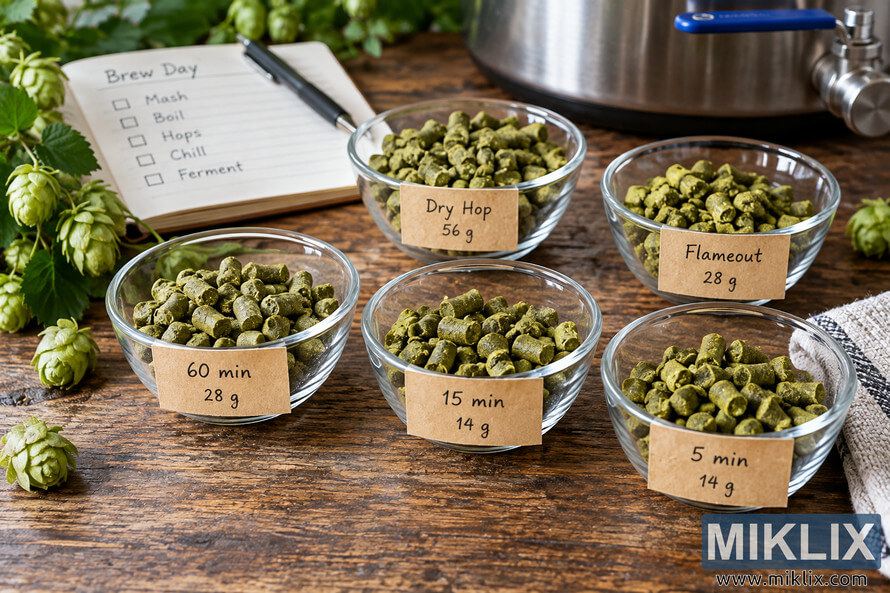
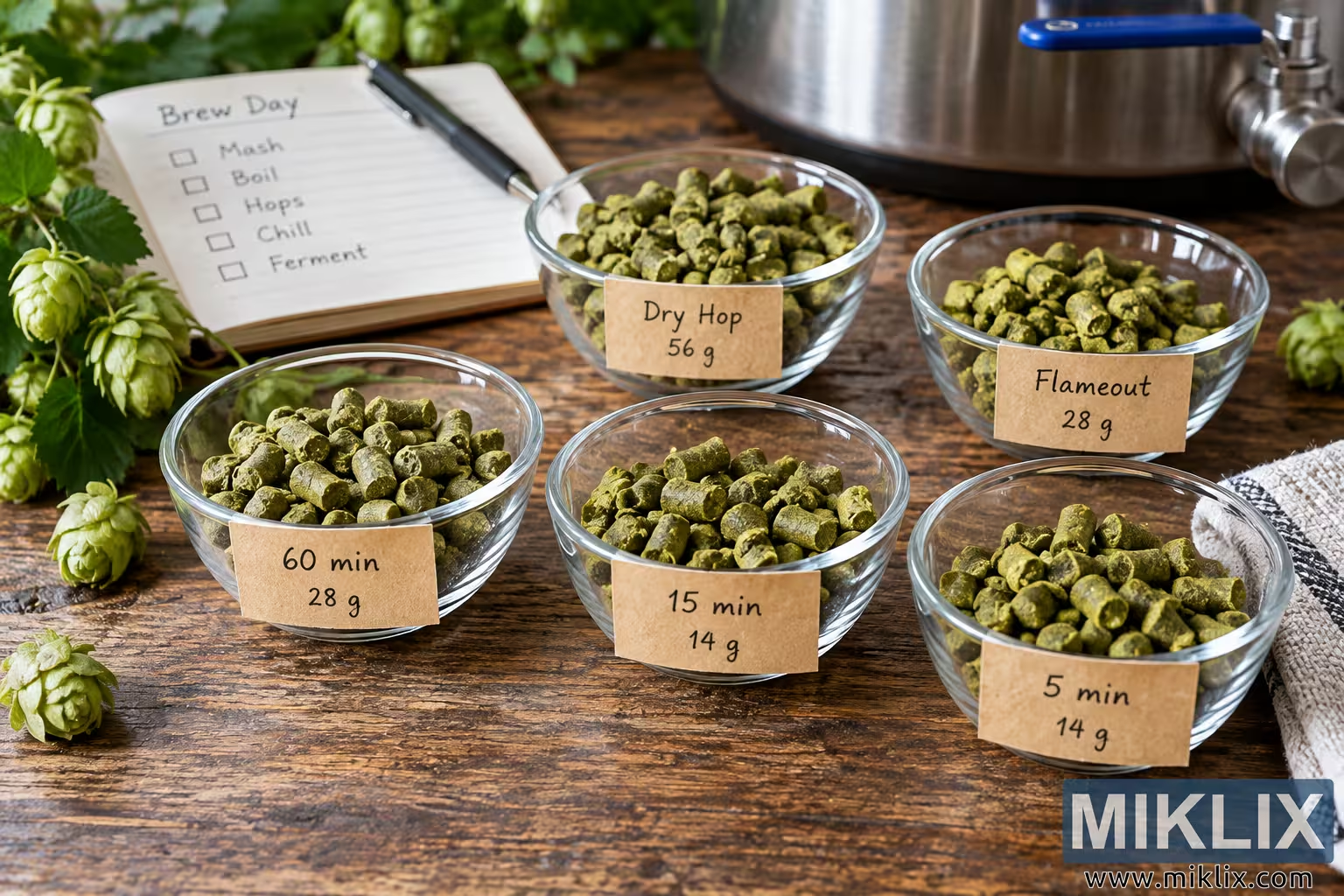
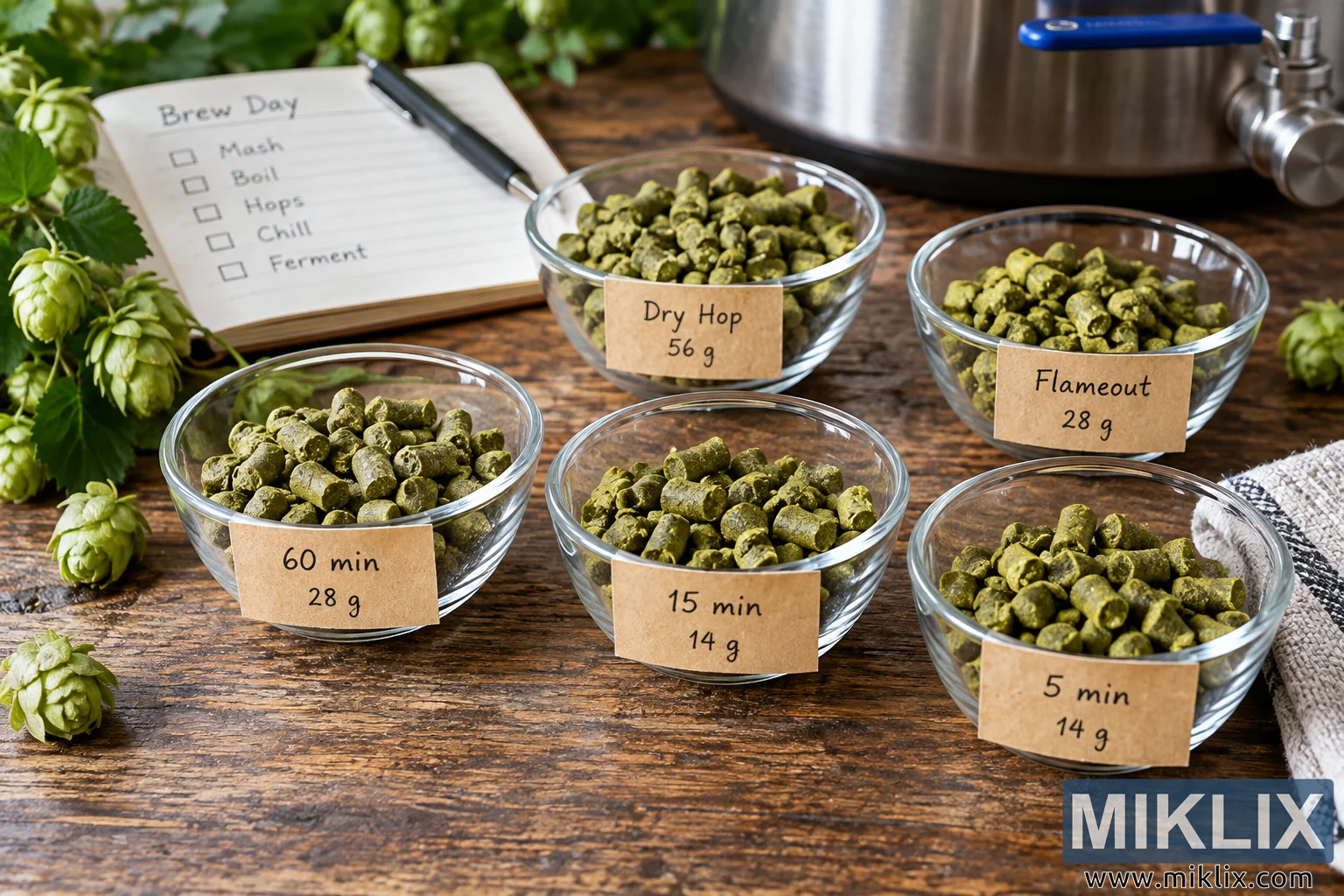
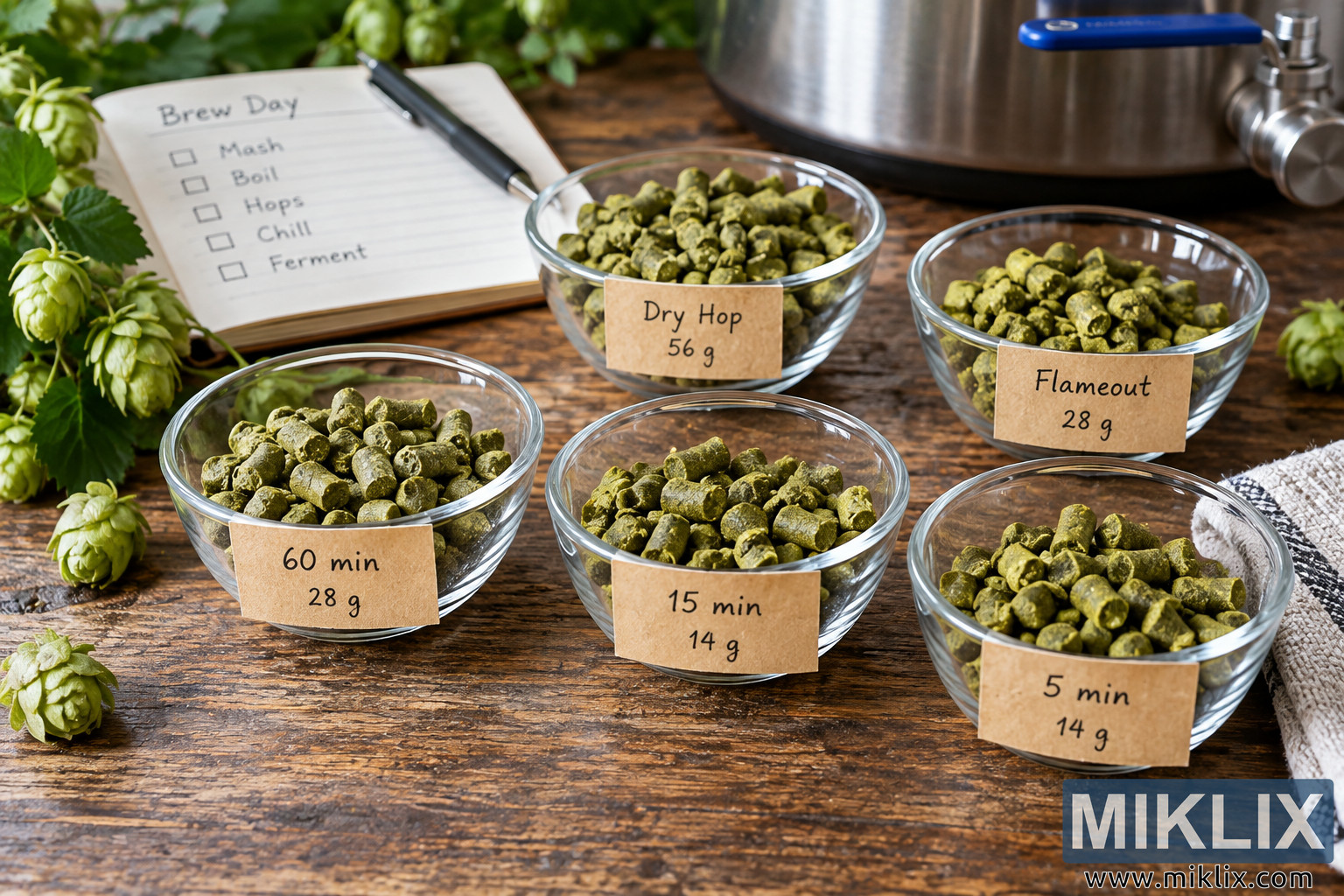
Pre-portioned hop additions arranged for brew day, with labeled bowls of hop pellets for timed additions, fresh hops, a brewing checklist, and a stainless-steel kettle.
Available versions of this image
The image files available for download below are less compressed and higher resolution - and as a result of that, higher quality - than the images embedded in articles and pages on this website, which are more optimized for file size in order to reduce bandwidth consumption.
Regular size (1,536 x 1,024)
Large size (3,072 x 2,048)
Very large size (4,608 x 3,072)
Extra large size (6,144 x 4,096)
Comically large size (1,048,576 x 699,051)
- Still uploading... ;-)
Image description
A landscape-oriented, photorealistic still-life image depicts a carefully organized homebrewing workspace prepared for brew day, with five individual hop additions pre-portioned into small, transparent glass bowls. The scene is arranged on a richly textured rustic wooden tabletop whose dark brown grain, scratches, knots, and natural variations give the setting a warm, practical, handcrafted character. Each bowl contains a measured quantity of compact green hop pellets, and every portion is clearly identified by a simple brown paper label with dark handwritten-style lettering. Together, the bowls communicate an orderly brewing process in which hop additions have been weighed and separated in advance so they can be added to the kettle at the appropriate stages.
In the foreground and middle of the composition, the five glass bowls form the main visual focus. At the lower left is a bowl labeled "60 min" and "28 g," indicating a 28-gram hop addition intended for sixty minutes. Near the center is another bowl labeled "15 min" and "14 g," containing a smaller 14-gram portion. At the lower right is a bowl marked "5 min" and "14 g." Behind these three bowls are two additional portions: a bowl toward the upper center labeled "Dry Hop" and "56 g," and a bowl toward the upper right labeled "Flameout" and "28 g." The labels are large enough to be immediately understandable and make the purpose of the arrangement visually explicit. The different quantities are also reflected in the apparent amount of hop material contained in each bowl, with the dry-hop portion looking particularly generous.
The hop pellets themselves are rendered with substantial tactile detail. They are predominantly muted olive green, with variations ranging from yellow-green highlights to darker forest and moss tones. Their compact cylindrical forms have rough, slightly crumbly surfaces, suggesting compressed plant material rather than smooth manufactured objects. Individual pellets sit at varied angles and heights within the bowls, creating an organic, irregular texture. The clear glass vessels catch and reflect the surrounding light, producing bright highlights around their rims and subtle distortions through their curved sides. This transparency allows the viewer to see both the volume and texture of the hops while keeping the overall presentation clean and organized.
Fresh hop cones and leafy hop vines appear around the edges of the scene, reinforcing the relationship between the processed pellets and their botanical origin. On the left side, several pale green hop cones hang among textured green leaves and stems. Additional hop cones are visible near the lower-left corner and along the right side of the composition. Their layered, papery bracts contrast with the dense compressed appearance of the pellets in the bowls. More green hop foliage is softly visible in the background, adding depth and a natural brewing-themed atmosphere without competing with the labeled portions in the foreground.
In the upper-left background, an open notebook rests diagonally on the table. The visible page is headed "Brew Day" and contains a handwritten checklist with the brewing stages "Mash," "Boil," "Hops," "Chill," and "Ferment," each accompanied by an empty checkbox. A dark pen lies diagonally across the notebook near its upper edge. This detail expands the scene beyond a simple ingredient display and suggests an active, methodical preparation process. The checklist conveys the sequence and planning associated with brewing while the pre-measured bowls illustrate one practical way of making that process more efficient and less error-prone once the brew is underway.
A large stainless-steel brewing kettle occupies much of the upper-right background. Only part of the vessel is visible because it extends beyond the top edge of the frame, giving it a sense of substantial size compared with the small ingredient bowls. Its brushed metal surface reflects soft ambient light. A metal valve assembly projects from the lower-right area of the kettle, topped by a simple blue lever handle. The equipment is generic and does not display any visible commercial branding or logos. Its presence immediately establishes the functional brewing context and makes the scene feel like a genuine brew-day preparation area rather than a purely decorative food arrangement.
Along the far right edge of the table, a folded or loosely draped kitchen towel with a light base and dark woven stripes introduces another domestic and practical element. The fabric's coarse texture contrasts with the hard glass bowls, metallic kettle, rough wooden tabletop, and granular hop pellets. The towel is partially cropped by the frame, which helps the image feel naturally composed, as though the viewer is looking at a real work surface that continues beyond the photograph.
The lighting is bright, warm, and naturalistic, appearing to come primarily from the left and slightly from the front. It produces attractive highlights on the glass rims and stainless steel while bringing out the green hues and rough surfaces of the hops. Shadows fall softly beneath and behind the bowls, providing dimensionality without becoming harsh. The foreground is exceptionally crisp, especially around the labels, glass edges, and hop pellets, while the background foliage and some portions of the kettle become progressively softer. This controlled depth of field guides attention toward the pre-portioned ingredients while still keeping the surrounding brewing context recognizable.
The composition is balanced across the wide landscape frame. The three front bowls establish a stable visual base, while the two rear bowls create a second tier and lead the eye deeper into the image. The notebook on the upper left and kettle on the upper right provide larger contextual anchors on opposite sides. Fresh hop plants frame the scene with natural green forms, and the open areas of wooden tabletop prevent the arrangement from feeling overly crowded. The slightly elevated, front-facing camera position makes the contents of all five bowls visible while also allowing the handwritten labels to face the viewer directly.
Overall, the image communicates organization, preparation, craftsmanship, and anticipation before brewing begins. Its central idea is immediately readable: several hop additions have already been weighed, separated, and labeled according to when they will be used during the brewing process. The combination of measured hop pellets, timing labels, a brew-day checklist, fresh hop cones, a stainless brewing kettle, and practical work-surface details creates a convincing visual narrative about getting ingredients ready before starting a batch. The warm wood and natural greenery give the photograph an inviting artisanal quality, while the orderly arrangement of the bowls emphasizes precision and good process management. No people are present, allowing the ingredients and equipment to tell the story on their own, and no actual commercial brands are visible anywhere in the scene.
The image is related to: Hops in Beer Brewing: Kohatu