
Image: Advanced Homebrewing Hop Experiment Setup with Randall and Hopback Equipment
Published: October 10, 2026 at 8:23:05 AM UTC
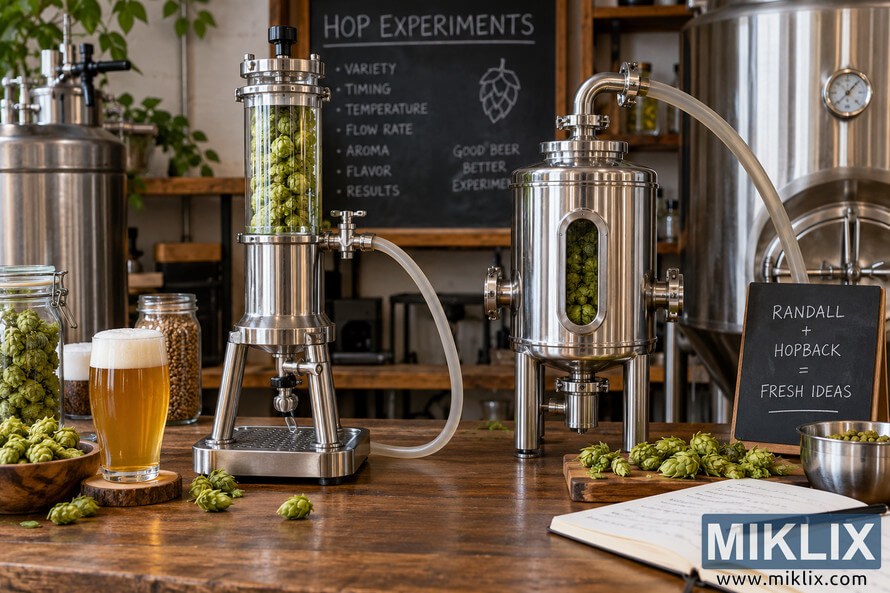
Advanced homebrewing setup for hop experiments featuring Randall-style infusion and hopback equipment, fresh hops, brewing notes, ingredients, and golden beer.
Available versions of this image
The image files available for download below are less compressed and higher resolution - and as a result of that, higher quality - than the images embedded in articles and pages on this website, which are more optimized for file size in order to reduce bandwidth consumption.
Regular size (1,536 x 1,024)
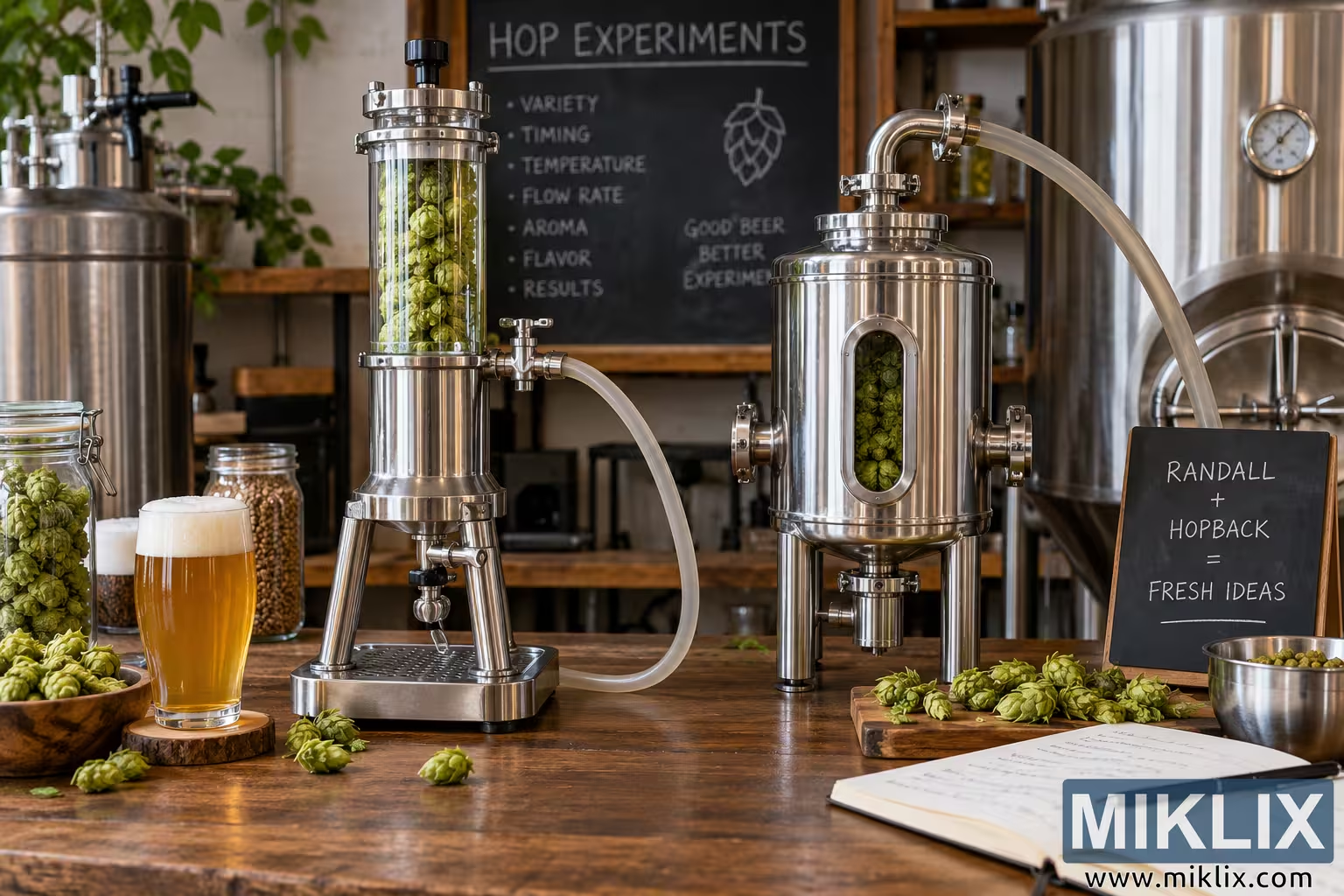
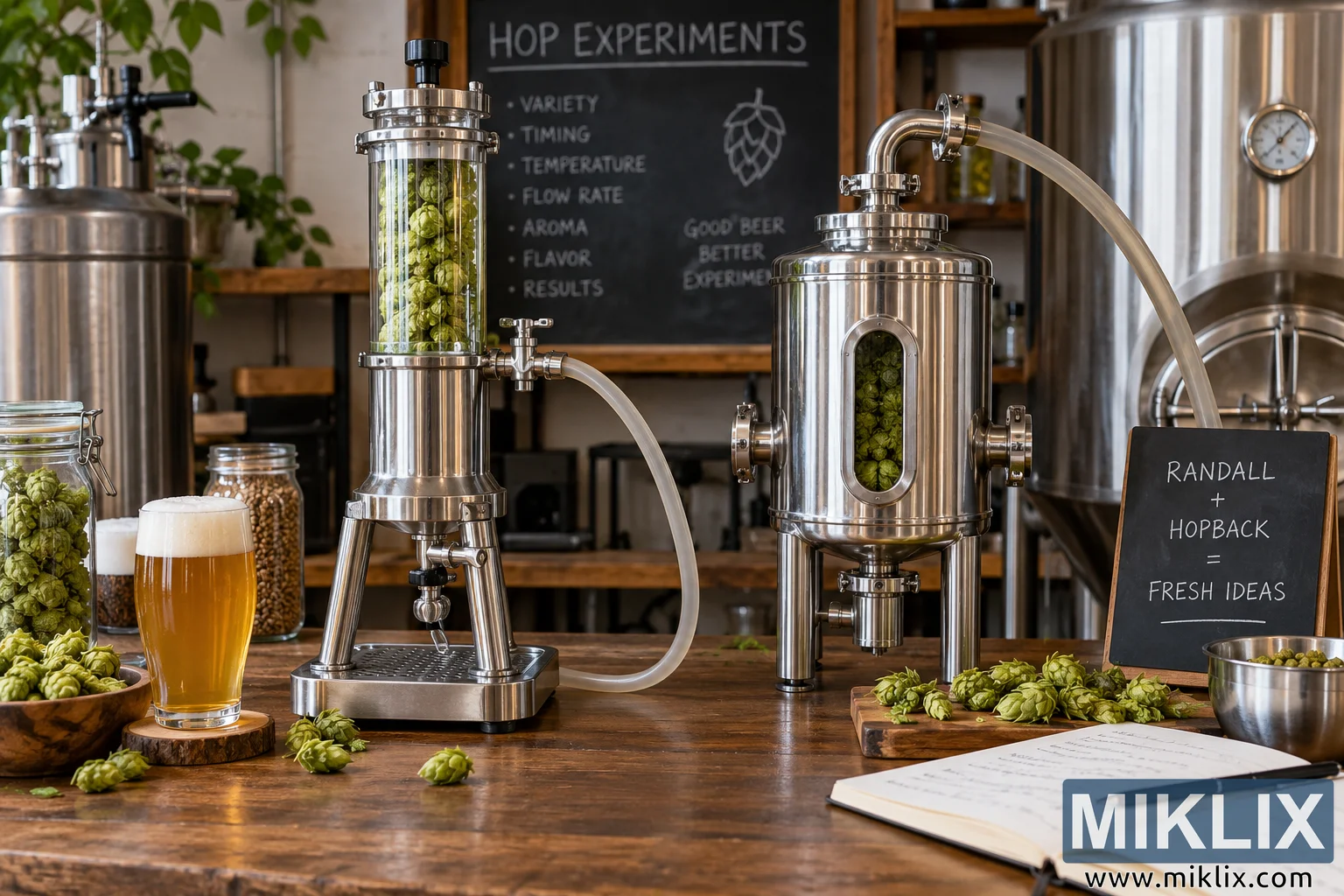
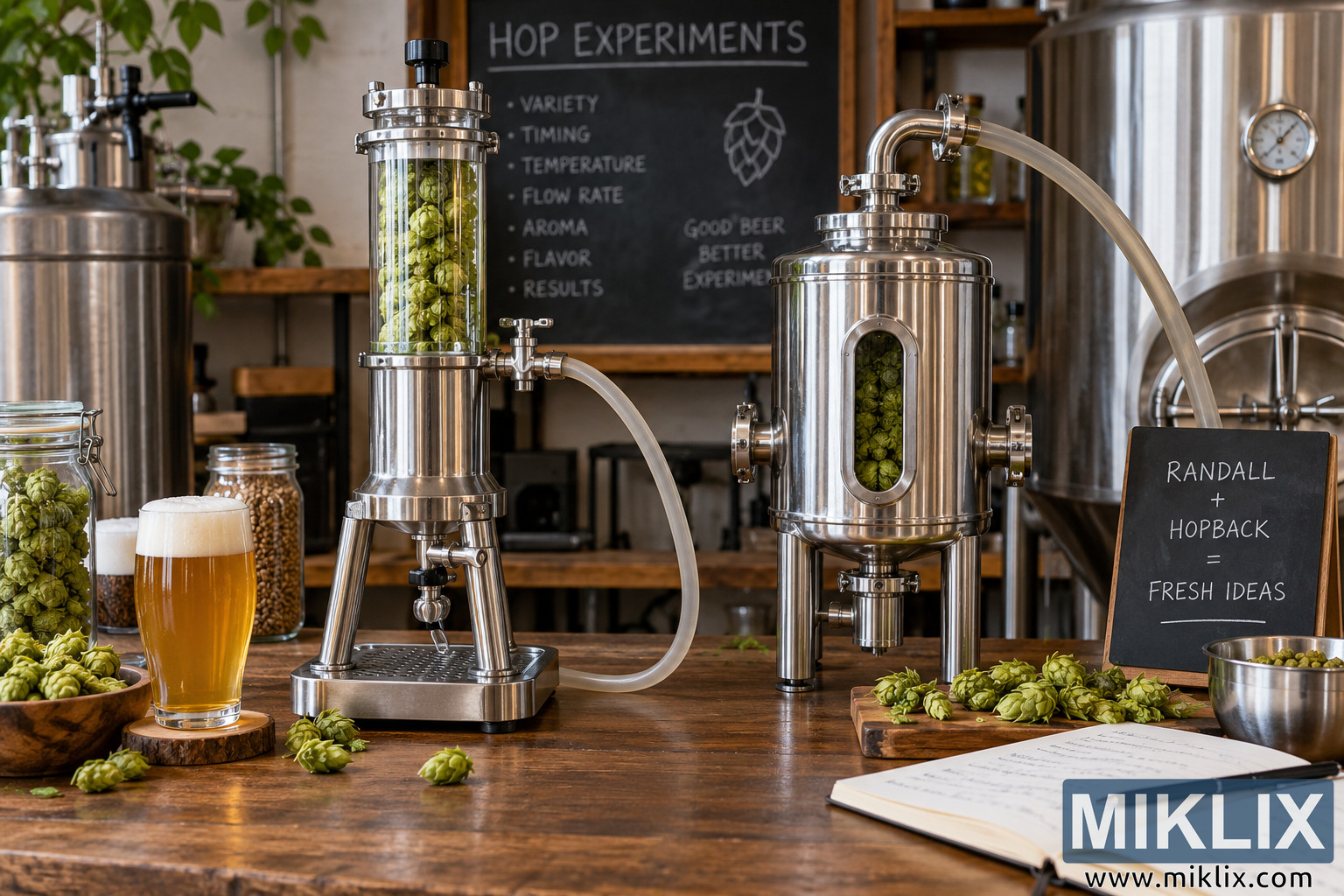
Large size (3,072 x 2,048)
Very large size (4,608 x 3,072)
Extra large size (6,144 x 4,096)
Comically large size (1,048,576 x 699,051)
- Still uploading... ;-)
Image description
A high-resolution, landscape-oriented photograph depicts an advanced homebrewing workspace designed specifically for experimental use of hops. The scene is arranged on a broad, richly grained wooden workbench in a warm, well-lit brewing room. Stainless-steel brewing equipment dominates the composition, while fresh hop cones, brewing ingredients, a glass of finished beer, laboratory-like accessories, and handwritten notes create the impression of an active and carefully organized experimental setup. The overall aesthetic combines professional brewing technology with the approachable character of a sophisticated home brewery.
At the center-left of the image stands a tall cylindrical hop-infusion device resembling a Randall-style inline hop filter. Its main chamber is transparent, allowing a dense column of whole green hop cones to remain clearly visible. Polished stainless-steel fittings cap the transparent chamber at the top and bottom, and the apparatus is elevated on sturdy metal legs above a compact drip platform. A valve and sanitary fittings are attached near the lower portion of the unit. A translucent flexible hose emerges from a side connection and curves smoothly across the workbench toward the larger vessel positioned to its right. The visibility of the hops inside the chamber emphasizes the experimental purpose of the equipment and visually communicates the concept of passing beer or wort through aromatic hop material.
Immediately to the right is a larger cylindrical stainless-steel hopback-style vessel. It has a highly polished reflective surface, several sanitary ports, sturdy supporting legs, and a narrow vertical viewing window in its front wall. More green hop cones can be seen through this window. At the top of the vessel, a curved stainless-steel pipe connects to a length of translucent tubing that arcs upward and toward the right side of the scene. Additional fittings and an outlet assembly are visible around the lower portion of the vessel. Together, the two central pieces of equipment form the technical focal point of the photograph and suggest a modular brewing system intended for testing hop varieties, extraction techniques, aroma intensity, flow rates, contact times, and other variables.
The foreground contains numerous details associated with brewing and hop experimentation. On the far left is a clear glass storage jar filled with dried green hop cones. Beside it, a wooden bowl holds additional hops, with several loose cones scattered naturally across the workbench. A tall, clear beer glass stands prominently near the left side of the central apparatus. It contains a hazy golden to amber beer topped by a thick, creamy white foam head. The glass rests on a small round wooden coaster, reinforcing the handcrafted atmosphere of the setting. Behind the beer are glass containers filled with brewing ingredients, including pale grain or malt kernels. These ingredients establish a visual connection between raw brewing materials, experimental processing equipment, and the finished beverage.
On the right side of the workbench, a wooden cutting board is covered with another generous pile of fresh-looking green hop cones. A small stainless-steel bowl nearby contains additional hop material. In the lower-right foreground, an open notebook lies across the wooden surface with handwritten brewing notes and observations visible on its pages, although the individual notes are not intended to be read in detail. A dark pen rests diagonally across the notebook. This record-keeping element reinforces the experimental theme, suggesting that different hop combinations, temperatures, timings, flow rates, sensory observations, and brewing results are being documented systematically.
Behind the main equipment is a large dark chalkboard framed in wood. The heading reads "HOP EXPERIMENTS" in large chalk-style lettering. Beneath it is a list of experimental variables such as variety, timing, temperature, flow rate, aroma, flavor, and results. A simple outline drawing of a hop cone appears beside the list. The chalkboard functions as a visual planning area for the brewing trials and strengthens the impression that the room is being used for controlled experimentation rather than ordinary beverage service. A second, smaller freestanding chalkboard sits on the right side of the workbench. It references Randall and hopback equipment and presents them as tools for developing fresh brewing ideas.
The background expands the setting into a fully equipped brewing room. Large stainless-steel tanks and fermenter-like vessels occupy both sides of the frame. On the far right, a tall cylindrical vessel includes a round analog gauge and substantial metal hardware. On the left, another stainless vessel with valves and fittings is partially visible. Wooden shelving, containers, brewing supplies, dark equipment, and small workshop objects fill the middle distance. Green leafy plants soften the industrial appearance of the stainless steel and introduce a natural visual connection to the botanical character of hops.
Lighting is warm and naturalistic, producing attractive reflections across the polished metal while preserving detail in the transparent chambers, hops, wood, glass, and background equipment. The composition uses a relatively shallow but practical depth of field: the principal Randall-style infuser, hopback vessel, beer glass, hops, and nearby workbench objects appear crisp and highly detailed, while the background remains sufficiently clear to establish the brewing environment without competing with the central subject. Warm brown wood, bright silver stainless steel, golden beer, creamy foam, and vivid green hops create a balanced and inviting color palette.
No people appear in the photograph, allowing the equipment and experimental process to remain the exclusive focus. There are also no visible commercial logos, product labels, branded packages, or recognizable brand marks. The machinery has a clean, generic professional appearance suitable for illustrating advanced homebrewing without promoting a particular manufacturer. Overall, the image presents a sophisticated yet believable homebrewing laboratory where an experienced brewer could investigate hop aroma and flavor using inline infusion and hopback techniques. It conveys craftsmanship, technical curiosity, precision, experimentation, and enthusiasm for hop-forward brewing while retaining the warm, tactile atmosphere of a dedicated home workshop.
The image is related to: Hops in Beer Brewing: Legacy