
Image: Different Hop Product Forms: Pellets, Leaf, Extract and Concentrate
Published: October 10, 2026 at 8:23:05 AM UTC
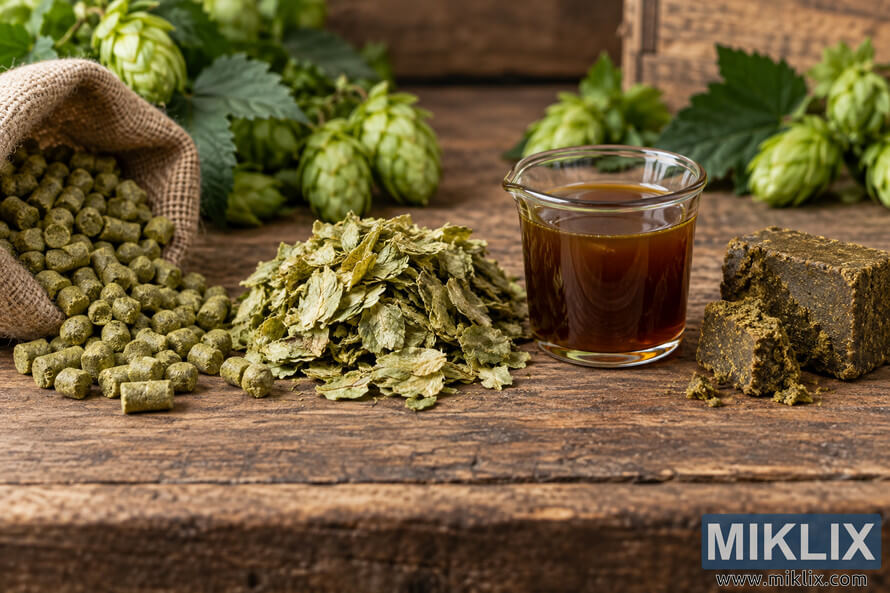
Explore a detailed still life showing different unbranded hop product forms, including compressed pellets, dried leaf material, amber liquid extract, and dense concentrate, arranged with fresh hops on a rustic wooden table.
Available versions of this image
The image files available for download below are less compressed and higher resolution - and as a result of that, higher quality - than the images embedded in articles and pages on this website, which are more optimized for file size in order to reduce bandwidth consumption.
Regular size (1,536 x 1,024)
Large size (3,072 x 2,048)
Very large size (4,608 x 3,072)
Extra large size (6,144 x 4,096)
Comically large size (1,048,576 x 699,051)
- Still uploading... ;-)
Image description
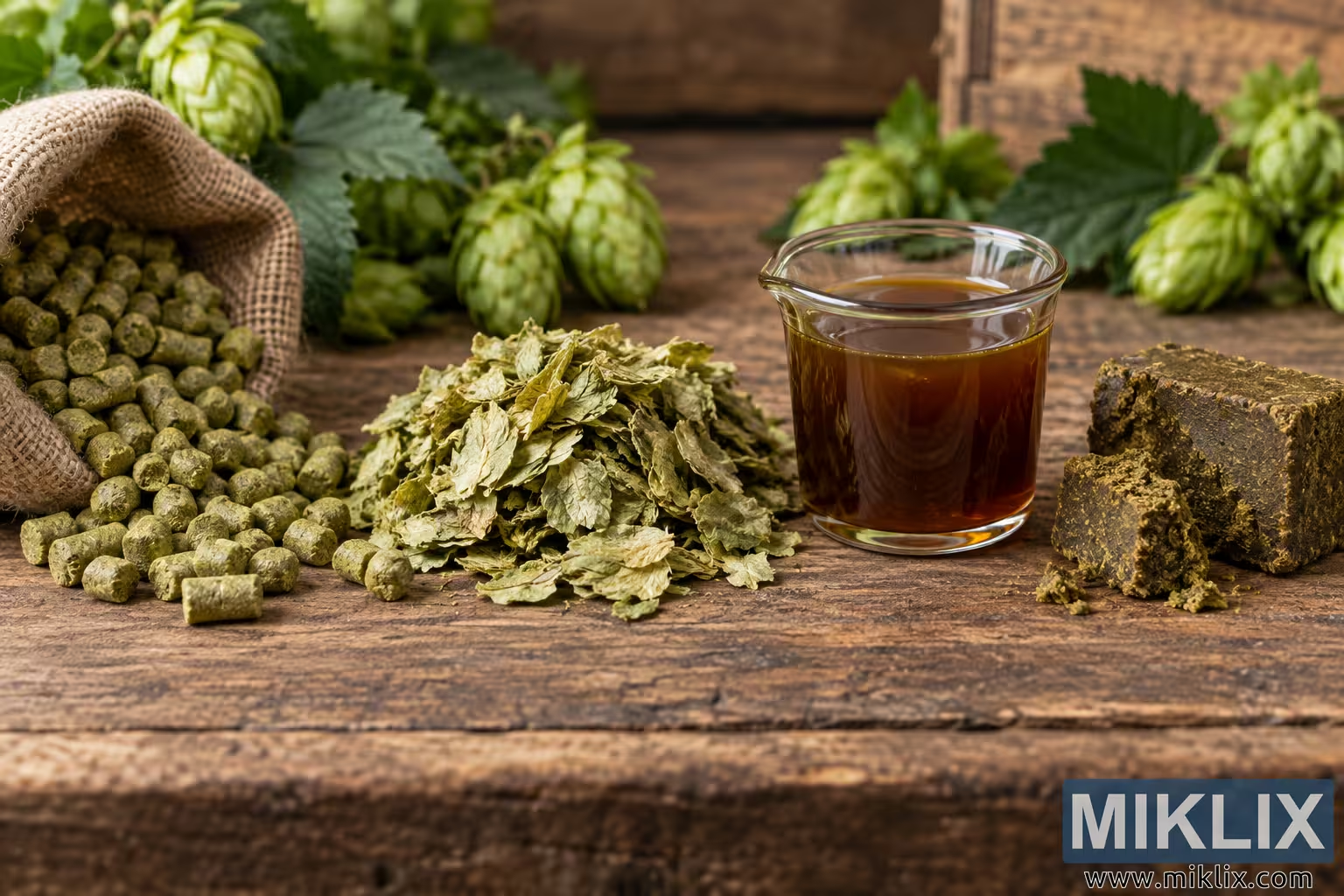
A high-resolution landscape-oriented still-life photograph presents four distinct hop-derived product forms arranged across a weathered wooden tabletop: compressed hop pellets, dried hop leaf material, a liquid hop extract, and a dense hash-like hop concentrate. The composition has a rustic, agricultural character and uses warm natural lighting, earthy colors, and a shallow depth of field to emphasize the ingredients while maintaining a softly detailed hop-growing context in the background. No branding, logos, labels, packaging graphics, or identifying commercial marks are visible anywhere in the image.
On the far left, a loosely woven burlap sack lies on its side with its opening directed toward the center of the scene. The sack is filled with numerous small cylindrical hop pellets in muted olive-green and brown-green tones. A generous quantity of the pellets has spilled from the bag and spread naturally across the wooden surface. Their compact cylindrical shapes, slightly rough surfaces, irregular edges, and subtle variations in color make them appear like compressed plant material rather than manufactured decorative objects. Some pellets rest individually in the foreground while others form a denser cluster around the mouth of the sack. The coarse beige fibers of the burlap provide a strong textural contrast with the compressed pellets and reinforce the agricultural, minimally processed presentation.
Immediately to the right of the pellets is a substantial mound of dried hop leaf material. The dried plant matter consists of overlapping flakes, fragments, and thin leafy pieces in pale green, yellow-green, and subdued olive shades. The individual pieces have visibly irregular outlines, folded edges, fine veins, and brittle-looking textures. Several fragments have fallen away from the main pile and lie scattered across the tabletop, creating a natural transition between the different product forms. Compared with the dense pellets on the left, this material appears light, dry, loose, and delicate, visually demonstrating the difference between compressed and uncompressed hop products.
Near the center-right of the composition is a clear, low glass vessel containing a translucent amber-brown liquid representing hop extract. The glass has a simple laboratory or ingredient-preparation appearance without any writing, measurement markings, labels, or branding. Its transparent walls catch highlights from the surrounding light and create subtle reflections and refractions along the rim and lower edge. The extract itself has a rich color ranging from warm golden brown around thinner illuminated areas to deeper reddish brown where the liquid is visually denser. The glossy surface of the liquid contrasts strongly with the dry, matte textures of the pellets and leaf material. The vessel is positioned upright and cleanly separated from the surrounding ingredients, making the liquid form immediately recognizable as a distinct category.
On the far right are several compact blocks of dark greenish-brown, hash-like hop concentrate. The pieces are dense and roughly rectangular but have uneven, crumbly surfaces and naturally broken edges. Their exterior contains mottled areas of brown, olive, dark green, and golden plant tones, suggesting highly concentrated compressed botanical material. Small crumbs and fragments are visible around the base of the blocks, adding realism and preventing the shapes from appearing artificially perfect. The concentrate is substantially darker and visually denser than the dried leaves and pellets, which helps distinguish this fourth product form from the other hop ingredients in the scene.
Behind the foreground arrangement, fresh green hop cones and leafy hop foliage create a softly focused botanical background. Several pale green hop cones hang or rest among broad green leaves, visually connecting the processed ingredients in the foreground with their agricultural origin. The hop cones display characteristic layered, overlapping bracts and rounded tapered forms. Although the background is intentionally less sharp than the foreground, enough botanical detail remains visible to establish the subject clearly. Wooden crates or boards occupy portions of the upper background, extending the rustic harvest and ingredient-processing atmosphere without introducing any commercial identity.
The entire arrangement rests on a thick, aged wooden table composed of broad boards with pronounced grain, scratches, grooves, knots, and variations in brown coloration. The surface looks well used and provides a neutral, organic foundation for the green and amber ingredients. The front edge of the table occupies the lower portion of the frame and falls gradually out of focus, strengthening the sense of depth. Tiny pieces of plant material scattered around the primary objects further integrate the ingredients with the surface and contribute to the authentic still-life presentation.
Lighting enters softly across the scene and produces warm highlights on the glass extract vessel, gentle illumination on the dried leaves, and dimensional shadows around the pellets and concentrate blocks. The lighting is controlled rather than dramatic, allowing textures and material differences to remain easy to inspect. The brightest greens appear in the fresh hop cones and leaves in the background, while the foreground transitions through olive green, pale dried green, amber, brown, and dark earthy tones. The resulting palette is natural and cohesive, with the transparent amber extract providing the strongest warm-color contrast.
The image is composed horizontally, with the four primary hop product forms distributed from left to right in a visually readable sequence. The burlap sack and pellets occupy the left portion, the dried leaf pile sits left of center, the liquid extract occupies center-right, and the dense concentrate blocks complete the arrangement on the right. This spacing allows each material to retain its own visual identity while presenting all four as parts of one coordinated ingredient family. The foreground subjects are rendered with crisp detail, while the gradual background blur separates them from the fresh hops and wooden elements behind them. Overall, the photograph communicates a comparison of different hop product formats through shape, texture, density, color, and physical presentation rather than through text or labels. It has the appearance of a professionally produced ingredient or product-form reference image, combining an artisanal agricultural setting with a clear visual overview of pellets, dried leaf material, liquid extract, and a dense hash-like concentrate. The absence of actual brands or commercial identifiers keeps the scene generic and focused exclusively on the physical characteristics of the hop-derived materials.
The image is related to: Hops in Beer Brewing: Legacy