
Image: Fresh Hop Pellets on a Rustic Brewing Table
Published: October 11, 2026 at 7:07:47 PM UTC
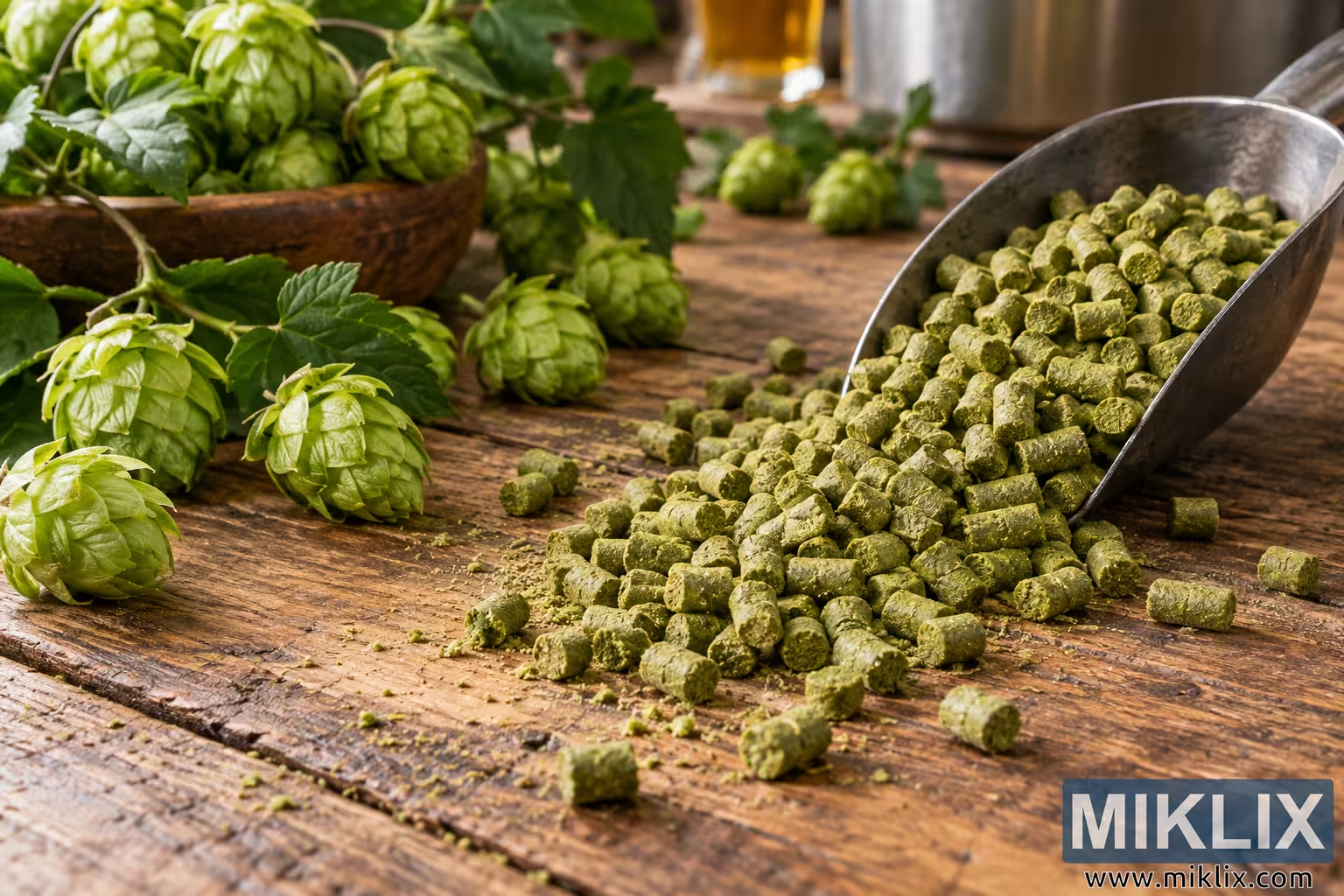
Photorealistic close-up of fresh green hop pellets scattered across a rustic wooden brewing table with whole hop cones, leafy vines, a metal scoop, and softly blurred brewery equipment.
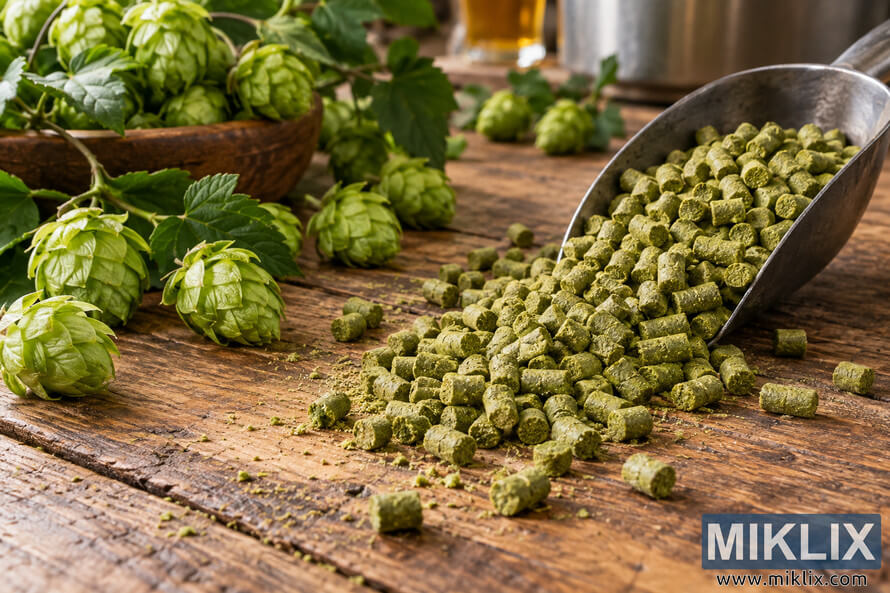
Available versions of this image
The image files available for download below are less compressed and higher resolution - and as a result of that, higher quality - than the images embedded in articles and pages on this website, which are more optimized for file size in order to reduce bandwidth consumption.
Regular size (1,536 x 1,024)
Large size (3,072 x 2,048)
Very large size (4,608 x 3,072)
Extra large size (6,144 x 4,096)
Comically large size (1,048,576 x 699,051)
- Still uploading... ;-)
Image description
A crisp, photorealistic landscape-oriented still-life photograph presents a generous quantity of green hop pellets scattered across a rustic wooden brewing table. The composition is arranged around a large, well-used metal scoop positioned on the right side of the frame. The scoop is tilted downward toward the tabletop and is filled almost to overflowing with compact cylindrical hop pellets. A substantial mound of pellets has spilled naturally from its open end, spreading from the center-right toward the middle and foreground of the image. Individual pellets are visible around the main pile, giving the arrangement an informal, freshly handled appearance rather than the precision of a staged product display. The pellets vary subtly in shape, length, orientation, and surface texture. Some are intact cylinders with clearly visible compressed plant fibers at their ends, while others appear slightly chipped or crumbly. Fine particles of green hop material and small fragments are scattered between them, emphasizing the dry, compressed botanical texture of the ingredient.
The wooden table provides a warm and strongly textured background beneath the hops. Its broad planks have a pronounced grain, irregular knots, scratches, seams, and variations in brown and amber coloration. These signs of wear create the impression of a traditional working surface in a brewery, workshop, or agricultural setting. Warm natural light travels across the table and catches raised portions of the wood grain, while shallow grooves and gaps between the planks remain darker. The contrast between the earthy brown wood and the muted olive-to-yellow-green hop pellets makes the brewing ingredient immediately prominent. Small crumbs and traces of hop powder scattered over the wood further connect the pellets to the surrounding working environment.
Fresh whole hop cones and leafy hop vines occupy much of the left side of the composition. Several large hop cones rest directly on the table in the foreground and middle ground. Their overlapping papery bracts are sharply defined, with colors ranging from bright yellow-green on the illuminated edges to deeper green in the shaded folds. The cones have a fresh, full appearance and provide a visual reference to the plant material from which the compressed pellets are produced. Dark green serrated leaves and slender stems weave between and behind the cones, introducing additional organic shapes and textures. In the upper-left portion of the frame, more whole hops are gathered inside a shallow rustic wooden bowl. The bowl has a dark, warm brown finish and a visible natural grain that complements the weathered tabletop. Some leaves and stems extend beyond its rim, making the arrangement feel abundant and freshly harvested.
The lighting is warm, soft, and directional, resembling natural daylight entering a brewery or farm workspace. Highlights illuminate the front-facing surfaces of the hop cones, the rough edges of the pellets, the rim of the metal scoop, and selected areas of the wooden table. Shadows remain gentle enough to preserve detail while giving the objects convincing depth and volume. The metal scoop has a darkened, slightly aged appearance rather than a highly polished commercial finish. Its curved interior catches soft reflections, and its worn surface fits naturally with the rustic brewing setting. The scoop enters from the upper-right corner at a diagonal, directing the viewer's attention toward the central pile of pellets.
A shallow depth of field separates the primary ingredients from the softly blurred background. In the distance, additional hop cones can be seen resting on the table, but their outlines become progressively less distinct. Near the upper center is a softly out-of-focus glass containing an amber-colored beverage suggestive of beer. Only the color, transparency, and general glass shape are apparent; there is no visible branding, label, logo, or identifying text. Behind and to the right of the glass is a large stainless-steel brewing vessel or similar piece of brewing equipment. It is also deliberately out of focus, contributing contextual information without competing with the hops in the foreground. The metallic surface reflects warm ambient tones and reinforces the visual association with small-scale or craft brewing.
The overall composition balances agricultural freshness with a practical brewing environment. Whole hop cones and vines on the left communicate the botanical origin of the ingredient, while the compressed pellets and metal scoop on the right emphasize the processed form commonly handled during brewing. The diagonal flow of pellets from the scoop creates movement through the otherwise static scene, guiding the eye from the upper-right toward the center and then outward across the tabletop. Foreground pellets and hop cones are rendered with especially strong detail, revealing fibrous, leafy, and crumbly textures. The background becomes increasingly soft, producing a natural photographic sense of depth and keeping attention on the ingredients.
The image has a warm, artisanal atmosphere without displaying any actual brand identity. There are no packages, printed labels, trademarks, logos, signs, or readable words anywhere in the scene. Instead, the visual narrative is communicated entirely through recognizable brewing materials: fresh green hop cones, leafy vines, compressed hop pellets, a utilitarian metal scoop, an amber beverage in the distance, rustic timber, and stainless-steel brewing equipment. The combination suggests freshness, hop aroma, brewing craftsmanship, and the transformation of harvested hops into a practical brewing ingredient. The landscape framing leaves ample horizontal space for the tabletop and surrounding hops, while the high level of photographic detail makes the image suitable for editorial, educational, brewing-related, agricultural, or ingredient-focused visual use.
The image is related to: Hops in Beer Brewing: Mount Rainier