
Image: Mount Rainier Hops Aroma Wheel – Flavor Compounds and Sensory Notes
Published: October 11, 2026 at 7:07:47 PM UTC
Explore a Mount Rainier hops aroma wheel illustrating floral, citrus, fruity, spicy, earthy, herbal, resinous, and sweet sensory notes with representative aroma compounds.
Available versions of this image
The image files available for download below are less compressed and higher resolution - and as a result of that, higher quality - than the images embedded in articles and pages on this website, which are more optimized for file size in order to reduce bandwidth consumption.
Regular size (1,536 x 1,024)
Large size (3,072 x 2,048)
Very large size (4,608 x 3,072)
Extra large size (6,144 x 4,096)
Comically large size (1,048,576 x 699,051)
- Still uploading... ;-)
Image description
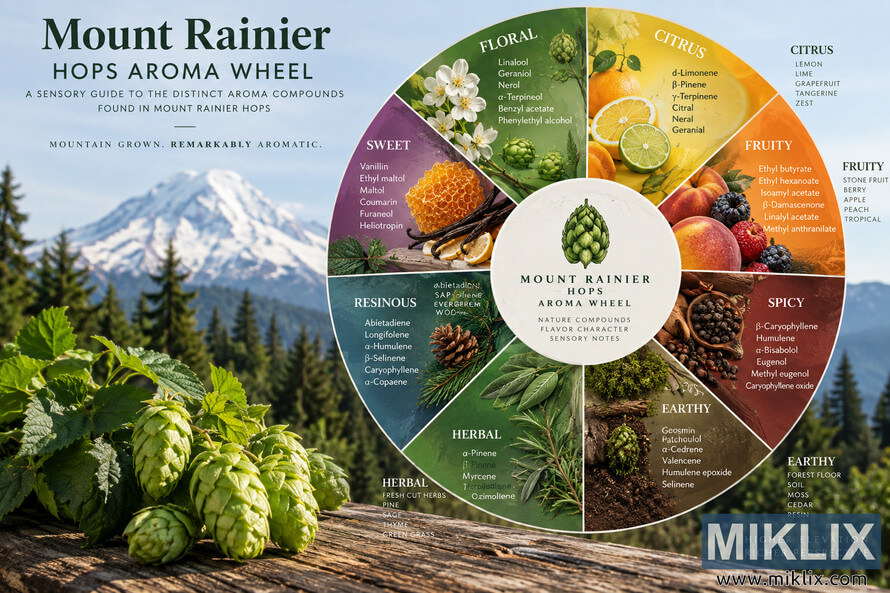
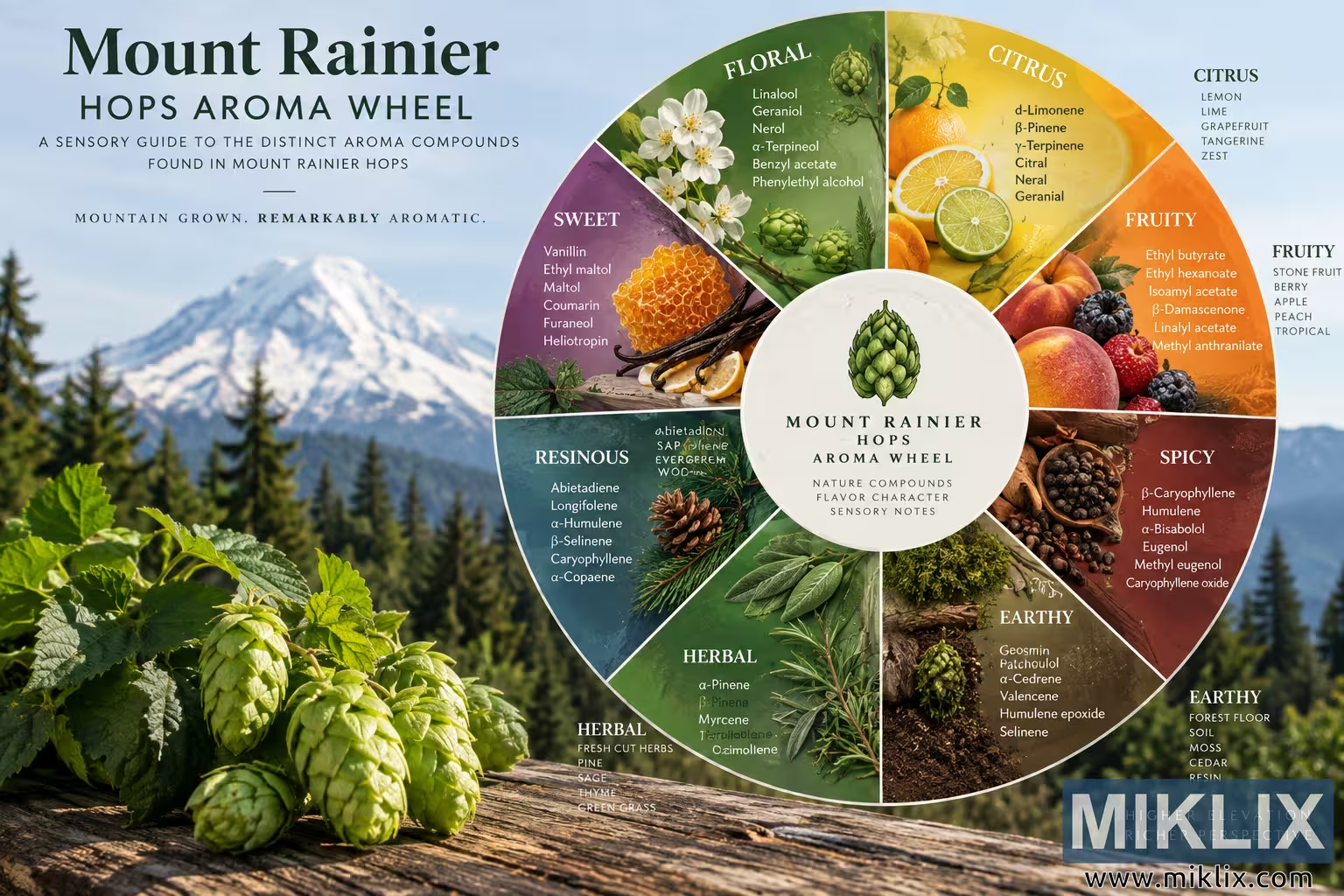
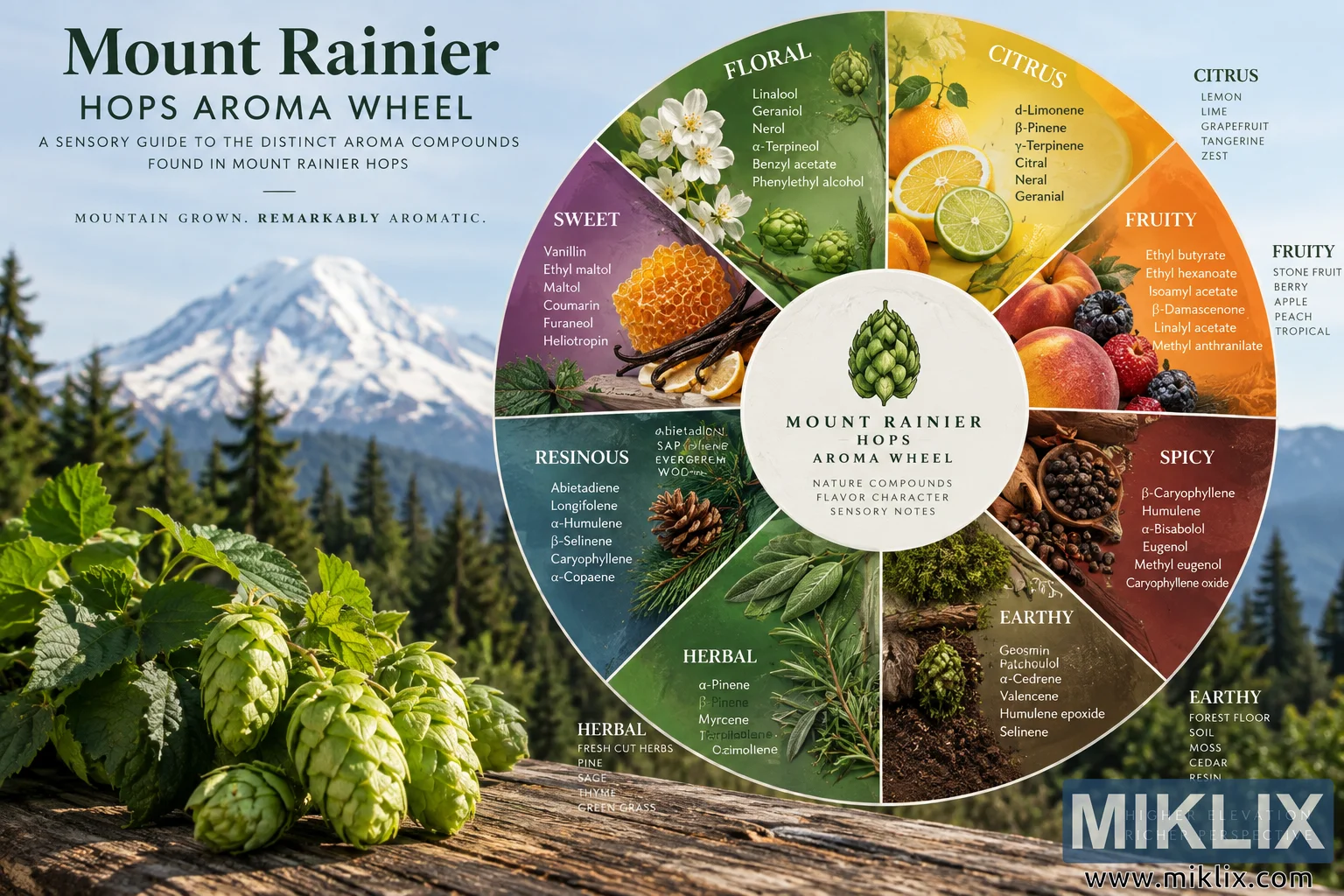
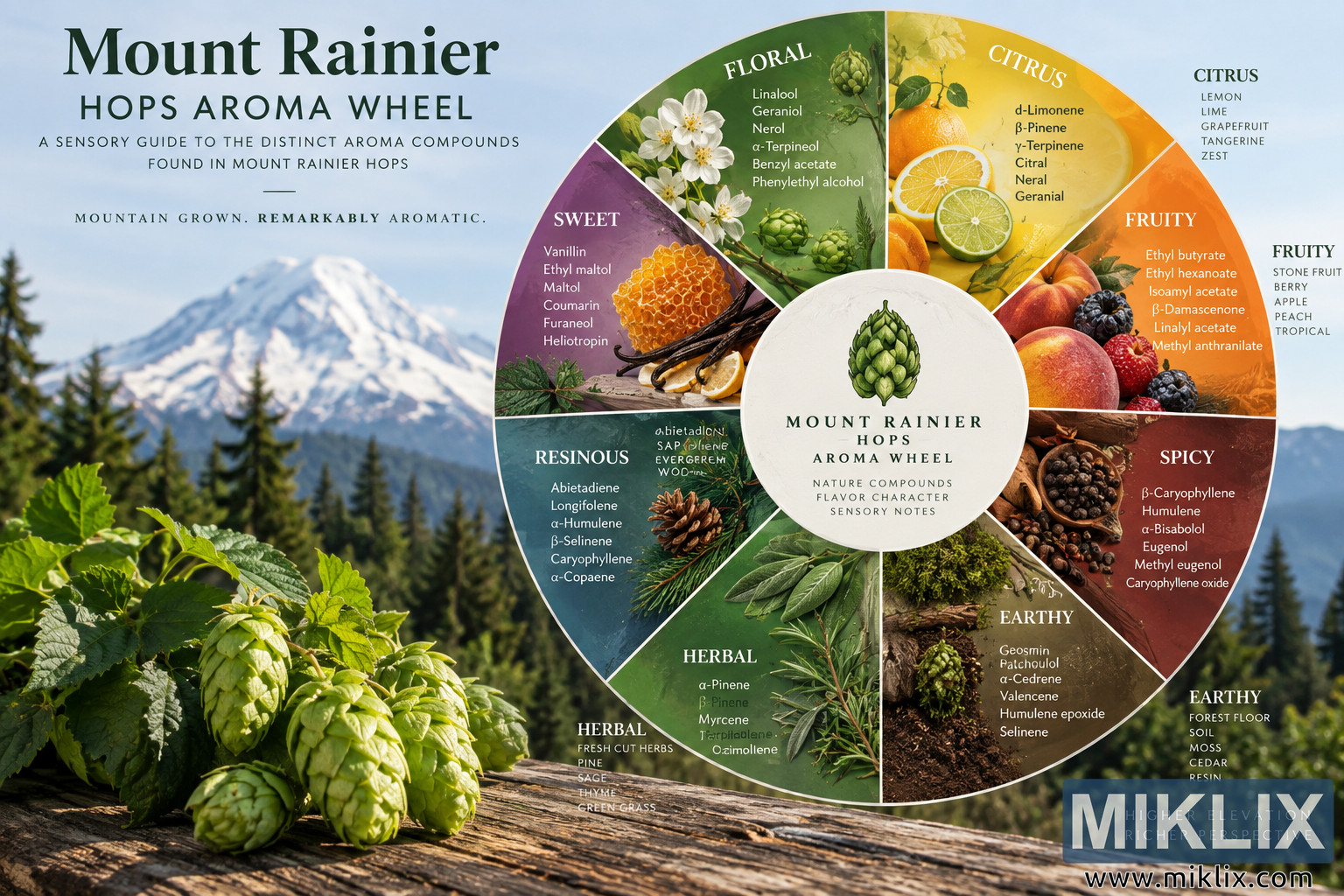
A wide, landscape-format infographic presents a sensory aroma wheel for Mount Rainier hops against a dramatic Pacific Northwest-inspired mountain landscape. The composition combines realistic botanical and landscape photography with an elegant, educational flavor-chart design. In the background, a large snow-covered mountain rises beneath a pale blue sky. Its white summit and softly shaded slopes are slightly out of focus, allowing the foreground information and hop imagery to remain dominant. Dark evergreen trees cover the lower mountain landscape and create a natural transition between the distant scenery and the close-up botanical elements. In the lower-left foreground, a cluster of fresh green hop cones and broad hop leaves rests on a weathered wooden surface. The cones are highly detailed, with overlapping pale-green bracts catching warm natural light, reinforcing the agricultural and botanical character of the subject.
The upper-left portion of the image contains the main heading, “Mount Rainier,” rendered in a large, traditional dark-green serif typeface. Directly beneath it is the uppercase subtitle “HOPS AROMA WHEEL,” followed by smaller explanatory copy describing the graphic as a sensory guide to aroma compounds associated with Mount Rainier hops. A thin decorative horizontal rule separates this introduction from the phrase “MOUNTAIN GROWN. REMARKABLY AROMATIC.” The restrained typography and generous open space in this area contrast with the richly illustrated aroma wheel on the right.
The primary visual feature is a very large circular aroma wheel positioned from the center toward the right side of the composition. A cream-colored circular hub sits at its center and contains an illustrated green hop cone. Beneath the hop illustration are the words “MOUNT RAINIER HOPS AROMA WHEEL,” followed by smaller text referring to nature compounds, flavor character, and sensory notes. Around this central hub, the wheel is divided into several wedge-shaped aromatic families. Each family has its own distinctive color palette, realistic ingredient imagery, category heading, and a list of representative aroma or flavor compounds.
At the top of the wheel, the FLORAL section uses deep and medium greens. White blossoms, green hop cones, and leafy botanical material visually suggest fresh flowers and plant aromatics. The compound list includes names such as linalool, geraniol, nerol, alpha-terpineol, benzyl acetate, and phenylethyl alcohol. Moving clockwise, the CITRUS section is bright yellow and golden orange, illustrated with whole and sliced citrus fruits, including orange-, lemon-, and lime-like forms. Its compound list includes d-limonene, beta-pinene, gamma-terpinene, citral, neral, and geranial. A separate text legend near the outer right edge summarizes citrus impressions such as lemon, lime, grapefruit, tangerine, and zest.
The next wedge, FRUITY, is saturated orange and contains peaches or nectarines, strawberries, blackberries, and other ripe fruit imagery. Representative compounds listed in this section include ethyl butyrate, ethyl hexanoate, isoamyl acetate, beta-damascenone, linalyl acetate, and methyl anthranilate. An adjacent legend expands the sensory vocabulary with terms including stone fruit, berry, apple, peach, and tropical. Below it, the SPICY wedge shifts into warm reddish-brown and mahogany tones. It is illustrated with peppercorns, cinnamon-like bark, cloves, and other dried spices. The listed compounds include beta-caryophyllene, humulene, alpha-bisabolol, eugenol, methyl eugenol, and caryophyllene oxide.
Continuing clockwise into the lower-right quadrant, the EARTHY section adopts dark brown, olive, and forest-floor colors. Moss, bark, soil, wood, and small botanical elements evoke damp woodland and natural earth. Compounds shown include geosmin, patchoulol, alpha-cedrene, valencene, humulene epoxide, and selinene. A nearby sensory legend identifies forest floor, soil, moss, cedar, and resin as associated impressions. At the bottom of the wheel, the HERBAL category is rendered in natural green and features rosemary-like sprigs, sage-like leaves, and other aromatic herbs. Its accompanying compound names include alpha-pinene, beta-pinene, myrcene, terpinolene, and alpha-ocimene. A small external legend reinforces descriptors such as fresh-cut herbs, pine, sage, thyme, and green grass.
On the lower-left side of the wheel, the RESINOUS section uses a cool, dark blue-green palette. Evergreen needles, pine cones, and woody forest imagery convey coniferous and resinous qualities. The visible compound list includes abietadiene, longifolene, alpha-humulene, beta-selinene, caryophyllene, and alpha-copaene. Above this section, the SWEET wedge is purple and plum-colored. It contains honeycomb, vanilla pods, citrus peel, and aromatic botanical details. Its listed compounds include vanillin, ethyl maltol, maltol, coumarin, furaneol, and heliotropin, visually suggesting honeyed, vanilla-like, confectionery, and softly aromatic sweetness.
Fine white dividing lines separate the aroma-wheel wedges, giving the circle a precise, organized structure while retaining the lush photographic appearance of each category. The wheel's color progression—from floral greens through citrus yellow, fruit orange, spice red-brown, earthy brown, herbal green, resinous blue-green, and sweet purple—makes the aromatic families immediately distinguishable. Ingredient photography within each wedge functions as a visual shorthand for the sensory descriptors and chemical compound names.
The overall image has a premium botanical and craft-oriented aesthetic, balancing scientific terminology with approachable sensory imagery. The realistic hops in the foreground establish the agricultural subject, while the mountain and evergreen forest provide a strong sense of place without displaying any commercial branding or logos. In the lower-right corner, widely spaced uppercase text reads “HIGHER ELEVATION” above “RICHER PERSPECTIVE,” acting as a concluding visual tagline. The combination of mountain scenery, fresh hops, botanical illustrations, fruit, spices, forest materials, chemical names, and carefully segmented categories creates an educational poster that communicates the broad aromatic spectrum associated with hops in an attractive and accessible visual format.
The image is related to: Hops in Beer Brewing: Mount Rainier