
Image: Dry Hop Addition to a Stainless-Steel Fermenter
Published: October 11, 2026 at 7:07:47 PM UTC
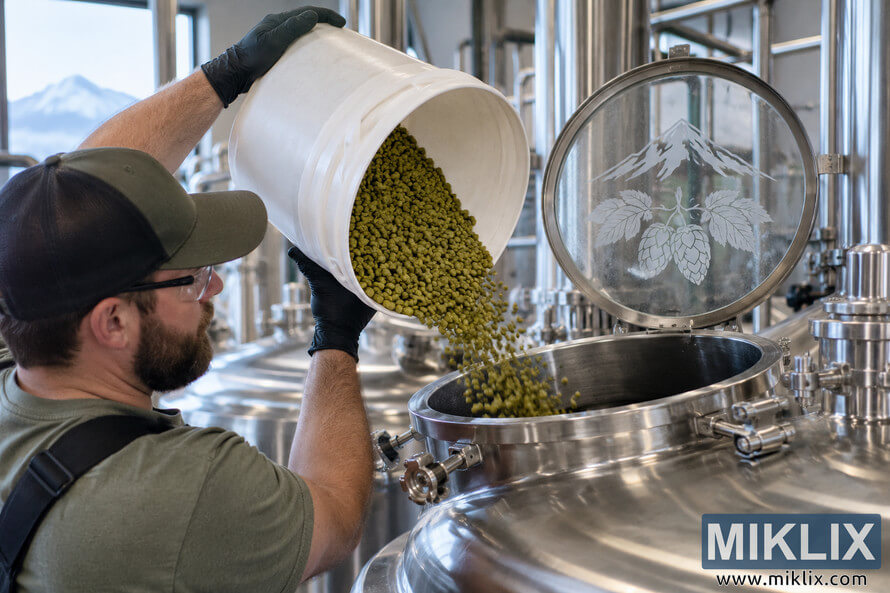
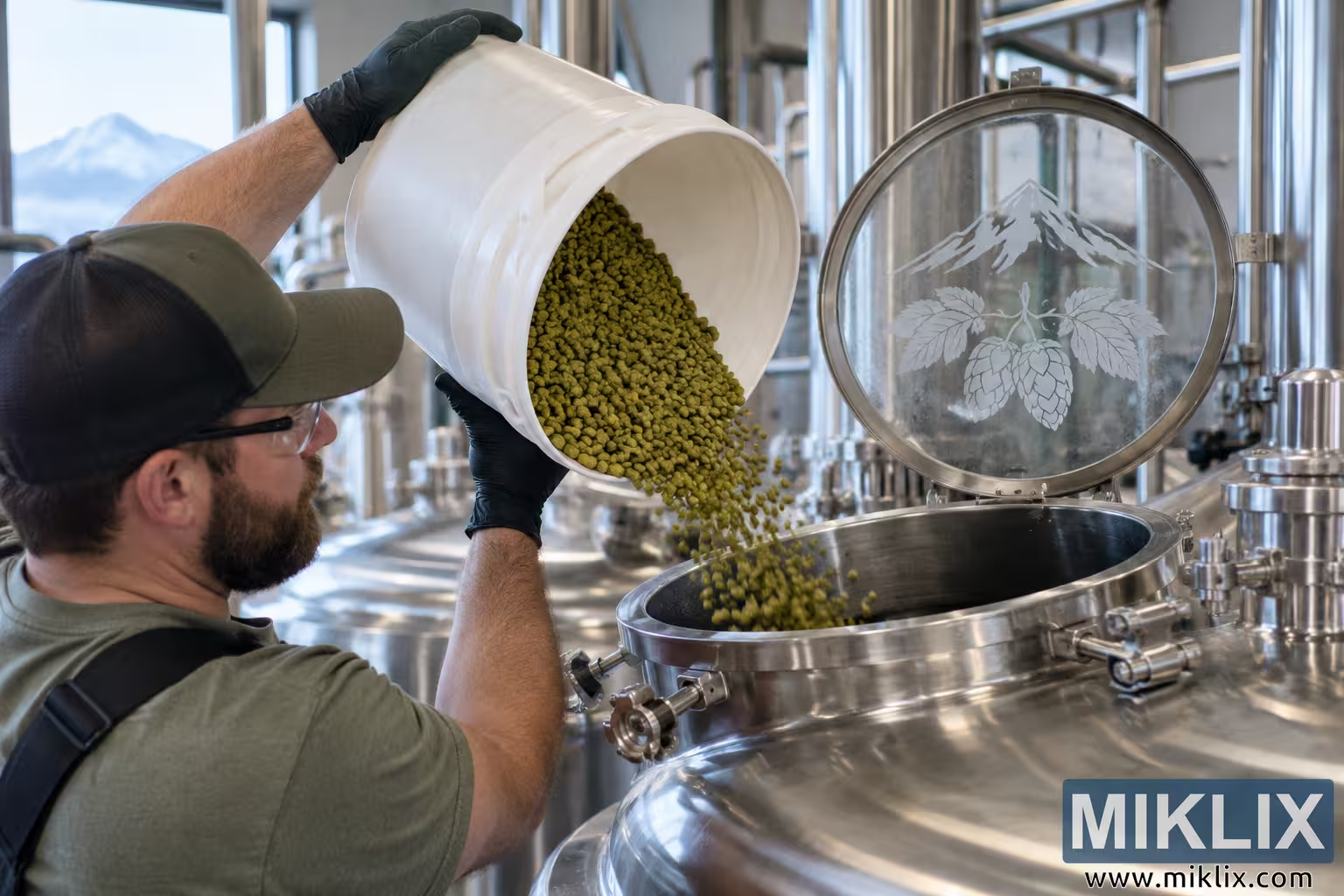
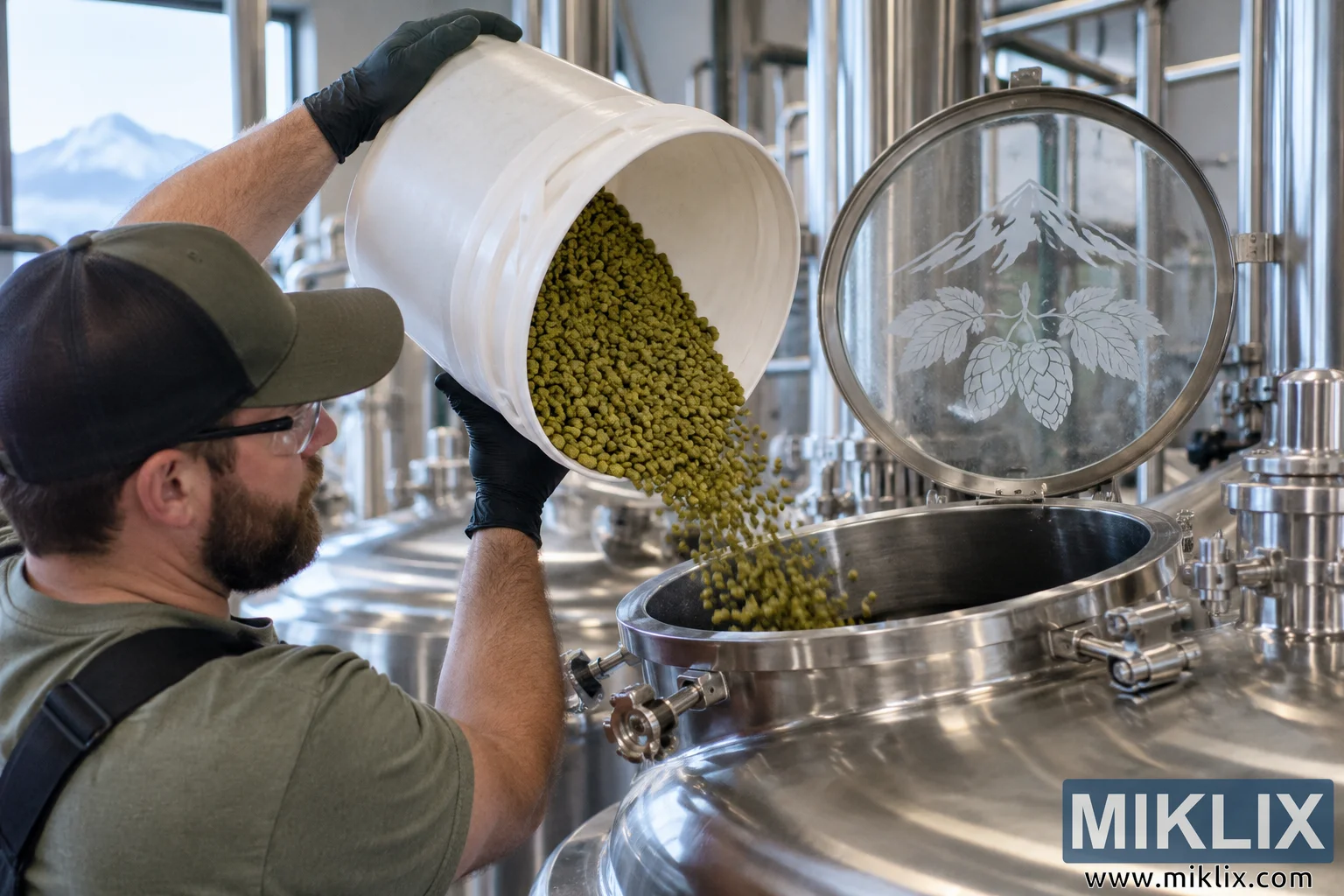
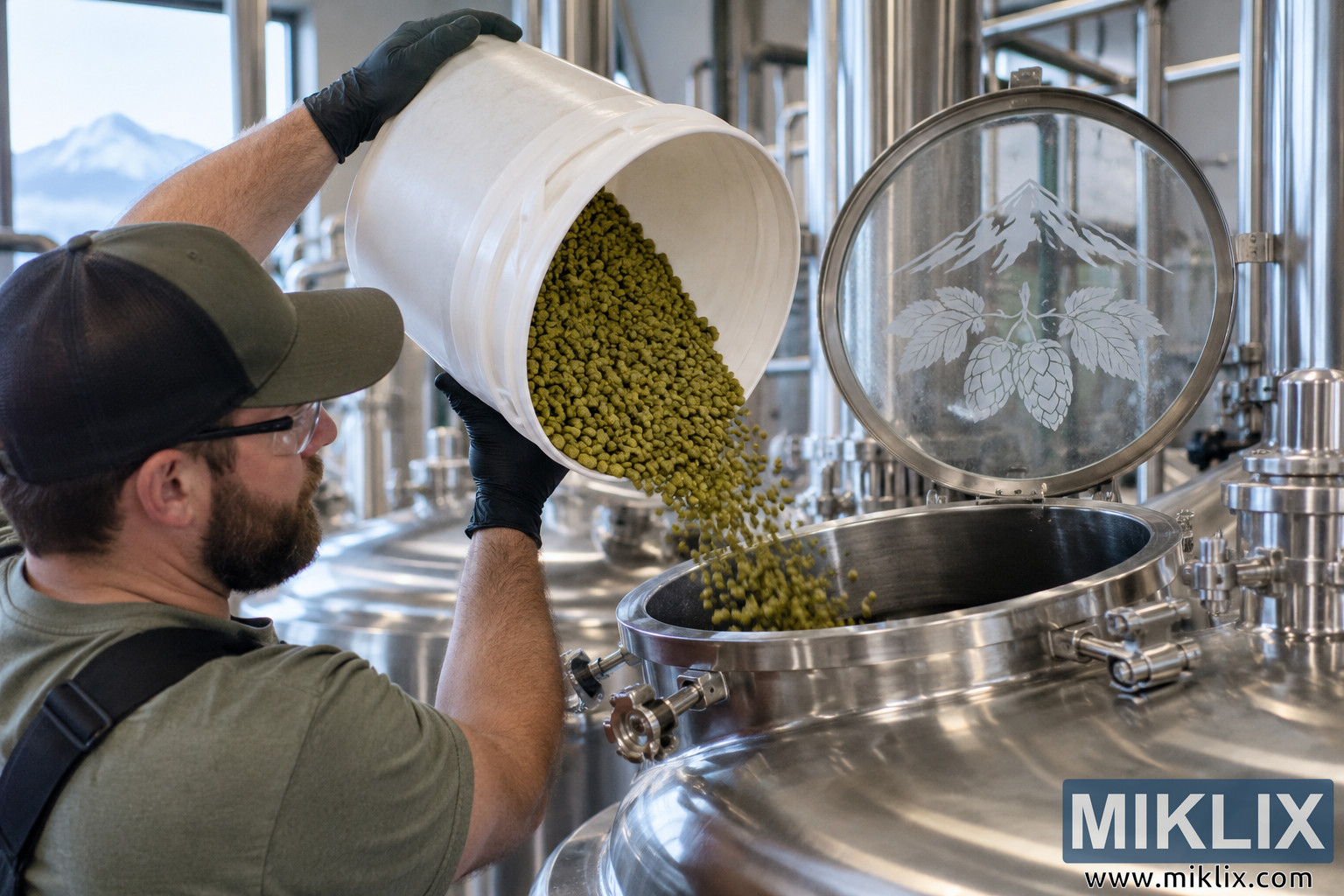
High-resolution brewery image showing a brewer adding green dry hop pellets to an open stainless-steel fermenter in a bright, modern production facility with mountain scenery.
Available versions of this image
The image files available for download below are less compressed and higher resolution - and as a result of that, higher quality - than the images embedded in articles and pages on this website, which are more optimized for file size in order to reduce bandwidth consumption.
Regular size (1,536 x 1,024)
Large size (3,072 x 2,048)
Very large size (4,608 x 3,072)
Extra large size (6,144 x 4,096)
Comically large size (1,048,576 x 699,051)
- Still uploading... ;-)
Image description
A high-resolution landscape photograph depicts a dry hop addition taking place inside a bright, modern craft brewery. The scene is dominated by a large stainless-steel fermenter positioned across the lower and right portions of the frame. Its polished metal surface reflects the surrounding brewery environment and catches the soft natural and industrial light, producing subtle highlights and curved reflections that emphasize the vessel's substantial size. At the top of the fermenter, a wide circular access hatch is open. The raised lid stands nearly vertical behind the opening, while the dark interior of the vessel is visible through the broad stainless-steel rim. A brewer occupies the left side of the composition and is shown actively pouring a generous quantity of green hop pellets from a large white plastic bucket into the fermenter. The bucket is tilted steeply downward above the opening, creating a dense stream of hop pellets that falls through the center of the image and into the vessel. Individual pellets can be distinguished throughout the falling stream, giving the photograph a strong sense of movement and capturing the dry hopping process at the precise moment the hops are being added. The hop pellets are muted olive to yellow-green in color and have the small compressed cylindrical shapes characteristic of pelletized brewing hops. Their earthy green tone provides a natural contrast to the silvery stainless steel and neutral colors of the brewery equipment. The brewer is viewed primarily from the side and slightly from behind. He has a beard and wears a dark baseball-style cap without visible branding, clear protective safety glasses, black protective gloves, an olive or muted green short-sleeved shirt, and dark workwear straps over his shoulders. His arms are raised as he firmly grips the bucket with both hands, and his posture communicates the physical effort required to control the container while directing the hops accurately into the open fermenter. His attention is focused on the vessel and the falling hops, reinforcing the impression of an authentic brewery production task rather than a posed portrait. The image does not display any identifiable commercial brand names, logos, packaging labels, or branded clothing. The fermenter's circular lid is a visually distinctive element in the upper-right portion of the composition. Its translucent or reflective central panel contains a decorative, generic etched illustration consisting of a snow-covered mountain above hop cones and hop leaves. The design evokes the relationship between mountain landscapes, agricultural hop cultivation, and brewing without identifying or reproducing a real-world commercial brand. Moisture, condensation, or subtle surface texture is visible across the panel, adding realism to the industrial environment. Beyond the brewer and fermenter, the background contains additional stainless-steel tanks, pipes, fittings, valves, supports, and other brewery infrastructure. These elements become progressively softer and less detailed with distance because of the shallow-to-moderate depth of field, keeping visual attention on the dry hop addition in the foreground while still establishing the setting clearly as a professional brewing facility. Large windows allow abundant daylight into the room. Through a window toward the upper-left background, a pale, snow-covered mountain can be seen in the distance beneath a bright sky. The mountain is softly out of focus and functions as atmospheric context rather than the primary subject. Its silhouette visually echoes the generic mountain motif on the open fermenter lid. The brewery interior is clean, orderly, and highly reflective, with vertical pipes and cylindrical tanks producing repeating metallic shapes throughout the background. The composition has a documentary and commercial-photography quality, with realistic proportions, crisp foreground detail, natural skin texture, convincing stainless-steel reflections, and clearly rendered hop pellets. The camera is positioned close enough to make the viewer feel present during the brewing operation. The tilted bucket creates a strong diagonal line from the upper left toward the center, while the falling hops continue that movement downward into the fermenter. The brewer's raised arms frame the bucket and guide the eye toward the stream of pellets. On the opposite side, the round raised lid provides a large circular form that balances the brewer and bucket visually. The fermenter's curved body fills much of the lower foreground and anchors the entire composition. Lighting is bright and naturalistic, combining cool daylight from the windows with softer illumination reflected from the stainless-steel equipment. There are no dramatic artificial colors or stylized effects; instead, the palette consists mainly of silver, gray, white, muted green, black, and pale blue. The strongest color accent comes from the mass of green hop pellets being poured into the vessel. The overall atmosphere is clean, technical, hands-on, and craft-oriented. The image communicates an important stage in beer production: dry hopping, in which aromatic hops are introduced to a fermenting or conditioning beer to contribute hop aroma and flavor. The visual emphasis is specifically on the addition itself rather than on finished beer, packaging, serving, or consumption. The mountain-inspired setting and botanical imagery complement the hop-focused subject, while the lack of visible commercial branding keeps the photograph generic and suitable for illustrating brewing, hop additions, brewery operations, fermentation, and craft beverage production.
The image is related to: Hops in Beer Brewing: Mount Rainier