
Image: Different Hop Varieties Arranged for Blending
Published: October 11, 2026 at 7:07:47 PM UTC
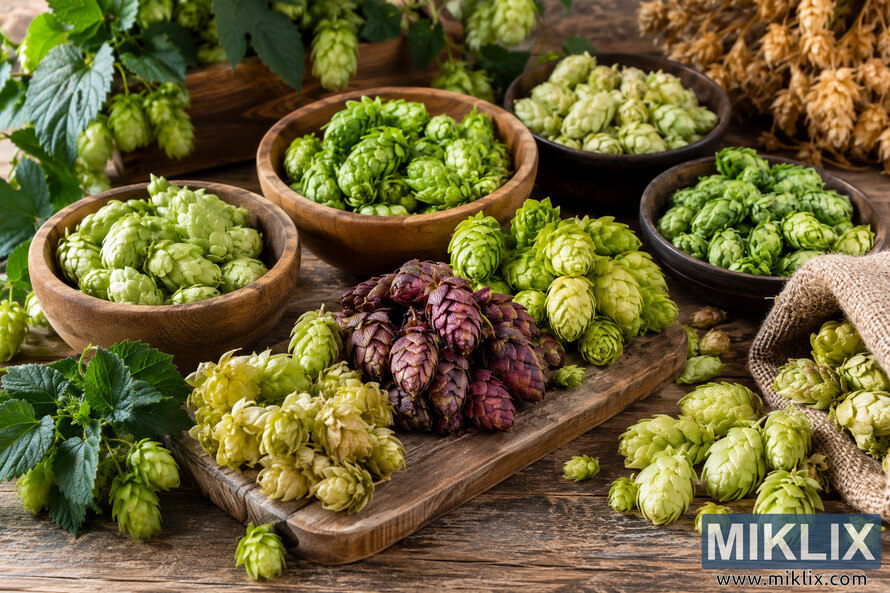
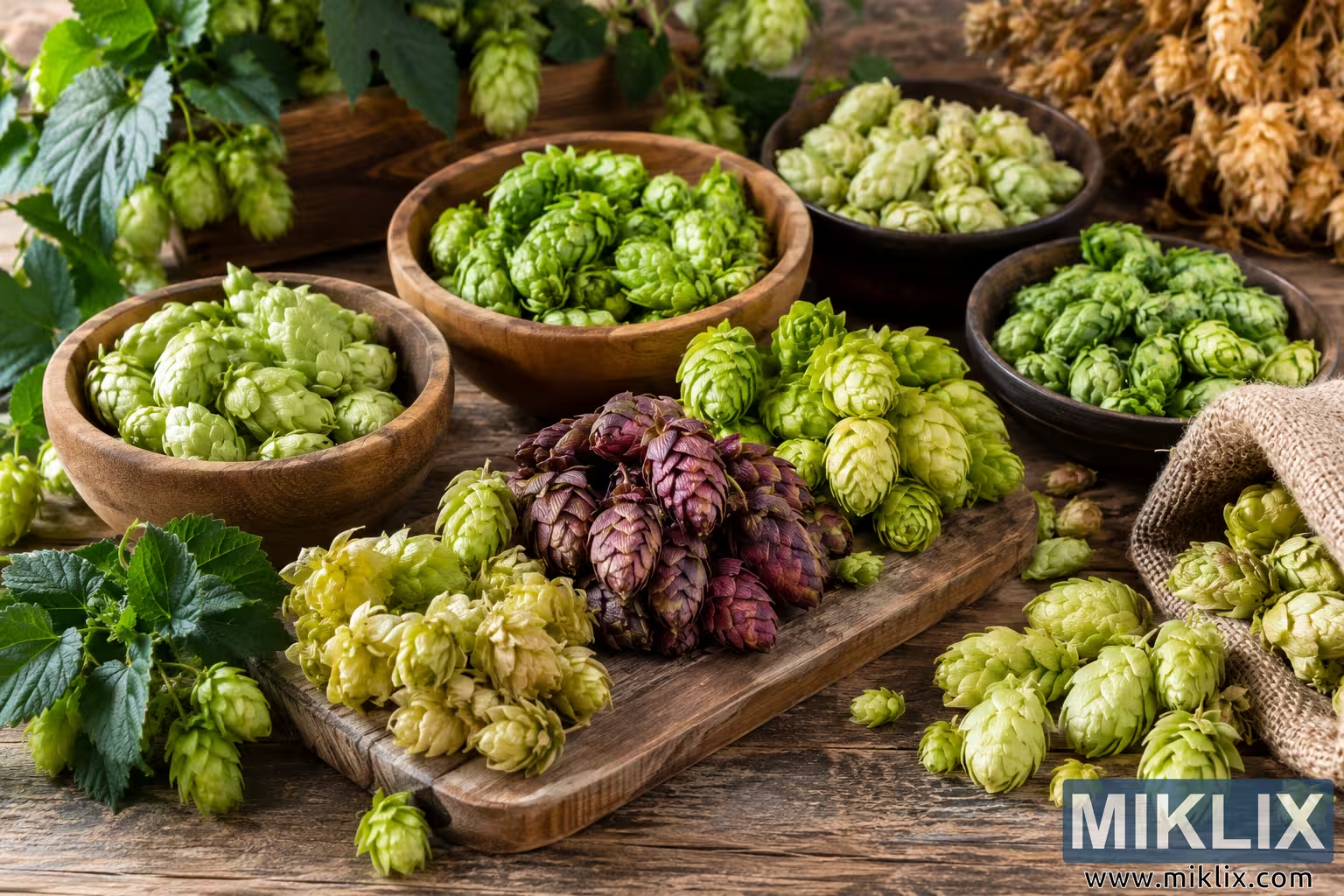
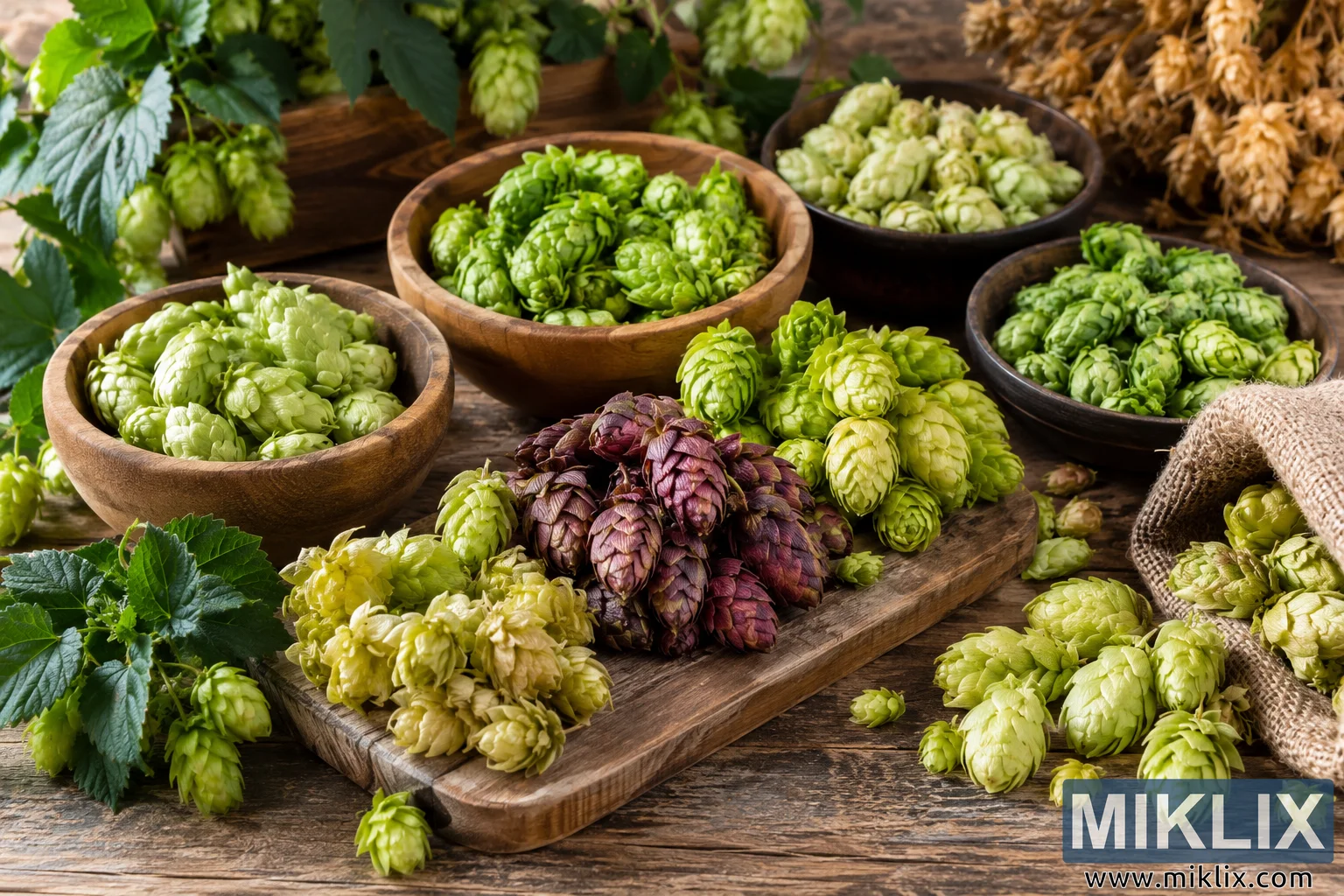
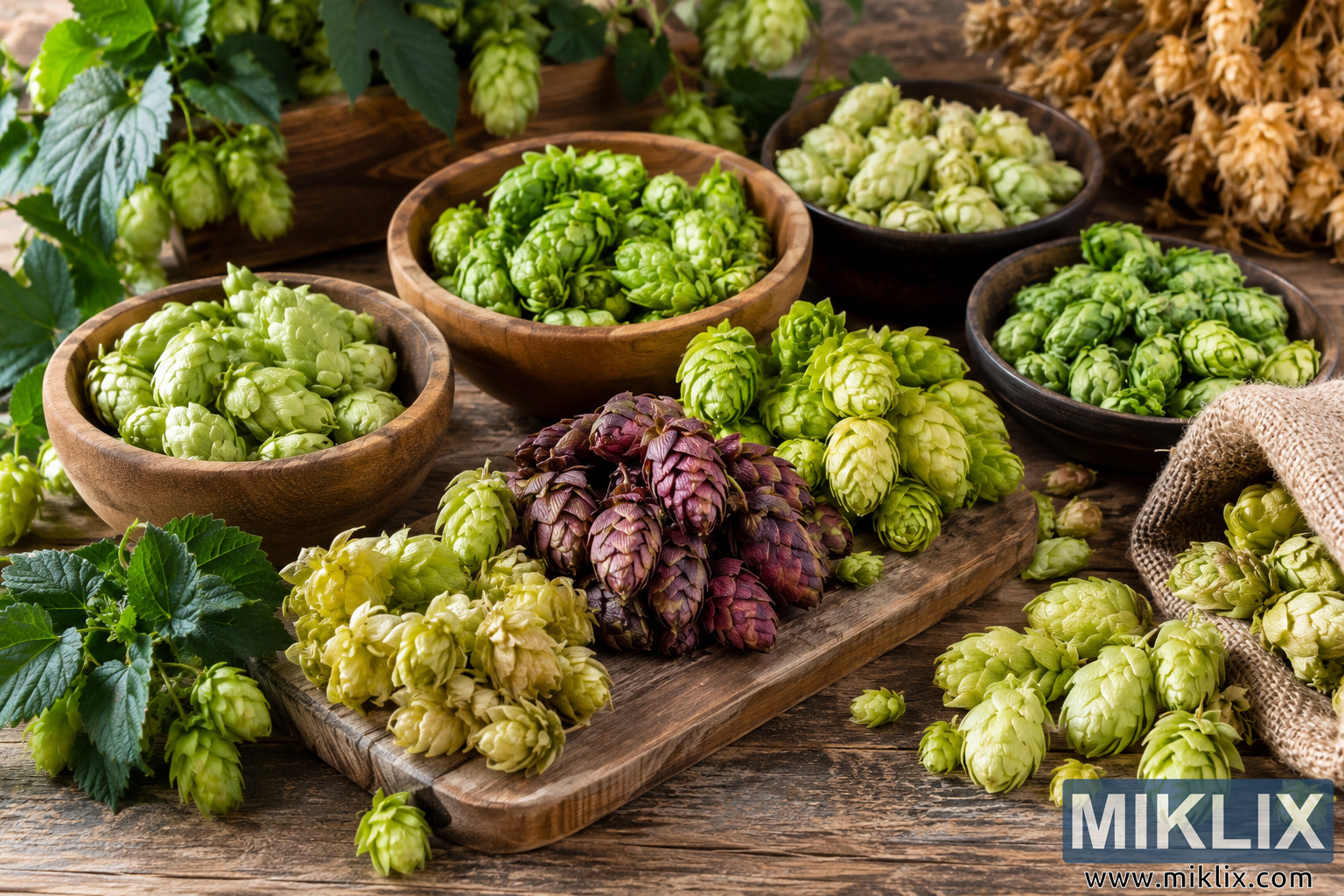
Different hop varieties arranged together for blending on a rustic wooden table, featuring fresh green, golden, and burgundy hop cones in bowls and natural clusters.
Available versions of this image
The image files available for download below are less compressed and higher resolution - and as a result of that, higher quality - than the images embedded in articles and pages on this website, which are more optimized for file size in order to reduce bandwidth consumption.
Regular size (1,536 x 1,024)
Large size (3,072 x 2,048)
Very large size (4,608 x 3,072)
Extra large size (6,144 x 4,096)
Comically large size (1,048,576 x 699,051)
- Still uploading... ;-)
Image description
A richly detailed landscape-oriented still-life photograph presents an abundant assortment of hop varieties arranged together as though they are being prepared for blending, evaluation, or brewing. The composition is set on a broad, rustic wooden tabletop whose weathered surface, visible grain, small scratches, and warm brown tones create an earthy agricultural atmosphere. Across the table, fresh hop cones appear in several distinct groups, allowing their differences in color, size, shape, and texture to be easily compared. The overall scene communicates freshness, variety, craftsmanship, harvest, and the careful selection of ingredients associated with hop blending and brewing.
At the center of the image, a rectangular wooden serving board acts as the primary visual anchor. Several contrasting groups of hop cones rest on this board. A prominent cluster of dark reddish-purple to burgundy hop cones occupies the middle, immediately distinguishing itself from the surrounding green varieties. The layered bracts of these cones are clearly visible, creating a dense, almost sculptural texture. Beside them is a group of bright yellow-green cones with plump, tightly layered forms. Toward the front left of the board, another cluster has a lighter golden-green or straw-yellow appearance, suggesting a different variety, level of maturity, or drying characteristic. The juxtaposition of these groups emphasizes the concept of combining different hops to create a blend.
Surrounding the central board are several wooden and dark-toned bowls filled generously with additional hop cones. On the left, a substantial round wooden bowl contains pale green hops with broad overlapping bracts. Their soft yellow-green color catches the natural light and contrasts with the darker brown interior of the bowl. Slightly behind and closer to the center is another wooden bowl packed with smaller, more intensely green hop cones. These appear fresh and vibrant, with tightly formed leaves and a saturated botanical color. In the upper-right portion of the scene, a dark bowl contains very pale green hops, while another dark bowl farther to the right holds a mass of deeper green cones. The separation of the hops into individual containers gives the impression that several varieties have been gathered independently before being selected and combined.
On the right side of the image, a loosely woven burlap sack lies partially open, with pale green hop cones spilling naturally from its mouth onto the wooden surface. The rough beige fibers of the sack contrast strongly with the smooth, layered surfaces of the hop cones and reinforce the agricultural, handcrafted character of the scene. Several loose cones are scattered nearby, preventing the arrangement from feeling overly formal and suggesting active handling or preparation. More hops are distributed along the lower-right edge of the table, where their soft green tones are illuminated by the directional light.
Fresh hop vines and leaves frame the composition, particularly along the left side and upper-left background. The leaves are broad, serrated, and deep green, with visible veins and slightly uneven natural edges. Small hop cones hang from portions of the vine, visually connecting the harvested ingredient on the table with the living plant from which it originates. Additional greenery appears behind the bowls, creating depth and helping the still life feel connected to a recent harvest rather than a purely decorative studio arrangement. In the upper-right background, a bundle of dried, golden-brown plant material introduces another contrasting texture and color. Its warm, muted tones complement the wood and burlap while making the fresh green hops appear even more vivid.
The lighting is warm, soft, and naturalistic, entering primarily from the left and front of the scene. Highlights gently define the overlapping bracts of individual hop cones, revealing their papery, layered construction without producing harsh reflections. Shadows beneath the bowls, board, leaves, and scattered cones provide convincing depth and dimensionality. The central and foreground ingredients are rendered with crisp detail, while elements farther toward the back become subtly softer, creating a natural photographic sense of depth. Despite the abundance of objects, the arrangement remains visually organized because the different hop groups are separated by bowls, clusters, and changes in color.
The photograph uses an earthy palette dominated by multiple shades of green, ranging from pale yellow-green and lime to rich leafy green, with burgundy-purple hops providing the strongest accent. Warm browns from the tabletop, serving board, and bowls establish a neutral foundation, while beige burlap and golden dried vegetation add complementary harvest colors. The variety of greens is especially important to the subject: rather than presenting hops as a single uniform ingredient, the image suggests that individual varieties can have noticeably different visual characteristics and can be selected together for blending.
No people, labels, packaging, logos, text, trademarks, or identifiable commercial brands appear anywhere in the image. The scene therefore focuses entirely on the raw botanical ingredient and the idea of combining multiple hop varieties. The overall visual style resembles premium editorial food, agricultural, or brewing photography, with careful attention to natural materials, tactile surfaces, and ingredient detail. The generous horizontal composition gives the individual hop varieties enough space to remain distinguishable while still presenting them as part of one cohesive collection. The resulting image conveys the concept of hop selection and blending through visual variety alone: bowls of separated hops surround mixed clusters on the central wooden board, while loose cones and vines create a natural transition between them. It is an inviting, highly textured representation of diverse hops gathered together for comparison and blending, suitable for illustrating topics related to brewing ingredients, hop cultivation, harvest, sensory selection, recipe development, or the creation of a balanced hop blend.
The image is related to: Hops in Beer Brewing: Mount Rainier