
Image: Brewing Troubleshooting Guide with Notes and Tasting Samples
Published: October 11, 2026 at 7:07:47 PM UTC
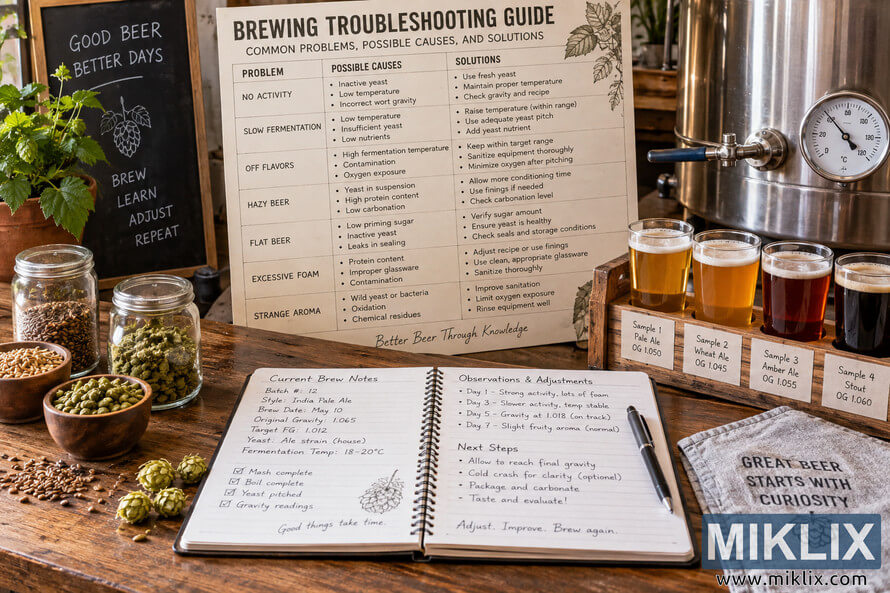
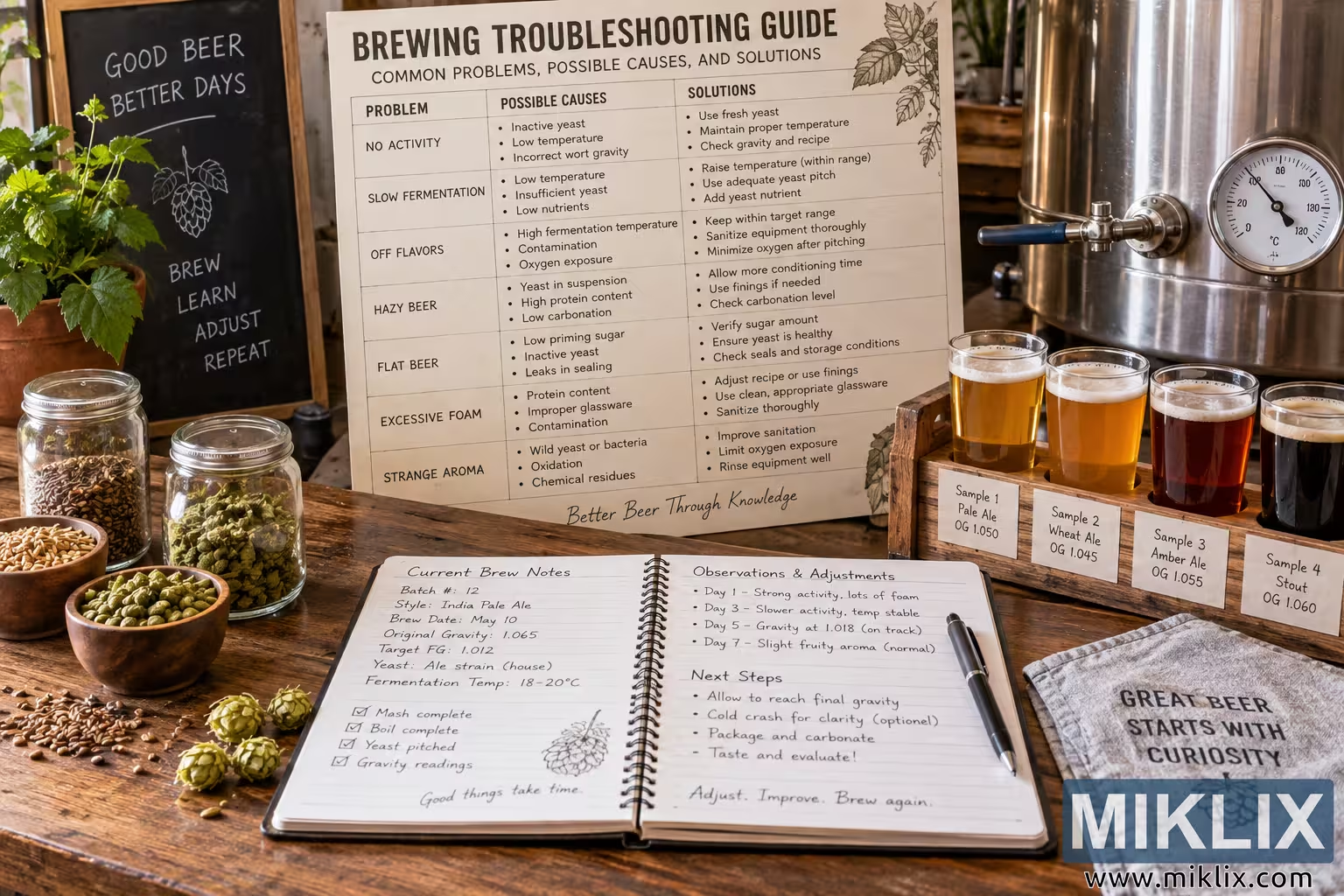
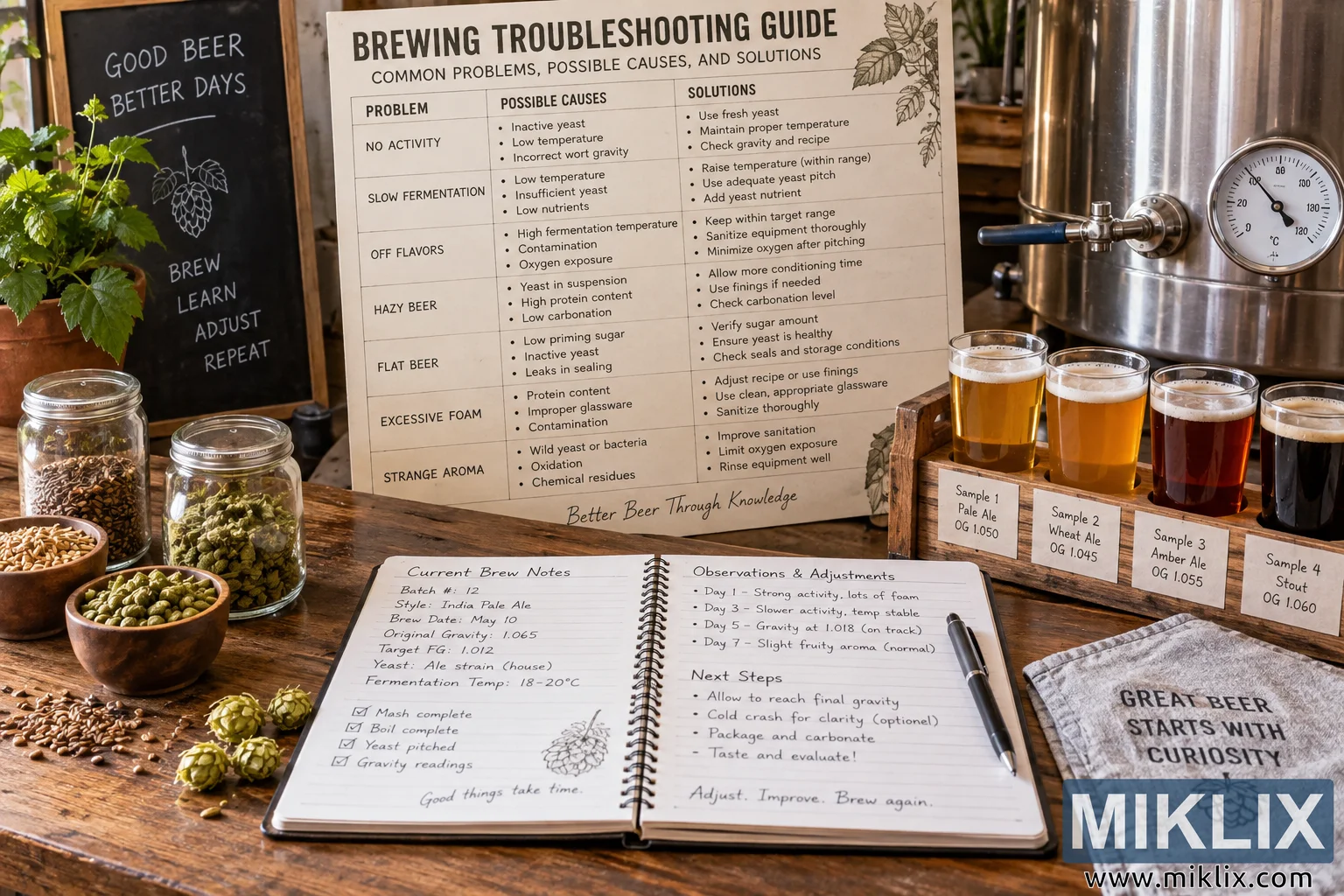
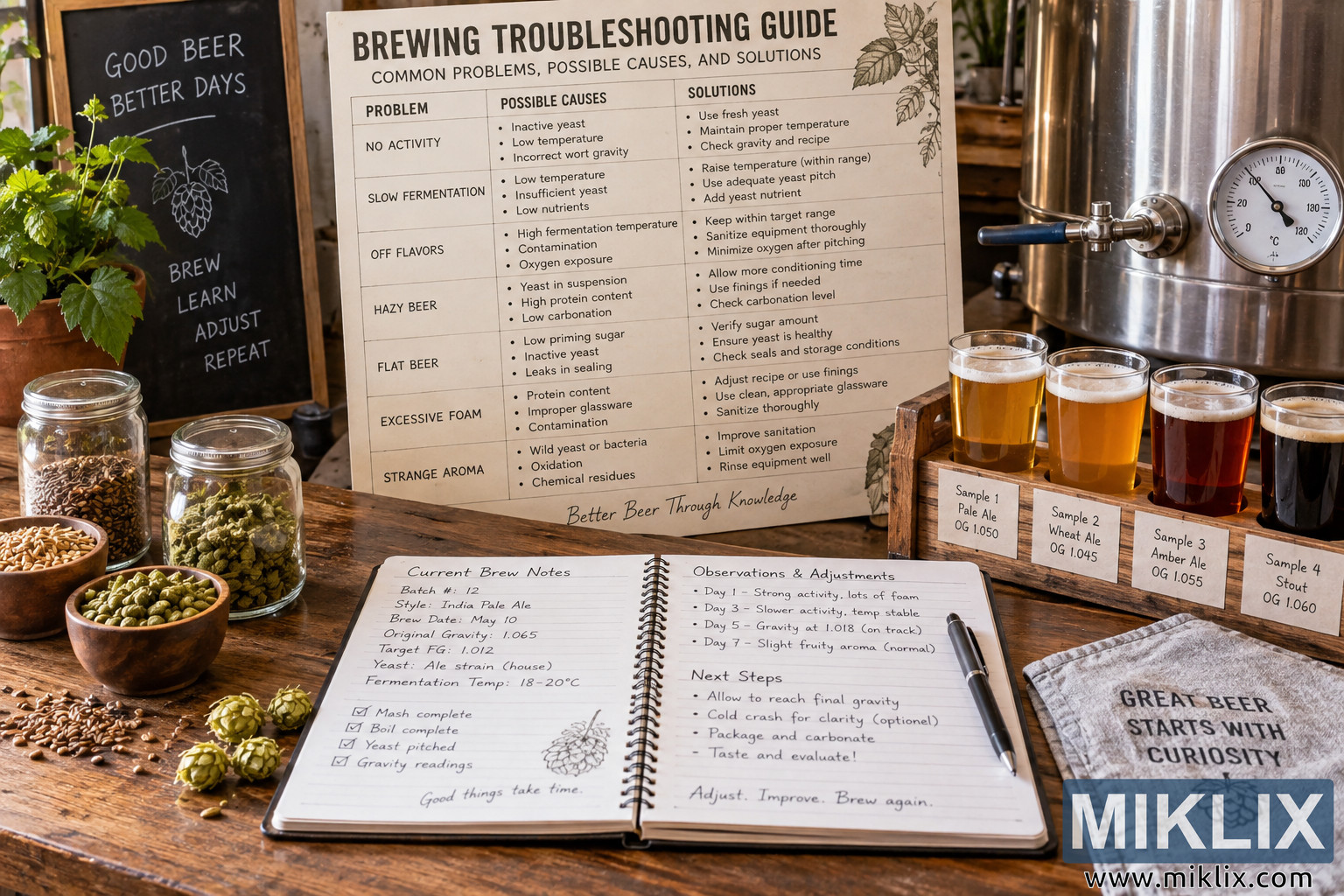
A detailed homebrewing troubleshooting scene featuring a reference guide, handwritten brewing notes, beer samples, hops, grains, brewing equipment, and practical fermentation observations.
Available versions of this image
The image files available for download below are less compressed and higher resolution - and as a result of that, higher quality - than the images embedded in articles and pages on this website, which are more optimized for file size in order to reduce bandwidth consumption.
Regular size (1,536 x 1,024)
Large size (3,072 x 2,048)
Very large size (4,608 x 3,072)
Extra large size (6,144 x 4,096)
Comically large size (1,048,576 x 699,051)
- Still uploading... ;-)
Image description
A richly detailed, landscape-oriented photograph depicts a warm and inviting homebrewing workspace arranged on a rustic wooden table. The scene combines practical brewing equipment, ingredients, tasting samples, handwritten notes, and educational reference material, creating the impression of an experienced brewer actively diagnosing and refining a batch. Warm natural light illuminates the tabletop and gives the image an artisanal, workshop-like atmosphere, while the shallow background and carefully arranged objects keep attention focused on the brewing process.
At the center of the composition stands a large cream-colored reference sheet titled "BREWING TROUBLESHOOTING GUIDE," with the subtitle "COMMON PROBLEMS, POSSIBLE CAUSES, AND SOLUTIONS." The sheet is formatted as a clear three-column table labeled "PROBLEM," "POSSIBLE CAUSES," and "SOLUTIONS." Its rows cover recognizable homebrewing issues such as no activity, slow fermentation, off flavors, hazy beer, flat beer, excessive foam, and strange aroma. Suggested causes include inactive or insufficient yeast, inappropriate fermentation temperature, contamination, oxygen exposure, low priming sugar, sealing problems, protein content, oxidation, and chemical residues. The corresponding solutions emphasize practical brewing techniques such as using fresh yeast, maintaining suitable temperatures, checking gravity and recipes, adding yeast nutrients, sanitizing equipment thoroughly, minimizing oxygen exposure, allowing additional conditioning time, checking carbonation levels, verifying sugar quantities, improving sanitation, and rinsing equipment well. Botanical hop illustrations decorate the guide, and a handwritten-style phrase near its lower edge reads "Better Beer Through Knowledge."
Behind the guide on the left is a black chalkboard in a simple wooden frame. Written in white chalk near the top is the phrase "GOOD BEER BETTER DAYS," accompanied by a small drawing of a hop cone. Lower on the board are the words "BREW LEARN ADJUST REPEAT," reinforcing the experimental and iterative character of homebrewing. A leafy green plant in a terracotta pot partially overlaps the chalkboard and introduces a fresh organic element to the otherwise equipment-focused setting.
The right side of the scene is dominated by a large cylindrical stainless-steel brewing vessel. Its polished metallic surface catches the warm ambient light. A spigot with a blue handle projects from the lower portion of the vessel, and a large circular analog temperature gauge is mounted beside it. These elements suggest active temperature control and careful measurement during the brewing process. In front of the vessel is a small wooden tasting rack containing four clear glasses of beer. The samples progress visually from pale golden and amber tones to a much darker stout-like beer, allowing comparison of color and appearance. Each glass has a light layer of foam at the top. Small handwritten cards identify the samples as a pale ale, wheat ale, amber ale, and stout, with original-gravity values noted beneath their names.
In the foreground, an open spiral-bound brewing notebook occupies a prominent position. The left page is headed "Current Brew Notes" and records batch information including the style, brew date, original gravity, target final gravity, yeast, and fermentation temperature. A checklist below records completed brewing stages such as mash completion, boiling, yeast pitching, and gravity readings. A small hop sketch appears near the bottom of the page beside the handwritten reminder "Good things take time." The right page is titled "Observations & Adjustments" and contains a chronological fermentation log. Notes describe strong early activity and foam, slower but stable activity after several days, a gravity reading that appears to be on track, and a slight fruity aroma described as normal. Beneath these observations, a "Next Steps" section suggests allowing the beer to reach final gravity, optionally cold-crashing for clarity, packaging and carbonating the beer, and finally tasting and evaluating it. The page ends with the encouraging phrase "Adjust. Improve. Brew again." A dark pen rests diagonally across the notebook, making the notes feel recently written and actively used rather than staged as a purely decorative element.
Around the notebook and guide are several brewing ingredients that add texture and authenticity to the scene. On the left side of the table, glass jars hold dried grain and green hop pellets or hop material. Small wooden bowls contain pale grain kernels and additional green hops. Loose malted grains are scattered across the wooden surface, while several whole hop cones lie near the lower center of the composition. The mixture of raw ingredients, brewing records, and finished tasting samples visually connects the different stages of the brewing process, from recipe formulation and ingredient selection through fermentation, troubleshooting, and sensory evaluation.
At the lower right, a folded gray cloth or towel carries the printed phrase "GREAT BEER STARTS WITH CURIOSITY" above a small hop illustration. This message complements the educational theme established by the troubleshooting chart, chalkboard, and notebook. Rather than presenting brewing as a perfectly predictable process, the image emphasizes observation, experimentation, measurement, adjustment, and repeated learning.
The overall visual style is cozy, realistic, and highly detailed. The weathered wooden tabletop, handwritten annotations, glass jars, botanical ingredients, stainless-steel equipment, and warm lighting create a balance between traditional craft and methodical technical practice. There are no visible commercial brand names or recognizable branded products. The composition reads as an educational homebrewing still life centered on troubleshooting: the brewer can compare beer samples, consult common problems and solutions, examine fermentation measurements, record observations, and decide on appropriate adjustments. The abundance of notes and samples makes the workspace feel active and purposeful, while the warm lighting and rustic materials give the technical subject an approachable, handcrafted character.
The image is related to: Hops in Beer Brewing: Mount Rainier