
Image: Fresh Versus Old Mount Rainier Hops Comparison
Published: October 11, 2026 at 7:07:47 PM UTC
Compare fresh versus old Mount Rainier hops, from vibrant green cones and strong aroma to faded color, brittle texture and reduced essential oils.
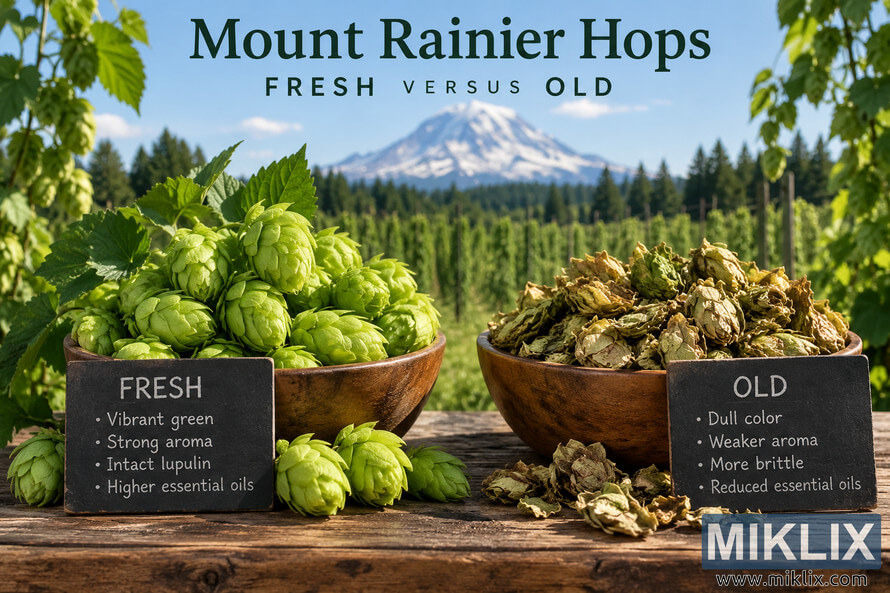
Available versions of this image
The image files available for download below are less compressed and higher resolution - and as a result of that, higher quality - than the images embedded in articles and pages on this website, which are more optimized for file size in order to reduce bandwidth consumption.
Regular size (1,536 x 1,024)
Large size (3,072 x 2,048)
Very large size (4,608 x 3,072)
Extra large size (6,144 x 4,096)
Comically large size (1,048,576 x 699,051)
- Still uploading... ;-)
Image description
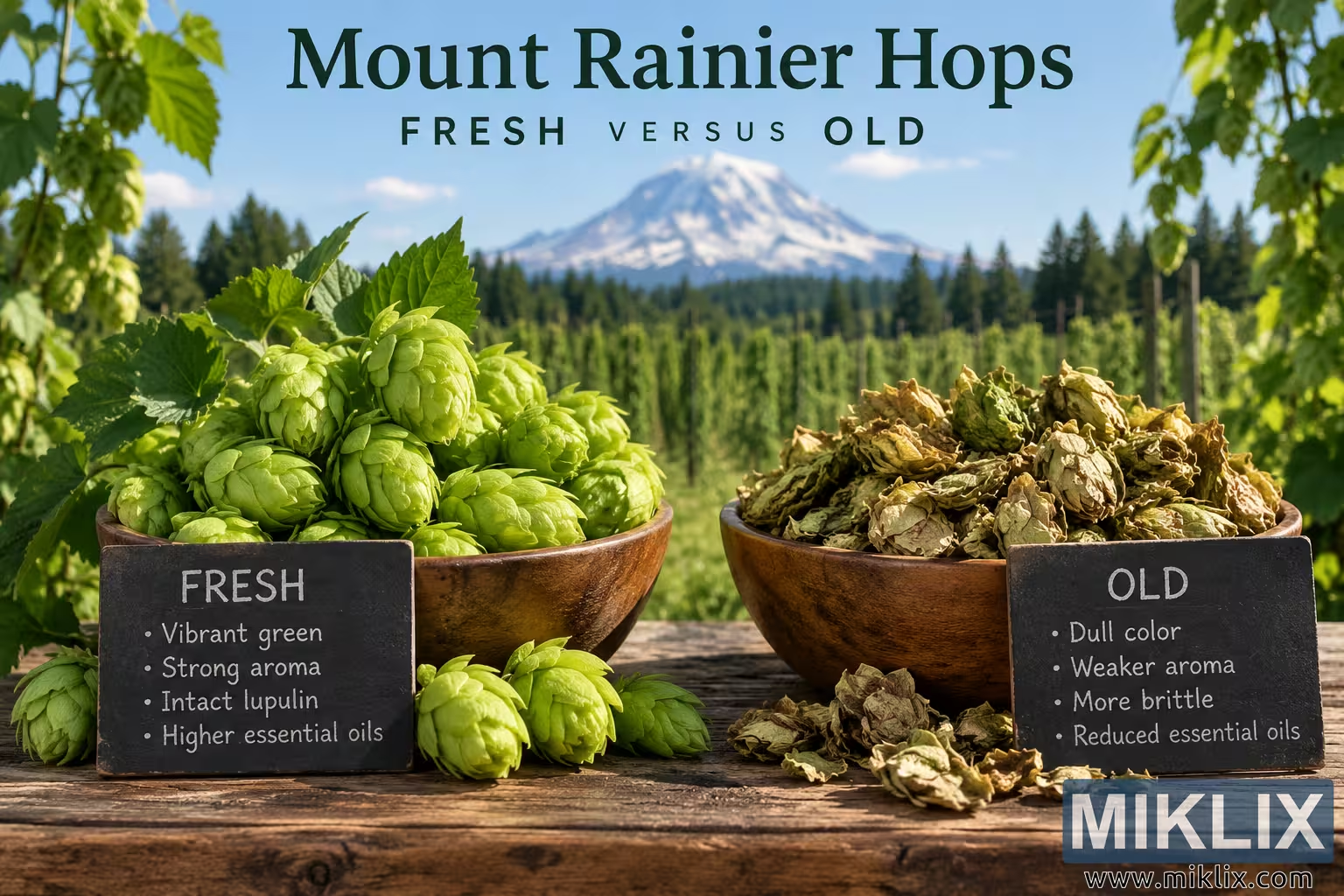
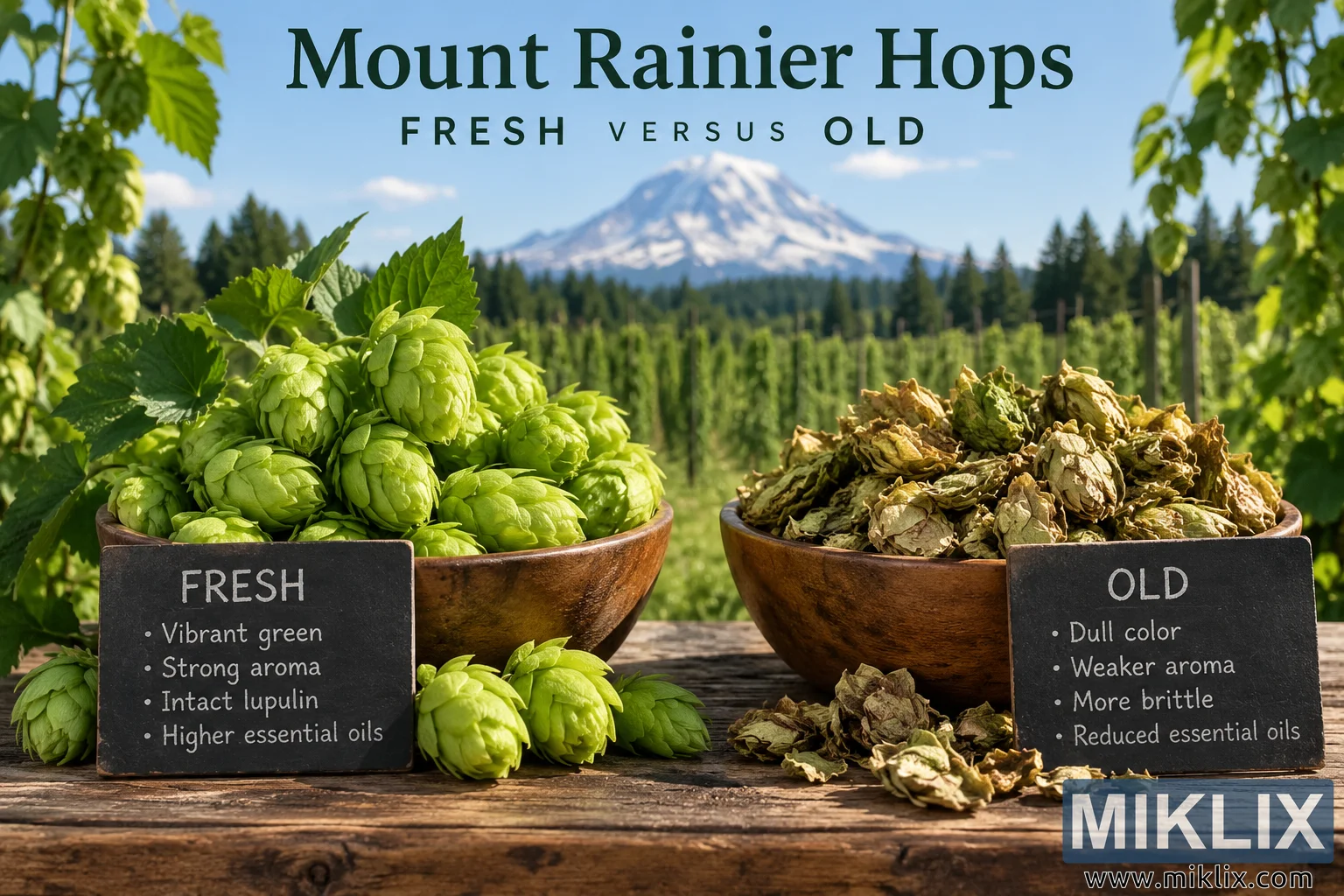
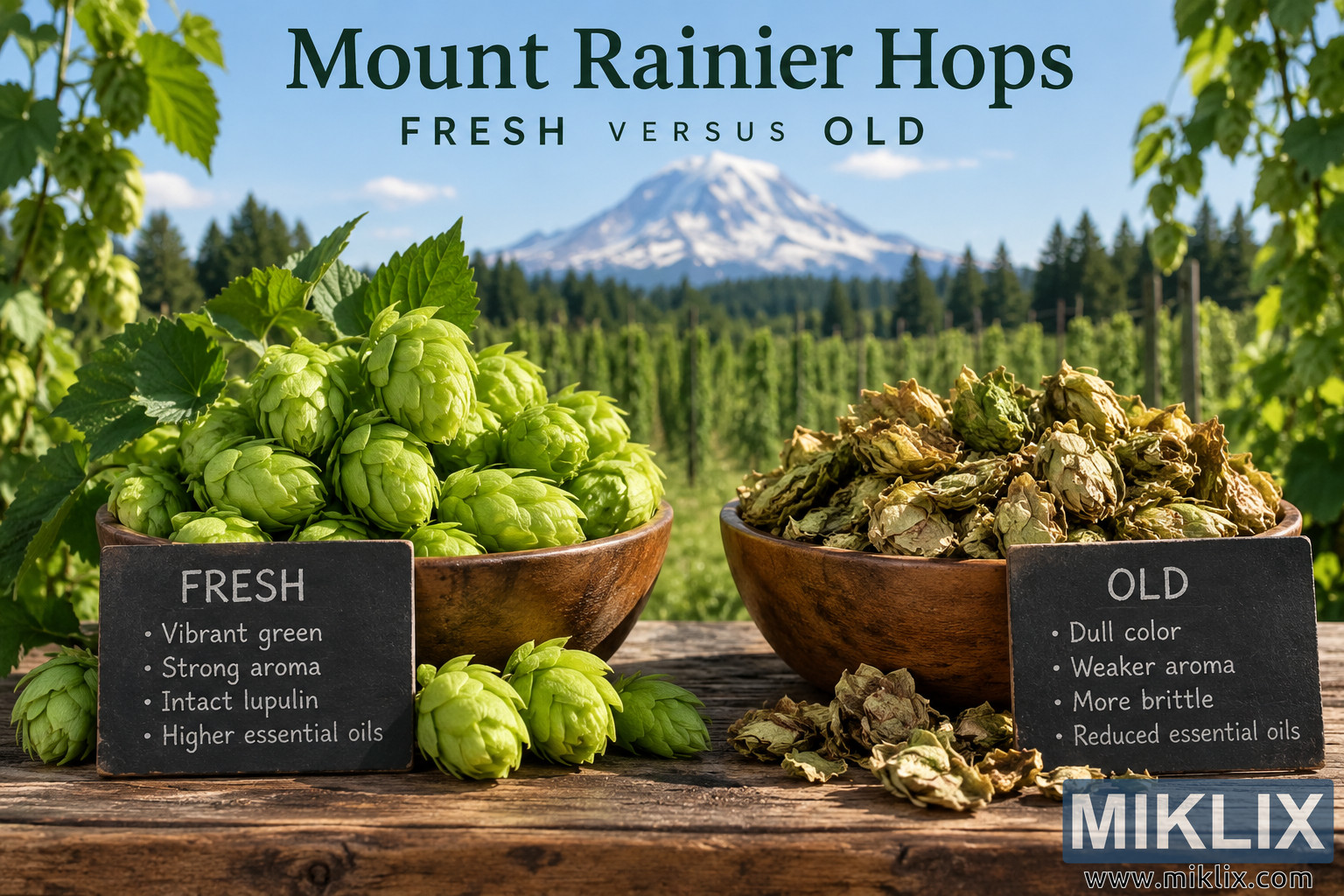
A wide, landscape-oriented photographic comparison presents fresh and old Mount Rainier hops in a bright outdoor agricultural setting. The composition is divided naturally into two contrasting halves, with fresh green hop cones displayed on the left and aged, dried hop cones displayed on the right. Both groups are arranged in substantial wooden bowls resting on a rustic, weathered wooden table. The image uses the appearance of a practical visual comparison while retaining the polished quality of a professional agricultural or brewing photograph.
Across the upper portion of the image, large dark green serif lettering reads “Mount Rainier Hops.” Directly beneath this heading, widely spaced uppercase text reads “FRESH VERSUS OLD.” The typography is centered against a clear blue sky and is positioned so that it remains highly legible without covering the main hop specimens. No commercial logos, product packaging, trademarks, or actual brand identities are visible anywhere in the scene.
The left side represents fresh hops. A large, rounded wooden bowl is filled generously with vivid green hop cones. The cones look plump, intact, and recently harvested, with overlapping bracts that retain a lively, healthy green coloration. Several cones extend beyond the bowl and rest naturally on the wooden tabletop in the foreground. Green hop leaves and stems surround portions of the fresh cones, reinforcing the impression that they have recently come from the field. Strong natural sunlight illuminates the fresh hops, producing crisp highlights along the edges of their bracts and revealing fine surface texture. Their bright yellow-green and leafy green tones stand out strongly against the darker brown wood of the bowl and table.
In front of the fresh hops is a small rectangular black chalkboard-style sign. The heading “FRESH” appears prominently in light lettering. Underneath it is a short bulleted list describing the visual and sensory characteristics associated with the fresh sample: “Vibrant green,” “Strong aroma,” “Intact lupulin,” and “Higher essential oils.” The handwritten chalk-like typography contributes to the agricultural, craft-brewing atmosphere of the photograph while keeping the comparison easy to understand at a glance.
The right side shows the contrasting old hop sample. Another rounded wooden bowl, similar in size and appearance to the first, contains a large pile of aged hop cones. Unlike the lush fresh hops, these cones are muted in color, ranging from faded olive green to tan, beige, yellow-brown, and darker brown. Their bracts appear curled, dry, papery, and brittle. Some cones look partially compressed or fragmented, and numerous loose pieces are scattered across the table in front of the bowl. This irregular debris emphasizes the dryness and physical deterioration of the older hops. The aged sample has noticeably less visual vitality than the fresh sample, creating an immediate side-by-side demonstration of how hops may change in appearance as they become old or poorly preserved.
A second black chalkboard-style sign sits in front of the aged hops. Its heading reads “OLD.” Beneath the heading, a bulleted list states “Dull color,” “Weaker aroma,” “More brittle,” and “Reduced essential oils.” The sign mirrors the design and placement of the fresh-hop sign, creating a balanced educational comparison. The two signs allow viewers to connect the visible physical differences with commonly associated changes in aroma, texture, and essential-oil character.
The background provides a scenic agricultural context. Rows of green hop plants stretch away from the foreground toward a dense line of evergreen trees. Upright supports within the hop field suggest the trellis structures commonly used for cultivating climbing hop plants. The field is rendered with progressively softer focus as it recedes, giving the image a convincing sense of depth while ensuring that the bowls and individual hop cones remain the primary subjects.
Beyond the field and forest, a large snow-covered mountain rises near the center of the horizon. Its broad, imposing shape evokes Mount Rainier and visually connects the landscape to the Mount Rainier hop variety named in the title. The distant mountain is slightly softened by atmospheric perspective and depth of field, while its white snow contrasts clearly with the blue sky and dark evergreen forest below. The mountain functions as a scenic backdrop rather than competing with the detailed foreground comparison.
Hop vines and green leaves partially frame the upper left and upper right edges of the photograph. These foreground plants create a natural border and make the viewer feel as though the comparison table has been positioned directly within or beside a working hop field. The surrounding foliage also reinforces the green tones of the fresh sample. Sunlight appears warm and directional, suggesting a clear day during the growing or harvest season. Shadows beneath the bowls, signs, cones, and scattered hop fragments add dimensionality and make the tabletop feel tactile and realistic.
The rustic table itself is an important visual element. Its broad wooden planks display pronounced grain, knots, cracks, and variations in brown coloration. These imperfections complement the natural subject matter and provide a warm neutral surface against which both the vivid fresh cones and muted old cones remain easy to distinguish. The wooden bowls share this earthy aesthetic, creating visual continuity across both sides of the comparison.
Overall, the image communicates the contrast between fresh and aged Mount Rainier hops through color, texture, condition, and supporting text. The fresh side is characterized by saturated green hues, intact cones, leafy growth, and an impression of moisture and vitality. The old side is characterized by faded brownish hues, curled and brittle plant material, broken fragments, and a visibly drier texture. The symmetrical arrangement makes the difference immediately understandable, while the hop field, evergreen forest, blue sky, and snow-covered mountain establish a natural Pacific Northwest-inspired agricultural atmosphere. The result resembles a polished educational photograph suitable for illustrating hop freshness, ingredient quality, brewing education, agricultural content, or an article explaining how the physical characteristics of hops can change with age and storage.
The image is related to: Hops in Beer Brewing: Mount Rainier