
Image: Fermentation Stages and Dry Hop Timing Options
Published: October 11, 2026 at 7:07:47 PM UTC
Explore beer fermentation stages and dry hop timing options in a detailed brewery infographic showing early, middle, late, and post-fermentation hop additions and their potential aromatic characteristics.
Available versions of this image
The image files available for download below are less compressed and higher resolution - and as a result of that, higher quality - than the images embedded in articles and pages on this website, which are more optimized for file size in order to reduce bandwidth consumption.
Regular size (1,536 x 1,024)
Large size (3,072 x 2,048)
Very large size (4,608 x 3,072)
Extra large size (6,144 x 4,096)
Comically large size (1,048,576 x 699,051)
- Still uploading... ;-)
Image description
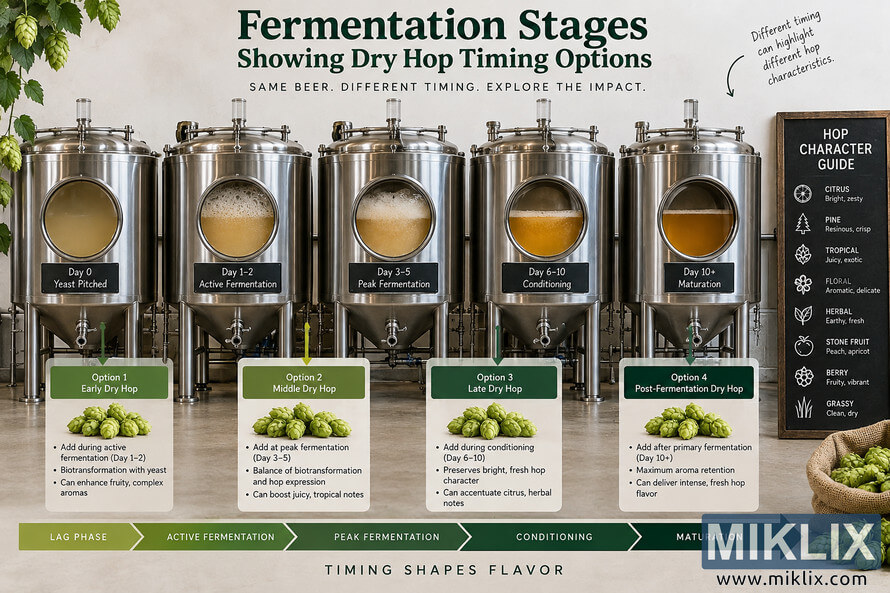
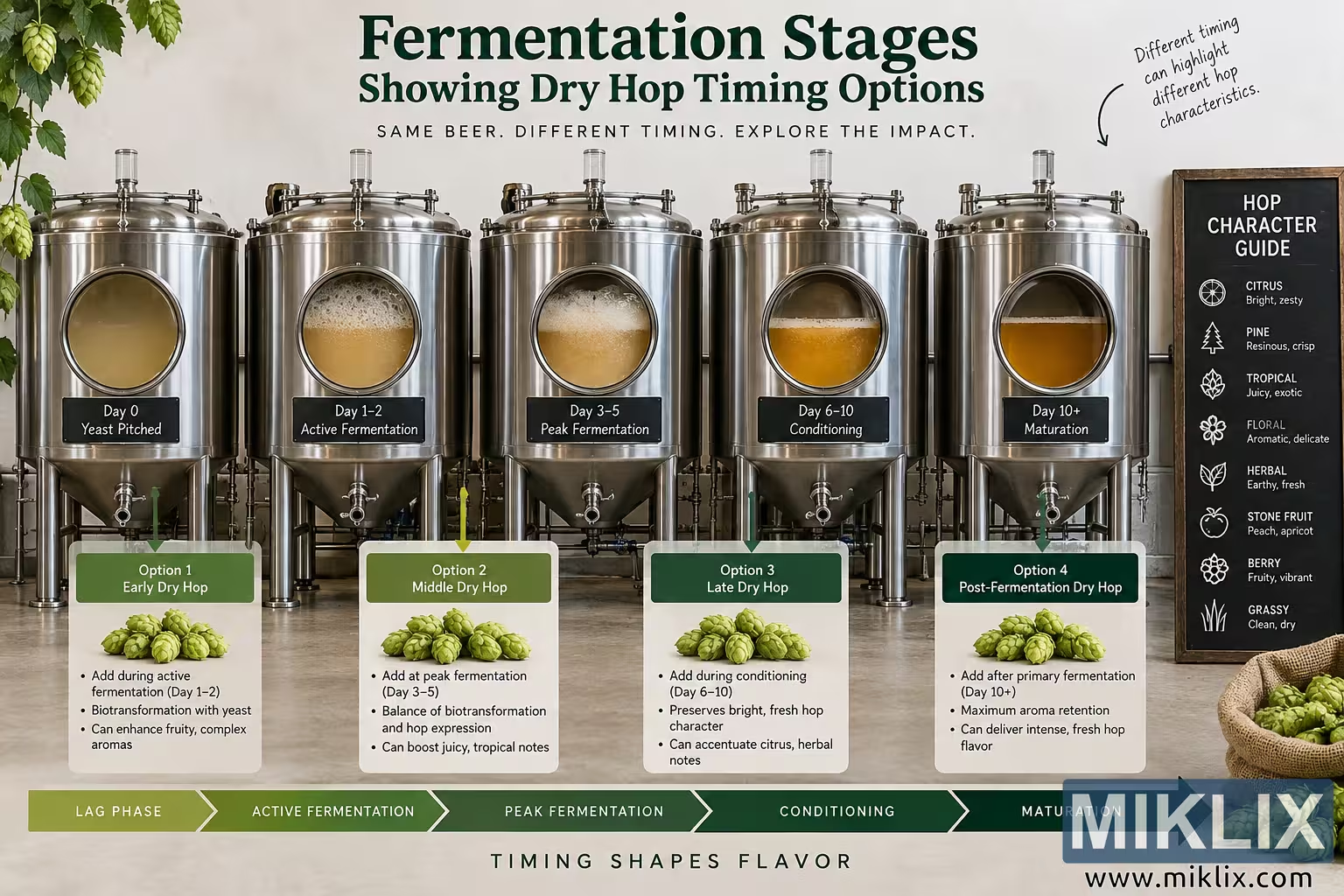
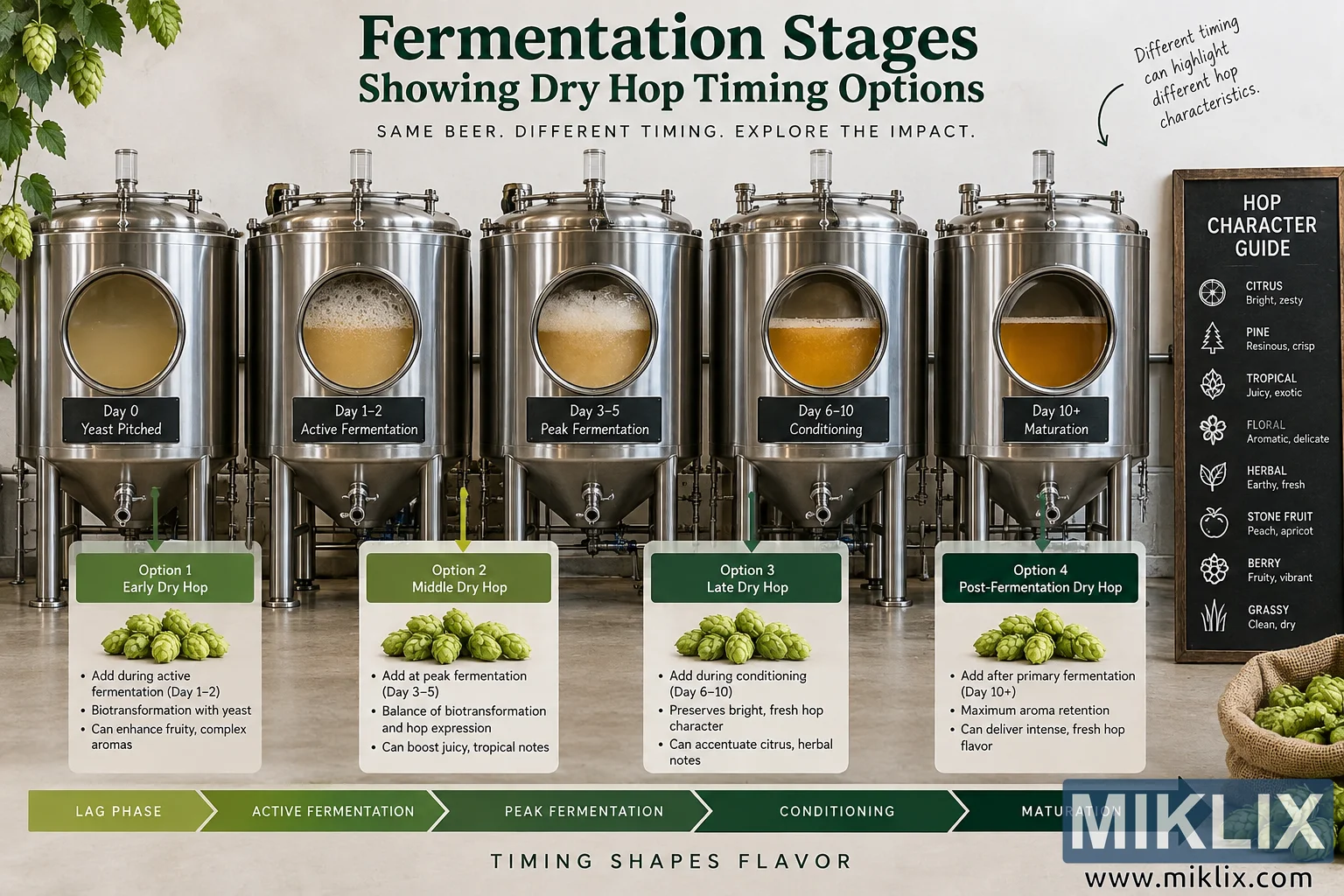
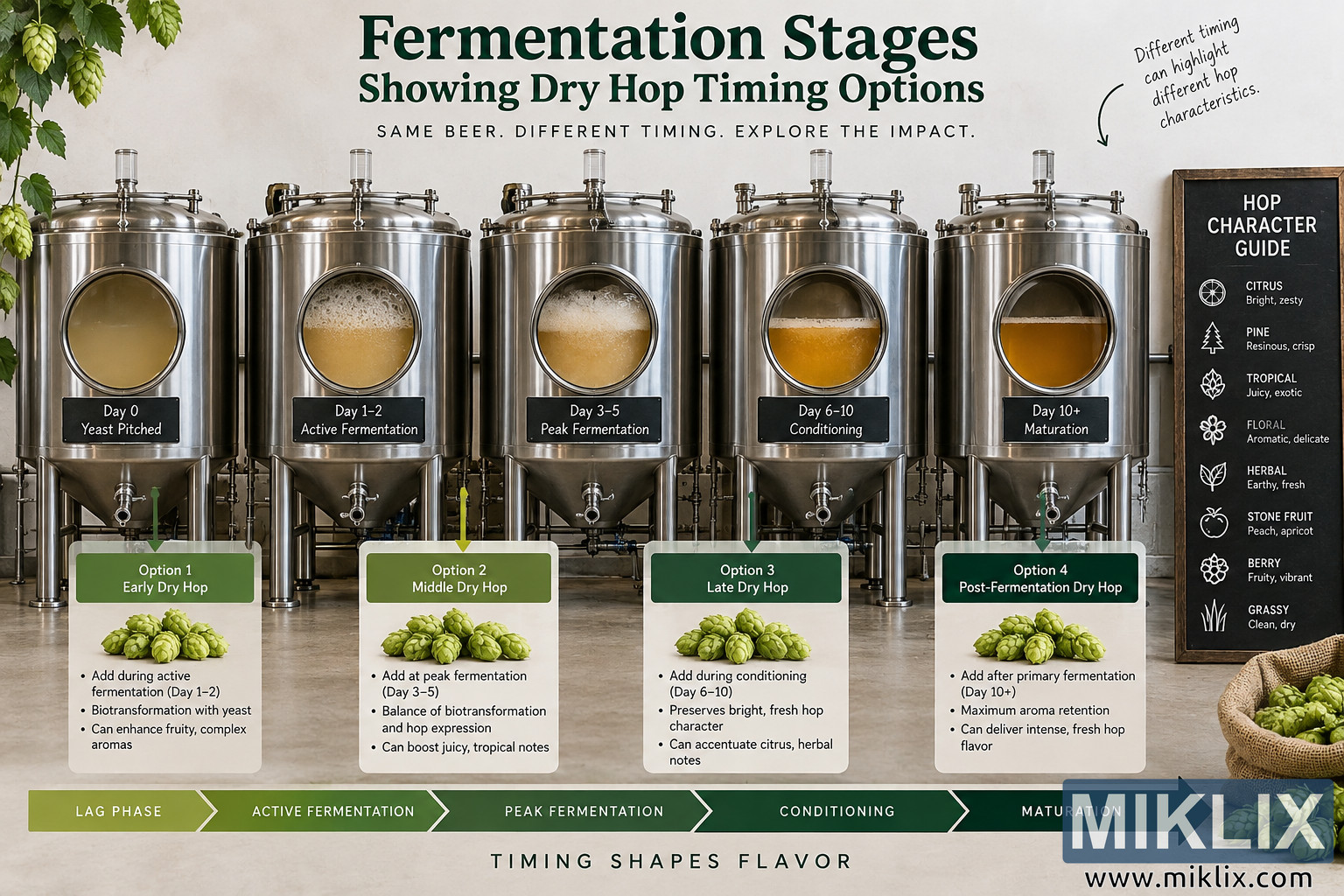
A wide, landscape-oriented educational brewery infographic presents the stages of beer fermentation and shows several possible moments for adding dry hops. The composition combines realistic photographic imagery of stainless-steel fermentation vessels with clean infographic elements, making the brewing process easy to follow from left to right. The background is a pale, lightly textured wall, while green hop vines enter from the upper-left corner and loose hop cones appear near the bottom-right corner, reinforcing the brewing theme without displaying any commercial branding.
Across the top, a large dark-green headline reads “Fermentation Stages,” followed by the subtitle “Showing Dry Hop Timing Options.” Beneath it is the phrase “Same beer. Different timing. Explore the impact.” Five polished stainless-steel fermentation tanks dominate the central portion of the image. Each vessel has industrial fittings, valves, legs, and a circular viewing window that reveals beer at a different apparent stage of fermentation. The visual progression moves from cloudy, relatively still wort on the left toward increasingly active fermentation, then clearer golden beer during conditioning and maturation on the right.
The first tank represents Day 0 and is labeled “Yeast Pitched.” Its viewing window contains pale, cloudy liquid with little visible foam, suggesting the beginning of fermentation. Below this vessel is Option 1, “Early Dry Hop.” A downward arrow connects the fermentation stage to a card containing a pile of fresh green hop cones. The explanatory text indicates that hops can be added during active fermentation around Days 1–2, that this timing allows interaction or biotransformation with yeast, and that it can enhance fruity and complex aromatic characteristics.
The second tank is labeled “Day 1–2 Active Fermentation.” The liquid visible through its round window is cloudy and topped with a noticeable layer of bubbles and foam, visually communicating vigorous yeast activity. Nearby, the second timing card is titled “Option 2 Middle Dry Hop.” It describes an addition around peak fermentation, approximately Days 3–5. The card explains that this approach can provide a balance between biotransformation and direct hop expression and may contribute juicy or tropical characteristics. Fresh hop cones are pictured prominently on the card.
The central tank represents “Day 3–5 Peak Fermentation.” Its viewing port shows cloudy golden beer with a substantial foamy head, suggesting fermentation at or near maximum activity. The tanks and timing cards overlap conceptually rather than functioning as isolated steps, emphasizing that brewers may select different hop-addition points depending on the aromatic result they are seeking.
The fourth vessel is labeled “Day 6–10 Conditioning.” The beer visible through the circular window is a clearer, deeper golden color, with only a narrow band of foam remaining at the surface. Beneath this area is “Option 3 Late Dry Hop.” Its text describes adding hops during conditioning, approximately Days 6–10. The explanation notes that this timing can preserve bright, fresh hop character and can emphasize qualities such as citrus and herbal notes. A pile of vivid green hop cones visually links the card with the hop ingredient itself.
The fifth and final fermentation vessel is labeled “Day 10+ Maturation.” Its viewing window contains clear amber-gold beer with a thin surface layer, conveying a more settled and mature stage. Below it is “Option 4 Post-Fermentation Dry Hop.” The associated card describes adding hops after primary fermentation, around Day 10 or later. It states that this approach can maximize aroma retention and can deliver an intense, fresh hop flavor and aroma. The overall sequence therefore illustrates that dry hopping is not limited to one fixed point in brewing but can occur at several stages, with timing potentially affecting the resulting aromatic profile.
Along the bottom of the composition, a long horizontal arrow acts as a fermentation timeline. It progresses through five labeled sections: “Lag Phase,” “Active Fermentation,” “Peak Fermentation,” “Conditioning,” and “Maturation.” The sections gradually shift through natural green tones and culminate in a pointed arrow at the right edge, clearly communicating chronological progression. Beneath the timeline, widely spaced capital letters state “Timing Shapes Flavor,” summarizing the central educational message of the graphic.
On the far right, a vertically oriented blackboard-style panel titled “Hop Character Guide” provides examples of sensory qualities associated with hops. Simple white line icons accompany each category. The listed characteristics include citrus, described as bright and zesty; pine, described as resinous and crisp; tropical, described as juicy and exotic; floral, described as aromatic and delicate; herbal, described as earthy and fresh; stone fruit, represented by peach and apricot; berry, described as fruity and vibrant; and grassy, described as clean and dry. Above this panel, a handwritten-style annotation with a curved arrow explains that different timing can highlight different hop characteristics.
The visual style blends brewery photography, instructional diagramming, and rustic craft-beverage aesthetics. Stainless steel, warm golden beer, chalkboard black, off-white backgrounds, and multiple shades of hop green create a natural brewing-related palette. The highly reflective tanks and realistic hop cones give the image a photographic foundation, while arrows, labels, information cards, icons, and the timeline provide the structure of an infographic. There are no recognizable commercial brands, logos, product labels, or branded brewery identifiers anywhere in the scene. Overall, the image functions as a detailed visual guide to fermentation stages and dry-hop timing, illustrating how early, middle, late, and post-fermentation hop additions relate to the evolving fermentation process and to different possible expressions of hop aroma and character.
The image is related to: Hops in Beer Brewing: Mount Rainier