
Image: Experimental Hop Tea Brewing and Tasting Process
Published: October 11, 2026 at 7:07:47 PM UTC
Explore an experimental hop tea brewing setup featuring whole hops, a glass brewer, tasting notes, steeping tools, sensory evaluation, and an iterative botanical tea process.
Available versions of this image
The image files available for download below are less compressed and higher resolution - and as a result of that, higher quality - than the images embedded in articles and pages on this website, which are more optimized for file size in order to reduce bandwidth consumption.
Regular size (1,536 x 1,024)
Large size (3,072 x 2,048)
Very large size (4,608 x 3,072)
Extra large size (6,144 x 4,096)
Comically large size (1,048,576 x 699,051)
- Still uploading... ;-)
Image description
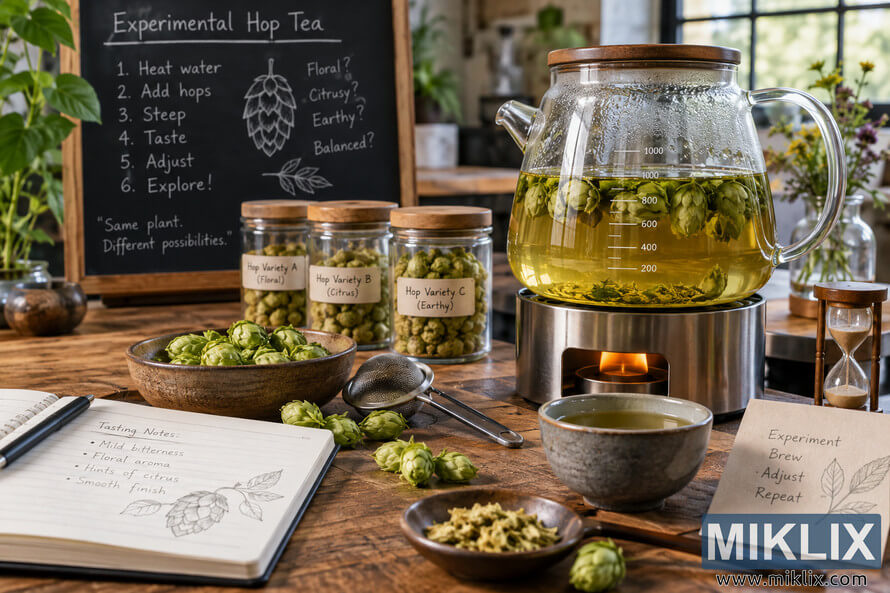
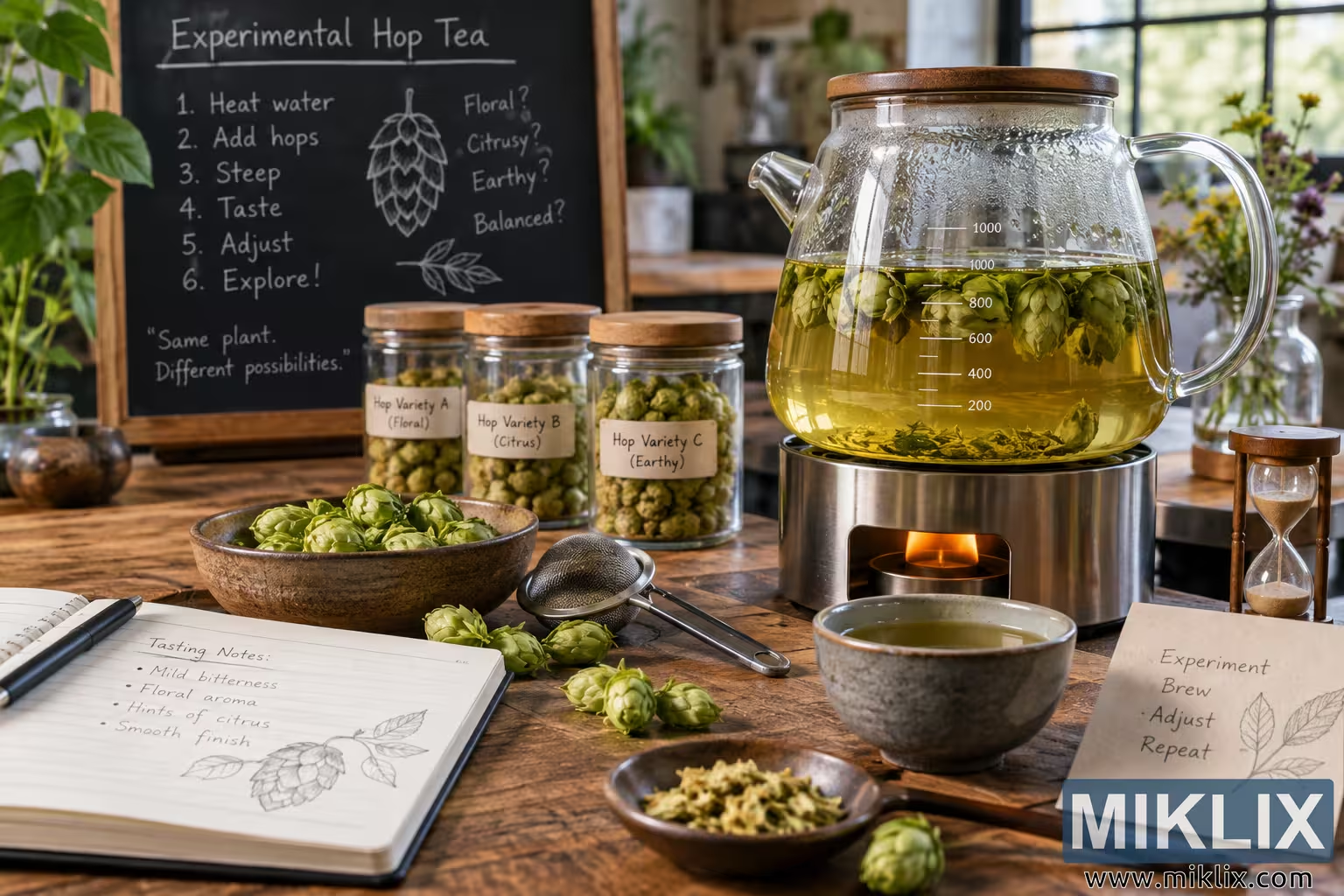
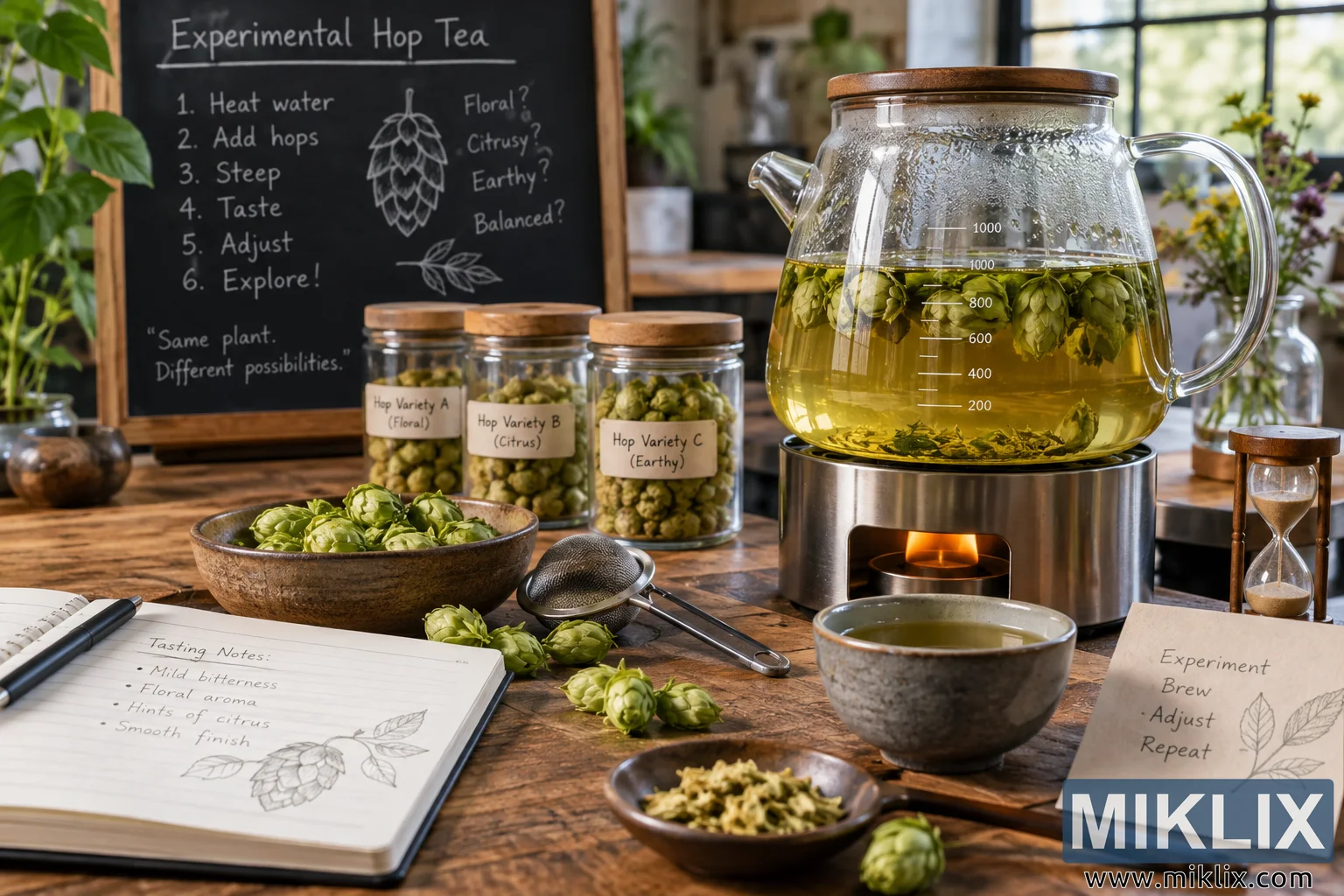
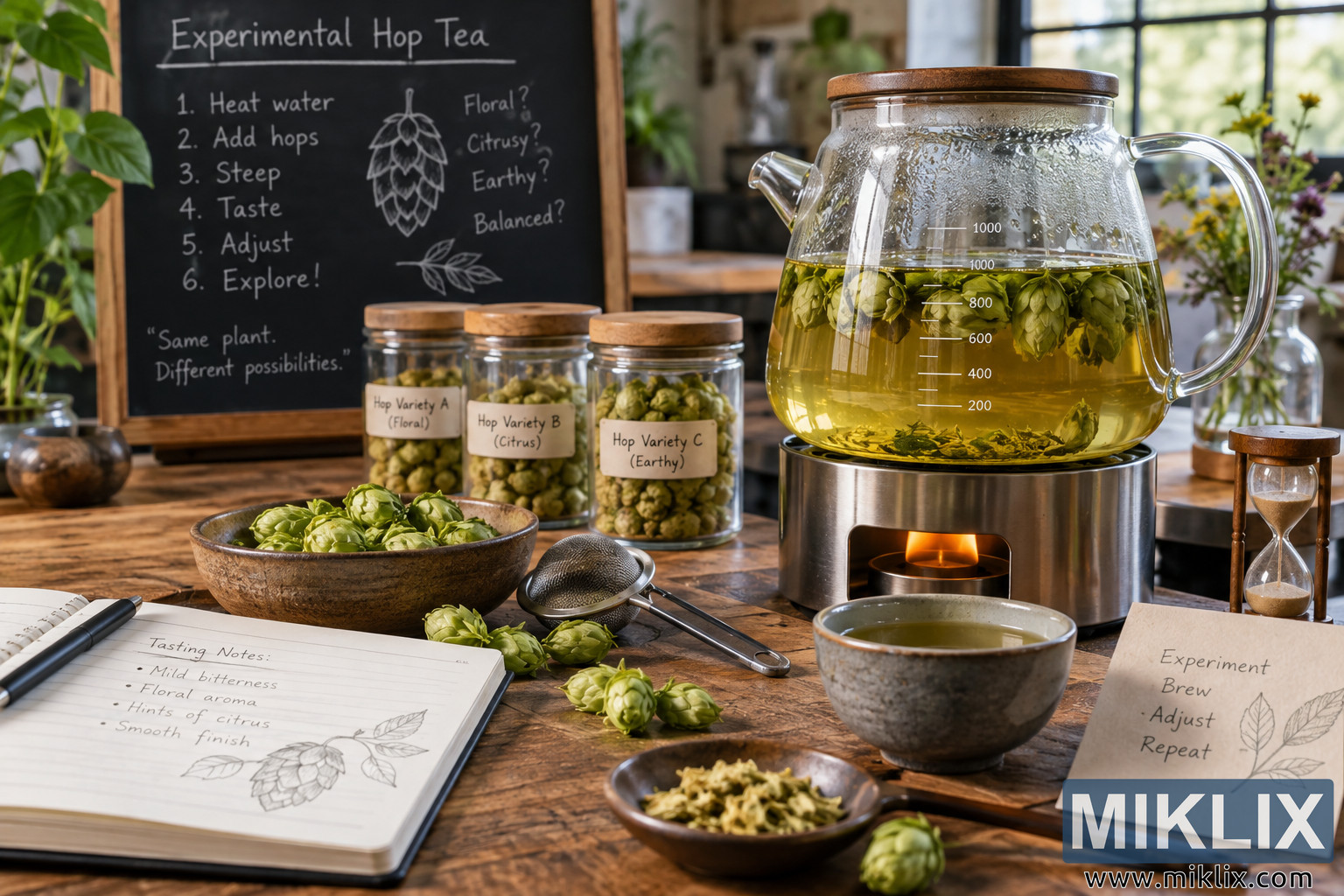
A richly detailed, landscape-oriented photograph presents an experimental hop tea brewing setup arranged across a warm, rustic wooden work surface. The scene combines the visual language of a cozy kitchen, a small botanical laboratory, and an artisanal tea-tasting station. Natural daylight enters from a large window in the upper-right background, while warmer illumination around the brewing equipment gives the composition an inviting golden glow. The central focus is a large transparent glass brewing pot positioned slightly right of center. It has a rounded body, a clear glass handle and spout, and a flat wooden lid. Condensation beads cover the upper interior of the vessel, suggesting that the liquid has recently been heated. Inside is a translucent golden-green infusion containing several whole green hop cones floating near the surface, along with smaller botanical material resting toward the bottom. White measurement markings run vertically along the side of the glass, reinforcing the experimental, measured character of the brewing process. The pot sits on a cylindrical metal warmer. Through a rectangular opening in its front, a small orange flame is visible, providing both a practical heat source and a warm visual accent.
Behind the brewing vessel stands a large framed black chalkboard. Written across the top in informal white chalk lettering is the heading 'Experimental Hop Tea.' Beneath it is a numbered brewing sequence: heat water, add hops, steep, taste, adjust, and explore. A hand-drawn hop cone appears beside a set of sensory prompts such as floral, citrusy, earthy, and balanced, each followed by a question mark. Lower on the board is the phrase 'Same plant. Different possibilities.' The handwritten notes make the setting feel exploratory rather than commercial, as though someone is testing different hop varieties and brewing parameters in a small workshop or home kitchen.
In front of the chalkboard are three cylindrical glass jars with simple wooden lids. Each contains dried green hop cones. Plain handwritten paper labels distinguish the contents as different experimental varieties, including a floral variety, a citrus-oriented variety, and an earthy variety. The labels are intentionally generic and contain no commercial branding. In front of the jars, a broad ceramic bowl is filled with fresh green hop cones. Several additional cones have been scattered naturally across the tabletop, visually connecting the raw ingredient to the infusion in the glass brewer.
The foreground contains a collection of tools and notes associated with careful tasting and experimentation. At the lower left is an open notebook with lined pages and a dark pen resting across it. The visible page is headed 'Tasting Notes' and includes observations such as mild bitterness, floral aroma, hints of citrus, and a smooth finish. A botanical sketch of a hop cone and leaves appears beneath the notes. The notebook suggests that each brewing trial is being documented so that aroma, bitterness, flavor, and overall balance can be compared between batches. Near the center lies a fine metal mesh tea strainer with a long handle, positioned beside loose hop cones. A small shallow dish in the lower foreground contains finely broken or dried plant material, suggesting another possible form of hops being evaluated during the experiment.
A substantial ceramic tasting cup occupies the lower-right-center area of the image. The cup has a handmade appearance, with a textured gray-brown exterior and a subtle warm rim. It contains a small serving of pale green-gold hop tea. A dark wooden utensil or tasting tool lies horizontally behind and beside the cup. Farther to the right stands a small wooden-framed hourglass containing light-colored sand, emphasizing the importance of steeping time. In the extreme lower-right area, a simple paper card carries the handwritten words 'Experiment, Brew, Adjust, Repeat' alongside a minimal botanical leaf drawing. This message summarizes the iterative character of the entire setup.
The background is softly out of focus, creating a shallow depth of field that keeps attention on the brewing equipment and ingredients. Green houseplants frame the left side of the scene, while small flowers and additional glass containers appear near the bright window on the right. Wooden cabinetry and neutral interior surfaces contribute to the natural, handcrafted atmosphere. The dominant palette consists of warm brown wood, muted gray ceramics, transparent glass, fresh botanical greens, pale golden tea, and the dark charcoal surface of the chalkboard. Reflections in the glass pot, visible steam condensation, the glowing flame, and the texture of the hop cones give the photograph a tactile and realistic quality.
Overall, the image depicts hop tea as an experimental botanical beverage rather than a finished commercial product. Every major element supports the idea of testing and refinement: multiple hop varieties are stored separately, fresh and dried ingredients are available for comparison, measurements are visible on the brewer, an hourglass tracks steeping time, tasting notes record sensory observations, and the chalkboard encourages adjustment after each trial. The absence of people allows the equipment, ingredients, and brewing methodology to tell the story. There are no visible brand names, logos, product packages, or other identifiable commercial marks. The resulting scene feels simultaneously scientific and approachable, illustrating a hands-on process in which hops are steeped in hot water, tasted, evaluated for characteristics such as floral, citrus, earthy, and bitter notes, and then adjusted through repeated brewing experiments.
The image is related to: Hops in Beer Brewing: Mount Rainier