
Image: Sustainable Hop Farming in Yakima Valley
Published: October 11, 2026 at 7:07:47 PM UTC
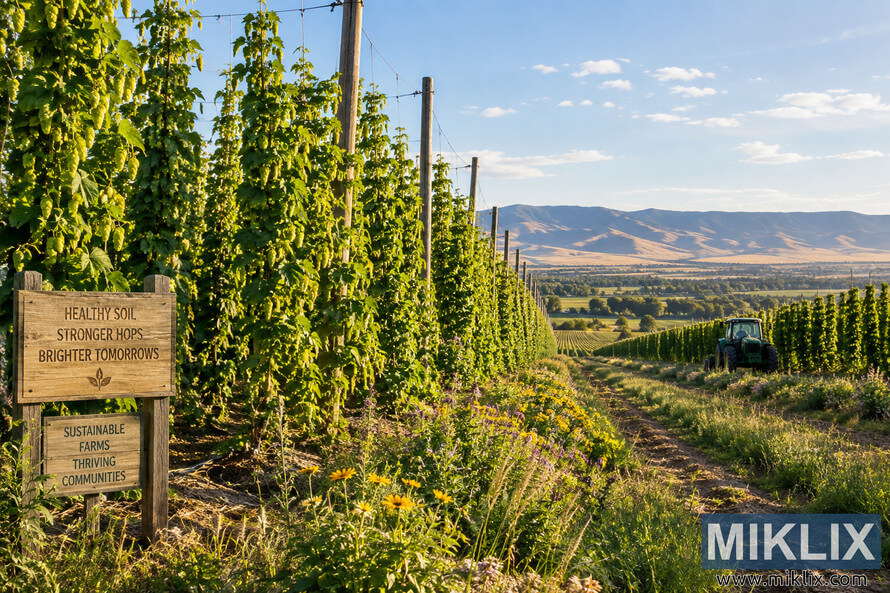
Photorealistic view of sustainable hop farming in Yakima Valley, featuring thriving hop trellises, healthy soil, efficient irrigation, wildflowers, biodiversity, an unbranded tractor, and a sweeping agricultural landscape.
Available versions of this image
The image files available for download below are less compressed and higher resolution - and as a result of that, higher quality - than the images embedded in articles and pages on this website, which are more optimized for file size in order to reduce bandwidth consumption.
Regular size (1,536 x 1,024)
Large size (3,072 x 2,048)
Very large size (4,608 x 3,072)
Extra large size (6,144 x 4,096)
Comically large size (1,048,576 x 699,051)
- Still uploading... ;-)
Image description
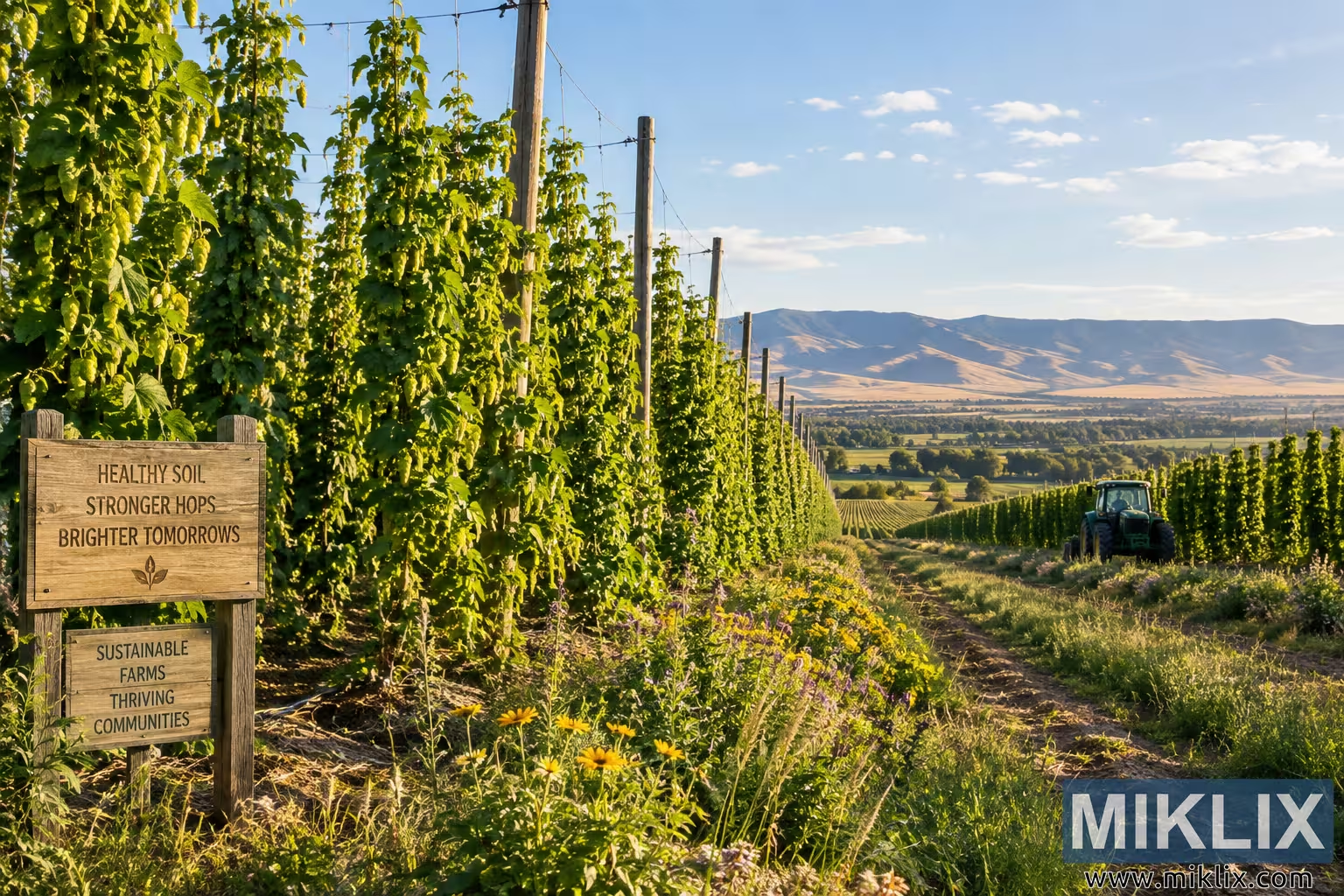
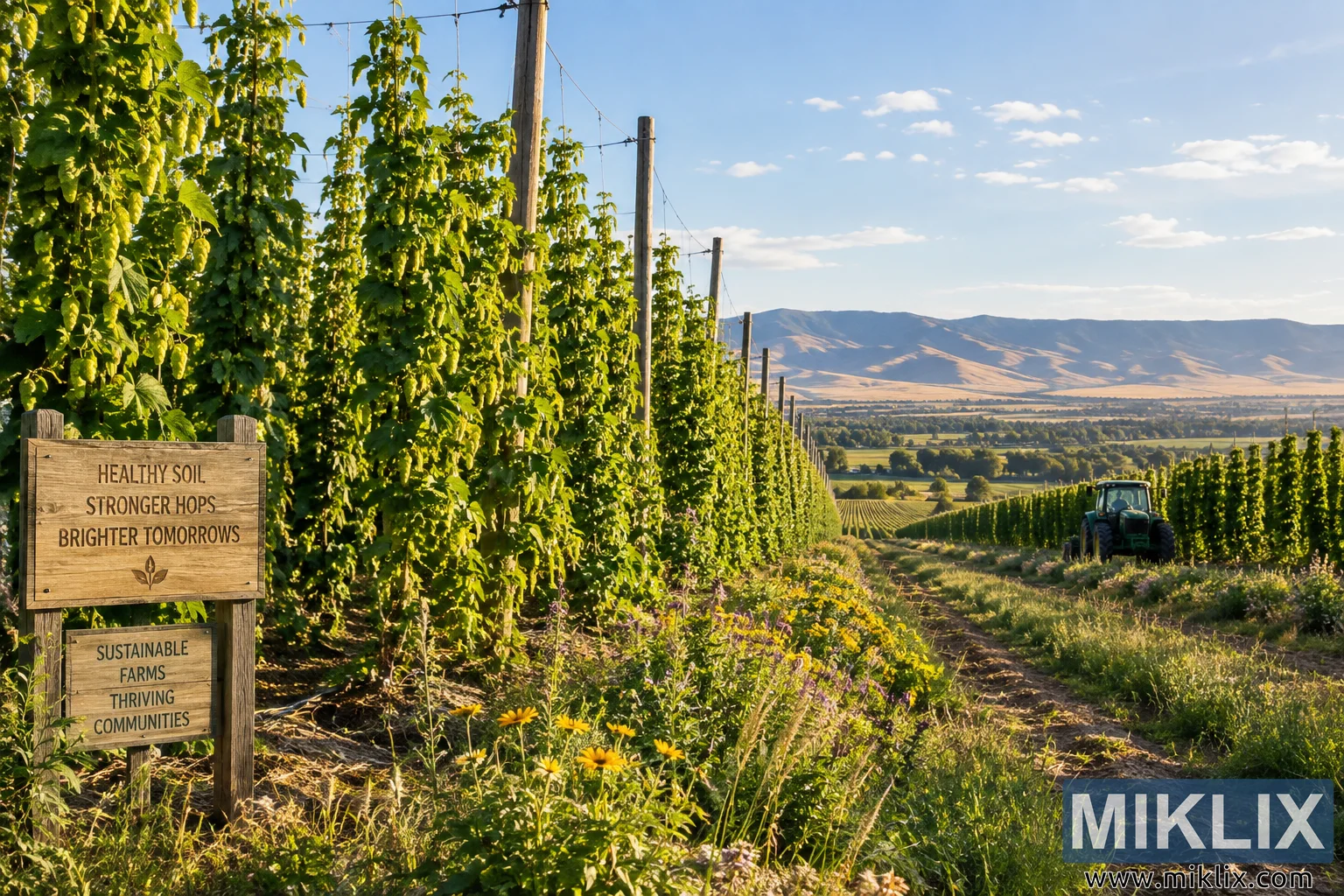
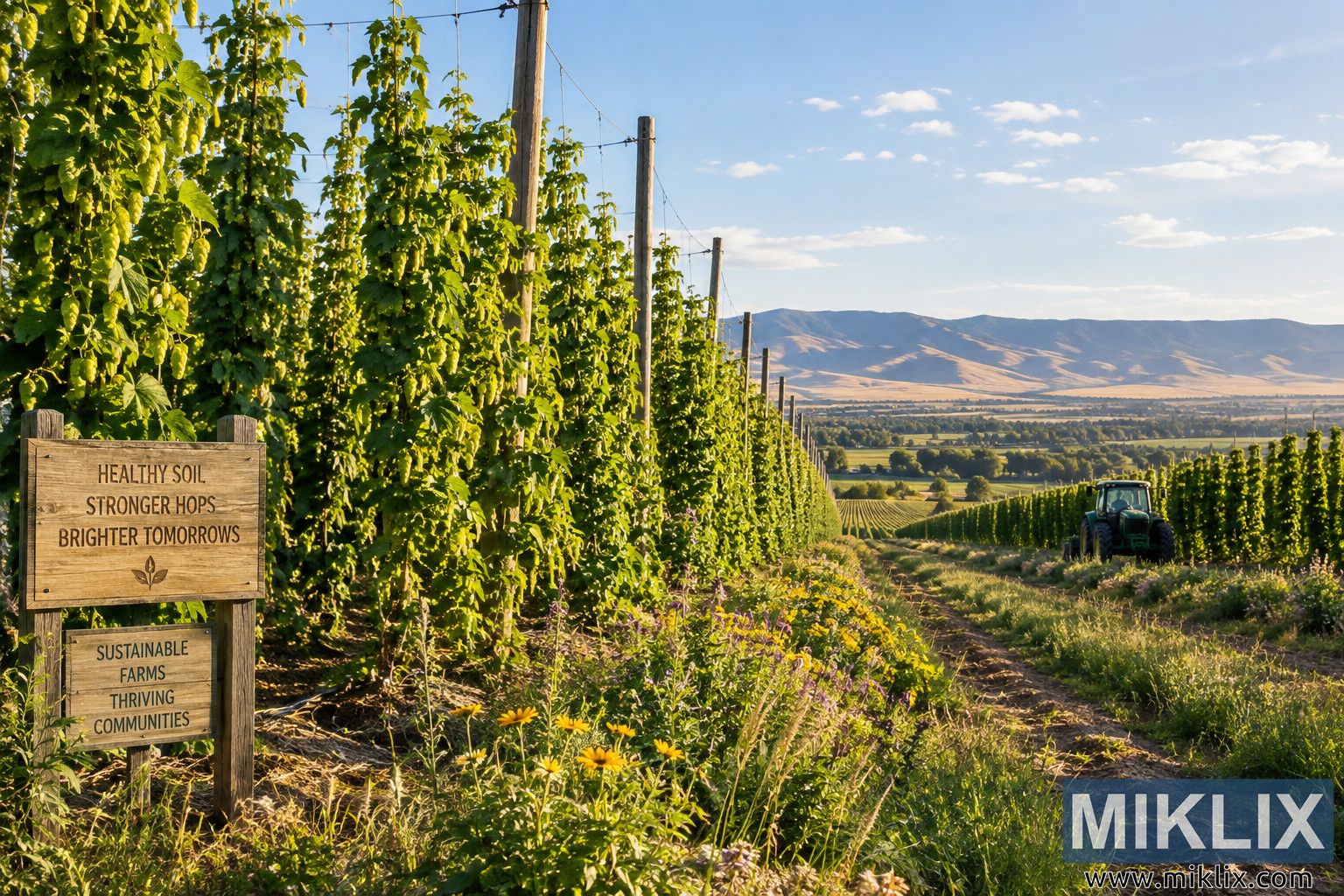
A wide, photorealistic landscape photograph depicts a flourishing hop farm in Washington State's Yakima Valley, presented in warm late-afternoon or early-evening sunlight. The composition looks down a gently descending agricultural slope toward the broad valley floor and a long range of dry, rounded mountains in the distance. The scene combines productive agriculture with visible signs of environmentally conscious land management, creating an optimistic visual representation of sustainable hop farming. Tall hop plants dominate the left side and middle distance of the image. Their vigorous green vines climb vertically up an extensive trellis system made from weathered wooden poles and suspended wires. The plants are dense with large green leaves and clusters of pale green hop cones, suggesting a healthy crop approaching harvest. Repeating rows of vines and poles create strong perspective lines that lead the eye from the foreground toward the center of the valley. Sunlight enters from the right side of the scene, illuminating the edges of leaves and hop cones and producing a rich mixture of bright yellow-green highlights and deep natural shadows. In the lower-left foreground, two rustic wooden signs are attached to sturdy posts beside the hop rows. The larger upper sign carries the words 'HEALTHY SOIL', 'STRONGER HOPS', and 'BRIGHTER TOMORROWS', with a small plant symbol underneath. A second, smaller sign below it reads 'SUSTAINABLE', 'FARMS', 'THRIVING', and 'COMMUNITIES'. The signs are deliberately simple and unbranded, with dark lettering burned or printed onto natural wood. Their weathered texture complements the surrounding farm environment and communicates the central theme of sustainability without referencing a commercial company or product. Beneath and around the signs, the soil is visible between the hop plants, with irrigation tubing running close to the base of the crop. The restrained placement of irrigation infrastructure suggests efficient delivery of water directly to the plants, an especially relevant consideration in the relatively dry climate of the Yakima Valley. The ground is not depicted as a perfectly cleared monoculture. Instead, a diverse strip of vegetation and flowering plants grows along the central field margin. Yellow, purple, white, and pink wildflowers mingle with grasses and other low-growing plants, providing a colorful contrast to the uniform vertical structure of the hop rows. This flowering habitat visually suggests practices such as maintaining biodiversity, supporting beneficial insects and pollinators, protecting soil, and reducing unnecessary disturbance of field margins. A rough farm track curves through the vegetation on the right half of the image. The path consists primarily of exposed soil with strips and patches of grass, giving it a practical, lightly managed appearance rather than the look of a heavily engineered road. A green agricultural tractor stands farther down this track among the hop rows. The tractor is small in relation to the expansive landscape and contains no visible manufacturer name, logo, or other branding. Its presence indicates that mechanized farming remains part of the operation while allowing the surrounding plants, soil, and landscape to remain the main visual focus. On both sides of the tractor, more tall hop vines extend across the hillside in carefully organized rows. Farther away, additional cultivated fields form geometric patterns across the valley floor. Lines of crops, green parcels, scattered trees, and agricultural plots demonstrate the scale and diversity of farming in the region. Darker bands of mature trees trace portions of the distant landscape and help visually separate the productive farmland from the arid mountain slopes beyond. The mountains stretch almost continuously across the horizon. Their muted blue-gray shadows and sunlit tan ridges evoke the semi-arid terrain surrounding the Yakima Valley. The contrast between the dry hills and the intensely green agricultural land emphasizes the importance of thoughtful soil and water management in this environment. The sky occupies roughly the upper third of the composition and is clear, bright blue with a scattering of small, soft white clouds. The atmosphere is calm, with no visible smoke, storms, industrial structures, or urban development. Warm directional sunlight gives the entire scene a golden quality and enhances the textures of the wooden trellis posts, foliage, flowers, soil, and distant hills. The photographic viewpoint is positioned close to ground level beside the first hop row, making the plants in the foreground appear especially tall and abundant. This perspective creates a strong sense of depth: large, detailed leaves and cones fill the immediate foreground, progressively smaller trellis posts draw the viewer into the middle distance, and the valley and mountains open up beyond them. The central strip of flowers and grasses functions as another leading line, visually connecting the sustainability message on the signs with the working fields farther into the landscape. Overall, the image portrays sustainable hop farming as a combination of productive cultivation and ecological stewardship. Healthy hop vines, targeted irrigation infrastructure, vegetated field margins, flowering habitat, maintained soil cover, agricultural machinery, and a diverse rural landscape all contribute to this theme. Rather than presenting sustainability as an abstract concept, the photograph expresses it through tangible features embedded in an active farm. The mood is productive, peaceful, hopeful, and forward-looking. The warm sunlight and thriving vegetation convey agricultural vitality, while the rustic signs explicitly connect healthy soil and strong crops with resilient farms and communities. The recognizable dry mountains, expansive agricultural valley, and extensive hop trellises establish a convincing Yakima Valley setting, while the complete absence of visible commercial branding keeps the emphasis on farming practices, landscape stewardship, and the long-term relationship between agriculture and the surrounding environment.
The image is related to: Hops in Beer Brewing: Mount Rainier