
Image: Historical Hop Breeding Research and Botanical Documentation
Published: October 14, 2026 at 3:37:39 PM UTC
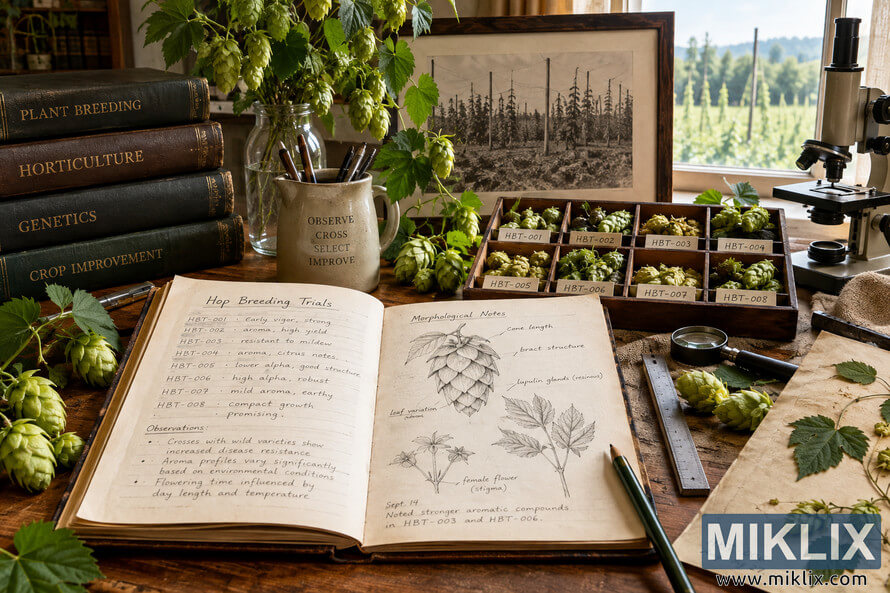
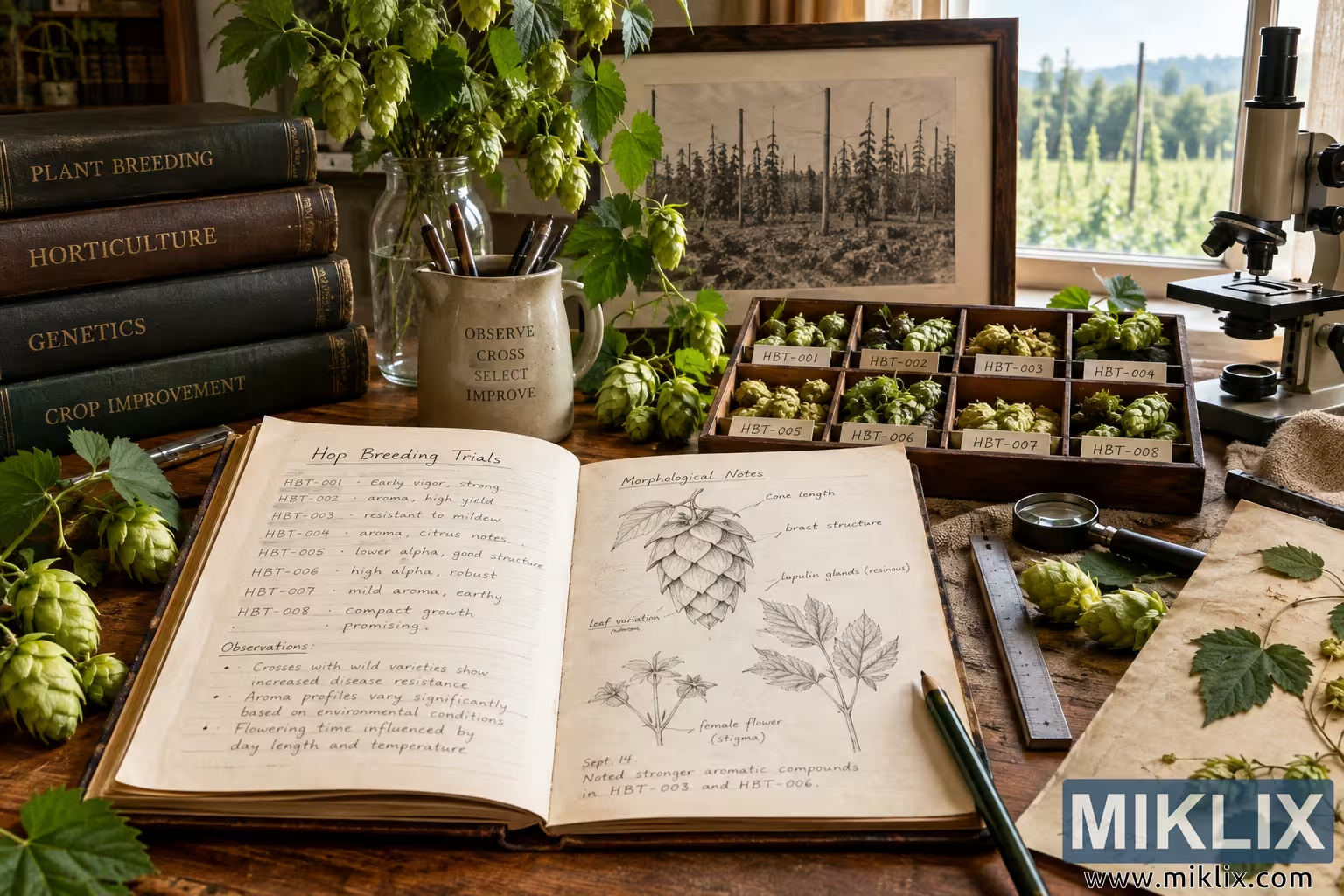
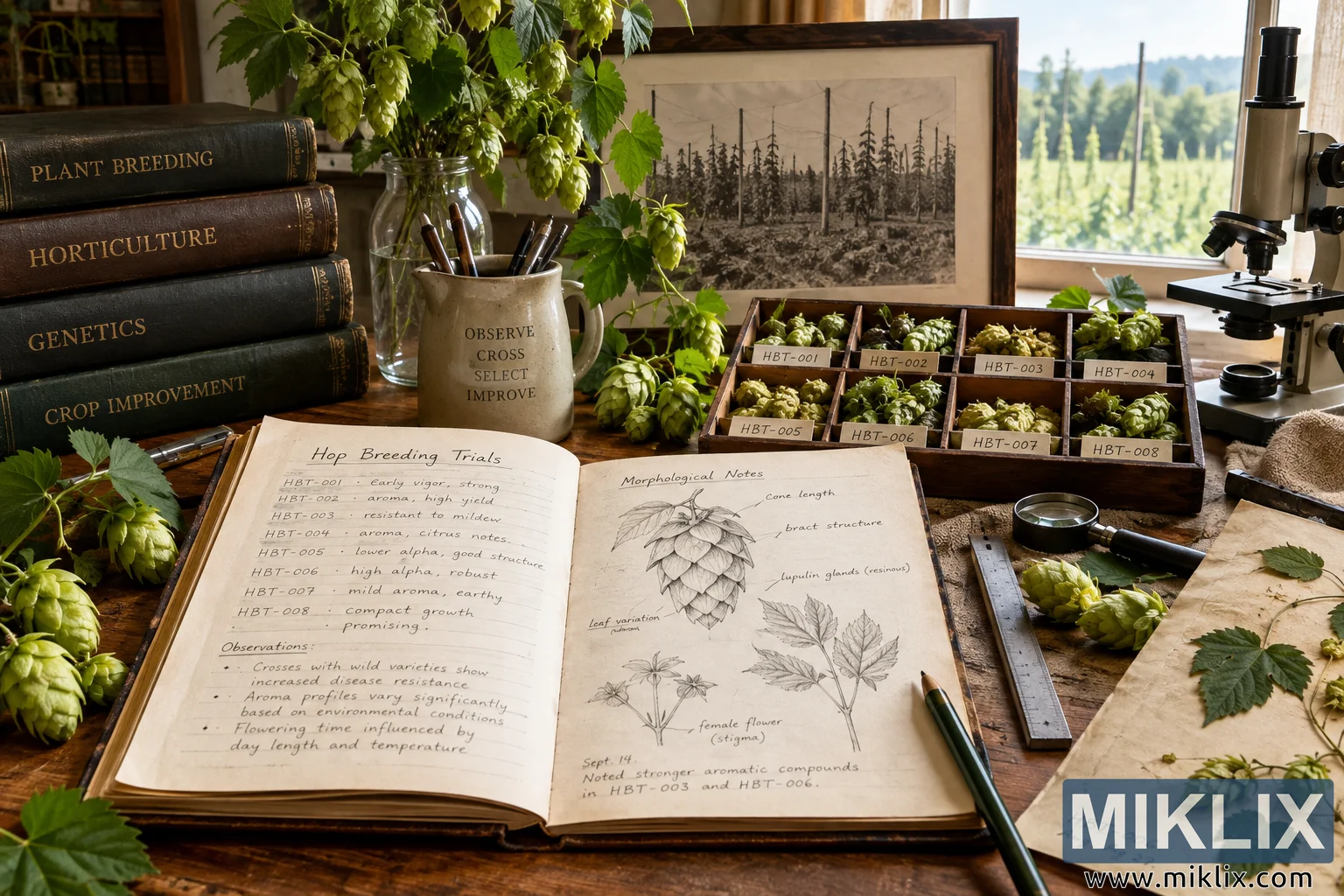
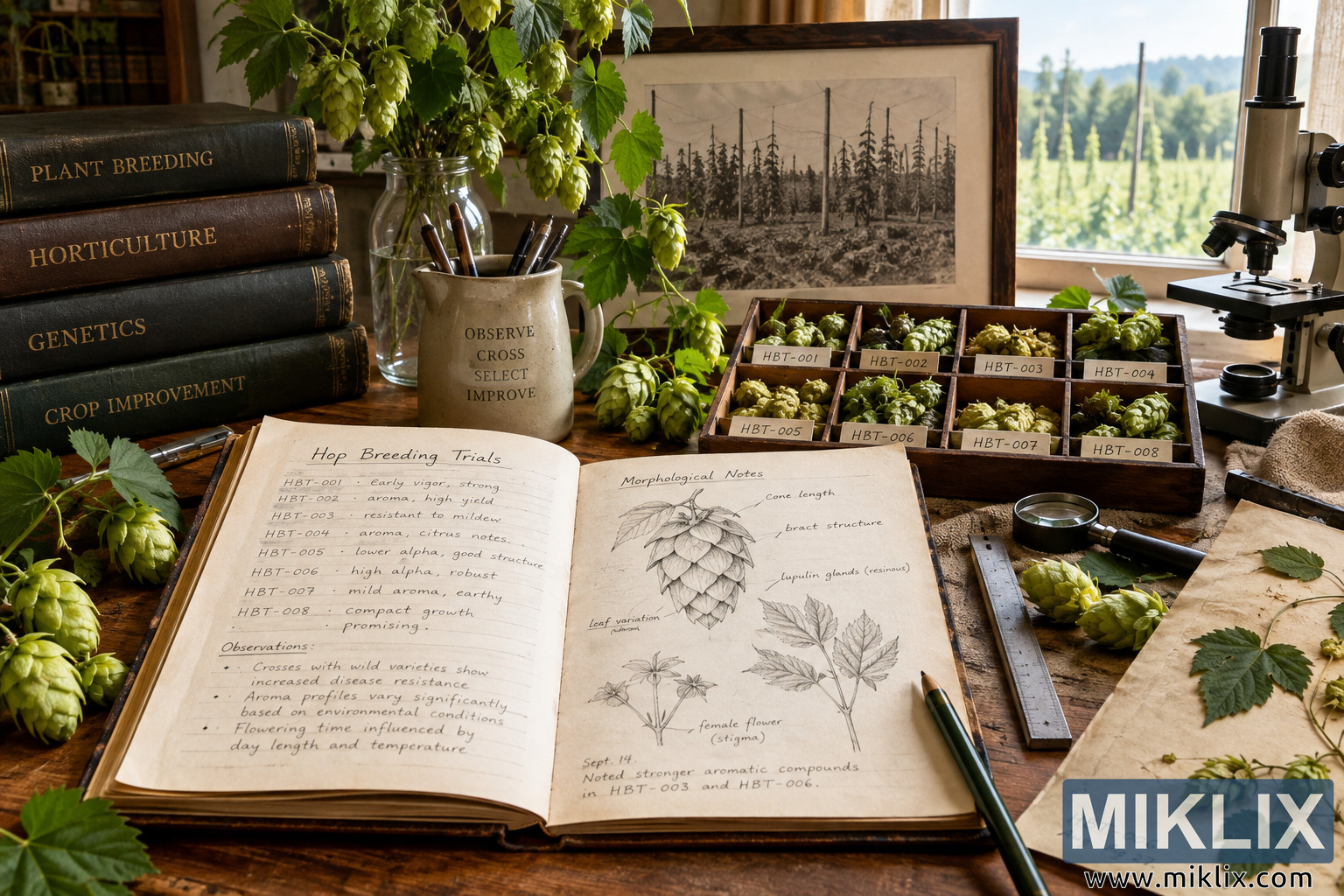
Historical hop breeding research scene featuring handwritten trial records, botanical drawings, labeled hop specimens, scientific instruments, reference books, pressed plants, and a hop field.
Available versions of this image
The image files available for download below are less compressed and higher resolution - and as a result of that, higher quality - than the images embedded in articles and pages on this website, which are more optimized for file size in order to reduce bandwidth consumption.
Regular size (1,536 x 1,024)
Large size (3,072 x 2,048)
Very large size (4,608 x 3,072)
Extra large size (6,144 x 4,096)
Comically large size (1,048,576 x 699,051)
- Still uploading... ;-)
Image description
A richly detailed, landscape-oriented historical research scene depicts a rustic workspace devoted to hop breeding, plant genetics, horticulture, and crop improvement. The composition is presented as a carefully arranged still life inside what appears to be an agricultural research room or field laboratory, with warm natural sunlight entering through a large window on the right. Beyond the window, rows of tall hop plants can be seen growing outdoors on a system of vertical poles and supports, immediately connecting the indoor scientific documentation with the living crop being studied in the field. The overall atmosphere combines botanical science, archival research, and traditional hands-on plant breeding, suggesting a period before modern digital laboratory equipment became dominant. In the foreground, an open research notebook occupies the central and most visually prominent part of the wooden worktable. Its aged cream-colored pages contain handwritten notes, identification codes, observations, and carefully rendered botanical illustrations. The left-hand page is headed with a reference to hop breeding trials and contains a sequence of experimental plant identifiers accompanied by short descriptions of characteristics such as vigor, aroma, yield, disease resistance, alpha-related properties, structure, and growth habit. Beneath these entries is a section of broader observations concerning breeding crosses, environmental effects, flowering, aroma, and other traits that a researcher might monitor during a long-term selection program. The facing page is dominated by precise pencil-style botanical drawings. A large hop cone is illustrated in the center, with lines pointing toward individual morphological features such as the cone structure and its overlapping bracts. Additional drawings show hop leaves and reproductive structures, reinforcing the impression of systematic botanical documentation. Handwritten annotations surround the sketches, while a sharpened green pencil rests diagonally near the lower-right edge of the notebook, as though the researcher has only recently stopped writing. Behind the notebook, a rectangular wooden specimen tray is divided into multiple compartments. Each compartment contains dried or freshly harvested hop cones and bears a simple handwritten experimental code. The samples vary subtly in size, shape, density, and coloration, suggesting that they represent different breeding lines or selections being compared for desirable characteristics. The lack of commercial branding and the use of generic research identifiers make the scene feel like an internal scientific breeding program rather than a commercial product display. To the left, several substantial, dark-bound reference books are stacked on the table. Their spines identify broad academic subjects including plant breeding, horticulture, genetics, and crop improvement. The books have a worn, archival appearance, with dark leather-like covers and understated gold lettering, implying that they have been consulted repeatedly over many years. In front of and beside the books are loose hop leaves and mature green hop cones, bringing living botanical material into direct contact with the written scientific literature. A glass jar behind the books holds freshly cut hop stems, leaves, and cones, creating a vertical burst of green foliage that fills the upper-left and central portions of the image. Nearby is a ceramic vessel containing pens and pencils. Its simple inscription summarizes a traditional breeding process through the concepts of observation, crossing, selection, and improvement, visually linking the tools of documentation to the iterative process of developing new plant varieties. In the background, a framed monochrome archival photograph shows an older hop field with tall poles and climbing plants. The historical photograph establishes a visual connection between past agricultural practice and the present research materials on the desk. Its muted black-and-white appearance contrasts with the vivid green hops and warm brown wood of the contemporary still life, strengthening the sense that the image represents the documentation of a long-running breeding tradition. On the far right of the table stands a traditional laboratory microscope. Its metal body, eyepiece, objective assembly, stage, and focusing controls are clearly visible, indicating that the work involves not only field observation but also close examination of plant structures. A small magnifying glass lies nearby on the table, positioned above several loose hop cones and leaves. A straight measuring ruler rests diagonally beside the specimens, suggesting that cone dimensions, leaf characteristics, or other physical traits are being measured and recorded. These instruments give the setting a practical scientific character while remaining consistent with the historical visual language of the scene. Along the lower-right portion of the composition, a sheet of aged botanical documentation contains pressed hop leaves, small plant structures, and detached cones. A handwritten experimental identifier and date-like notation appear near its bottom edge, evoking the appearance of a herbarium sheet or preserved breeding record. The specimens are arranged carefully rather than decoratively, emphasizing comparison, identification, and preservation. Additional hop cones are scattered naturally across the work surface, some attached to leafy stems and others separated for examination. Their overlapping papery bracts and varied green tones are rendered with considerable detail. The wooden table itself is visibly worn, with scratches, grain patterns, and an uneven patina that imply years of practical use. Burlap-like fabric appears beneath some of the equipment on the right, contributing another tactile agricultural texture. The lighting is warm and directional, with sunlight entering from the right and illuminating the notebook, specimens, microscope, and foliage. Highlights on the hop cones emphasize their layered structure, while gentle shadows between the books, tray compartments, and laboratory tools add depth to the arrangement. The color palette is dominated by natural greens, warm browns, cream paper, muted black, and aged metallic tones. This restrained palette reinforces the historical and documentary character of the scene without making it appear artificially antique. The image contains no people; instead, the researcher is implied through the objects left in active use. The open notebook, uncapped writing instruments, arranged samples, measuring tools, microscope, reference books, and freshly gathered plant material collectively suggest an ongoing investigation interrupted only briefly. The viewer is positioned close to the worktable, almost in the place of the researcher, making the documentation and specimens feel accessible and tangible. The outdoor hop field visible through the window extends the narrative beyond the room: experimental plants are grown outside, harvested and brought indoors, compared with one another, examined, measured, illustrated, and documented before selections are made for future breeding cycles. Taken as a whole, the image presents historical hop breeding as a patient, observational scientific practice built around field trials, botanical knowledge, genetic selection, physical specimens, meticulous handwritten records, and repeated comparison across generations. It communicates both the agricultural nature of hop cultivation and the methodical research required to develop improved varieties, while maintaining the intimate atmosphere of a traditional horticultural research station or breeder's study.
The image is related to: Hops in Beer Brewing: MultiHead