
Image: Proper Hop Storage Containers and Methods
Published: October 14, 2026 at 3:37:39 PM UTC
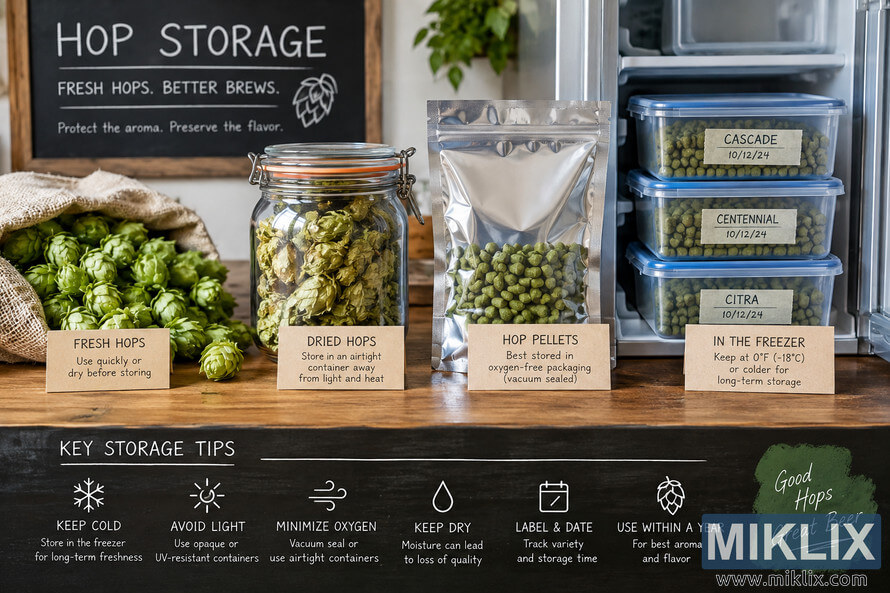
A detailed visual guide to proper hop storage, illustrating airtight containers, vacuum-sealed packaging, freezer storage, labeling, and methods for preserving hop aroma, flavor, and freshness.
Available versions of this image
The image files available for download below are less compressed and higher resolution - and as a result of that, higher quality - than the images embedded in articles and pages on this website, which are more optimized for file size in order to reduce bandwidth consumption.
Regular size (1,536 x 1,024)
Large size (3,072 x 2,048)
Very large size (4,608 x 3,072)
Extra large size (6,144 x 4,096)
Comically large size (1,048,576 x 699,051)
- Still uploading... ;-)
Image description
A wide, landscape-oriented educational image presents a clear visual guide to proper hop storage containers and methods in a bright, rustic-modern kitchen or brewing workspace. The composition is arranged across a warm wooden countertop, with several different forms of hops and storage solutions displayed from left to right. The overall image combines realistic food and product photography with infographic-style labels and instructional text, making it suitable as a visual reference for home brewers, craft brewers, and anyone interested in preserving hop freshness, aroma, and flavor.
On the far left, a loosely woven natural burlap sack lies partially open on the countertop. A generous quantity of vivid green, freshly harvested hop cones spills from the sack and spreads naturally across the wooden surface. The hop cones have clearly defined overlapping bracts and a fresh botanical appearance, emphasizing their delicate and perishable nature. A small kraft-paper information card positioned in front of the hops identifies them as fresh hops and explains that they should be used quickly or dried before longer-term storage. This section visually establishes the difference between freshly harvested hops and the processed forms shown elsewhere in the image.
Immediately to the right of the fresh hops is a large transparent glass storage jar filled with dried whole hop cones. The jar has a sturdy hinged clamp lid and an orange rubber gasket, suggesting an airtight seal. The dried hops inside are visibly less vibrant than the fresh green cones, with muted olive-green and yellow-green tones that communicate their dried condition. A kraft-paper label in front of the jar identifies the contents as dried hops and recommends storing them in an airtight container away from light and heat. The transparent jar makes the contents easy to identify while the accompanying instruction reinforces that, in practical storage situations, limiting exposure to light is important for preserving quality.
At the center of the image stands a metallic silver barrier pouch containing green hop pellets. The upper portion of the pouch is opaque and reflective, while a transparent lower window reveals the compact cylindrical pellets inside. The package is shown as tightly sealed, visually representing oxygen-resistant or vacuum-sealed packaging. A label positioned in front identifies the contents as hop pellets and states that they are best stored in oxygen-free packaging, such as vacuum-sealed bags. The reflective packaging also suggests protection from light, another major factor in maintaining hop quality during storage.
On the right side of the composition, an open freezer provides an example of long-term hop storage. Three rectangular food-storage containers with blue lids are stacked neatly on freezer shelves. Each container holds a substantial quantity of green hop pellets. Simple handwritten-style labels on the fronts of the containers identify different hop varieties, including Cascade, Centennial, and Citra, along with storage dates. These names are presented as hop varieties rather than commercial branding. The dated labels demonstrate an important organizational practice: clearly recording both the hop variety and the date it was packaged or placed into storage. A kraft-paper information card in front of the freezer section explains that hops intended for long-term storage should be kept frozen, with a suggested temperature around 0°F or -18°C.
Behind the main storage examples, a large framed black chalkboard occupies the upper-left background. In hand-drawn white lettering, the board introduces the subject of hop storage and emphasizes the goal of maintaining fresher hops for better brewing results. Additional text refers to protecting aroma and preserving flavor, while a simple line illustration of a hop cone reinforces the brewing theme. The dark chalkboard contrasts strongly with the bright green hops and warm wood countertop, giving the scene the approachable character of a brewing workshop or instructional kitchen.
A broad black infographic panel spans the entire bottom portion of the image. It is headed with the phrase 'KEY STORAGE TIPS' in large white lettering. Beneath the heading, six illustrated recommendations are arranged horizontally, each accompanied by a simple white line icon and concise explanatory text. The first recommendation uses a snowflake symbol to emphasize keeping hops cold and storing them in the freezer for long-term freshness. The second uses a light or sun symbol to indicate that hops should be protected from light, preferably through opaque or UV-resistant packaging. The third uses an airflow-style symbol to emphasize minimizing oxygen exposure through vacuum sealing or airtight containers. The fourth uses a droplet icon to communicate the importance of keeping hops dry because excess moisture can reduce quality and encourage deterioration. The fifth uses a calendar icon to recommend labeling and dating stored hops so that varieties and storage duration can be tracked. The final recommendation uses a hop-cone icon and advises using stored hops within a reasonable period for the best aroma and flavor.
At the lower-right corner of the infographic panel, a textured green brushstroke contains a short handwritten brewing-themed message linking good-quality hops with good beer. This decorative element adds visual warmth without representing an actual company, product, or commercial brand. No recognizable brand logos or branded packaging appear anywhere in the scene. Instead, all storage containers and packages are intentionally generic, allowing the image to focus entirely on storage practices rather than specific products.
The image communicates several interconnected principles of proper hop storage. Hops should be protected from heat, light, oxygen, and moisture, all of which can accelerate deterioration and diminish desirable aromatic compounds. Fresh hops require particularly prompt use or appropriate processing, while dried whole hops benefit from airtight storage. Hop pellets are shown in sealed barrier packaging to minimize oxygen exposure, and frozen storage is presented as the preferred approach for maintaining quality over longer periods. The dated freezer containers demonstrate that good storage is not only about temperature and packaging but also about organization and inventory management.
Visually, the scene is clean, bright, realistic, and highly legible. Natural green hops provide the dominant color accent, complemented by warm brown wood, neutral kraft-paper labels, reflective silver packaging, transparent glass, cool freezer surfaces, and dark chalkboard panels. Soft daylight and controlled studio-style illumination reveal the textures of the hop cones, pellets, burlap, glass, metal packaging, plastic containers, and wooden countertop. The horizontal arrangement creates an intuitive progression from fresh hops through dried hops and pelletized hops to long-term frozen storage. The combination of realistic storage examples and concise infographic guidance makes the image both visually appealing and instructional, presenting a comprehensive overview of practical containers, environmental conditions, labeling habits, and storage methods designed to preserve hop freshness, aroma, and brewing quality.
The image is related to: Hops in Beer Brewing: MultiHead