
Image: Water Chemistry Adjustment for Beer Brewing
Published: October 14, 2026 at 3:37:39 PM UTC
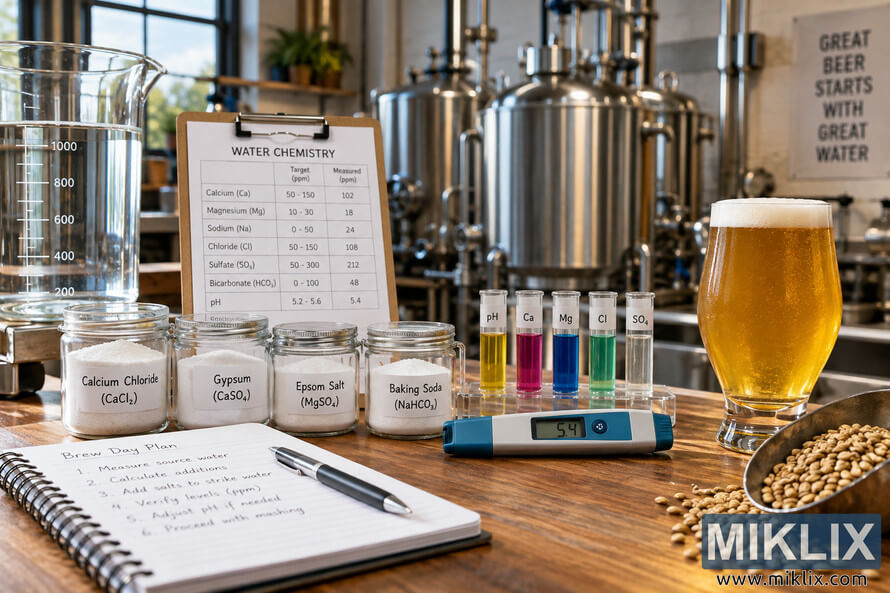
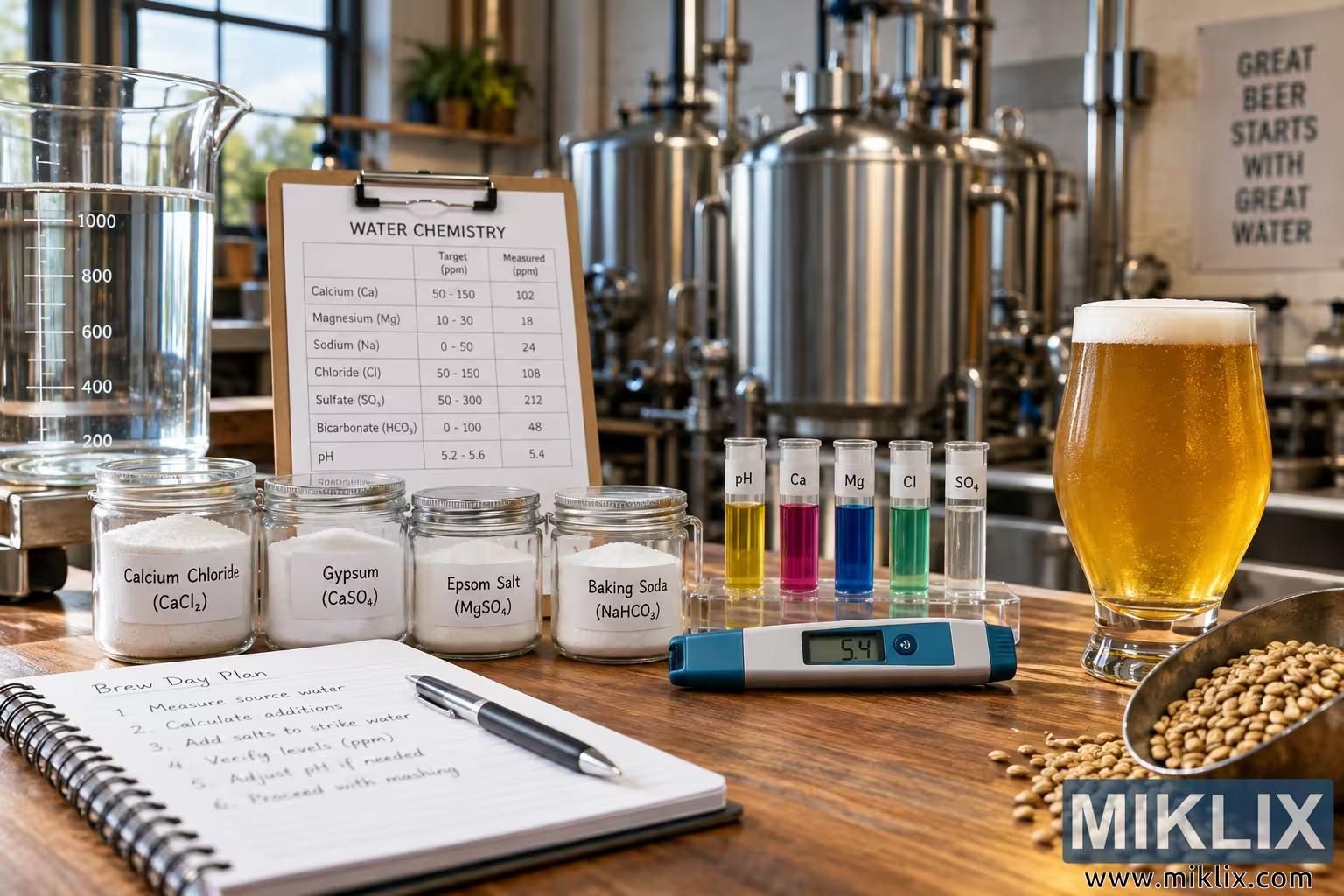
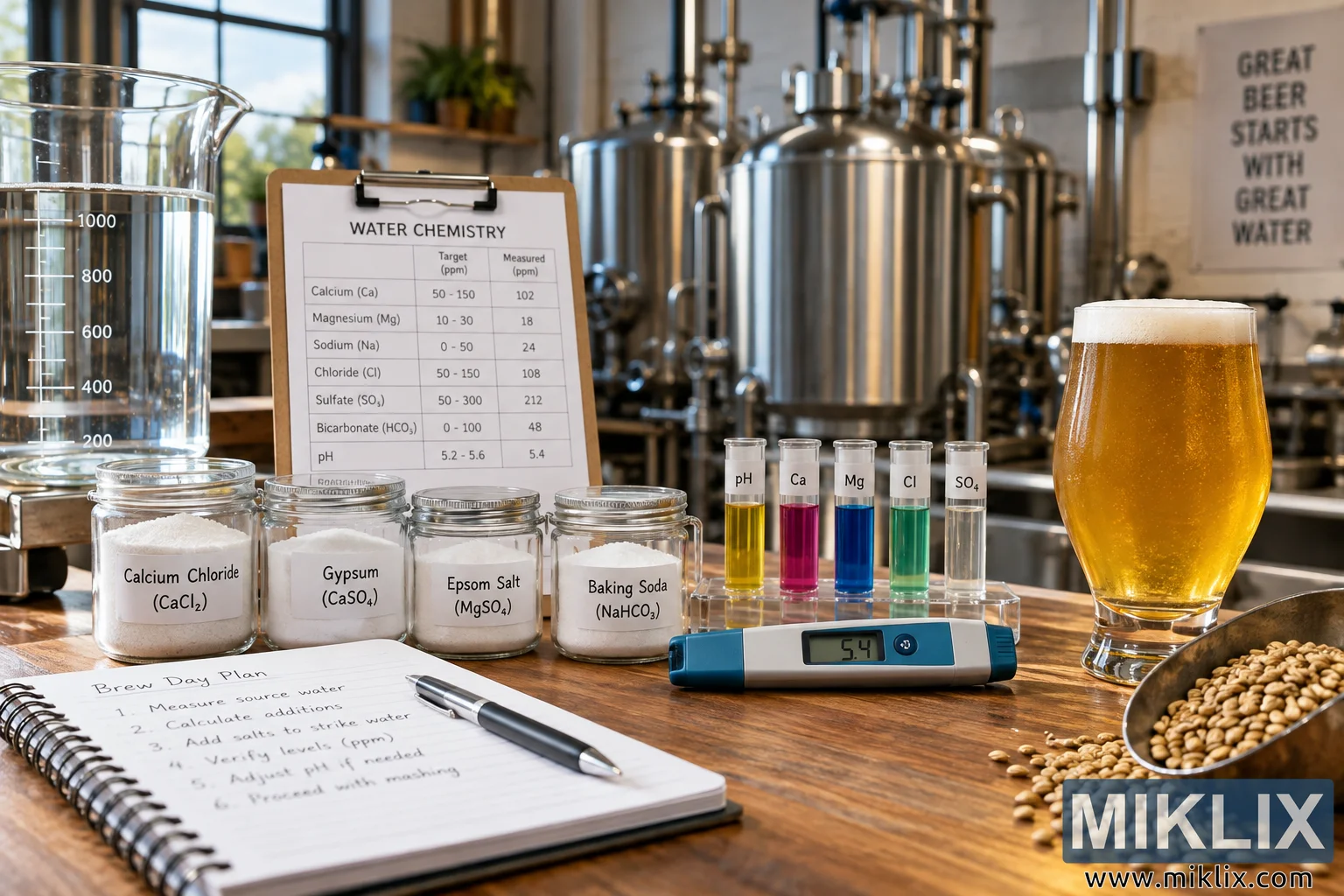
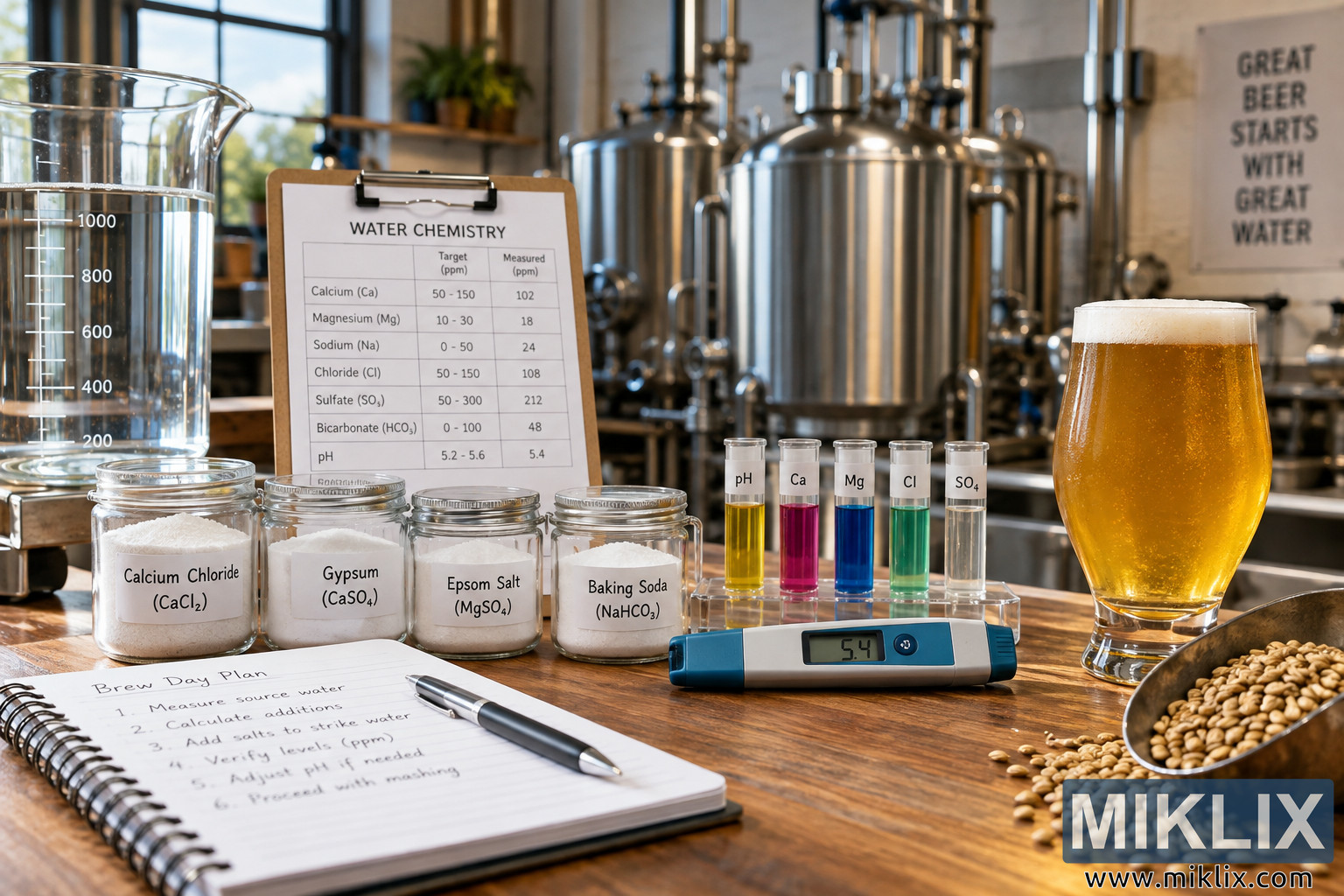
Photorealistic brewery scene illustrating beer brewing water chemistry adjustment with mineral salts, water analysis, pH testing, malted barley, brewing tanks, and a finished golden beer.
Available versions of this image
The image files available for download below are less compressed and higher resolution - and as a result of that, higher quality - than the images embedded in articles and pages on this website, which are more optimized for file size in order to reduce bandwidth consumption.
Regular size (1,536 x 1,024)
Large size (3,072 x 2,048)
Very large size (4,608 x 3,072)
Extra large size (6,144 x 4,096)
Comically large size (1,048,576 x 699,051)
- Still uploading... ;-)
Image description
A crisp, photorealistic landscape image depicts a carefully organized water chemistry workspace inside a small professional brewery or brewing laboratory. The scene is viewed across a warm wooden workbench, with stainless-steel brewing vessels and pipework forming an industrial backdrop. Natural daylight enters through a large window on the left side of the room, combining with warm interior illumination to produce a clean, inviting atmosphere. The shallow depth of field keeps the equipment on the workbench sharply detailed while allowing the larger brewery tanks in the background to remain slightly softened. No people are present, and there are no visible commercial brands or branded products.
On the left side of the foreground stands a large transparent laboratory beaker filled with clear water. White graduated markings run vertically along the glass, emphasizing careful measurement and the importance of water as the starting point for the brewing process. Immediately beside the beaker is a clipboard holding a sheet titled "WATER CHEMISTRY." The sheet contains a structured table comparing target concentrations with measured concentrations for several important brewing-water parameters. Calcium, magnesium, sodium, chloride, sulfate, bicarbonate, and pH are represented. The displayed measurements include calcium at 102 ppm, magnesium at 18 ppm, sodium at 24 ppm, chloride at 108 ppm, sulfate at 212 ppm, bicarbonate at 48 ppm, and a pH value of 5.4. The table visually communicates the analytical process involved in matching a source-water profile to desired brewing conditions.
Arranged across the center of the wooden bench are four clear glass jars containing white mineral salts used for brewing-water adjustment. Their simple labels identify calcium chloride, gypsum, Epsom salt, and baking soda, with corresponding chemical formulas. The containers have plain metallic lids and deliberately generic presentation without any manufacturer logos or commercial branding. These mineral additions illustrate several of the common tools available to a brewer when modifying the ionic composition of brewing liquor. Their placement directly below the water chemistry chart connects laboratory measurements with the practical process of calculating and adding brewing salts.
To the right of the mineral jars is a small rack of transparent laboratory test tubes. The tubes contain liquids in several distinct colors, including yellow, magenta, blue, green, and nearly clear tones, and are marked with abbreviated chemical or analytical labels. They provide a strong visual reference to testing and measurement rather than ordinary beverage preparation. In front of the tubes lies a compact digital pH meter. Its display clearly reads 5.4, reinforcing mash pH as one of the central measurements in brewing-water chemistry. The instrument is presented as generic laboratory equipment and carries no identifiable brand name or logo.
A spiral-bound notebook occupies much of the lower-left foreground. Its handwritten heading reads "Brew Day Plan," and beneath it is a numbered sequence of steps associated with water preparation. The visible notes refer to measuring source water, calculating additions, adding salts to strike water, verifying levels, adjusting pH if necessary, and proceeding with mashing. A black-and-silver pen rests diagonally across the open page. This notebook introduces a practical brewing context and suggests that the chemistry measurements are part of a planned production workflow rather than an isolated laboratory experiment.
On the right side of the composition stands a clear stemmed beer glass filled with bright golden beer beneath a dense white foam head. Tiny bubbles are visible throughout the liquid, giving the finished beer a fresh and lively appearance. The glass serves as a visual representation of the final objective of the water-adjustment process: a carefully brewed finished beverage. Nearby, a metal grain scoop lies tipped on its side, allowing pale malted barley kernels to spill naturally across the wooden surface. The combination of brewing liquor, minerals, analytical instruments, malt, and finished beer visually connects the entire brewing process from raw ingredients and water preparation to the final glass.
The background establishes the setting as an operational brewery. Several tall cylindrical stainless-steel brewing tanks dominate the middle and right portions of the scene. Their polished surfaces catch highlights from the windows and interior lighting, while valves, fittings, handles, and vertical pipes contribute realistic industrial detail. Additional pipes and brewery hardware rise toward the ceiling, creating a technically credible environment without overwhelming the foreground chemistry demonstration. Shelving and a small green plant near the window soften the otherwise metallic workspace and add a subtle sense of everyday brewery life.
A wall sign in the upper-right background reads "GREAT BEER STARTS WITH GREAT WATER," summarizing the central theme of the image. The composition emphasizes that brewing water is not merely a neutral ingredient but a measurable component whose mineral profile and acidity can be deliberately adjusted according to brewing objectives. The laboratory-style presentation conveys precision, repeatability, and technical control, while the wooden workbench, grain, and golden beer retain the handcrafted character associated with brewing. Overall, the image presents water chemistry adjustment as an accessible but scientifically informed stage of beer production, combining measurement, mineral additions, pH control, record keeping, brewing equipment, raw materials, and the finished beer within one coherent landscape scene.
The image is related to: Hops in Beer Brewing: MultiHead