
Image: Different Forms of Hops from Fresh Cones to Pellets and Extract
Published: October 14, 2026 at 3:37:39 PM UTC
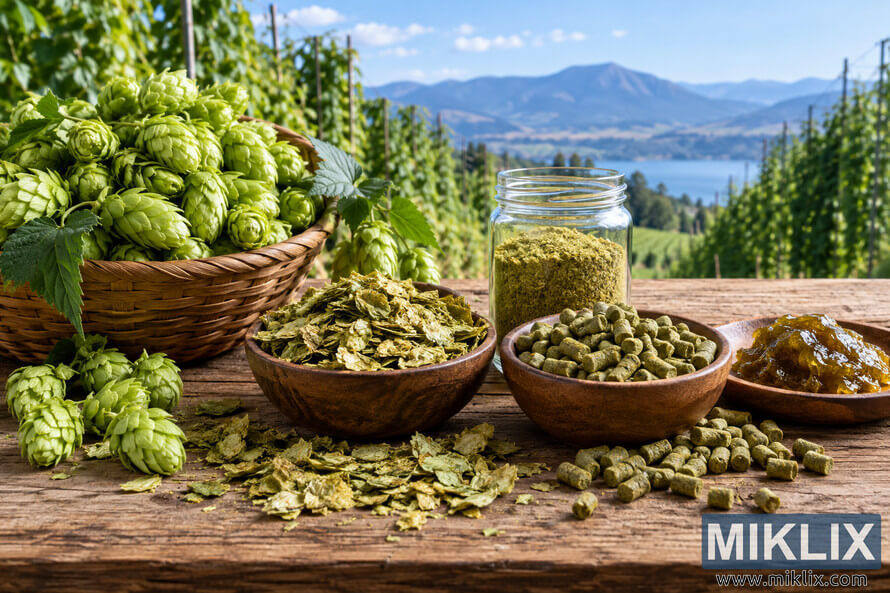
Explore different forms of hops, from fresh cones and dried flakes to ground hops, compressed pellets, and concentrated extract, displayed against a scenic hop field.
Available versions of this image
The image files available for download below are less compressed and higher resolution - and as a result of that, higher quality - than the images embedded in articles and pages on this website, which are more optimized for file size in order to reduce bandwidth consumption.
Regular size (1,536 x 1,024)
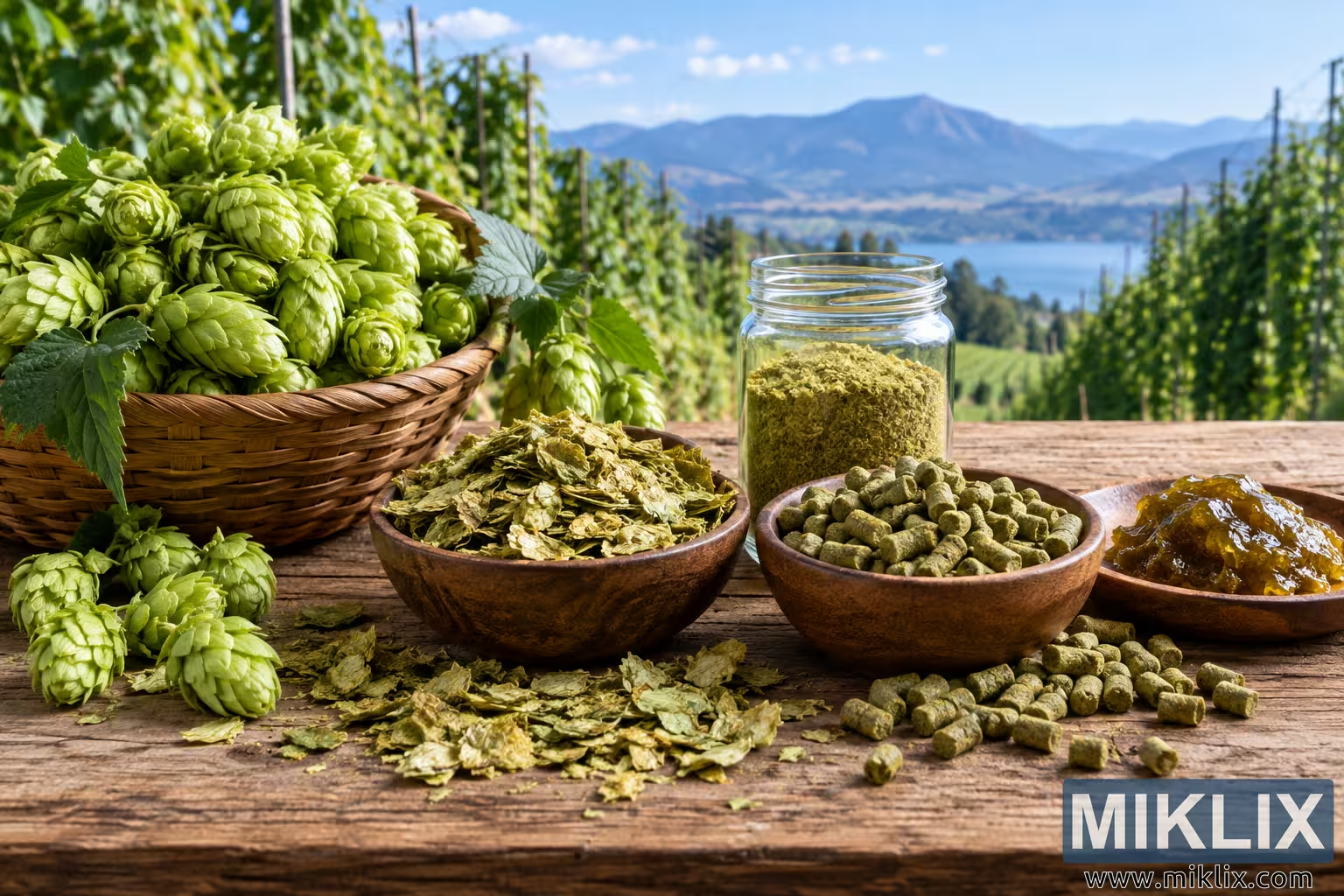
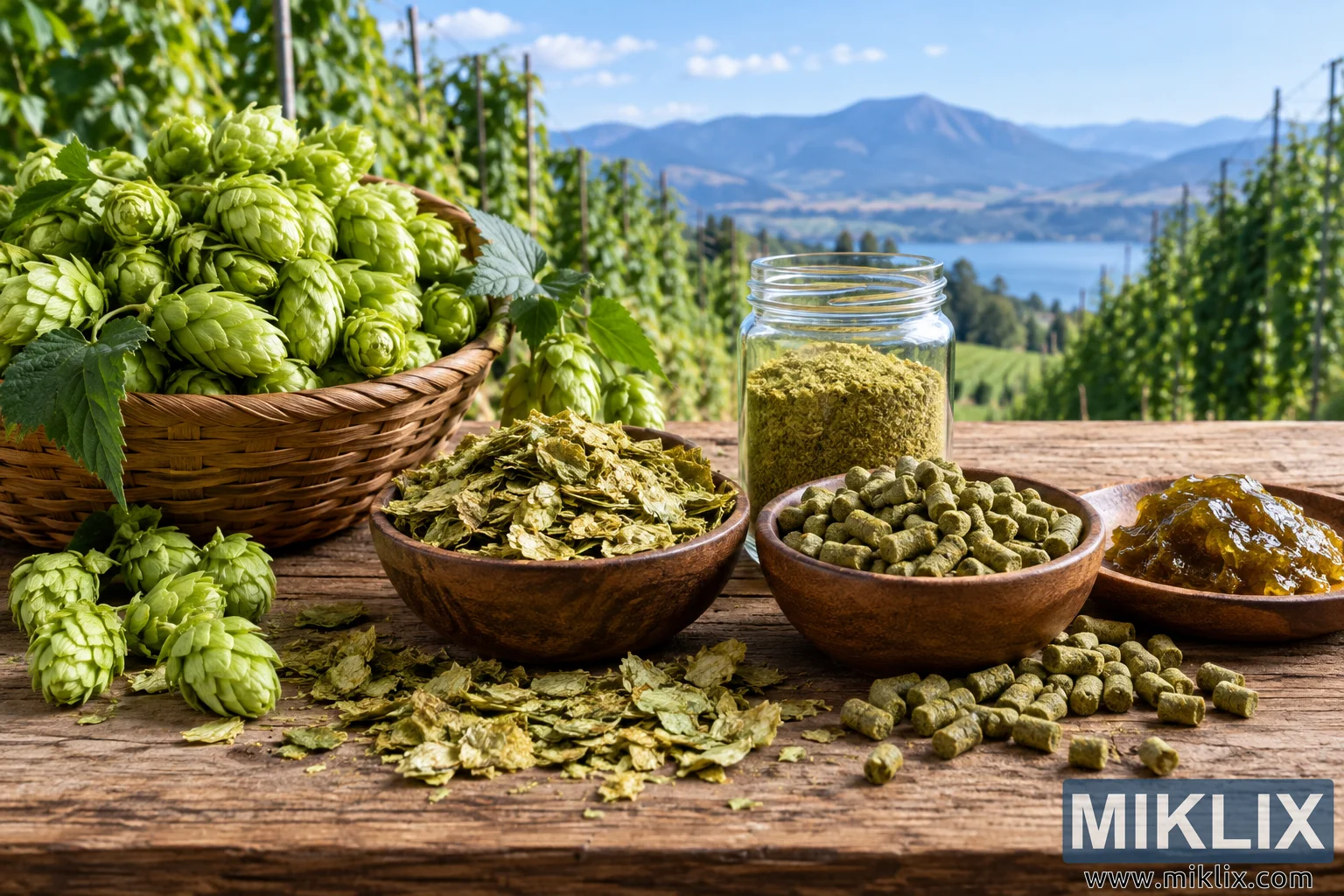
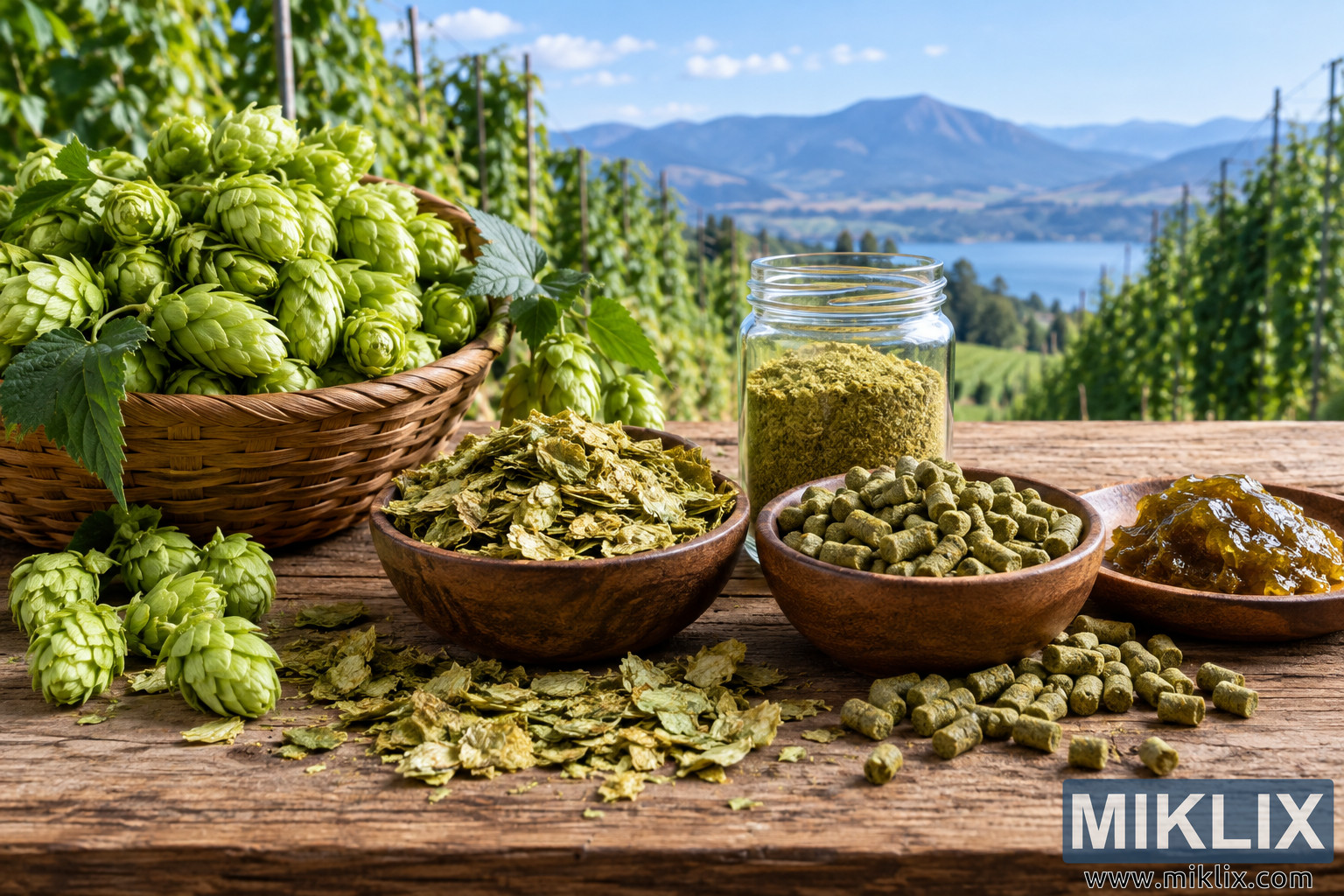
Large size (3,072 x 2,048)
Very large size (4,608 x 3,072)
Extra large size (6,144 x 4,096)
Comically large size (1,048,576 x 699,051)
- Still uploading... ;-)
Image description
A wide, landscape-oriented photograph presents an abundant selection of hops in several different physical forms, arranged as a rustic still life on a weathered wooden table. The composition is set outdoors in a hop-growing landscape, connecting the harvested and processed ingredients in the foreground with their agricultural origin in the background. Bright natural daylight illuminates the scene, producing crisp detail, vivid green tones, warm brown wood textures, and a fresh, inviting atmosphere.
On the left side of the image, a large woven wicker basket is filled generously with fresh green hop cones. The cones have tightly layered, overlapping bracts that create their distinctive rounded, slightly elongated shape. Their surfaces range from yellow-green highlights to deeper leafy greens in the shaded areas. Several broad hop leaves remain attached among the cones, adding darker green accents and emphasizing the freshly harvested character of the display. A few loose hop cones have been placed directly on the tabletop in front of the basket, extending the arrangement naturally toward the viewer.
Near the center-left foreground sits a round wooden bowl containing dried hop material. The dried pieces are flatter, thinner, and more fragmented than the fresh cones, with muted olive-green and pale yellow-green coloring. Additional dried flakes are scattered loosely across the wooden table in front of the bowl. This irregular scattering gives the still life a natural, working-farm quality rather than the appearance of a perfectly controlled studio arrangement. The flakes also provide a clear visual contrast with the intact fresh hop cones nearby.
Behind the bowls, close to the center of the composition, is a transparent glass jar filled with finely ground hop material. The contents have a dry, granular texture and a subdued yellow-green to olive color. Because the jar is clear and unbranded, the texture and density of the ground hops can be seen directly through the glass. Highlights along the rim and sides of the container reflect the bright outdoor light, while the simple cylindrical form provides a clean visual counterpoint to the organic shapes surrounding it.
To the right of the dried hops is another shallow wooden bowl filled with compressed hop pellets. The pellets are small, short cylinders with rough, slightly irregular surfaces and a muted green color. Some pellets have spilled from the bowl onto the tabletop, making their individual size and shape easier to distinguish. Their compact, uniform form contrasts strongly with both the leafy dried material and the large, dimensional fresh cones, helping the image communicate at a glance that hops can be prepared and handled in substantially different forms.
At the far right is a shallow wooden dish holding a glossy amber-brown hop extract or resin-like substance. Its translucent surface catches the sunlight and produces bright reflections, while darker amber areas suggest thickness and concentration. The smooth, sticky-looking material provides the strongest textural contrast in the foreground: fresh cones appear leafy and layered, dried hops appear brittle and flaky, powder appears finely granular, pellets appear compressed and cylindrical, and the extract appears dense, glossy, and viscous. Together, these forms create a visual progression from minimally processed plant material to increasingly processed hop products.
The tabletop itself is made from broad, aged wooden boards with visible grain, cracks, knots, scratches, and tonal variations. Its warm brown color complements the greens and amber tones of the hops while reinforcing the agricultural character of the scene. Small fragments of dried hops and loose pellets are scattered across the surface, making the display feel tactile and authentic. The low viewing angle places the ingredients prominently in the foreground, allowing their shapes, textures, and differences to remain the primary focus of the image.
In the background, long rows of cultivated hop plants rise on tall trellises on both sides of the scene. Vertical support poles and climbing green vines form repeating lines that guide the eye into the distance. The hop plants are lush and dense, suggesting an established field during the growing season. The central opening between the rows reveals a broad valley landscape with green vegetation descending toward a blue body of water. Beyond the water, layered mountains rise across the horizon in soft blue and gray tones.
The distant landscape is intentionally less sharp than the foreground ingredients, creating a natural sense of depth. The mountains and water provide a calm backdrop without competing with the detailed hop display. Above them stretches a clear blue sky containing scattered small white clouds. Strong but pleasant daylight creates defined highlights and shadows throughout the composition and gives the fresh hops a particularly vibrant appearance.
The overall image combines agricultural scenery with an educational ingredient display. It visually communicates the relationship between hop cultivation and the different forms in which hops may be prepared for subsequent use. Fresh whole cones, dried hop material, finely ground hops, compressed pellets, and concentrated extract are all represented without packaging, labels, logos, trademarks, or recognizable commercial branding. The result is a clean, brand-neutral visual suitable for illustrating hop cultivation, processing, brewing ingredients, agricultural production, or the transformation of a harvested crop into multiple usable forms.
The image is related to: Hops in Beer Brewing: MultiHead