
Hops in Beer Brewing: Nadwislanska
Published: February 8, 2026 at 6:16:22 PM UTC
Nadwislanska, a native Polish hop, is celebrated for its aroma rather than its bittering qualities. It falls into the noble/aroma class, known for its floral, earthy, and grassy notes. These are complemented by subtle fruit tones, making it a favorite in traditional European-style beers.
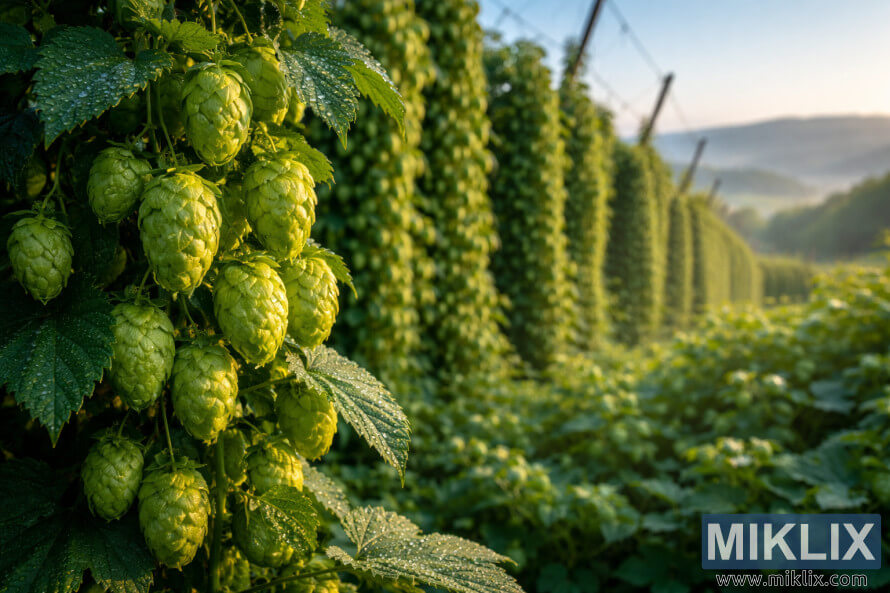
Click or tap the image for more information and higher resolutions.
Nadwislanska, a Polish hop variety, is prized for its delicate finishing and late additions. It falls into the category of aroma hops, alongside bittering hops and dual-use varieties. Nadwislanska is particularly valued for enhancing floral, herbal, and spicy notes in European lagers and subtle ales.
Found in major germplasm collections like Oregon State University and USDA, Nadwislanska is accessible to researchers and small growers. Despite its limited commercial presence, it stands out among Polish hops for its green stems. This trait aids in identification during breeding.
This article delves into Nadwislańska's identity and practical applications. It explores its sensory profile, historical background from hop collections, and brewing and growing advice. It aims to shed light on why Nadwislanska hops are a cherished, albeit rare, noble aroma choice.
Key Takeaways
- Nadwislanska hops are a Polish noble aroma hop best used for late additions and dry hopping.
- The hop variety Nadwislanska is preserved in USDA/OSU germplasm collections with specific accession numbers.
- Nadwislańska is suited to European lager hops styles and delicate ales needing floral, herbal aromas.
- The cultivar is rare commercially but accessible for research and small-scale cultivation through repositories.
- Distinctive physical traits, like green stems, help differentiate Nadwislanska from other Polish hops.
Overview of Nadwislanska hops
Nadwislanska, a native Polish hop, is celebrated for its aroma rather than its bittering qualities. It falls into the noble/aroma class, known for its floral, earthy, and grassy notes. These are complemented by subtle fruit tones, making it a favorite in traditional European-style beers.
The variety is found in major germplasm collections, including those at the USDA and Oregon State University. Records show Nadwislanska (USDA accession 21114) and a virus-free accession 21524. This indicates ongoing preservation and research efforts at OSU and the USDA World Hop Cultivar Collection.
Its origins are rooted in Poland, where it was once a regional cultivar. However, its low yields and sensitivity to viruses have limited its commercial planting. Today, it is mostly found in germplasm banks and specialty trial plots.
Brewers looking for Old World character often turn to Nadwislańska. The variety is known for its noble aroma, gentle floral profile, and earthy backbone. These qualities make it ideal for lagers, pilsners, and classic ales, enhancing their refined hop character.
- Polish origin and heritage among Polish hop varieties
- Classified as an aroma/noble hop
- Maintained in USDA/OSU germplasm collections
- Rare in commercial production due to yield and virus issues
- Key aromatic descriptors: floral, earthy, grassy, subtle fruit
Botanical profile and classification
Nadwislanska falls under the genus Humulus and species lupulus. This categorization gives it the formal name, Humulus lupulus Nadwislanska, seen in botanical records and hop databases.
It is listed as a named Polish landrace in germplasm records. USDA accession Nadwislanska entries show its inclusion in the World Hop Cultivar Collection at Oregon State University. These records support research and the distribution of virus-free hop material.
Nadwislanska is classified as a female cultivar in commercial lists. This is typical for brewing varieties. Female plants are prized for their cone-bearing lupulin glands, which brewers value.
Morphological features distinguish Nadwislanska from other Polish types. Its green stems stand out, unlike the stems of Lubelski/Lubelska lines. Growers and taxonomists rely on these differences when comparing regional landraces.
- Taxonomy: genus Humulus, species lupulus.
- Cultivar identity: Nadwislanska recorded in OSU/USDA lists.
- Sex: commercially maintained as female plants.
- Morphology: green stems distinguish it from Lubelski types.
Germplasm repositories are crucial for preserving Nadwislanska material. They ensure virus-free accessions, maintain protocols, and provide clear USDA accession Nadwislanska records. This allows breeders and growers to access verified stock for propagation and study.
The botanical profile is vital for both practical use and conservation. It supports research on hop botany Nadwislanska, aids in variety comparisons, and informs breeding programs focused on European noble-type aroma hops.
Typical alpha and beta acid ranges
Nadwislanska has low alpha values, ranging from 3.0% to 5.0%. This makes it ideal for late kettle additions and dry hopping, rather than primary bittering.
The beta acid content of Nadwislanska is reported to be between 2.5% and 5.0%. Brewers pay close attention to this because it impacts aging stability and bitterness evolution in bottles and kegs.
- Alpha level: 3.0%–5.0% — indicates aroma hop use rather than high-IBU bittering.
- Beta level: 2.5%–5.0% — helps predict hop storage and bitterness longevity.
- Cohumulone: about 23% of alpha acids — a lower share that often correlates with a smoother perceived bitterness.
When formulating recipes, Nadwislanska's hop bitterness range guides the focus towards flavor and aroma. Short or late whirlpool rests and dry-hop additions are recommended. This approach captures volatile oils without relying on Nadwislanska for high IBUs.
Germplasm records from institutions like Oregon State University and USDA confirm Nadwislanska's accession and testing. Although some listings lack numeric details, these trials validate the variety's characterization. They support its classification as an aroma-focused cultivar.

Click or tap the image for more information and higher resolutions.
Essential oil composition and aroma compounds
Nadwislanska essential oils define the hop's delicate scent, making it ideal for aroma hops. Lab data and hop collections reveal oil fractions that categorize varieties. Nadwislanska's hop oil profile aligns with a subtle, noble style, unlike the bold American citrus flavors.
The total oil content is about 0.5 mL per 100 g, which is relatively modest. Myrcene makes up around 32%, while humulene is roughly 27%. Caryophyllene and farnesene are present at 8.2% and 13.5%, respectively. This balance of myrcene, humulene, and caryophyllene is crucial for the hop's fresh aroma and how it evolves in beer.
Myrcene contributes to the hop's resinous, citrus, and fruity notes. However, its lower concentration compared to many U.S. hops results in a less intense citrus flavor. Humulene, on the other hand, adds woody, spicy, and noble qualities, perfect for lagers and pilsners. Caryophyllene brings spicy, piney, and herbal notes, enhancing the profile without overpowering it.
Farnesene introduces fresh green and floral elements. The combination of farnesene and a balanced myrcene/humulene ratio supports complex, delicate aromas. This makes Nadwislanska ideal for adding subtle floral and noble tones to beer.
- Low total oil content favors subtle aroma expression.
- Balanced myrcene/humulene ratios aid aroma stability over time.
- Farnesene and caryophyllene add green and spicy layers.
Understanding Nadwislanska essential oils is key for brewers to predict the impact of hop additions. Whether added in the kettle, whirlpool, or as a dry-hop, the oil composition supports recipes that value finesse and tradition over bold citrus flavors.
Flavor and aroma profile for brewers
The Nadwislanska flavor profile is deeply rooted in Old World hop tradition. It is characterized by a refined, noble character with floral and earthy top notes. Mild grassy and light fruity accents complement the primary aromatics.
The Nadwislanska brewing aroma is known for its subtlety, avoiding the boldness of citrus. To enhance its delicate petals, spice, and herb tones, brewers use late-kettle additions, whirlpool hops, or dry hopping. This approach ensures that the malt and yeast character remain unobscured.
When crafting recipes, consider the noble hop flavors that Nadwislanska embodies. Pair it with clean malt bills and lager or neutral ale yeasts to showcase its nuanced character. European-style lagers, pilsners, and classic ales are particularly well-suited to this hop variety.
- Primary traits: floral, earthy, noble hop flavors
- Secondary notes: grassy, light fruitiness
- Best use: late additions, whirlpool, dry hopping
Germplasm records and USDA/OSU lists provide detailed sensory descriptions of Nadwislanska. These records are invaluable for brewers, helping them predict the hop's performance in both small-batch trials and large-scale production.
For practical application, begin with conservative dry-hop rates and adjust based on desired aroma intensity. Maintaining a clean fermentation process is crucial to preserve the Nadwislanska flavor profile. This ensures that its classic, understated brewing presence is fully appreciated.
Aroma vs bittering use in recipes
Nadwislanska is classified as an aroma hop. Its alpha acids are low, ranging from 3.0% to 5.0%. This makes it ideal for adding scent and subtle flavors, rather than for primary bitterness.
When planning recipes with Nadwislanska, it's best to add it late in the boil. Add it in the last 10 minutes, during whirlpool, or as part of dry-hop schedules. This captures its floral and noble notes effectively.
Assessing Nadwislanska's bittering suitability reveals its limitations. Its low alpha acids restrict its ability to contribute significantly to IBUs. To achieve a firm backbone in a recipe, pair Nadwislanska with a higher-alpha bittering hop. Options include Magnum, Warrior, or Styrian Golding.
- Use: late boil, whirlpool, dry-hop for aromatic lift.
- Bittering role: minimal; best as smoothing adjunct when early-added.
- Blend idea: combine with a high-alpha bittering hop for balance.
European lager, pilsner, Kölsch, blonde ale, and saison styles benefit the most. In these beers, Nadwislanska's aroma use provides a subtle noble character. It enhances malt clarity without overpowering the hops.
In recipe planning with Nadwislanska, consider its cohumulone content near 23% for early additions. This profile can offer a smoother bitterness. However, its total alpha limits mean it rarely replaces a dedicated bittering hop.
Keep your additions simple and precise. Use measured late additions and small dry-hop weights. This showcases the hop's delicate perfume. Rely on a robust bittering partner when needed.
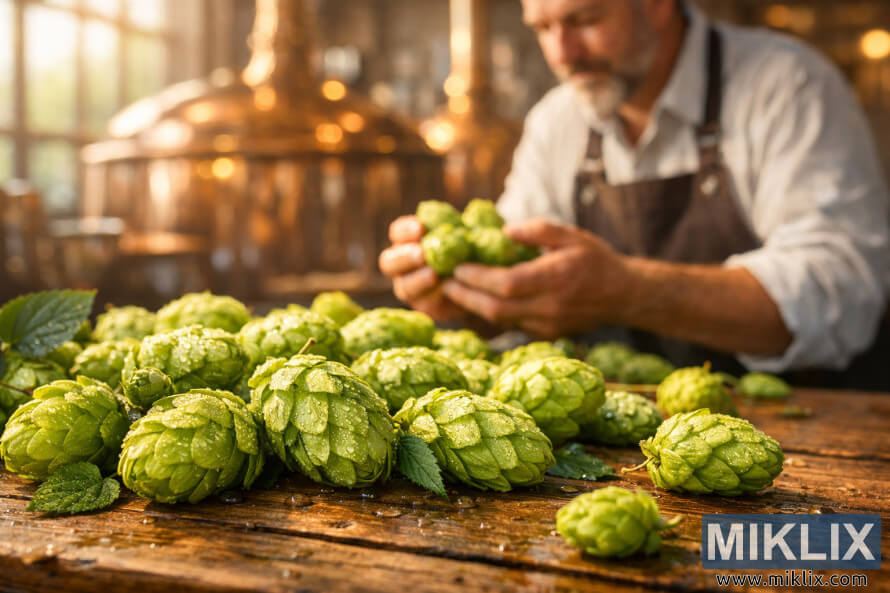
Click or tap the image for more information and higher resolutions.
Historical and breeding notes from hop collections
The Nadwislanska hop variety has its roots in Central European breeding efforts. These programs aimed to create hops that excel in both bittering and aroma. Initially, Nadwislanska was categorized as a dual-purpose hop. It was prized for its noble, floral characteristics rather than its yield.
Records indicate Nadwislanska's inclusion in the OSU/USDA World Hop Cultivar Collection. Accessions like Nadwislanska 21114 and Nadwislanska,vf 21524 are part of this collection. This listing in the USDA hop collection Nadwislanska signifies its formal preservation. It also ensures controlled characterization and access for researchers and breeders.
The Nadwislanska germplasm in public collections safeguards rare genetic traits. These traits are less common in today's commercial hop varieties. Despite its low yields and susceptibility to common hop viruses, Nadwislanska remains available for study and breeding purposes.
Morphological characteristics set Nadwislanska apart from other Polish cultivars. Growers and ampelographers note its greener stems compared to Lubelski. Additionally, its cone and leaf traits aid in identification during germplasm evaluation.
Breeders draw upon Nadwislanska's history to enhance noble aroma chemistry in new cultivars. Its inclusion in the USDA hop collection Nadwislanska offers a reliable source for crosses. These crosses aim to restore desirable scent profiles while improving yield and disease resistance.
The conservation of Nadwislanska germplasm supports long-term research objectives. Public collections, such as OSU/USDA, maintain detailed passport data, propagation material, and chemical profiles. This ensures that future breeding programs can incorporate these heritage traits into modern cultivars.
Growing traits and agricultural considerations
Nadwislanska cultivation is best suited for trial plots and small-scale heritage gardens. It's not ideal for large commercial plantings. Germplasm collections report modest vigor and a green-stem morphology, making scouting easier. Growers should focus on careful site selection and modest inputs for this variety.
Field records indicate Nadwislanska yield is lower than average. This results in reduced returns per hectare, making it more suitable for research plots or specialty brewing gardens. Budgeting should include lower harvest volume and extra labor for selective hand-picking if necessary.
Hop disease susceptibility Nadwislanska is a crucial factor in planting decisions. Historical notes show virus sensitivity, increasing management needs. Regular virus testing, rogueing symptomatic vines, and using certified virus-free planting stock from USDA or university germplasm sources are essential to mitigate long-term risks.
- Planting material: choose virus-free (vf) accessions from trusted germplasm banks.
- Cultural care: rotate soil, manage irrigation to avoid water stress, and use balanced fertilization to support moderate vigor.
- Monitoring: scout frequently for common hop viruses and foliar diseases; keep records.
Given Nadwislanska's modest yield and susceptibility to disease, commercial adoption is limited. Researchers and craft growers who value genetic diversity might still find it useful for trial blocks. Small plots allow for evaluation without the commitment of large acreage.
If you plan to grow Nadwislanska, expect to oversee pest and disease management closely. Adhere to best practices for certified stock, sanitation, and monitoring to protect nearby hops and maintain plant health.
Storage stability and hop handling
Nadwislanska's storage stability is moderate, especially when compared to many aroma varieties. Research from Ohio State University and USDA highlights its better retention when chilled and sealed. The commercial success often hinges on the consistent preservation of alpha acids and oils.
Effective hop handling Nadwislanska begins with cold storage. Store whole cones or pellets at 0–4°C. Use vacuum or nitrogen-flushed bags to minimize oxygen exposure. Opting for small, frequent purchases for single-batch use helps avoid aroma loss during extended storage periods.
Alpha acid retention Nadwislanska declines to about 58% after six months at 20°C. This indicates brewers should steer clear of room-temperature storage for consistent bitterness. Pelletized forms generally fare better during shipping and brief storage compared to loose cones.
Nadwislanska's total oil content is relatively low, near 0.5 mL per 100 g. This makes its aromatic compounds more susceptible to degradation. For optimal aromatic impact, use hops fresh and add them later in the boil or as dry hops. Proper handling preserves the delicate terpenes that define its profile.
Follow a simple checklist for best results:
- Store cold and dark, ideally 0–4°C.
- Use vacuum or nitrogen-flushed packaging.
- Buy in quantities matched to single or few batches.
- Prefer pelletized product if long transport is unavoidable.
Monitoring alpha acid retention Nadwislanska with periodic testing is crucial. It allows brewers to adjust recipes and maintain consistency. Adhering to good warehouse practices and ensuring quick turnover protects both bitterness and aroma. This makes Nadwislanska a more reliable choice for both commercial and craft production.
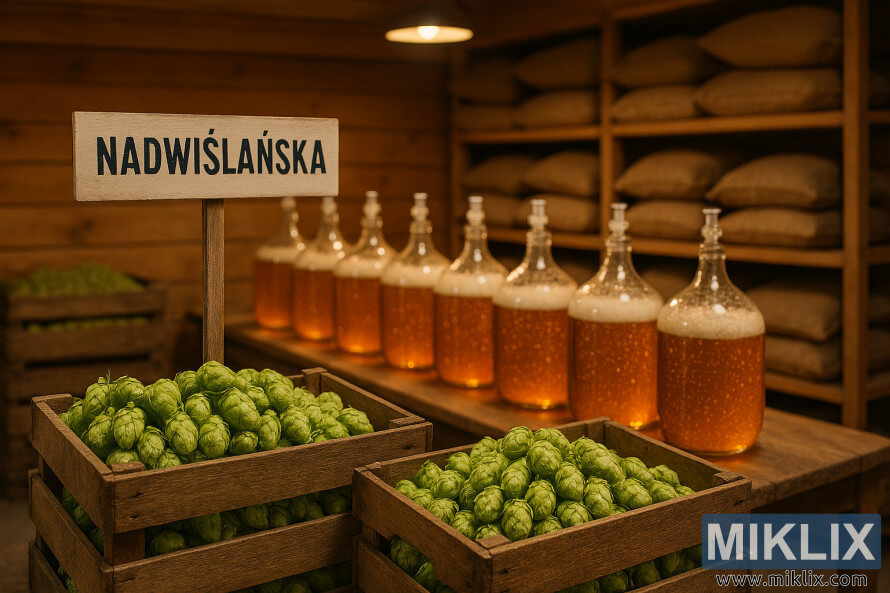
Click or tap the image for more information and higher resolutions.
Brewing techniques and recipe suggestions
Nadwislanska recipes excel when used as an aroma hop, not a primary bittering source. Its low alpha acids necessitate a high-alpha bittering hop for IBUs. Then, Nadwislanska is added late to highlight floral and noble notes.
For late-kettle additions, add Nadwislanska in the last 10 minutes. A 0-minute or flameout addition captures delicate oils. Whirlpool at 160–170°F to extract volatile aromatics without harsh vegetal tones.
When dry-hopping, keep charges light. A typical 5-gallon batch uses 0.5–1 oz of Nadwislanska. Add it after primary fermentation to preserve nuanced fruity and earthy aromas.
- Target styles: European lager hops are perfect for pilsners, traditional lagers, and crisp wheat beers, where subtle noble character is desired.
- Bitterness strategy: Begin with a neutral, high-alpha bittering hop to reach target IBUs. Then, layer Nadwislanska for flavor and aroma.
- Timing: Last 10 minutes, 0-minute/flameout, whirlpool at 160–170°F, and small dry-hop post-fermentation.
For a 5-gallon pilsner, use a modern high-alpha hop for bittering to reach IBUs. Add Nadwislanska at 5–10 minutes and at flameout for flavor. Then, apply a modest Nadwislanska dry hop after fermentation.
When brewing with Nadwislanska, maintain a clean malt bill and yeast profile. Use neutral Vienna or Pils malt and classic lager yeast. This lets the noble hop character shine without interference.
Adjust recipe balance for alpha range: since Nadwislanska often falls between 3.0%–5.0% alpha, blend it with a higher-alpha variety for early bitterness. This pairing preserves target IBU while allowing Nadwislanska to contribute aroma and subtle spice.
Sensory evaluation and tasting notes for quality control
Evaluating Nadwislanska sensory attributes starts with a strict protocol. Begin by smelling fresh cones and pellets in a neutral space. Record the immediate top notes, mid tones, and any off-aromas right away.
Use a standardized lexicon to describe the aroma. Common descriptors include noble, floral, earthy, grassy, and subtle fruity hints. These terms help brewers and lab technicians compare results from different lots.
During hop tasting Nadwislanska, expect gentle floral top notes over an earthy, noble backbone. Green, grassy nuances and light fruitiness should appear but never dominate. The overall impression is restrained and elegant rather than bold or tropical.
- Check for musty, phenolic, or moldy off-notes that indicate storage problems or infection.
- Note intensity and balance: floral versus earthy and grassy elements.
- Use repeatable scales for aroma strength to enable batch comparisons.
Quality control hops procedures pair sensory checks with chemistry. Quantify alpha and beta acids, targeting expected ranges near 3.0%–5.0% alpha. Compare oil totals and proportions of myrcene and humulene to sensory impressions.
- Sample preparation: open cones, crush pellets if needed, warm gently to release volatiles.
- Sensory panel: three to five trained tasters using the same lexicon and scales.
- Analytical follow-up: GC or HPLC results to confirm aroma-linked compounds and alpha values.
Document each hop tasting Nadwislanska session with date, lot number, and storage history. This record supports traceability when a sample shows unexpected aromas. Regular sensory sampling keeps quality control hops aligned with brewers' expectations and breeding data from OSU and USDA characterizations.
When deviations appear, compare descriptors to analytical data. A drop in oil totals or a shift toward musty notes often points to poor storage. Clear notes and measured values speed corrective action and help maintain consistent brewing performance.
Supply, sourcing, and alternatives
Nadwislanska hops are categorized into three types: bittering, aroma, and dual-use. These categories guide crop planning and market production. This classification explains why Nadwislanska availability varies by region and why commercial quantities are scarce.
Germplasm repositories house Nadwislanska accessions. The USDA and Oregon State University have virus-free entries, like accession 21524. Researchers can access this material for study. However, commercial seedstock is rare in the mainstream market.
Growers have largely stopped large-scale Nadwislanska production due to low yields and high virus pressure. This variety is rare for brewers seeking commercial quantities. Hobbyists and craft brewers may need to contact heritage-hop producers or germplasm collections to acquire Nadwislanska plants or cones.
- Small farm channels: specialty hop farms and micro-nurseries sometimes offer limited stock for home growers.
- Research releases: university programs and repositories can provide material for trials and breeding.
- Heritage growers: limited-run harvests appear occasionally through heritage-hop producers.
When Nadwislanska is hard to find, consider noble hop substitutes with similar floral and herbal profiles. Polish Lubelski, Czech Saaz (Žatec), Tettnang, and Hallertauer Mittelfrüh are good alternatives, offering classic noble character.
Commercial brewers looking for a Lubelski alternative often turn to Lubelski or Saaz. These hops provide both aroma nuance and brewing reliability. Tettnang and Hallertauer Gold offer similar grassy and spice notes, with more stable supply chains.
Hobbyists should build relationships with specialized growers and monitor repository releases. Commercial operations should scout multiple vendors and plan substitutions early. If you need to buy Nadwislanska, expect limited runs and plan recipes with noble hop substitutes in reserve.
Case studies and historical uses in brewing
Brewers and researchers have categorized Nadwislanska for recipe guidance. It's used as an aroma hop for light lagers and a mild bittering hop in older boil schedules. This versatility is evident in various brewing trials.
Germplasm records from Oregon State University and USDA highlight Nadwislanska's preservation. These records detail its origin, traits, and historical significance. They do not mention specific breweries, but they help recreate the beers Nadwislanska once flavored.
Polish brewing traditions valued noble aroma qualities in local hops. Nadwislanska is linked to the aroma profiles of traditional Polish lagers and regional ales. This connection underscores the importance of Polish hops in brewing for noble character.
Experimental brewers can explore Nadwislanska's potential in small-batch lager recreations. If Nadwislanska is unavailable, comparisons with Lubelski, Saaz, and Tettnang can approximate its historic character.
- Trial 1: Single-hop Nadwislanska pale lager to assess floral and herbal top notes.
- Trial 2: Blend of Nadwislanska with Lubelski for a balanced European lager aroma.
- Trial 3: Comparative bittering test using Saaz and Tettnang to match acidity and perceived bitterness.
Each case study should document alpha and essential oil data, dry-hop impact, and sensory notes. This method connects modern analysis to Nadwislanska's brewing history. It ensures results are comparable across laboratories and craft breweries.
Reconstructive projects deepen our understanding of historic beers Nadwislanska. They reveal how Polish hops in brewing influenced regional flavors. Brewers, maltsters, and historians can use these studies to trace the impact of a single variety on older recipes and tasting traditions.
Regulatory and nomenclature notes
Clear naming is crucial for growers, brewers, and researchers to avoid confusion. It's important to use a single consistent form. This means either Nadwislanska for texts without diacritics or Nadwislańska where they are supported. Consistent use of Nadwislanska nomenclature in reports simplifies tracking and compliance.
Germplasm records are vital for legal and practical reasons. When referring to specific plant material, always cite USDA accession Nadwislanska numbers. For example, accession 21114 and the virus-free entry 21524. These identifiers document the origin, availability, and cultivar status in public collections at USDA and partner institutions.
Registries and repositories list alternate romanizations in their notes. Publications may show both Nadwislanska and Nadwislańska. Include both forms on first mention to aid searches and indexing. This practice supports clarity under hop naming regulations that favor traceable cultivar identity.
- Obtain virus-free stock from recognized repositories to meet phytosanitary rules.
- Record USDA accession Nadwislanska numbers in trial logs and shipping documents.
- Follow hop naming regulations for labeling, plant patenting, and cultivar registration.
Trade and research exchanges often require phytosanitary and certification paperwork. Import and export of plant material must meet federal and international plant health rules. Request the vf accession when growers need certified virus-free Nadwislanska material.
When preparing reports or labels, include clear provenance statements and accession citations. Proper Nadwislanska nomenclature and documented USDA accession Nadwislanska entries reduce disputes over identity. They support transparent sharing of breeding lines and planting stock.
Nadwislanska hops
This Nadwislanska summary condenses data into a single reference for brewers, growers, and researchers. It originates from Poland and is classified as an aroma hop. It has a noble, floral core with hints of earthy, grassy, and fruity tones.
A brief Nadwislanska characteristics recap:
- Alpha acids: ~3.0%–5.0%.
- Beta acids: ~2.5%–5.0%.
- Cohumulone: ~23% of total alpha.
- Oil content: about 0.5 mL/100 g; myrcene ~32%, humulene ~27%, caryophyllene ~8.2%, farnesene ~13.5%.
USDA and OSU records list Nadwislanska accessions (21114, 21524) as virus-free material in the World Hop Cultivar Collection. This confirms its provenance and conservation status for trialing and study.
Growers should note green stems distinct from the red-stemmed Lubelski. Yield tends to be low and plants show susceptibility to some hop viruses. This limits commercial acreage despite favorable aroma traits.
Technical performance points for brewers include gentle bittering and pronounced aroma when used late in the kettle or in dry hopping. Storage tests show roughly 58% alpha retention after six months at 20°C. So, fresh handling is advised.
Use cases span pilsners, saisons, and lighter ales where floral and subtle fruity notes are desired without aggressive bitterness. The Nadwislańska final profile supports recipes that highlight hop perfume rather than assertive resinous character.
This Nadwislanska characteristics recap and Nadwislańska final profile serve as a concise, usable guide. It is for anyone evaluating the variety for cultivation trials, sensory panels, or recipe design.

Click or tap the image for more information and higher resolutions.
Conclusion
Nadwislanska conclusion: this noble Polish hop summary highlights its practical role. It brings delicate floral, earthy, and grassy notes to beer. These qualities make it stand out in late-kettle, whirlpool, and dry-hop additions. This distinguishes it from high-alpha bittering hops, showing the importance of preserving aroma hops.
Nadwislanska takeaways reveal its rarity and cultivation challenges. Thanks to USDA and Oregon State University, virus-free material is available for research and small-scale propagation. However, its low yields and disease susceptibility explain its scarcity in commercial markets, despite its appealing aroma.
For brewers looking for alternatives, consider Lubelski, Saaz, Tettnang, or Hallertauer when Nadwislanska is not available. Those interested in preserving this heritage variety should explore germplasm collections for sourcing and characterization. In summary, Nadwislanska is ideal for aroma-driven European styles and deserves targeted preservation and experimentation.
Further Reading
If you enjoyed this post, you may also like these suggestions:
- Hops in Beer Brewing: Pacific Sunrise
- Hops in Beer Brewing: Groene Bel
- Hops in Beer Brewing: Wuerttemberger