
Image: Homebrewing Hop Additions at Different Stages of the Boil
Published: October 15, 2026 at 7:40:36 PM UTC
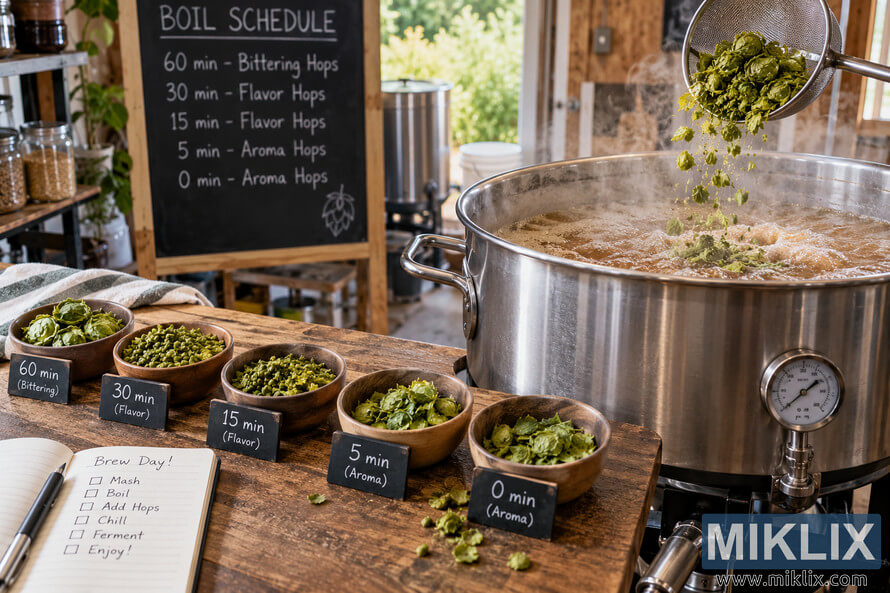
Detailed homebrewing scene showing a boiling kettle, measured hops, and timed hop additions for bitterness, flavor, and aroma throughout the beer boil.
Available versions of this image
The image files available for download below are less compressed and higher resolution - and as a result of that, higher quality - than the images embedded in articles and pages on this website, which are more optimized for file size in order to reduce bandwidth consumption.
Regular size (1,536 x 1,024)
Large size (3,072 x 2,048)
Very large size (4,608 x 3,072)
Extra large size (6,144 x 4,096)
Comically large size (1,048,576 x 699,051)
- Still uploading... ;-)
Image description
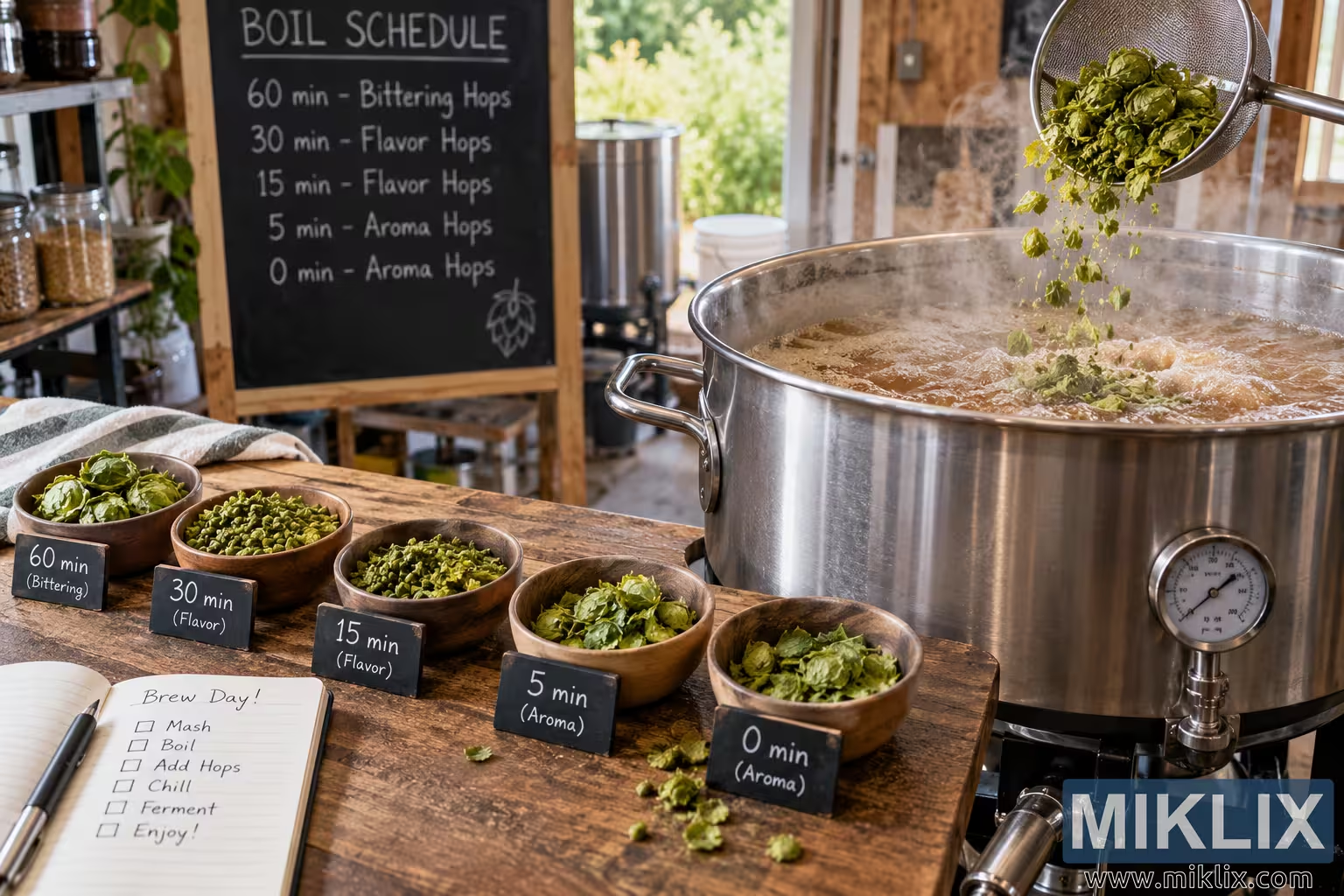
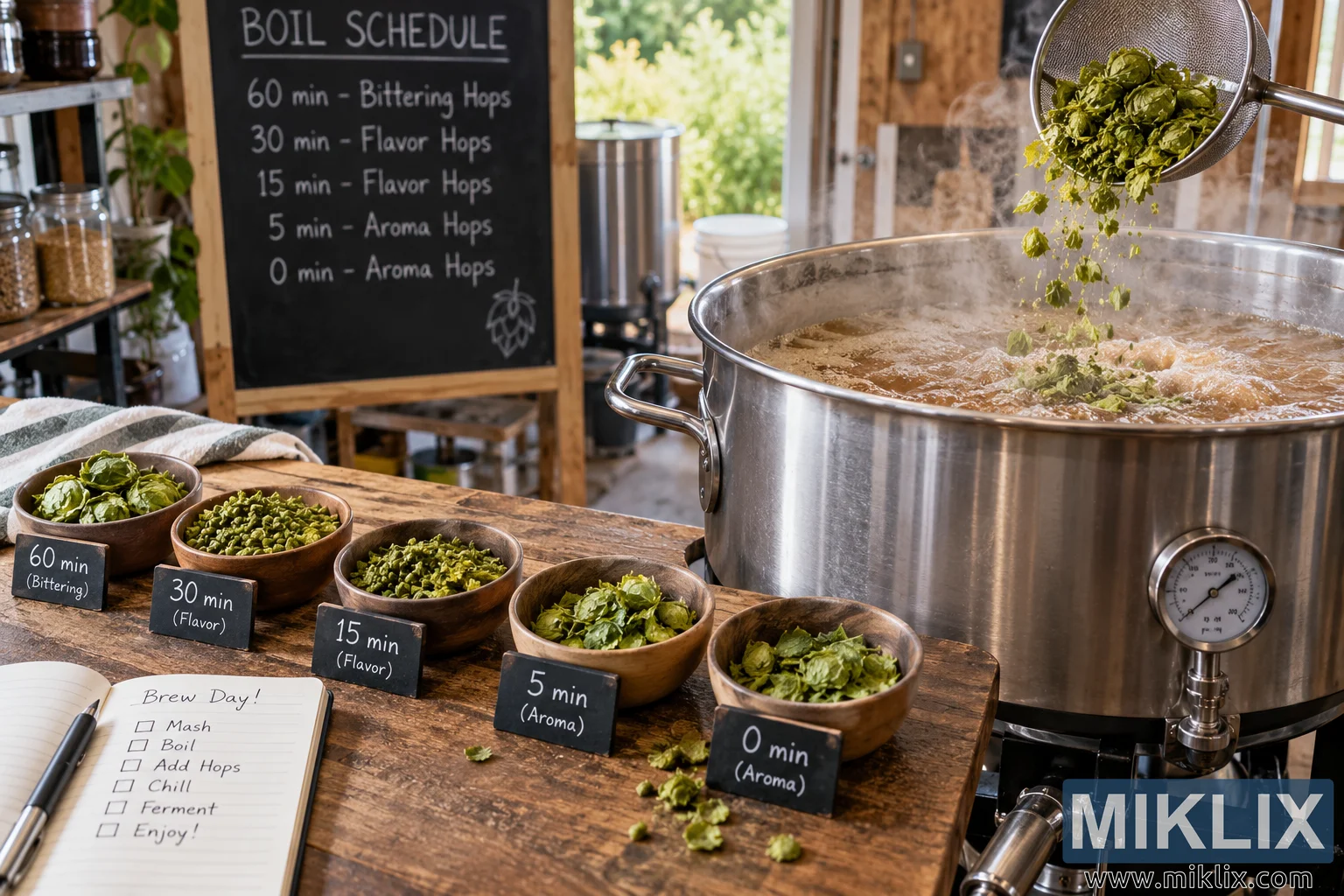
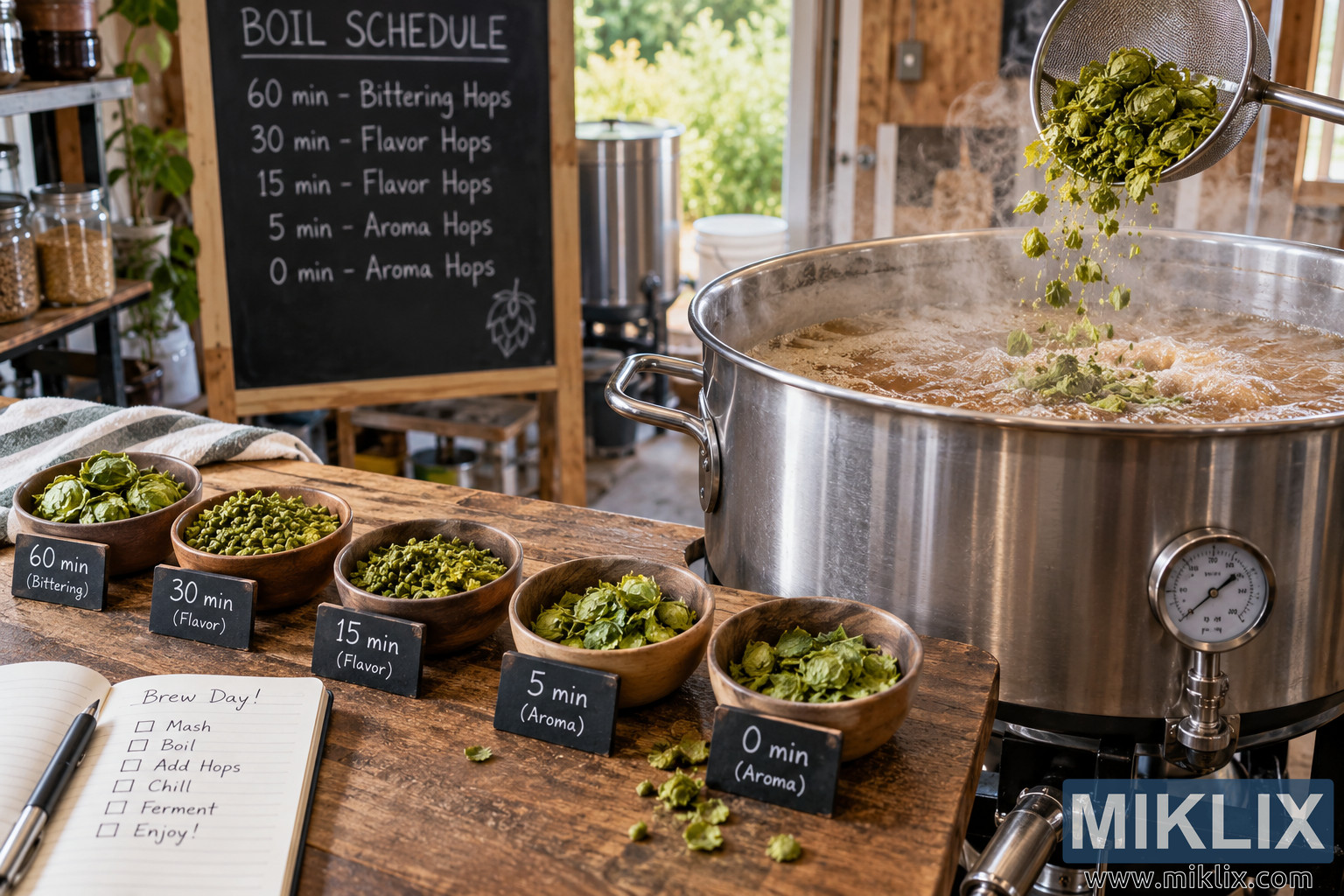
A wide, landscape-oriented photograph depicts a detailed homebrewing workspace during the hop-addition stage of a beer boil. The scene is set in a warm, rustic brewing area with wooden walls, natural surfaces, stainless-steel equipment, shelves of ingredients, and bright daylight entering through an open doorway or large opening in the background. The composition is designed to illustrate how hops can be added at several different points during the boil, with separate portions prepared and clearly associated with different times and brewing purposes.
The dominant object is a large stainless-steel brewing kettle positioned on the right side of the image. The kettle is filled with amber-colored wort at an active rolling boil. Its surface is turbulent and foamy, with bubbles and waves visible across the liquid. Wisps and clouds of steam rise above the kettle, reinforcing the impression of heat and an ongoing brewing process. The reflective metal sides of the vessel catch the warm ambient light, and a round analog gauge is mounted prominently on the front. Additional stainless-steel fittings and a valve assembly can be seen near the bottom of the kettle, while the vessel rests securely on a dark brewing stand or burner structure.
Above the kettle, a large metal mesh strainer or scoop is held at an angle, releasing a portion of green hops into the boiling wort. Individual pieces of hop material are captured in midair as they fall toward the liquid. Some are clustered near the strainer while others are scattered farther down, immediately above the surface of the boil. The suspended hop pieces create a strong visual focal point and make the brewing action easy to understand: hops are being added directly to the kettle while the wort boils. Steam curls around the falling hops and the strainer, emphasizing both movement and temperature.
Across the foreground, a rustic wooden worktable holds five separate wooden bowls containing measured hop additions. Each bowl has a small dark chalkboard-style label placed in front of it. From left to right, the labels indicate additions at 60 minutes for bittering, 30 minutes for flavor, 15 minutes for flavor, 5 minutes for aroma, and 0 minutes for aroma. The hop portions vary in appearance. Some bowls contain leafy green hop material, while others contain small green pellets, reflecting forms commonly encountered in homebrewing. A few loose pieces of hops are scattered naturally across the tabletop between the bowls, giving the workspace a practical, actively used appearance rather than a perfectly staged one.
The timed arrangement of the bowls communicates the central concept of the image. Hops added earlier in the boil are represented as contributing primarily to bitterness, while later additions are associated with flavor and aroma. The 60-minute bowl sits toward the left side of the table, followed sequentially by the 30-minute, 15-minute, 5-minute, and 0-minute portions. This orderly progression provides a visual timeline that leads toward the brewing kettle on the right, where an addition is visibly taking place.
Behind the table, a large black chalkboard displays the heading “BOIL SCHEDULE” in light handwritten lettering. Beneath the heading is a corresponding list of hop-addition times and purposes: 60 minutes for bittering hops, 30 minutes for flavor hops, 15 minutes for flavor hops, 5 minutes for aroma hops, and 0 minutes for aroma hops. A simple hand-drawn hop cone appears near the bottom of the board. The chalkboard acts as an instructional element within the photograph and reinforces the relationship between addition timing and the intended contribution of the hops.
In the lower-left foreground, an open notebook rests on the wooden table beside a dark pen. The visible page is headed “Brew Day!” and contains a handwritten checklist of brewing steps, including mash, boil, add hops, chill, ferment, and enjoy. The notebook adds another layer of homebrewing context and suggests that the brewer is following an organized process or recording the session. A folded striped kitchen towel lies farther back on the table, partially behind the first bowls of hops.
The left side of the background contains shelving stocked with glass jars of brewing ingredients. Some jars appear to hold pale grains or malt, while other containers and equipment are arranged around them. Green houseplants soften the industrial character of the stainless-steel brewing gear and contribute to the welcoming workshop atmosphere. Toward the center background, another tall stainless-steel brewing vessel is visible near the open doorway. A pale bucket sits nearby, suggesting additional equipment used during brewing, cleaning, transfer, or fermentation.
Bright greenery can be seen outside through the opening at the back of the room. The outdoor vegetation is softly out of focus, producing a pleasant depth-of-field effect and contrasting with the warm wood and polished metal inside. Sunlight entering from outside illuminates portions of the brewing equipment and steam, helping separate the foreground subjects from the background. The overall lighting is natural and warm, with realistic reflections on the stainless steel and subtle shadows across the rough wooden tabletop.
The image has the appearance of a high-resolution lifestyle and instructional photograph rather than a technical diagram. Its visual storytelling combines an active brewing moment with an organized display of ingredients and timing information. The large boiling kettle and falling hops provide immediate action, while the row of labeled hop portions and the boil-schedule chalkboard explain the idea of staged hop additions. The composition communicates that different hop additions are prepared for different points in the boil and can serve different brewing purposes, particularly bitterness, flavor, and aroma.
No commercial beer, brewing-equipment, ingredient, or other real-world brand logos are visible. The equipment is generic, and the handwritten labels are descriptive rather than commercial. Overall, the photograph presents an inviting, practical homebrewing environment centered on a boiling kettle, measured hop portions, and a clearly organized hop schedule, visually demonstrating the process of adding hops at multiple stages during a homebrew beer boil.
The image is related to: Hops in Beer Brewing: Neo1