
Image: Measured Hop Samples for a Replacement Blend Trial
Published: October 15, 2026 at 7:40:36 PM UTC
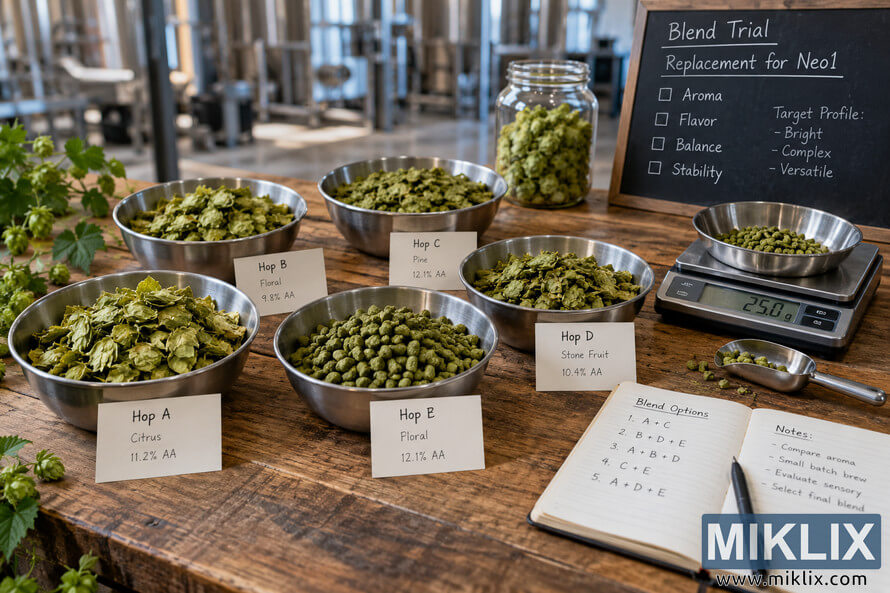
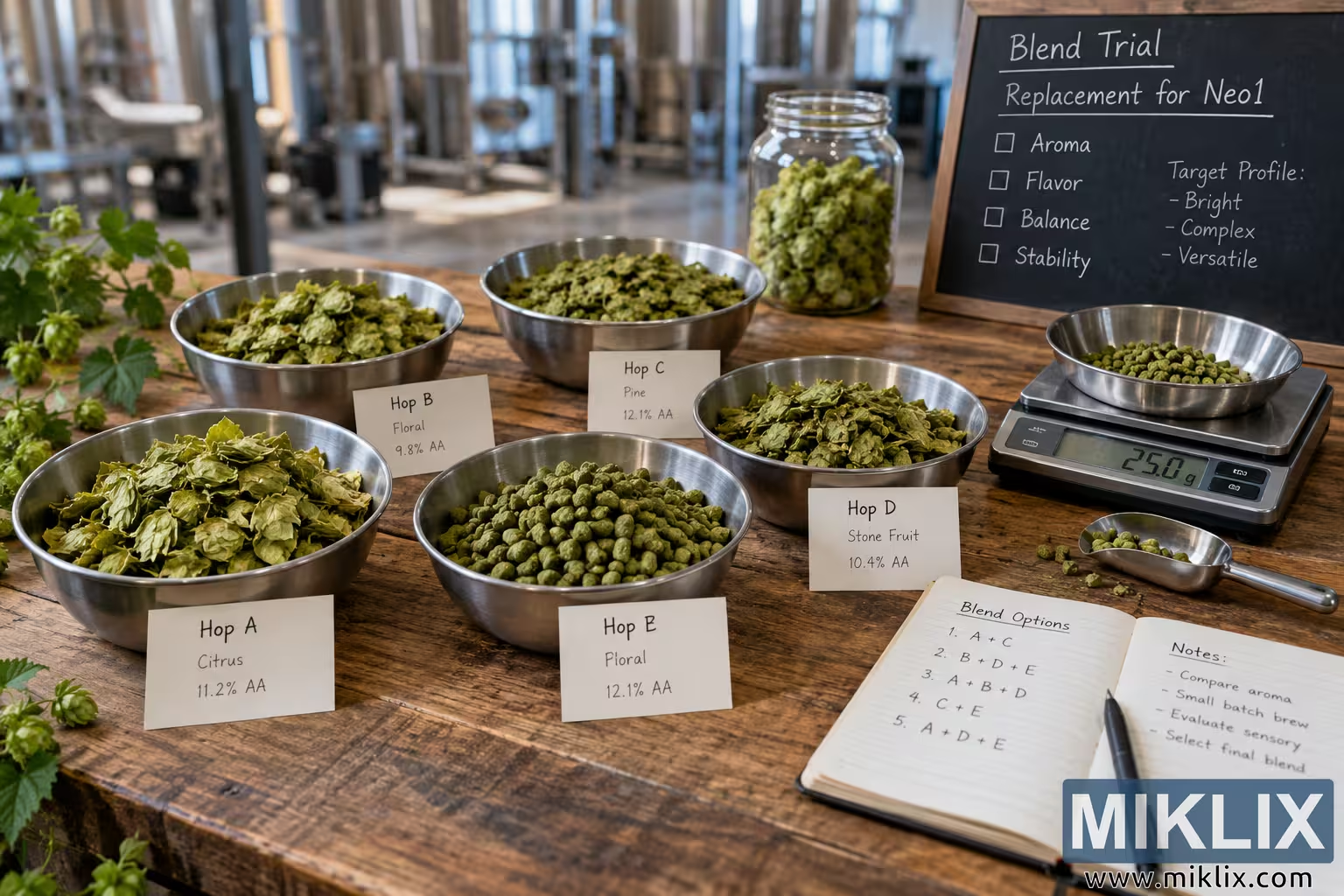
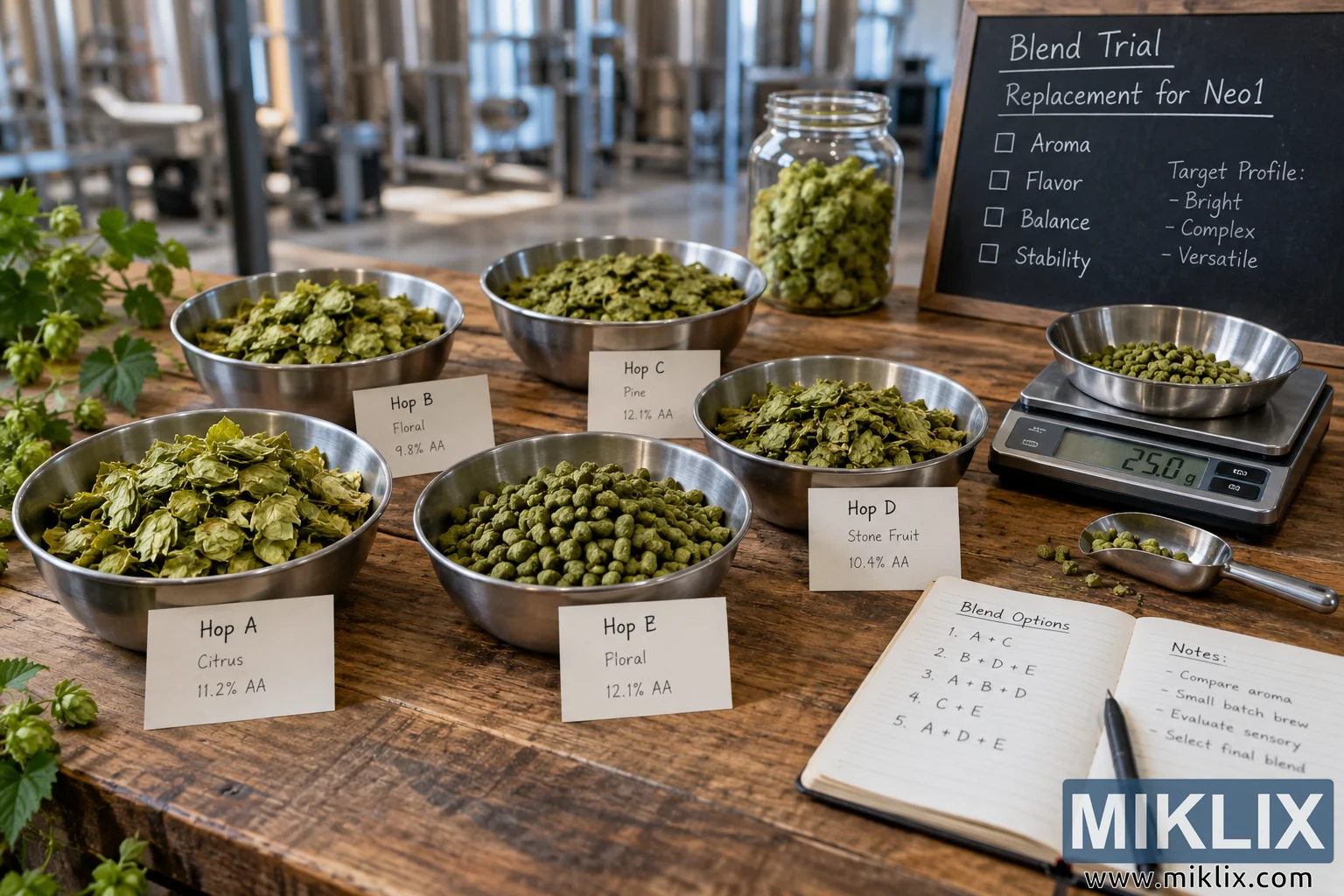
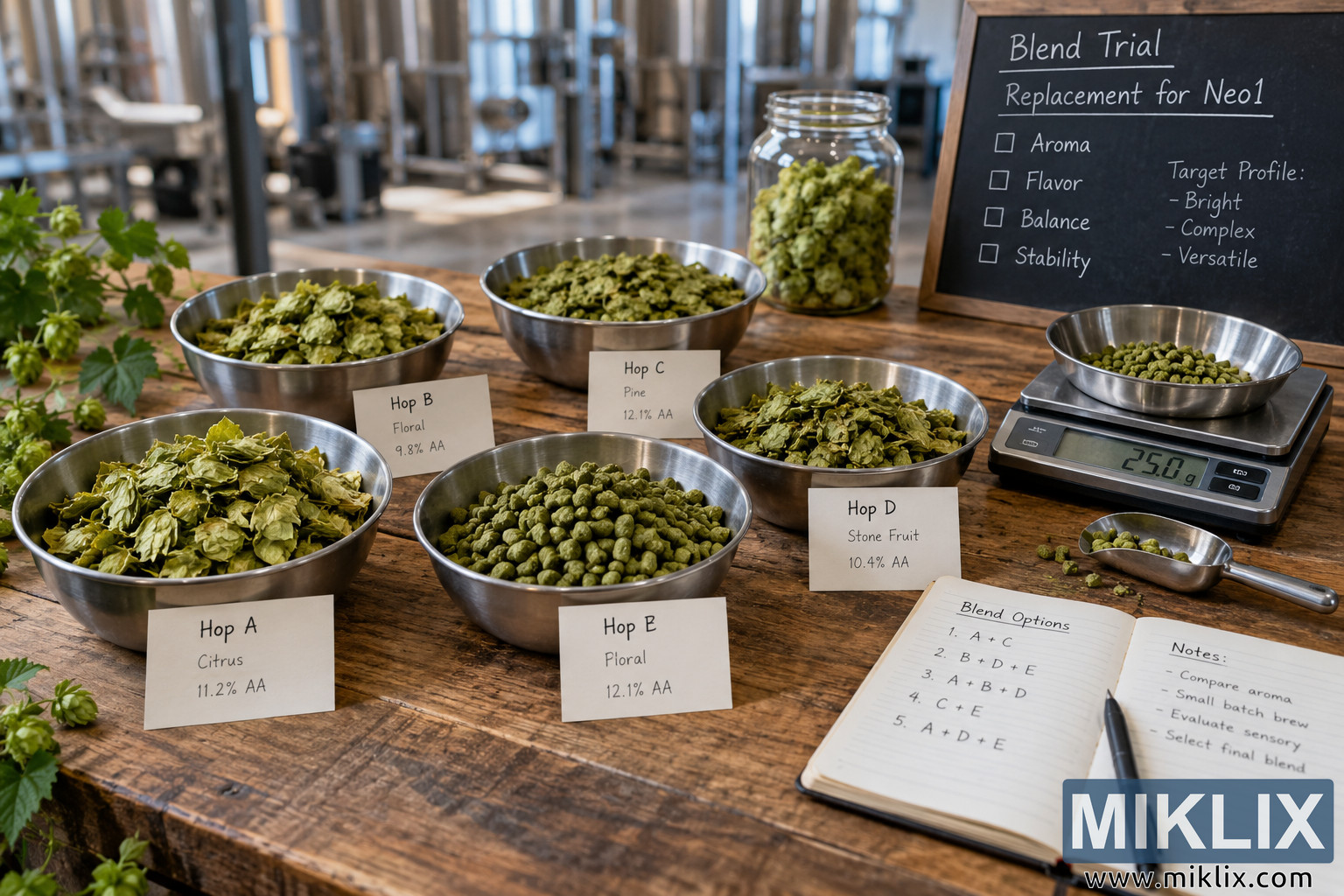
A realistic brewery laboratory scene showing multiple measured hop samples, a precision scale, blend trial notes, sensory targets, and formulation records for developing a replacement hop blend.
Available versions of this image
The image files available for download below are less compressed and higher resolution - and as a result of that, higher quality - than the images embedded in articles and pages on this website, which are more optimized for file size in order to reduce bandwidth consumption.
Regular size (1,536 x 1,024)
Large size (3,072 x 2,048)
Very large size (4,608 x 3,072)
Extra large size (6,144 x 4,096)
Comically large size (1,048,576 x 699,051)
- Still uploading... ;-)
Image description
A high-resolution landscape photograph presents a carefully arranged hop-blending trial inside an industrial brewing laboratory. The scene is viewed from a slightly elevated angle across a large, weathered wooden worktable, with the brewing facility extending into the softly blurred background. Stainless-steel tanks, pipes, fittings, vessels, and other brewery equipment establish the setting as a professional production and testing environment, while bright natural light enters from large windows and creates a clean, realistic atmosphere. The central focus is a collection of whole hop cones and compressed hop pellets being prepared for comparison and measurement as part of a blend-development exercise. Several shallow stainless-steel bowls are arranged across the table, each containing a different hop sample. The samples vary visibly in form and texture: some bowls contain loose, leafy green hop cones with papery bracts, while another contains compact cylindrical green pellets. Small handwritten cards positioned in front of the bowls identify the samples as Hop A, Hop B, Hop C, Hop D, and Hop E. The cards also include descriptive sensory notes and alpha-acid percentages, reinforcing the analytical nature of the trial. Hop A is associated with a citrus character and an 11.2 percent alpha-acid value. Hop B is associated with a floral character and a 9.8 percent alpha-acid value. Hop C is associated with a pine character and a 12.1 percent alpha-acid value. Hop D is associated with a stone-fruit character and a 10.4 percent alpha-acid value. Hop E is associated with a floral character and a 12.1 percent alpha-acid value. The labels make the image read as a practical research and development workspace rather than a casual brewing scene. On the right side of the table, one of the green pellet samples sits in a digital precision scale, whose display visibly reads approximately 25.0 grams. A stainless-steel scoop rests nearby, with several individual pellets scattered naturally across the wooden surface. This combination of labeled samples, weighing equipment, and loose material communicates that the hops are being measured systematically before blend preparation. Behind the samples, a large transparent glass jar holds additional green hop material, providing another layer of depth and visual context. Fresh hop plants and cones are also visible toward the left edge of the frame, subtly connecting the processed ingredients with their agricultural source. In the upper-right portion of the image, a dark chalkboard mounted on a wooden frame summarizes the trial. It is headed 'Blend Trial' and identifies the exercise as a replacement study for an existing reference product. Beneath the heading, a checklist includes aroma, flavor, balance, and stability, while a target profile lists bright, complex, and versatile characteristics. The board gives the scene a clear experimental objective: multiple hop samples are being evaluated and combined to create a new blend intended to reproduce or approximate a desired sensory profile without depicting any actual commercial brand. In the lower-right foreground, an open lined notebook provides a second layer of documentation. Its pages contain a handwritten 'Blend Options' list with several proposed combinations of the numbered hop samples, followed by notes concerning aroma comparison, small-batch brewing, sensory evaluation, and selection of a final blend. A dark pen lies diagonally across the notebook, suggesting that the formulation process is active and still being documented. The wooden table has visible grain, scratches, knots, and natural variations that contrast with the polished stainless steel of the bowls, scale, and scoop. The realistic imperfections help give the photograph the appearance of a genuine working laboratory rather than a staged illustration. The composition uses the table as a strong foreground plane, with the bowls distributed across different depths to create a sense of dimensionality. The closest sample bowls are rendered with especially clear detail, allowing the individual hop cones and pellets to be distinguished. The background brewery equipment is intentionally softened by shallow depth of field, keeping attention on the experimental ingredients and documentation while still making the environment immediately recognizable. Lighting is bright but natural, with gentle highlights on the stainless-steel surfaces and subtle shadows beneath the bowls and labels. The overall color palette consists of natural greens from the hops, warm brown wood, silver-gray metal, muted cream paper, and neutral industrial tones in the background. The image has a polished documentary-photography aesthetic, combining the visual clarity of a product-development photograph with the atmosphere of an authentic brewing research workspace. There are no people in the frame, so the viewer's attention remains entirely on the ingredients, measurements, records, and experimental setup. The visual narrative centers on methodical comparison: multiple hop varieties are individually identified, weighed, examined, and considered as components of several possible blends. The arrangement communicates a progression from raw samples and quantitative measurement to sensory analysis and formulation. Overall, the image depicts a professional hop-blending experiment in which multiple measured samples are being evaluated as candidates for a replacement blend, with the surrounding equipment, labels, scale, chalkboard, notebook, and sensory notes collectively illustrating a structured process of ingredient selection, formulation, testing, and refinement.
The image is related to: Hops in Beer Brewing: Neo1