
Image: Traditional Hop Harvest in a Historical English Hop Field
Published: October 16, 2026 at 5:44:56 PM UTC
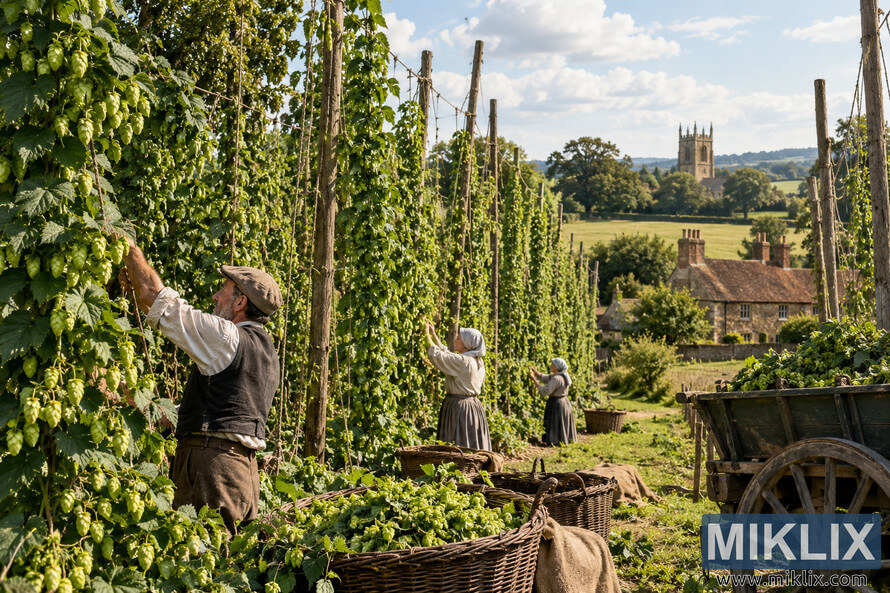
A photorealistic historical English hop field showing traditional hand harvesting, tall wooden trellises, wicker baskets, a farm cart, rural cottages, and a distant village church.
Available versions of this image
The image files available for download below are less compressed and higher resolution - and as a result of that, higher quality - than the images embedded in articles and pages on this website, which are more optimized for file size in order to reduce bandwidth consumption.
Regular size (1,536 x 1,024)
Large size (3,072 x 2,048)
Very large size (4,608 x 3,072)
Extra large size (6,144 x 4,096)
Comically large size (1,048,576 x 699,051)
- Still uploading... ;-)
Image description
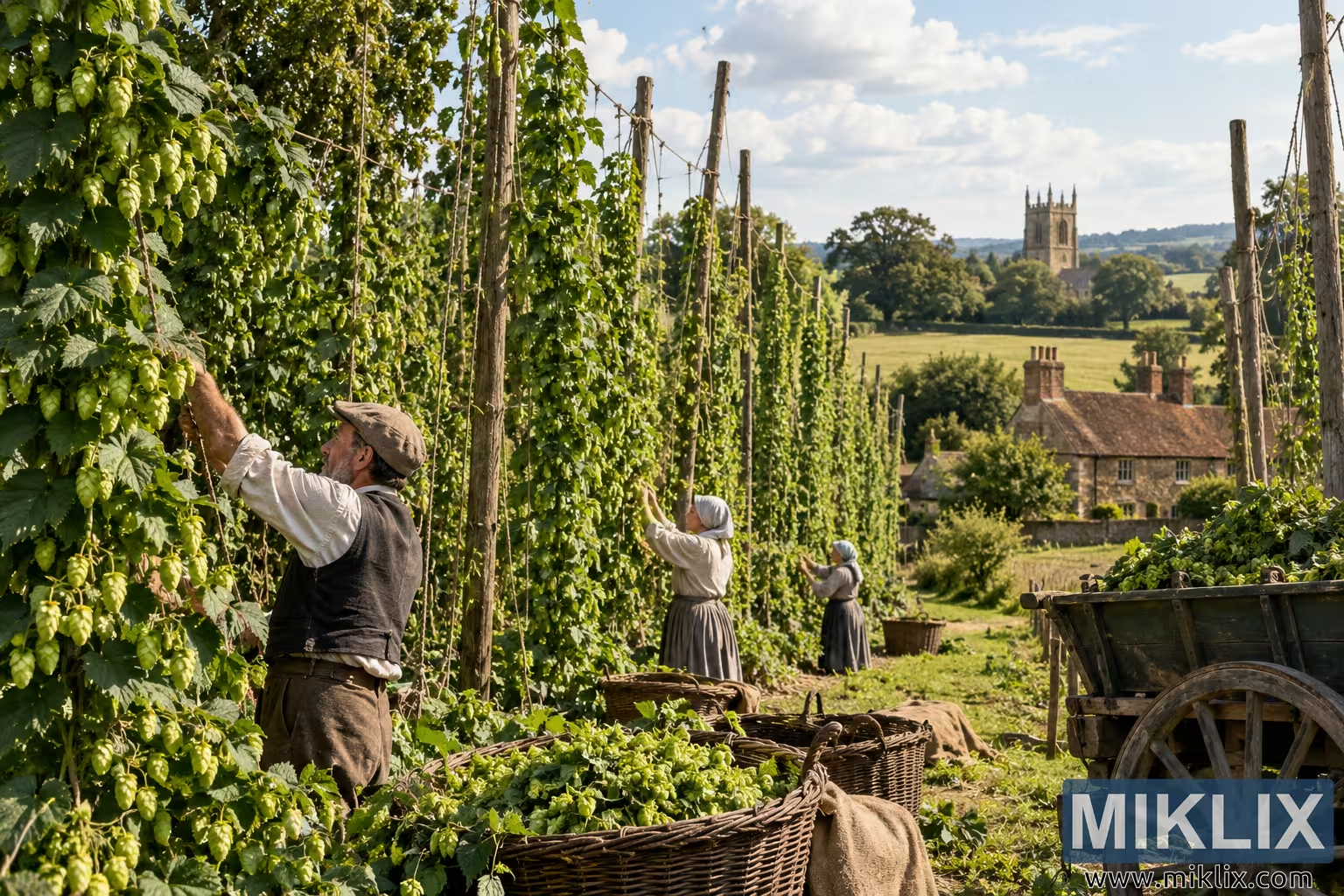
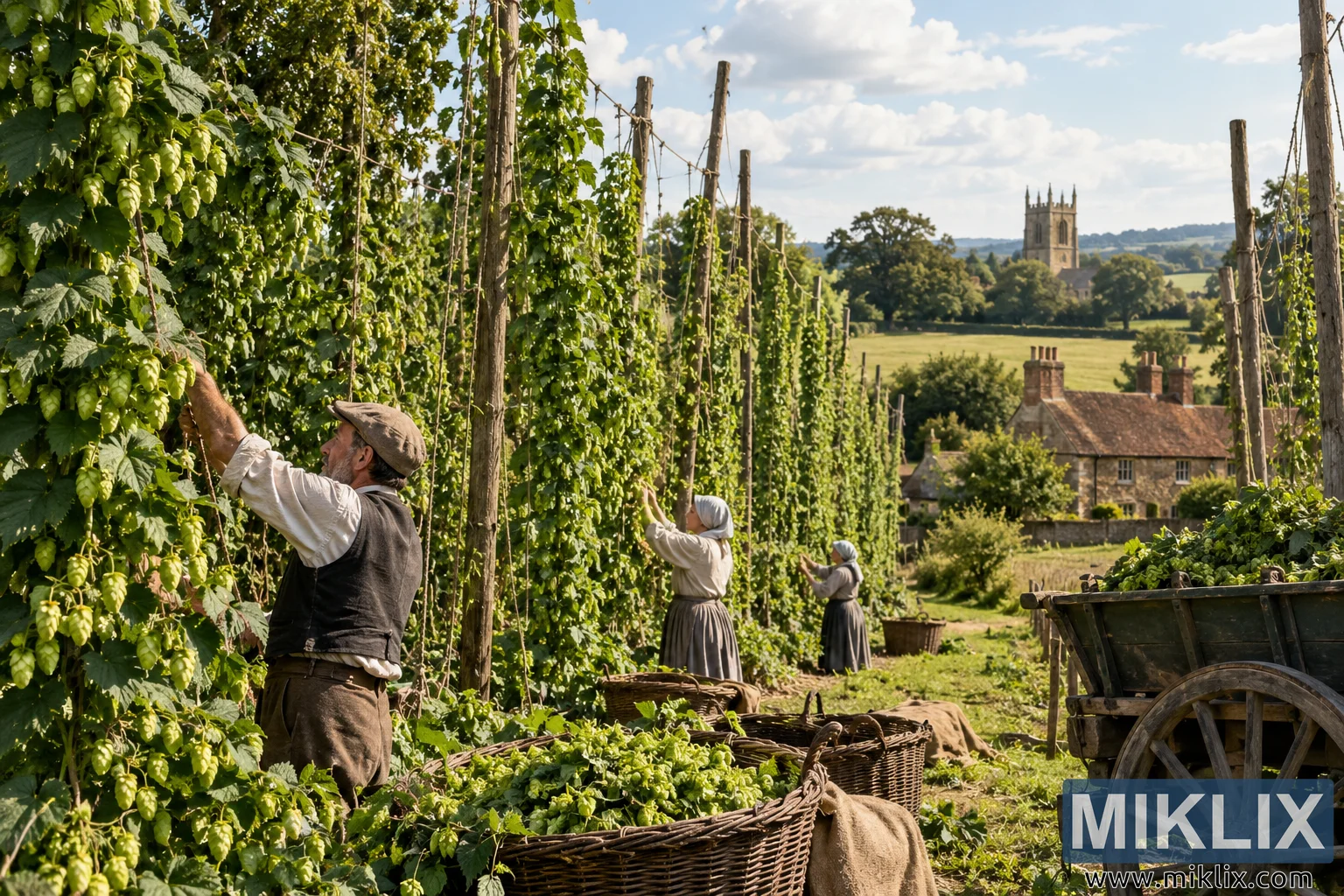
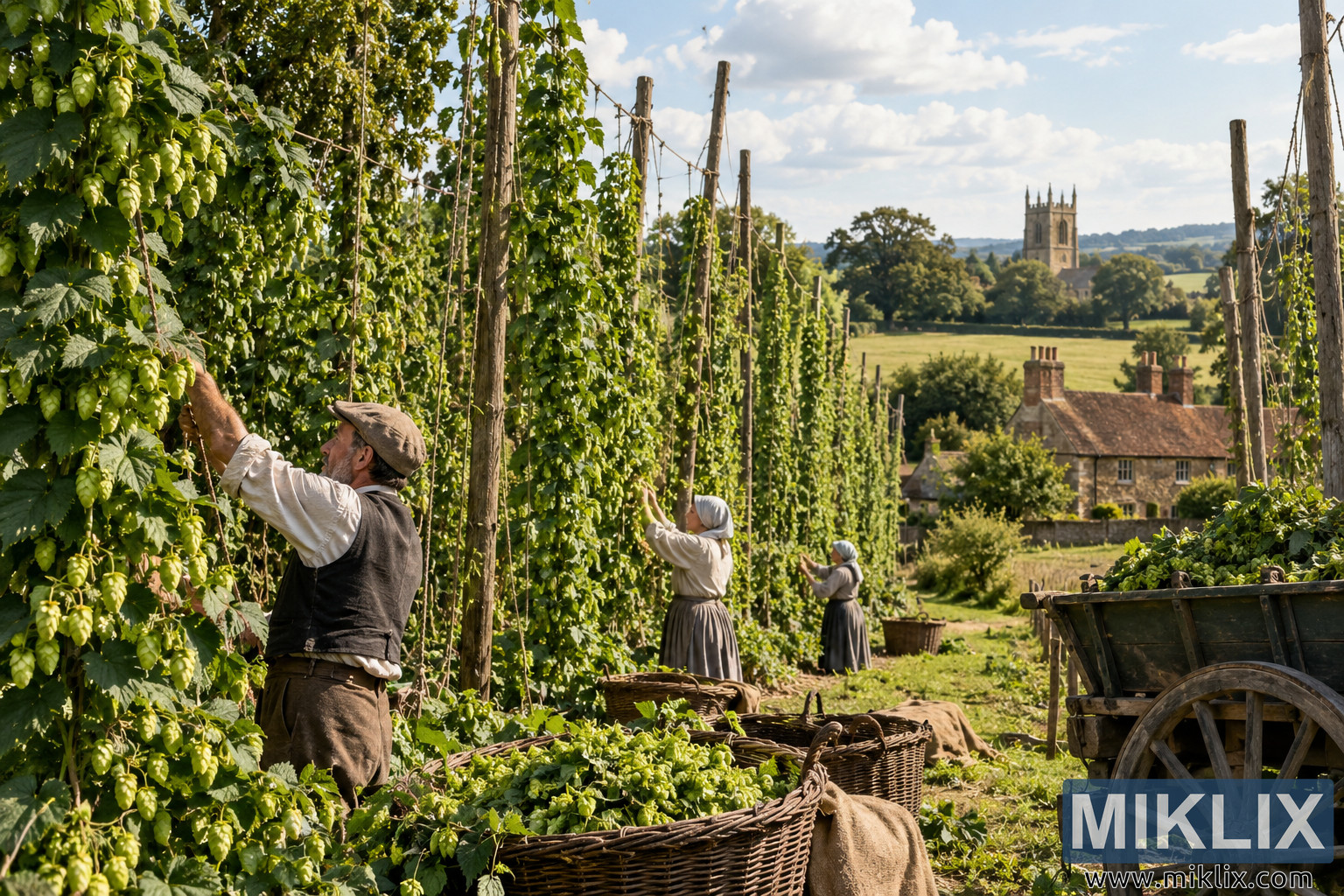
A wide, photorealistic landscape depicts a historical English hop field during the harvest season, presenting traditional agricultural methods in a warm rural setting. The scene is viewed from within the hop garden, where long, orderly rows of vigorous hop plants extend from the foreground toward the middle distance. The plants climb tall wooden poles and a network of suspended ropes or wires, illustrating the traditional trellis system used to support the rapidly growing hop bines. The rough, weathered poles vary slightly in height and alignment, giving the field an authentic handmade character rather than the appearance of modern mechanized agriculture. Dense green foliage covers much of the trellis, and numerous pale green hop cones hang in clusters among the broad, textured leaves. The cones are especially prominent along the left side of the image, where the nearest plants fill much of the foreground and allow their distinctive layered, papery structure to be clearly seen.
Several agricultural workers dressed in historical rural clothing are harvesting the hops by hand. Closest to the viewer, on the left side of the field, a man stands beside a heavily laden hop bine. He wears practical clothing in muted natural tones, including a light-colored long-sleeved shirt, a dark waistcoat, brown trousers, and a soft flat cap. His arms are raised toward the vegetation as he works directly among the leaves and hop cones. His posture conveys concentration and physical involvement in the harvest. Farther down the row, two women are also engaged in gathering the crop. They wear simple long skirts, pale blouses, and cloth head coverings appropriate to a historical countryside setting. One woman reaches upward toward a hanging bine while another works farther away, partially framed by the repeating vertical lines of the hop poles. The workers are distributed naturally through the field, emphasizing the labor-intensive character of hop harvesting before widespread mechanization.
The foreground contains several large woven wicker baskets overflowing with freshly gathered hops and leafy cuttings. Their dark brown, irregular weaving contrasts with the vivid greens of the harvested plants. Some loose vegetation spills around the baskets and across the grassy earth, suggesting that harvesting is actively underway rather than staged or completed. Pieces of coarse brown fabric or sacking lie nearby, reinforcing the practical agricultural atmosphere. On the right side of the image stands a traditional wooden farm cart with a large spoked wheel. The cart is dark, weathered, and constructed from substantial wooden boards. Its bed is piled high with freshly collected hop foliage and cones. The cart provides a strong visual reference to the methods by which the harvested crop would have been transported away from the field before the use of modern tractors and mechanized harvesting equipment.
Beyond the workers and hop rows, the landscape opens into a peaceful English countryside. Green pastureland stretches across the middle distance, divided by hedges, trees, and natural field boundaries. Mature deciduous trees create irregular masses of dark green foliage across the horizon. A cluster of traditional stone or brick cottages occupies the right-center background. Their warm, weathered walls and pitched reddish-brown roofs blend naturally with the rural landscape. Several tall brick chimneys rise above the rooftops, contributing to the historical village character. The buildings appear modest and functional, suggesting a small agricultural settlement closely connected with the surrounding farmland.
In the distance, a substantial stone church tower rises above the trees and fields. Its square form, vertical openings, and crenellated upper silhouette create a recognizable feature of an old English village skyline. The church serves as a distant focal point and helps establish a strong sense of place, while remaining secondary to the hop harvest in the foreground. Rolling countryside continues behind it toward a softly defined horizon, creating depth and giving the impression that the hop field belongs to a larger patchwork of farms, meadows, villages, and wooded areas.
The lighting is bright, warm, and natural, resembling clear late-summer or early-autumn afternoon sunshine. Sunlight falls from the side, illuminating the hop leaves, cones, workers, baskets, and wooden structures with crisp highlights while producing soft but distinct shadows. The nearest hop foliage glows in places where sunlight passes through the leaves, revealing variations from deep forest green to fresh yellow-green. The wooden poles, baskets, cart, clothing, and village buildings contribute earthy brown, beige, gray, and ochre tones that complement the dominant vegetation. Above the landscape is a broad blue sky scattered with large, soft white clouds. The combination of sunlight and broken cloud gives the scene a pleasant, settled agricultural atmosphere without appearing overly idealized.
The composition uses the repeating hop poles and rows as strong perspective lines that lead the eye from the detailed foreground into the distant village and church. The dense hop plants on the left form a natural frame, while the wooden cart and cottages balance the right side. Human figures placed at different distances reinforce the depth of the field and communicate the scale of the tall hop-growing structures. Fine visual details, including individual leaves, clusters of cones, rough timber grain, woven basket fibers, folds in the workers' clothing, grass, cut vegetation, stonework, roof tiles, and distant trees, contribute to the image's documentary realism. There are no visible modern machines, vehicles, signs, logos, advertisements, product packaging, or identifiable commercial brands. Overall, the image portrays a traditional English hop harvest as a communal, manual agricultural activity, combining historical farming practices with the characteristic architecture and gently rolling landscape of the English countryside.
The image is related to: Hops in Beer Brewing: Northern Brewer