
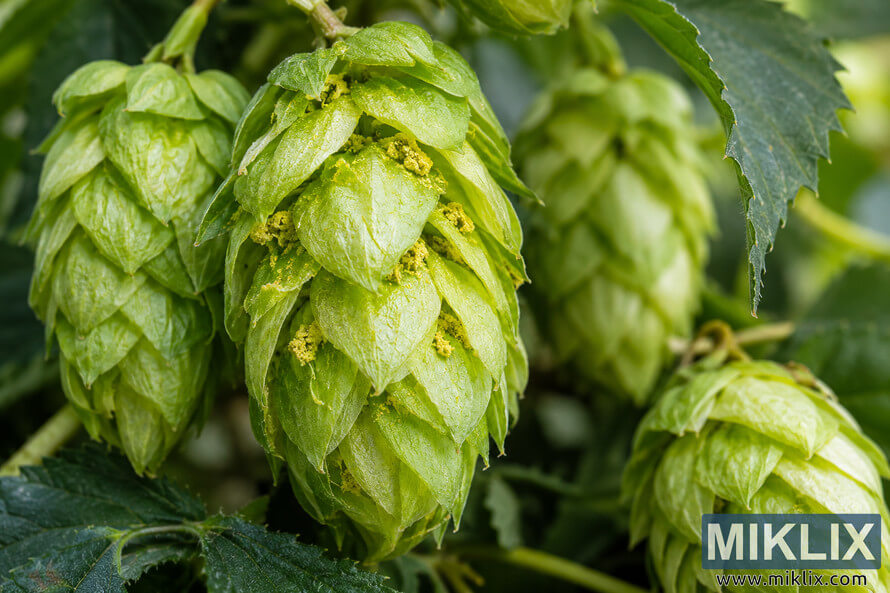
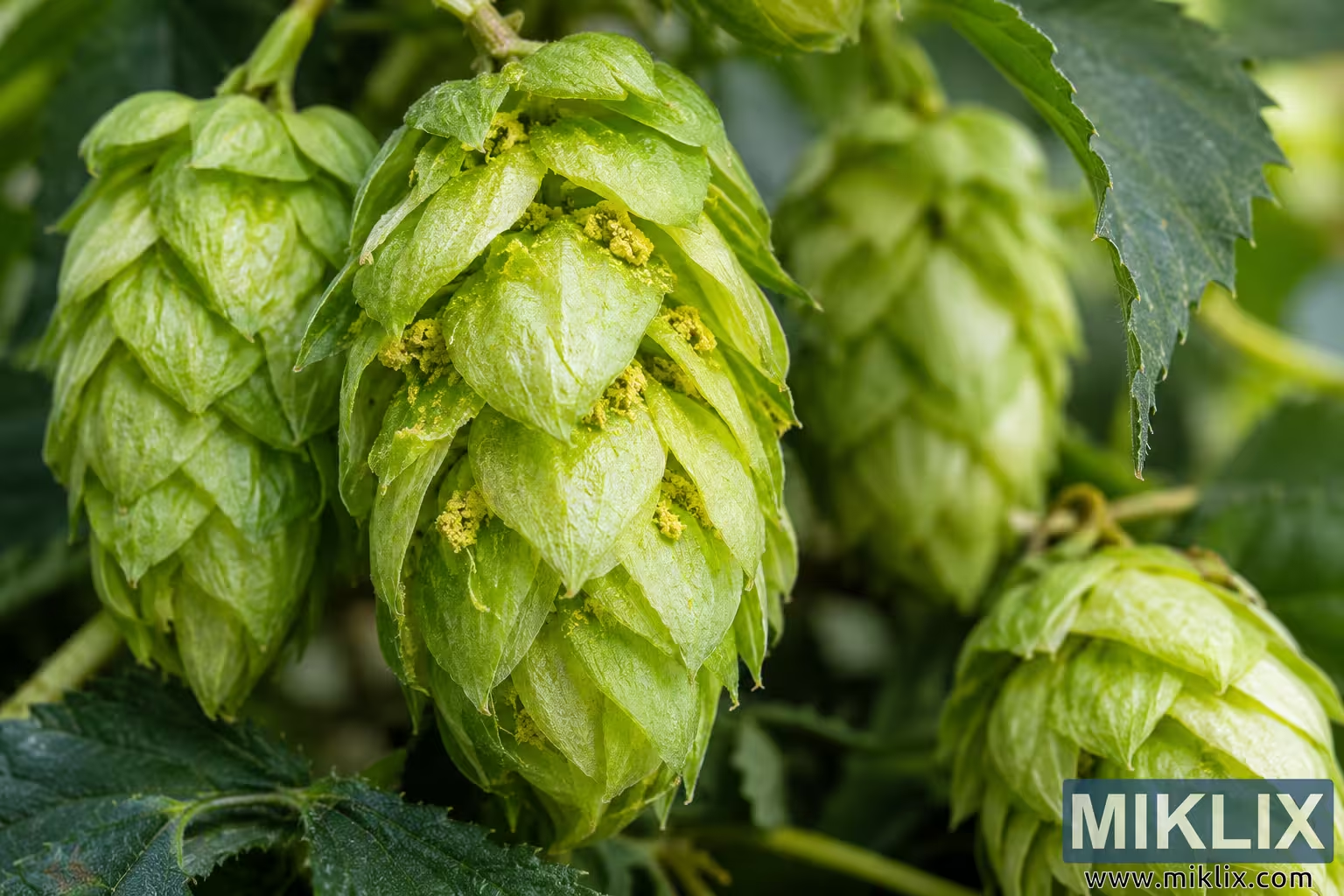
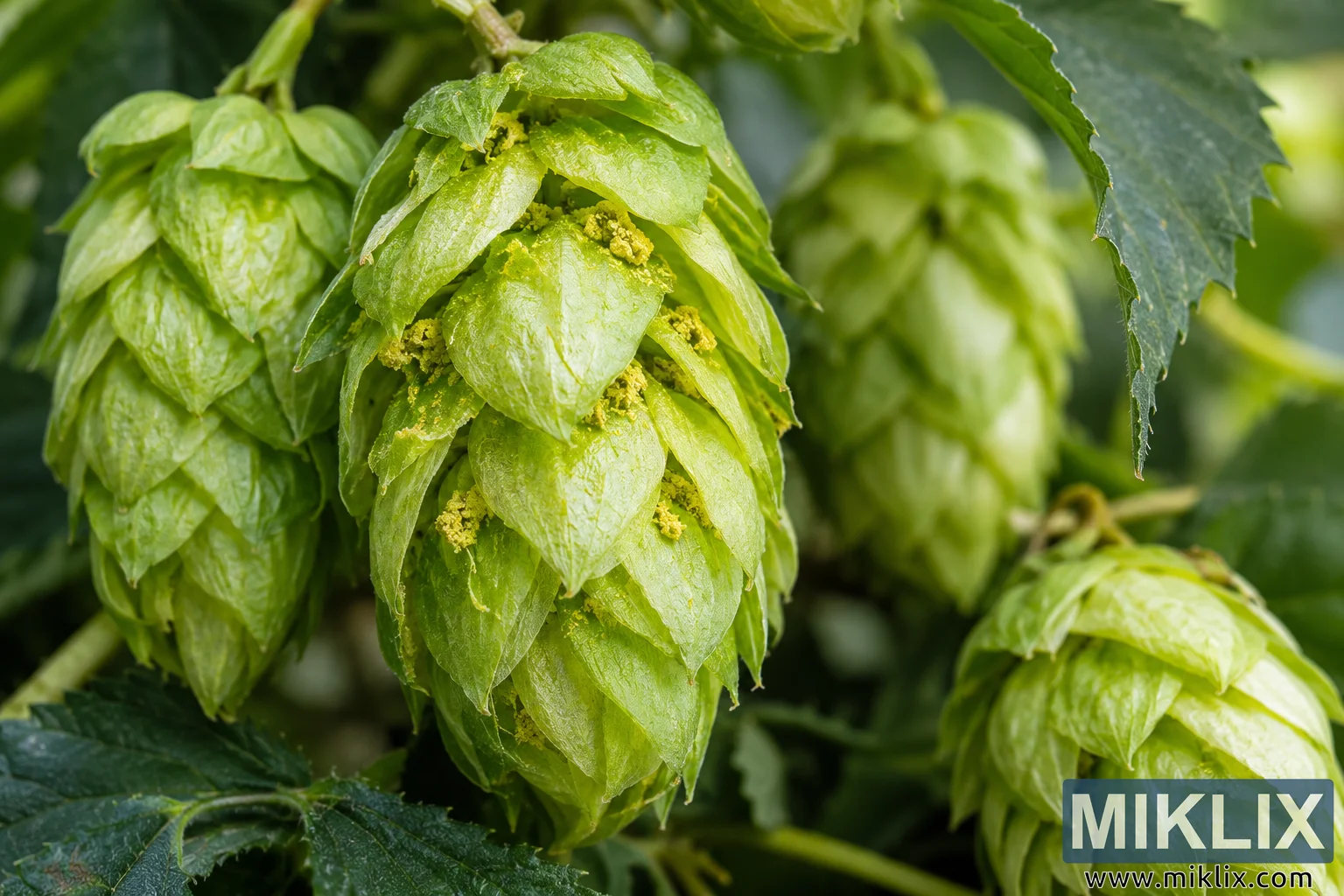
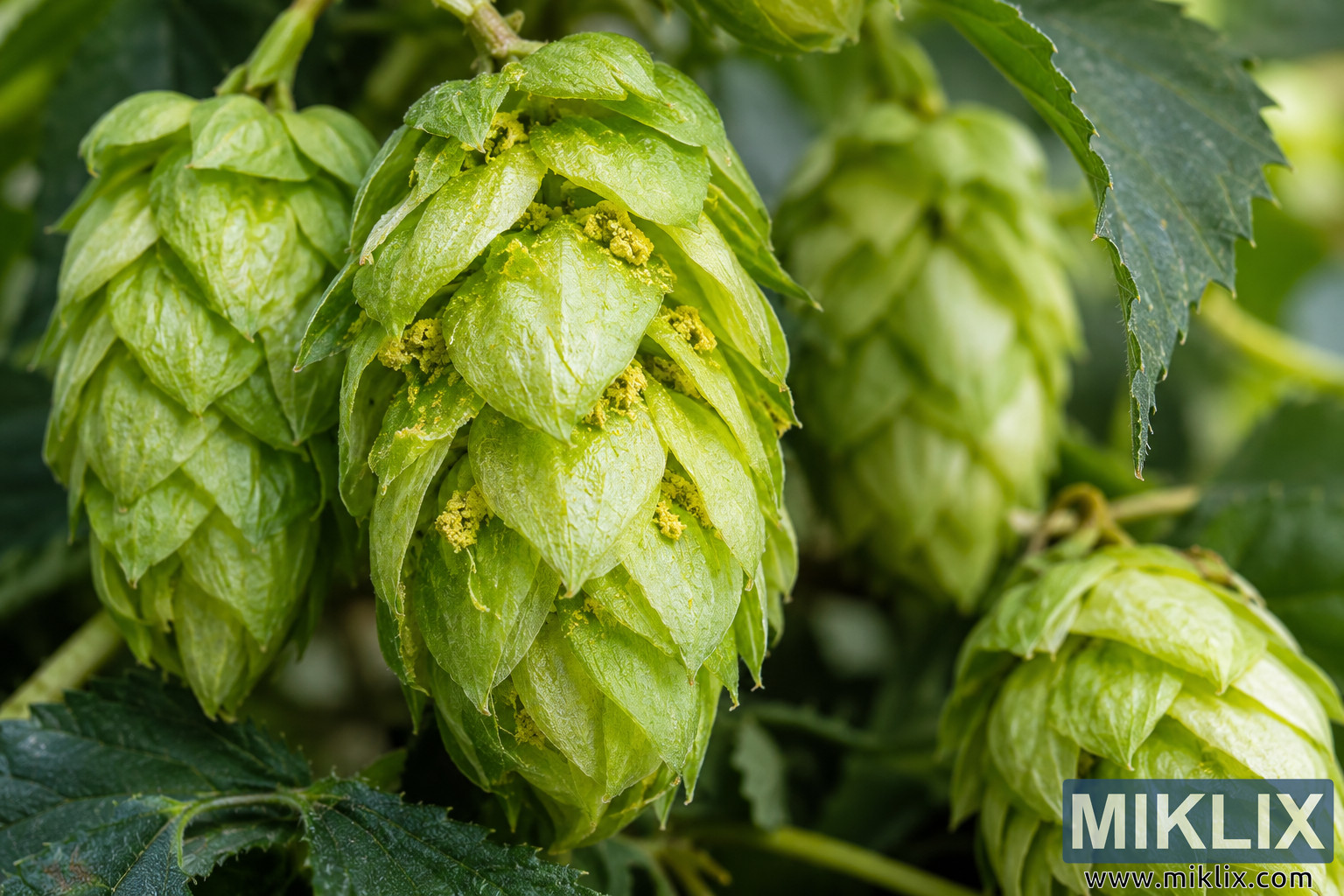
Image: Green Hop Cones with Visible Lupulin Glands
Published: October 16, 2026 at 5:44:56 PM UTC
High-resolution macro image of fresh green hop cones showing layered bracts, natural foliage, and detailed yellow lupulin glands in a lush botanical setting.
Available versions of this image
The image files available for download below are less compressed and higher resolution - and as a result of that, higher quality - than the images embedded in articles and pages on this website, which are more optimized for file size in order to reduce bandwidth consumption.
Regular size (1,536 x 1,024)
Large size (3,072 x 2,048)
Very large size (4,608 x 3,072)
Extra large size (6,144 x 4,096)
Comically large size (1,048,576 x 699,051)
- Still uploading... ;-)
Image description
A high-resolution, landscape-oriented macro photograph presents a close-up view of several fresh green hop cones growing naturally on the plant. The composition is dominated by a large, sharply focused hop cone positioned slightly left of center. This central cone fills a substantial portion of the frame and displays the characteristic overlapping, leaf-like bracts of a mature hop flower. Each bract is rendered with considerable surface detail, including delicate veins, subtle wrinkles, gently curled edges, and small variations in green coloration. The cone ranges from bright yellow-green in the areas receiving the strongest illumination to richer medium and deep green tones in the more shaded folds. Between several of the overlapping bracts, clusters and deposits of yellow lupulin are clearly visible. These lupulin glands appear as fine golden-yellow to yellow-green granular material concentrated near the bases and inner surfaces of the bracts. Their warmer color provides a noticeable contrast with the surrounding green plant tissue and emphasizes one of the most distinctive botanical features of a hop cone. The detailed macro perspective makes the lupulin especially prominent, allowing the viewer to distinguish its powdery and slightly clustered appearance among the layered structures of the flower. To the left of the main cone is another hop cone that is also relatively close to the camera. It remains recognizable and detailed but is somewhat less visually dominant than the central specimen. Its overlapping bracts form a compact, tapered structure, with alternating areas of highlight and shadow revealing the dimensional arrangement of the cone. A third hop cone appears in the background toward the upper-right portion of the image. Because of the shallow depth of field, this cone is softly blurred, contributing a sense of depth while reinforcing the botanical environment without competing with the main subject. In the lower-right foreground, another large hop cone enters the frame. It is brightly illuminated and partially in focus, with pale green bracts catching the light along their curved surfaces. This foreground cone is cropped by the edge of the photograph, which creates the impression that the visible flowers are part of a larger, abundant hop plant extending beyond the boundaries of the image. Darker green hop leaves surround the cones. A particularly noticeable leaf occupies part of the lower-left foreground, displaying a broad surface, pronounced veins, and serrated edges. Another leaf descends from the upper-right area and shows a sharply toothed margin against the softer green background. These leaves provide visual context for the cones and introduce deeper green tones that balance the brighter lime and yellow-green colors of the flowers. Slender green stems and vine-like plant structures weave through the scene, although many of them are partially obscured by the cones and foliage. The background consists almost entirely of naturally blurred vegetation in different shades of green. The shallow depth of field produces smooth areas of soft focus and subtle bokeh, isolating the central hop cone while maintaining the impression of dense living foliage. There are no artificial objects, labels, packages, logos, typography, people, buildings, or recognizable commercial branding anywhere in the scene. The image is entirely botanical in appearance. Lighting is naturalistic and relatively even, with soft highlights illuminating the thin bracts and revealing their slightly translucent quality. The brightest areas occur on the central and lower-right cones, where the light accentuates the fine texture of the plant surfaces. Shadows form naturally between the overlapping bracts, giving each cone substantial three-dimensional depth. The central cone shows especially rich textural variation: some bracts appear smooth and gently glossy, while others display fine creases, veins, and slightly irregular edges. Small yellow lupulin deposits are visible at numerous points around the cone, particularly where individual bracts separate and expose the inner flower structures. Their granular texture stands apart from the smoother green surfaces surrounding them. The overall color palette is strongly botanical, consisting primarily of fresh greens, lime greens, yellow-greens, muted forest greens, and small accents of golden yellow from the lupulin. The image conveys freshness, plant maturity, and the tactile character of recently grown hops. Its close viewing distance gives the photograph an observational, almost botanical-study quality while retaining the attractive shallow-focus aesthetic associated with professional macro photography. The horizontal composition provides enough surrounding foliage to establish the natural growing environment while keeping attention firmly on the hop cones and their lupulin glands. Fine botanical details, including leaf serrations, veins, folded bracts, stems, and glandular yellow material, are clearly represented in the areas of strongest focus. The central cone acts as the primary focal point because of its size, sharpness, placement, and visible lupulin, while the surrounding cones create repetition and visual continuity across the landscape frame. Overall, the photograph depicts healthy green hop cones at close range with an emphasis on their layered structure, fresh coloration, and conspicuous yellow lupulin glands, presented against a softly blurred background of hop foliage.
The image is related to: Hops in Beer Brewing: Northern Brewer