
Image: Woody and Herbal Flavor Descriptors – Rustic Botanical Still Life
Published: October 16, 2026 at 5:44:56 PM UTC
Explore woody and herbal flavor descriptors through a rustic still life of aromatic wood, bark, rosemary, sage, thyme, evergreen foliage, dried herbs, moss, pine cone, and fresh citrus.
Available versions of this image
The image files available for download below are less compressed and higher resolution - and as a result of that, higher quality - than the images embedded in articles and pages on this website, which are more optimized for file size in order to reduce bandwidth consumption.
Regular size (1,536 x 1,024)
Large size (3,072 x 2,048)
Very large size (4,608 x 3,072)
Extra large size (6,144 x 4,096)
Comically large size (1,048,576 x 699,051)
- Still uploading... ;-)
Image description
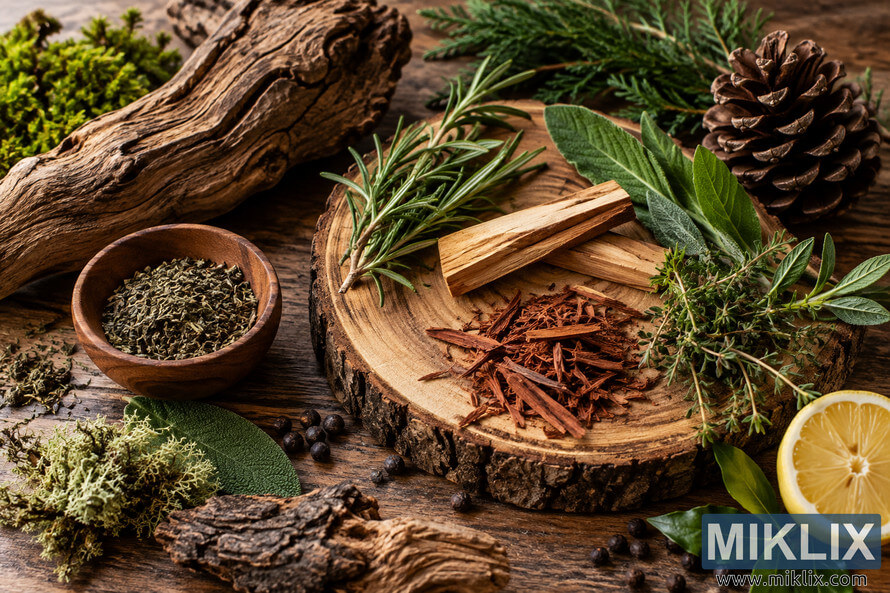
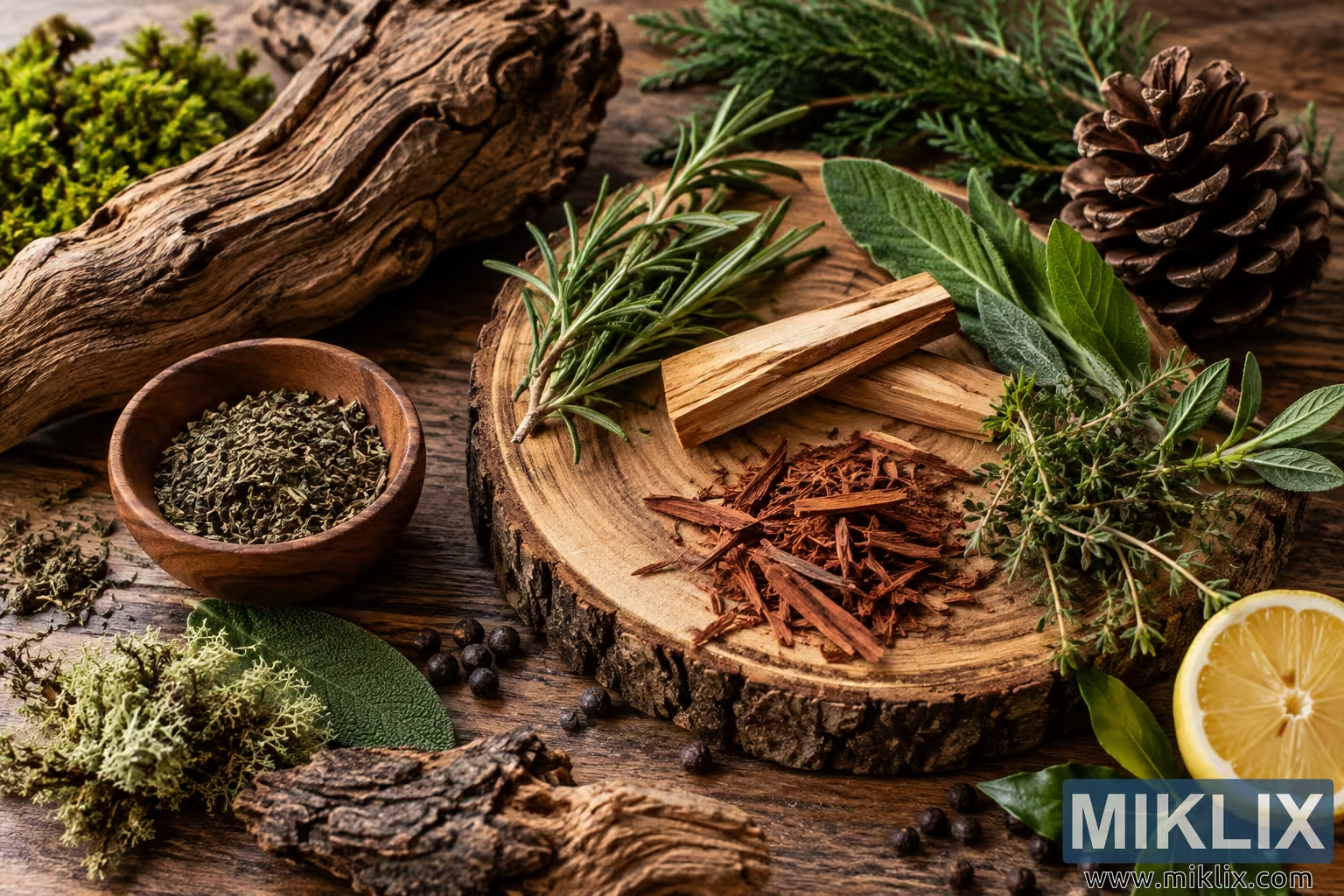
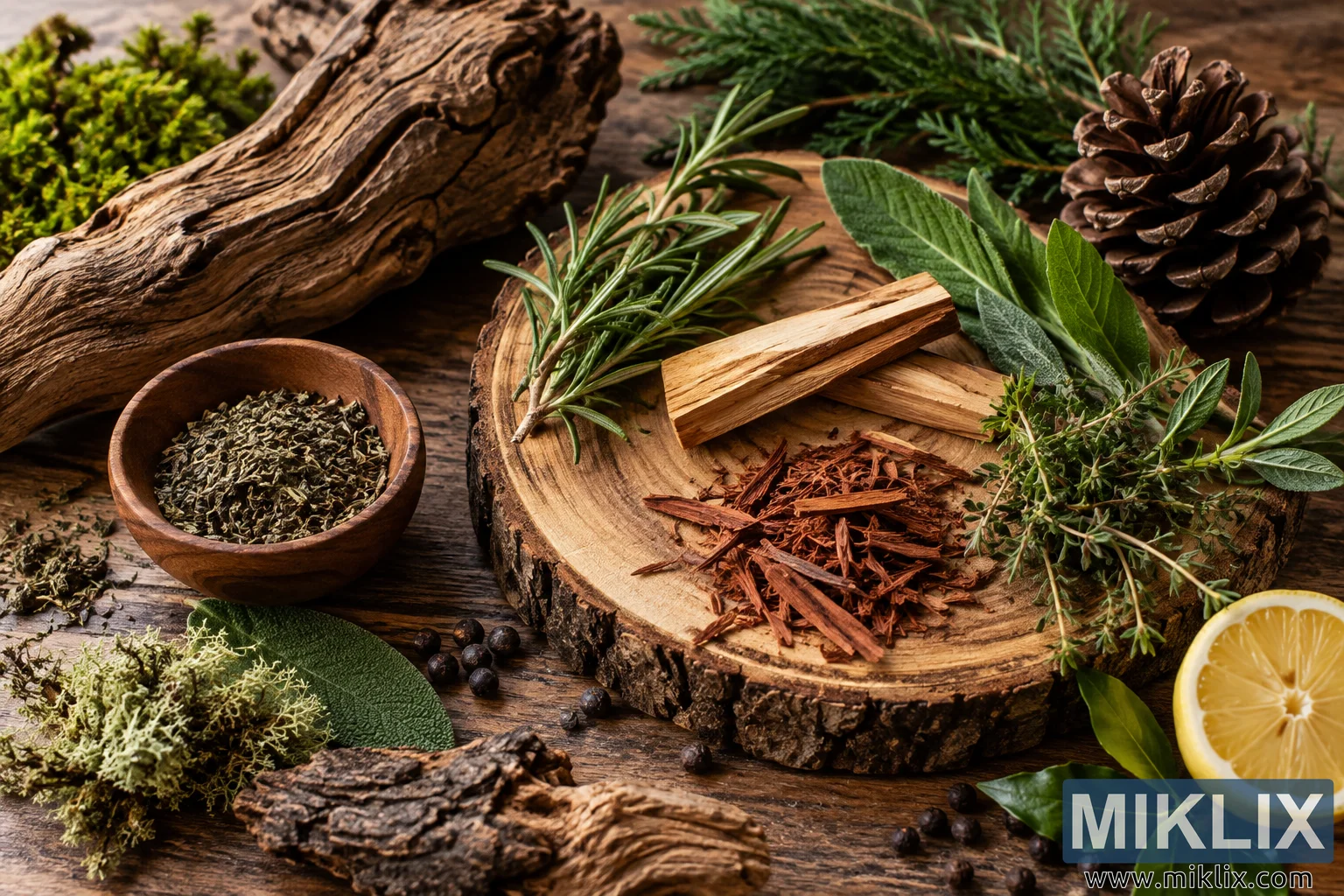
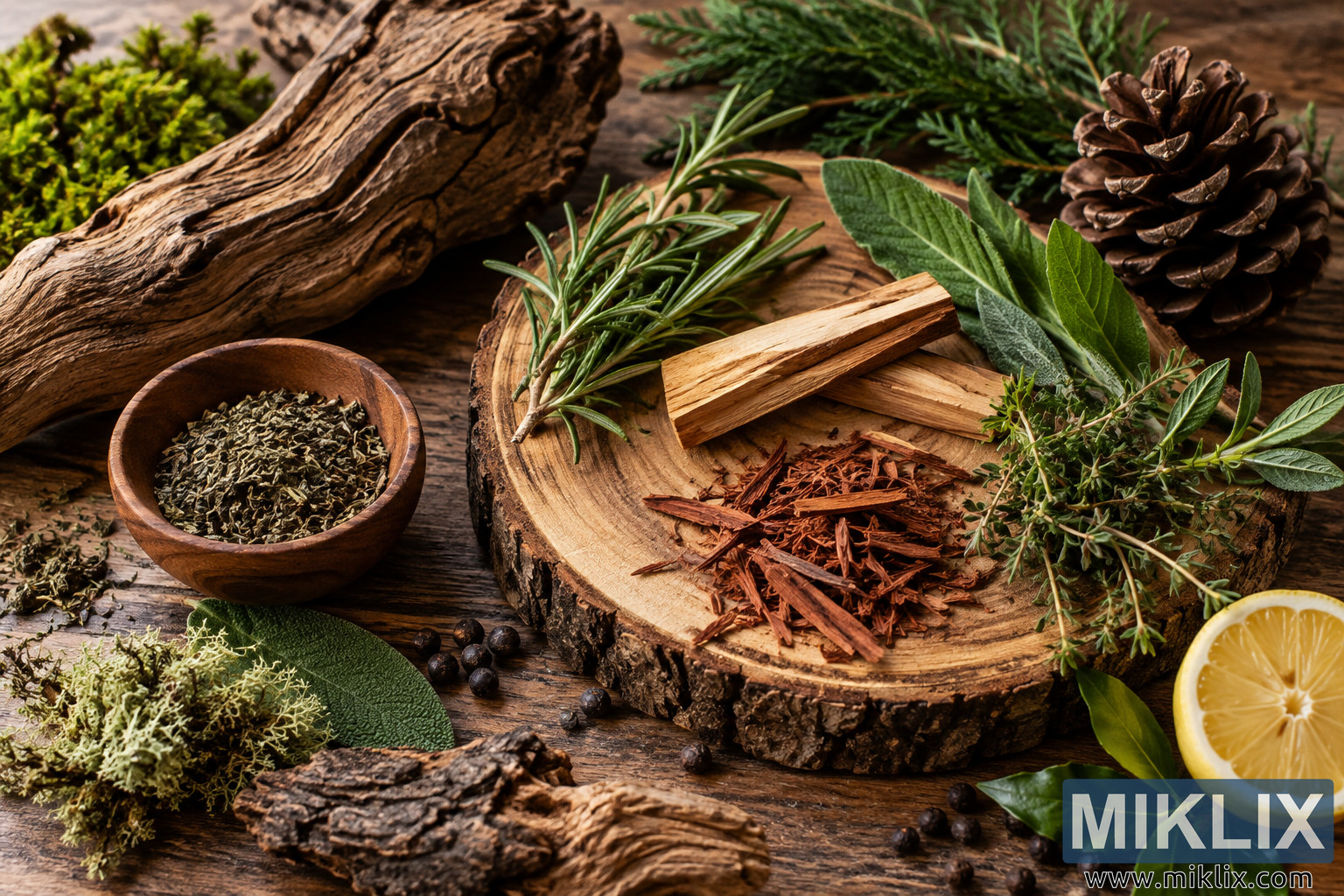
A richly detailed, landscape-oriented still-life photograph presents an evocative collection of woody, herbal, earthy, and botanical elements arranged across a dark, weathered wooden tabletop. The composition is designed to visually communicate woody and herbal flavor descriptors through natural ingredients, textures, colors, and materials rather than through written labels or branded packaging. At the center of the image sits a substantial circular slice of a tree trunk, its pale golden-brown cut surface displaying prominent growth rings, subtle cracks, and organic variations in the grain. The rough, dark bark remains attached around its perimeter, creating a strong contrast between the smoother interior wood and the rugged exterior. This central wooden platform serves as the primary stage for several aromatic botanical elements. Resting across it are fresh sprigs of rosemary with slender, needle-like green leaves, broad velvety sage leaves in muted gray-green tones, delicate thyme-like stems with many tiny leaves, and several pale split pieces of aromatic-looking wood. A loose scattering of reddish-brown bark shavings occupies the foreground portion of the tree slice, adding another layer of fibrous, dry, woody texture. Together, these materials suggest sensory associations such as cedar, forest wood, bark, resin, dried herbs, rosemary, sage, thyme, and other earthy aromatic notes.
To the left of the central tree slice is a small rounded wooden bowl filled with finely cut dried green herbs. The bowl has a polished warm-brown surface and visible natural grain, reinforcing the organic character of the scene. A few fragments of dried herbs have spilled onto the tabletop nearby, making the arrangement feel tactile and naturally assembled rather than perfectly formal. Behind and above the bowl lies a large piece of deeply weathered driftwood or aged timber. Its twisting grain, cracks, grooves, knots, and irregular contours provide one of the strongest woody visual cues in the image. Patches of vivid green moss appear near the upper-left corner, while pale branching lichen and additional moss-like material occupy the lower-left foreground. These forest-floor elements introduce associations with damp woodland, undergrowth, mineral earthiness, and cool green vegetation.
The upper-right portion of the composition contains a large brown pine cone with sharply defined layered scales. Behind it, dense evergreen branches extend horizontally across the background, their deep green needles suggesting pine, fir, conifer resin, and fresh forest aromas. The surrounding botanical arrangement includes additional leafy sprigs in several shades of green, ranging from dark evergreen to soft silvery sage and brighter fresh foliage. The different leaf shapes and surface textures make the herbal theme immediately recognizable: some leaves are narrow and needle-like, others broad and softly textured, while the smallest herbs form intricate clusters of fine stems and miniature leaves.
Across the lower portion of the tabletop, several small dark round berries or peppercorn-like seeds are scattered irregularly. Their nearly black brown color provides small points of visual contrast against the warm wood. Additional pieces of rough bark and aged wood extend through the foreground, including a prominent fragment with deeply ridged dark bark and a lighter exposed interior. These pieces create a sense of depth and make the viewer feel close to the materials, as though examining a collection of aromatic ingredients gathered from a woodland environment.
A bright half lemon appears at the lower-right edge of the image and provides the strongest color contrast in the entire composition. Its saturated yellow rind and translucent pale-yellow flesh stand out clearly against the predominantly brown and green palette. The cut surface faces the viewer, revealing radial segments and a moist, fresh texture. Glossy dark-green leaves surround the citrus fruit, catching highlights from the directional light. Although the principal visual theme is woody and herbal, this citrus element introduces the suggestion of freshness, brightness, zest, and acidity, balancing the deeper forest-like notes represented elsewhere in the photograph.
The lighting is warm, directional, and naturalistic, emphasizing surface detail throughout the arrangement. Highlights reveal the fine hairs and veins of the sage leaves, the slender structure of the rosemary needles, the rough scales of the pine cone, the porous surfaces of bark, the branching structure of lichen, and the concentric grain of the central tree slice. Soft shadows between objects increase the sense of dimensionality without obscuring important details. The shallow-to-moderate depth of field keeps most of the key ingredients clearly recognizable while allowing the background to feel slightly softer and more atmospheric.
The overall color palette is dominated by warm walnut and chestnut browns, tan and golden wood tones, forest green, olive, sage, moss green, and subtle reddish-brown accents. The yellow citrus provides a concentrated complementary highlight. There are no people, logos, labels, packages, recognizable commercial products, or brand identifiers anywhere in the scene. Instead, the photograph relies entirely on natural materials to communicate its sensory concept. The visual vocabulary strongly evokes a rustic forest, an herbalist's worktable, an apothecary-inspired ingredient collection, or a sensory tasting display. The combination of tree rings, raw timber, bark, pine cone, evergreen foliage, rosemary, sage, thyme-like herbs, dried leaves, moss, lichen, seeds, and citrus makes abstract flavor descriptors tangible and visually intuitive. Woody qualities are represented by aged timber, bark, tree grain, pine, and split aromatic wood, while herbal qualities are represented by the abundance of fresh and dried green leaves. Earthy, resinous, forest-like, spicy, and citrus-fresh nuances emerge as secondary associations. The result is an atmospheric, highly textured still life that translates woody and herbal flavor language into a cohesive natural landscape of ingredients and materials.
The image is related to: Hops in Beer Brewing: Northern Brewer