
Image: Northern Brewer Hops Essential Oil Breakdown Infographic
Published: October 16, 2026 at 5:44:56 PM UTC
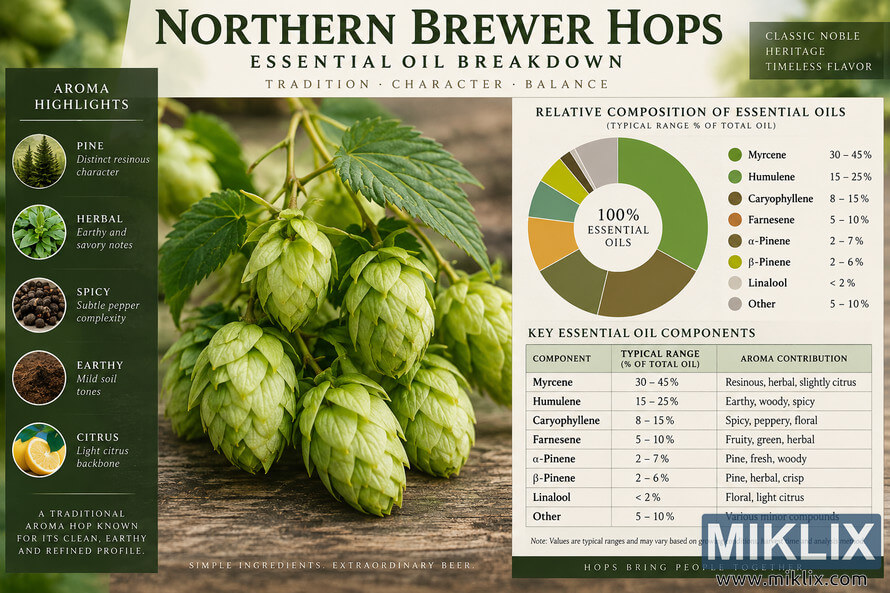
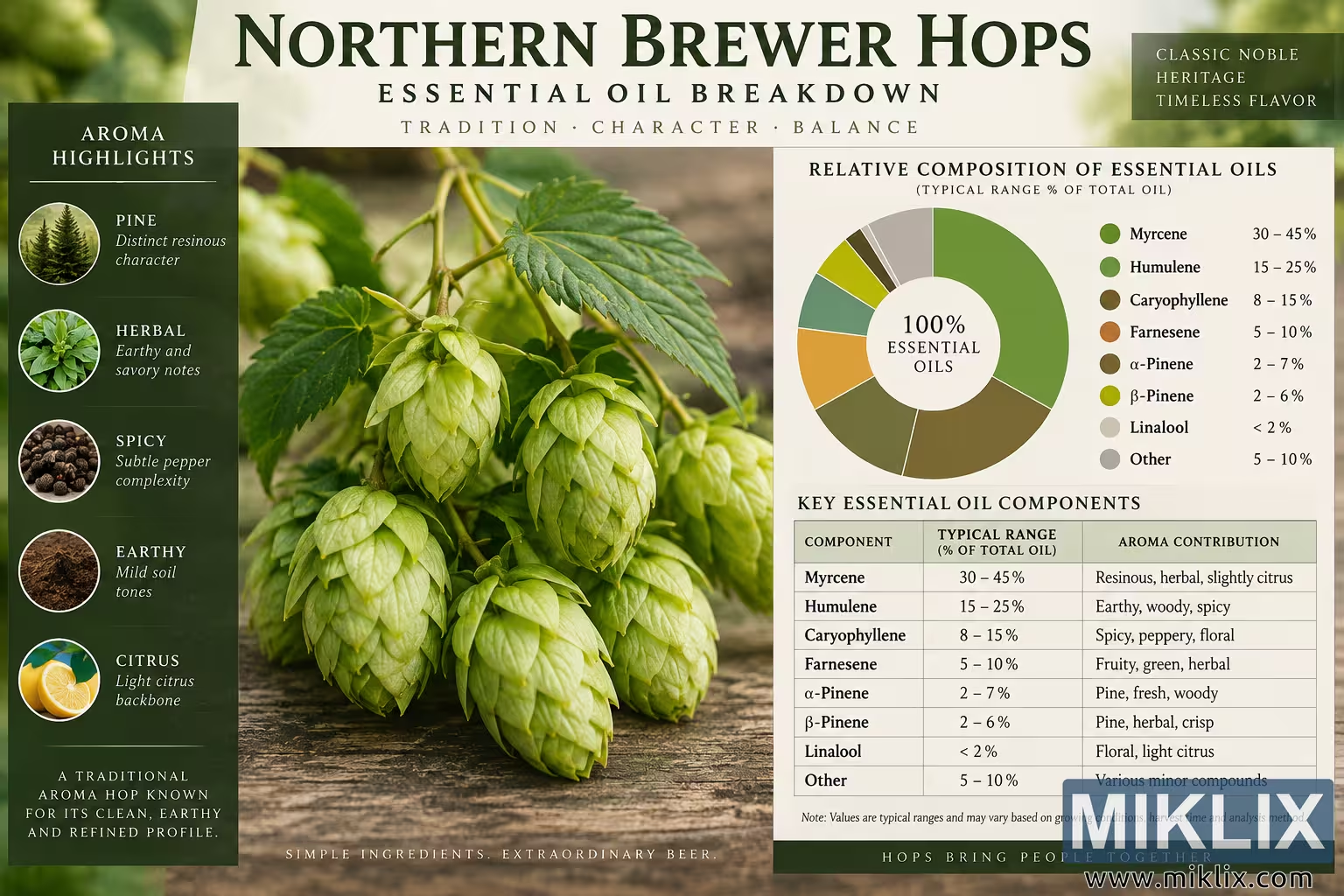
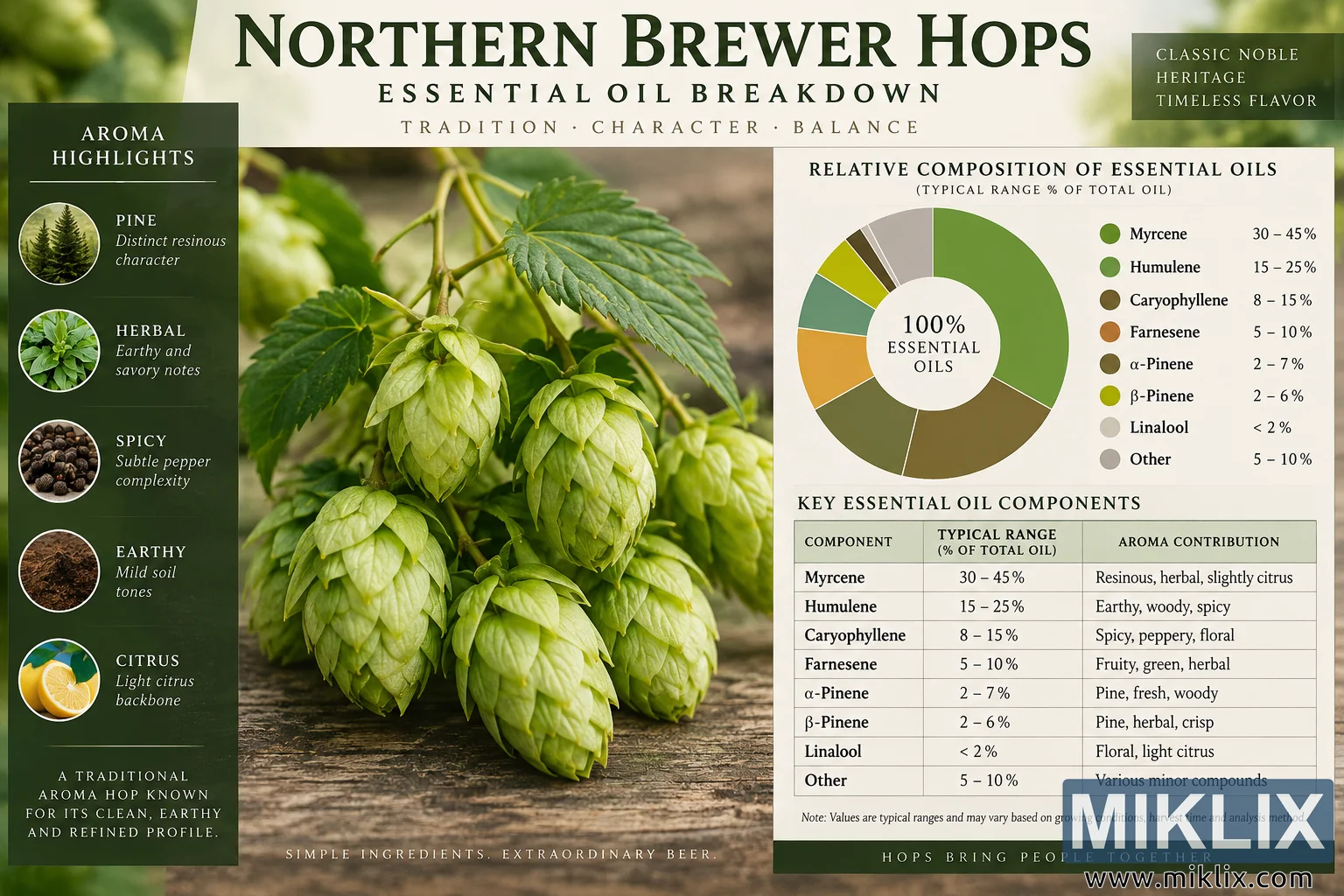
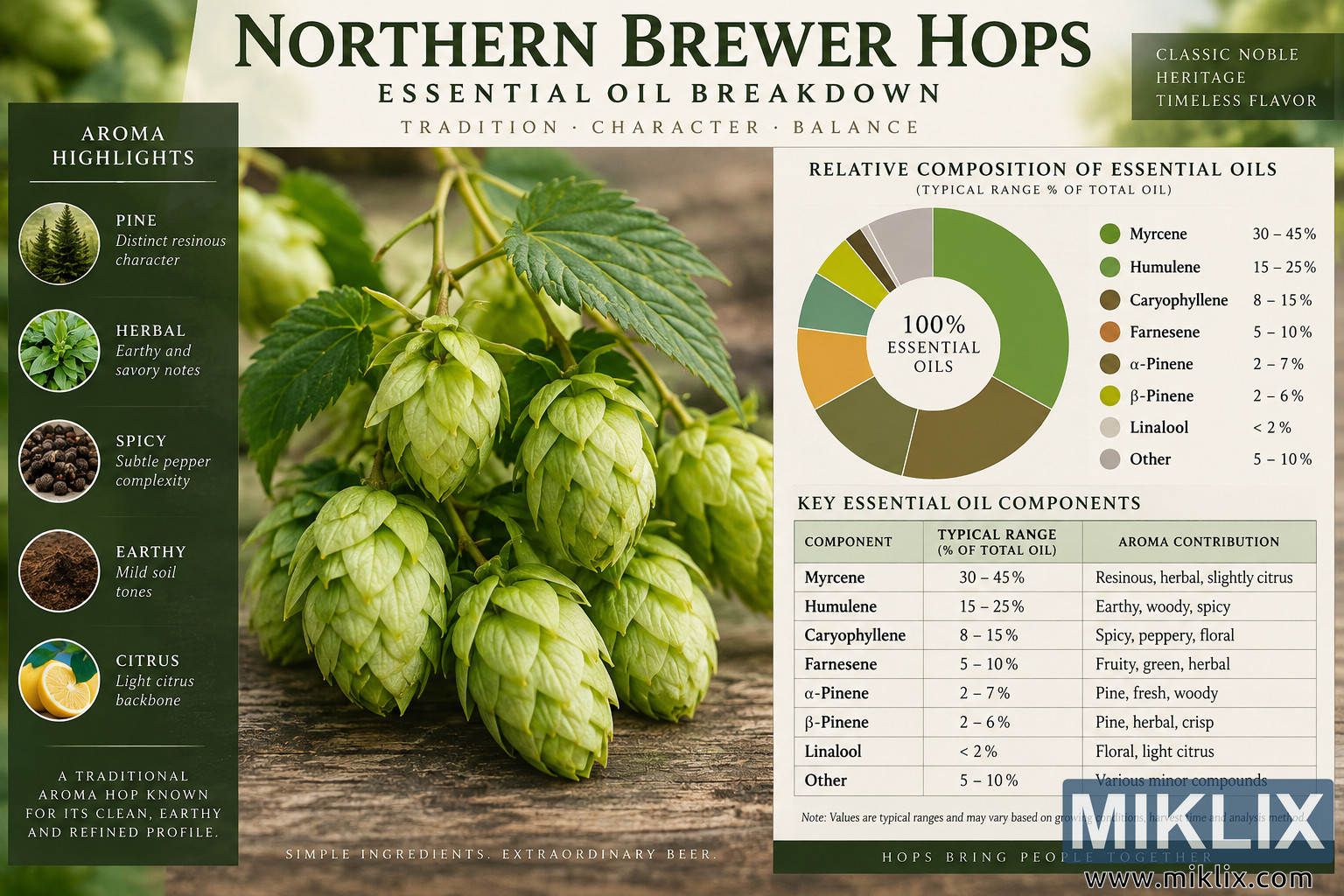
A detailed landscape infographic about Northern Brewer hops, combining botanical hop imagery with aroma highlights and an educational breakdown of representative essential-oil components, ranges, and aroma contributions.
Available versions of this image
The image files available for download below are less compressed and higher resolution - and as a result of that, higher quality - than the images embedded in articles and pages on this website, which are more optimized for file size in order to reduce bandwidth consumption.
Regular size (1,536 x 1,024)
Large size (3,072 x 2,048)
Very large size (4,608 x 3,072)
Extra large size (6,144 x 4,096)
Comically large size (1,048,576 x 699,051)
- Still uploading... ;-)
Image description
This wide, landscape-format educational infographic presents an essential-oil breakdown for Northern Brewer hops in a polished botanical and brewing-inspired visual style. The overall design uses natural greens, cream, beige, muted brown, olive, and warm wood tones, giving the composition an earthy agricultural character. There are no visible commercial brand logos or branded product packages. The central subject is the hop plant itself, supported by informational graphics intended to communicate the hop variety’s aromatic character and representative essential-oil composition.
Across the top of the image is a broad cream-colored title banner. Large, dark green serif lettering reads “NORTHERN BREWER HOPS.” Directly underneath, smaller widely spaced capital letters read “ESSENTIAL OIL BREAKDOWN.” A third line states “TRADITION · CHARACTER · BALANCE,” reinforcing the traditional, botanical presentation. In the upper-right corner, a dark translucent green panel contains the words “CLASSIC NOBLE HERITAGE” and “TIMELESS FLAVOR.” The typography throughout the design has an elegant, traditional editorial quality, with serif headings and restrained spacing that evoke historical botanical references and classic brewing literature.
The dominant photographic element occupies the center-left portion of the composition. It shows a cluster of fresh, pale-green hop cones hanging from a leafy hop bine. The cones are rendered in close detail, with overlapping papery bracts, soft highlights, and natural variations in green. Serrated hop leaves extend behind and above the cones, while the background is softly blurred to keep attention on the plant. The hops appear to rest or hang immediately above a weathered wooden surface, which adds a rustic agricultural atmosphere. Warm natural lighting brings out the texture of both the cones and the wood while preserving the fresh green appearance of the plant.
A tall dark-green information panel runs down the far left side under the heading “AROMA HIGHLIGHTS.” Five circular photographic illustrations accompany five aroma categories. “PINE” is represented by evergreen trees and described as having a distinct resinous character. “HERBAL” is accompanied by fresh green herbs and described with earthy and savory notes. “SPICY” is illustrated with dark peppercorn-like spices and described as contributing subtle pepper complexity. “EARTHY” uses an image of rich brown soil and refers to mild soil tones. “CITRUS” is represented by bright sliced citrus fruit and is described as providing a light citrus backbone. Near the bottom of this panel, additional text characterizes the hop as a traditional aroma hop known for a clean, earthy, and refined profile. These small images act as quick visual cues, allowing the viewer to associate the abstract aroma descriptors with familiar natural ingredients and environments.
The right half of the infographic is devoted to the essential-oil breakdown. Its upper section is headed “RELATIVE COMPOSITION OF ESSENTIAL OILS,” followed by the qualifier “TYPICAL RANGE % OF TOTAL OIL.” A large donut chart uses several shades of green, olive, ochre, brown, and neutral gray to distinguish the components. The center of the chart reads “100% ESSENTIAL OILS.” Beside it is a legend listing representative components and typical ranges: Myrcene at 30–45%, Humulene at 15–25%, Caryophyllene at 8–15%, Farnesene at 5–10%, alpha-Pinene at 2–7%, beta-Pinene at 2–6%, Linalool at less than 2%, and an Other category at 5–10%. Because these values are displayed as typical ranges rather than a single measured sample, the donut chart functions primarily as a visual overview of relative prominence rather than as a mathematically exact composition of one specific laboratory analysis.
Below the chart is a structured table titled “KEY ESSENTIAL OIL COMPONENTS.” The table has three columns: component, typical range as a percentage of total oil, and aroma contribution. Myrcene is associated with resinous, herbal, and slightly citrus-like qualities. Humulene is associated with earthy, woody, and spicy qualities. Caryophyllene is described as spicy, peppery, and floral. Farnesene is connected with fruity, green, and herbal impressions. Alpha-Pinene is associated with pine, fresh, and woody notes, while beta-Pinene is associated with pine, herbal, and crisp characteristics. Linalool is linked to floral and light citrus impressions. The final Other category represents various minor compounds. The table mirrors the information in the chart while adding sensory context, making it easier to connect chemical names with the aromas a brewer or beer enthusiast might perceive.
A small note beneath the table explains that the displayed values are typical ranges and may vary depending on growing conditions, harvest time, and analytical method. This qualification is important to the educational nature of the graphic because hop-oil composition is not visually presented as an immutable formula. Instead, the ranges are framed as representative reference values that can vary between crops and analyses.
The composition closes with decorative text integrated into the bottom edge. Beneath the central hop photograph, widely spaced lettering reads “SIMPLE INGREDIENTS. EXTRAORDINARY BEER.” On the lower-right dark-green strip, another line reads “HOPS BRING PEOPLE TOGETHER.” These phrases contribute to the traditional brewing atmosphere without introducing an actual commercial brand identity.
Visually, the infographic balances photographic realism with structured scientific-reference design. The large hop photograph provides an immediate botanical focal point, the aroma panel translates sensory characteristics into recognizable visual motifs, and the chart and table provide a more technical view of the essential-oil profile. Thin borders, restrained rules, carefully aligned columns, muted natural colors, and generous cream-colored information areas keep the relatively dense content organized. The overall impression is that of a premium educational poster or reference sheet for brewers, hop enthusiasts, tasting rooms, brewing courses, or ingredient-focused presentations, with Northern Brewer hops presented as the central subject rather than any brewery or commercial product.
The image is related to: Hops in Beer Brewing: Northern Brewer