
Image: Fresh vs. Degraded Northern Brewer Hops: Visual Comparison
Published: October 16, 2026 at 5:44:56 PM UTC
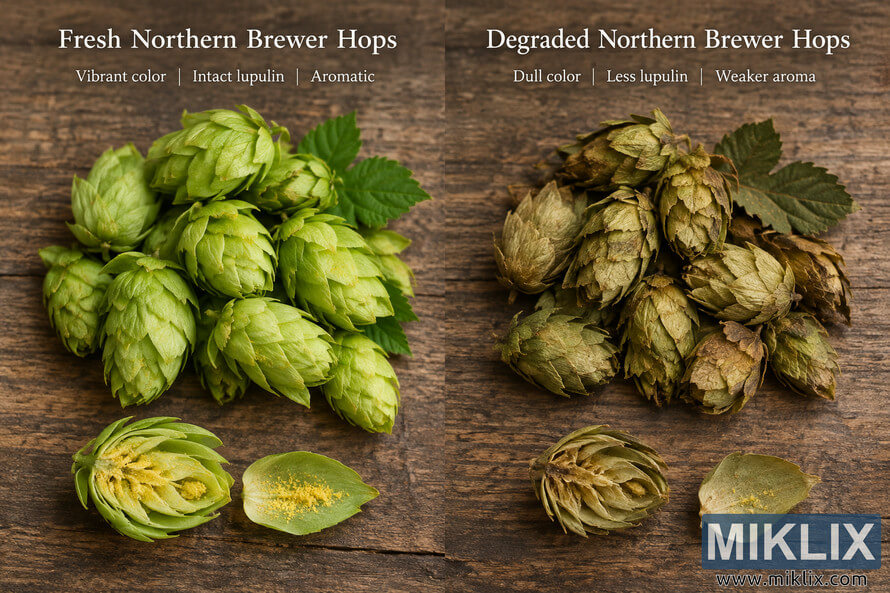
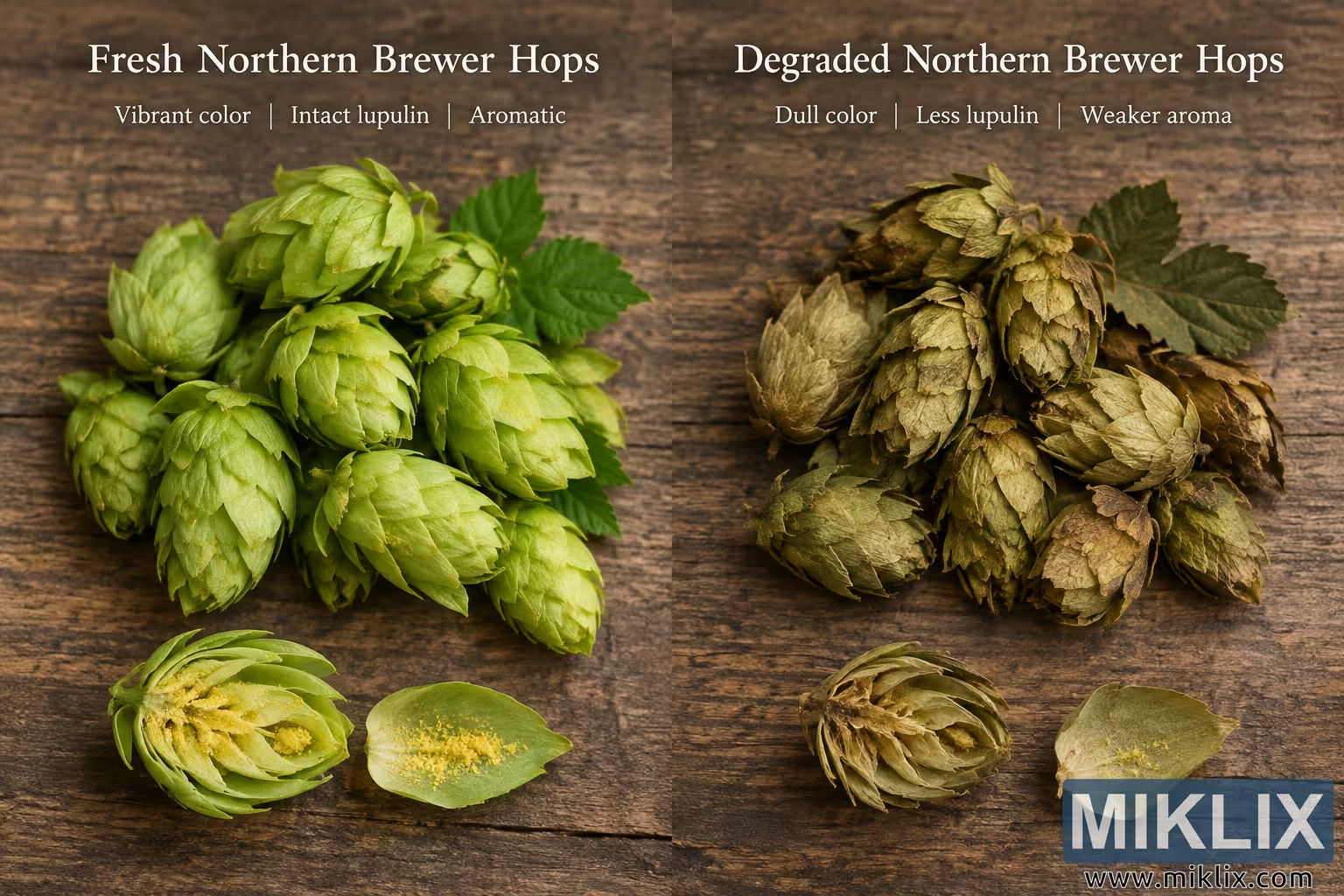
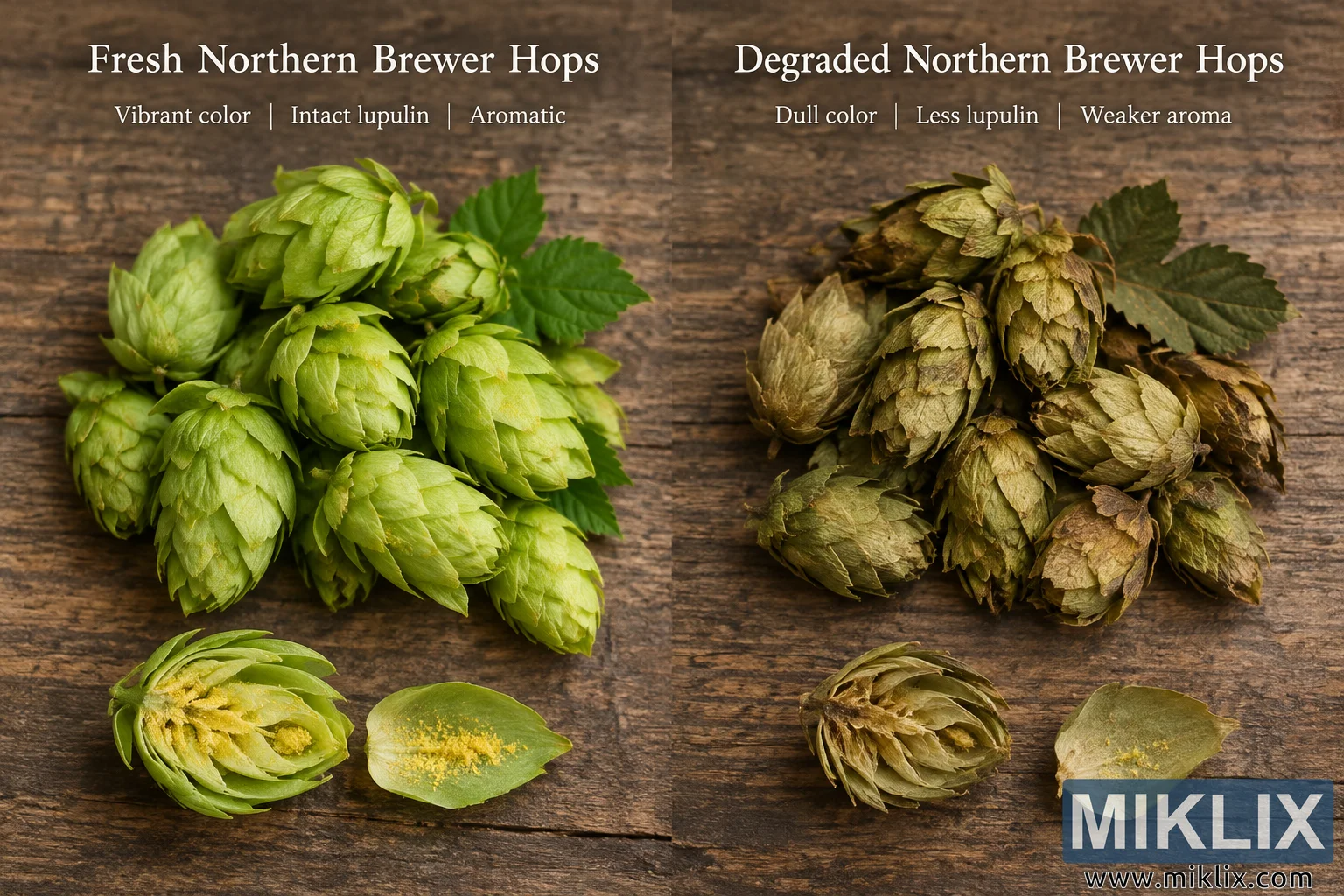
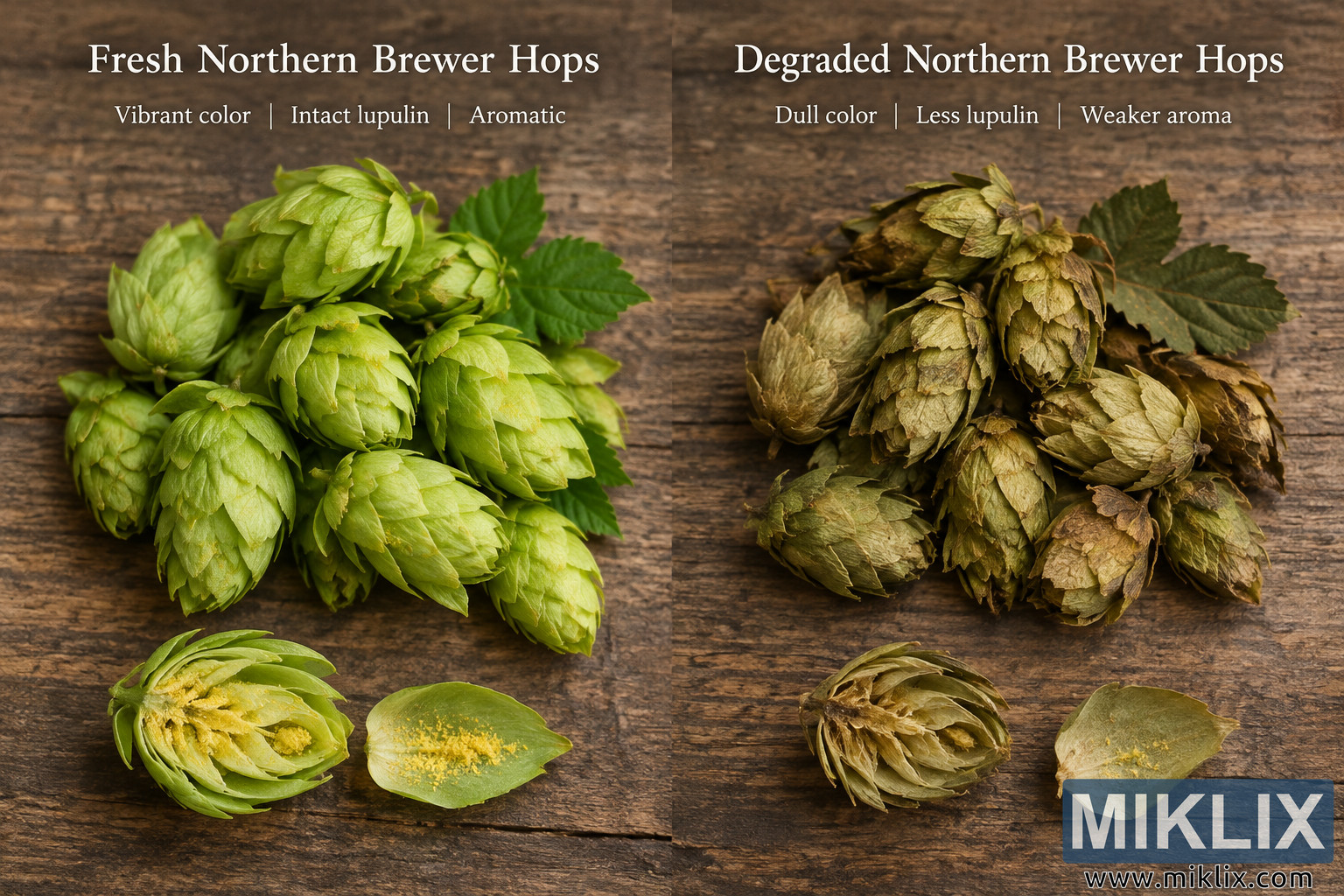
Visual comparison of fresh and degraded Northern Brewer hops, showing differences in green color, cone texture, lupulin content, dryness, and signs of hop deterioration.
Available versions of this image
The image files available for download below are less compressed and higher resolution - and as a result of that, higher quality - than the images embedded in articles and pages on this website, which are more optimized for file size in order to reduce bandwidth consumption.
Regular size (1,536 x 1,024)
Large size (3,072 x 2,048)
Very large size (4,608 x 3,072)
Extra large size (6,144 x 4,096)
Comically large size (1,048,576 x 699,051)
- Still uploading... ;-)
Image description
A landscape-oriented, high-resolution photographic infographic presents a clear side-by-side visual comparison between fresh and degraded Northern Brewer hops. The composition is arranged as a top-down flat lay on a dark, warm brown, weathered wooden surface whose visible grain, knots, scratches, and tonal variations create a rustic agricultural backdrop. The image is divided conceptually into two nearly equal vertical halves without a hard dividing line. Fresh hops occupy the left side, while degraded hops occupy the right, allowing their differences in color, texture, structure, and apparent condition to be compared immediately.
Across the upper left portion of the image, large white serif lettering reads “Fresh Northern Brewer Hops.” Directly underneath is a smaller line of white text reading “Vibrant color
Intact lupulin
Aromatic.” Beneath these labels is a generous cluster of fresh hop cones. They are predominantly vivid yellow-green to medium green, with healthy-looking overlapping bracts that appear supple, full, and well defined. Several cones have brighter highlights along their raised surfaces, emphasizing their plump three-dimensional form. Darker green hop leaves extend behind and around the cluster, adding visual contrast and reinforcing the impression of recently harvested plant material. The cones vary slightly in size and orientation, making the arrangement feel natural rather than mechanically repeated. Their overall appearance is lively, saturated, and structurally intact.
Near the bottom left, a fresh hop cone has been cut open lengthwise to reveal its internal structure. Its green bracts curl outward around a central area containing conspicuous yellow lupulin material. The lupulin appears as rich golden-yellow powdery or granular deposits concentrated inside the cone, visually illustrating the image’s reference to intact lupulin. Beside the opened cone lies a separate green bract or leaf-like segment dusted with additional yellow lupulin. These close-up elements provide a more detailed view of the fresh hop’s internal condition and make the contrast with the degraded material on the opposite side especially easy to understand.
The upper right side is headed by matching large white serif text reading “Degraded Northern Brewer Hops.” Beneath it, smaller white lettering reads “Dull color
Less lupulin
Weaker aroma.” The degraded hop cluster below is similar in general scale and arrangement to the fresh cluster, but its visual characteristics are markedly different. Instead of bright green, the cones display subdued olive, khaki, tan, brown, and gray-green tones. Their bracts look drier, thinner, more curled, and more papery, with irregular browned edges and areas that appear brittle or desiccated. The cones lack the lush, full quality seen on the left and have a flatter, rougher, aged appearance. Dark, muted leaves behind the cluster reinforce the impression of deterioration and loss of freshness. Some cones retain traces of green, but the overall color palette is noticeably less saturated and more brown than that of the fresh sample.
At the bottom right, a degraded hop cone is also opened to expose its interior. The internal bracts are faded olive-brown and appear dry and curled. Only a relatively small amount of yellowish material is visible compared with the abundant golden lupulin shown inside the fresh cone. To the right of this opened specimen is a detached faded bract with a sparse scattering of yellow particles. This close-up mirrors the fresh-hop detail on the left, creating a controlled visual comparison between abundant, bright lupulin in a fresh cone and diminished, duller lupulin in a degraded cone.
The lighting is soft and directional, producing realistic highlights on the hop bracts and gentle shadows underneath the cones. These shadows separate the plant material from the wooden background and make differences in surface texture particularly visible. The fresh cones reflect more lively green and yellow tones, while the degraded cones absorb the light in muted, earthy shades. The rustic wood remains consistent across both halves, which helps ensure that the perceived differences come primarily from the hops themselves rather than from changes in setting or lighting.
Overall, the image functions as an educational visual comparison of hop freshness and degradation. Its symmetrical organization, parallel headings, concise condition labels, matching clusters, and corresponding cut-open specimens make the intended contrast immediately legible. The left side communicates freshness through vivid green color, full intact cones, healthy leaves, and abundant golden lupulin. The right side communicates degradation through faded olive and brown coloration, dry papery bracts, reduced visual vitality, and visibly less lupulin. The photographic realism and close-up botanical details make the image suitable for illustrating discussions of hop quality, storage deterioration, brewing ingredients, sensory characteristics, and the visible signs associated with aging hops.
The image is related to: Hops in Beer Brewing: Northern Brewer