
Image: Water Testing and Mineral Addition for Brewing
Published: October 16, 2026 at 5:44:56 PM UTC
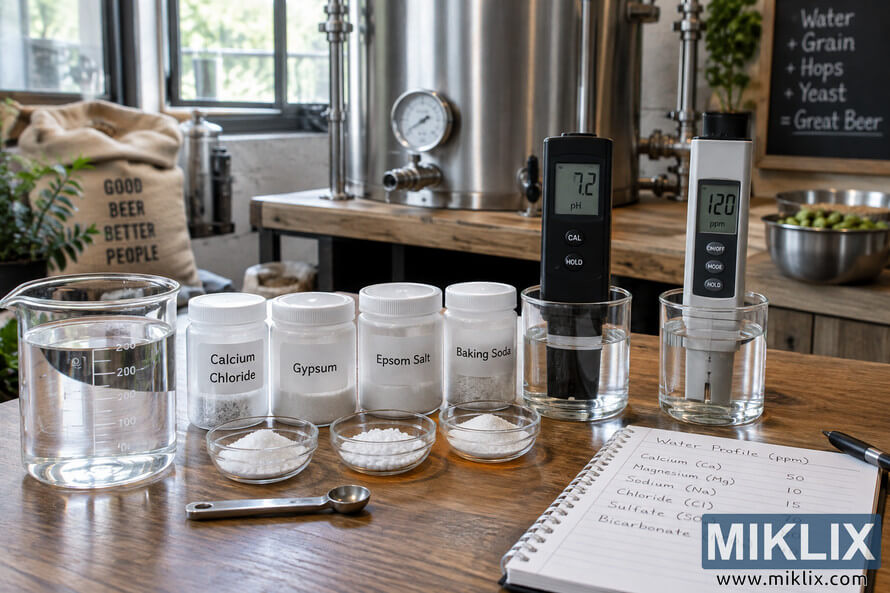
Water testing and brewing-water adjustment with pH and TDS meters, measured mineral additions, laboratory glassware, brewing salts, and stainless-steel brewing equipment.
Available versions of this image
The image files available for download below are less compressed and higher resolution - and as a result of that, higher quality - than the images embedded in articles and pages on this website, which are more optimized for file size in order to reduce bandwidth consumption.
Regular size (1,536 x 1,024)
Large size (3,072 x 2,048)
Very large size (4,608 x 3,072)
Extra large size (6,144 x 4,096)
Comically large size (1,048,576 x 699,051)
- Still uploading... ;-)
Image description
A high-resolution, photorealistic landscape image shows a carefully organized water-testing and mineral-adjustment station for brewing. The scene is set in a bright craft-brewing workspace with a warm wooden workbench in the foreground and stainless-steel brewing equipment in the background. Natural daylight enters through a large window on the left side of the room, creating soft reflections on the glassware, polished metal surfaces, water samples, and brewing vessels. The overall atmosphere combines the precision of a small laboratory with the practical, hands-on character of a home or small-scale craft brewery.
Across the foreground of the workbench is a collection of equipment used to analyze brewing water and make controlled mineral additions. On the far left stands a large transparent glass beaker filled with clear water. White measurement markings are visible on its side, reinforcing the technical and quantitative nature of the brewing process. Beside the beaker are several small white containers holding common brewing-water minerals. Their simple black-and-white labels identify calcium chloride, gypsum, Epsom salt, and baking soda. The containers are deliberately generic and carry no commercial branding. Some of the containers are partially translucent, allowing the pale crystalline or powdered substances inside to be seen.
In front of the mineral containers are three shallow glass dishes containing small samples of white brewing salts. The different textures of the materials are visible: some appear as fine powder, while others have a more granular or crystalline structure. A small stainless-steel measuring spoon rests horizontally on the wooden surface nearby, suggesting that precise quantities of these minerals are being measured before being dissolved into brewing water. The arrangement visually communicates an important part of brewing-water preparation: testing the starting water profile and then adding measured amounts of minerals to achieve a desired composition.
Near the center-right of the image are two electronic water-testing instruments positioned in separate clear glasses of water. The dark meter displays a pH reading of 7.2, while the lighter meter displays a total dissolved solids reading of 120 ppm. Both instruments are partially immersed in the samples, making their purpose immediately recognizable as analytical tools. Their clean digital displays contrast with the natural texture of the wooden bench and the traditional brewing equipment surrounding them. The meters have a neutral, unbranded appearance with basic functional controls, keeping the emphasis on water chemistry rather than on any particular manufacturer.
In the lower-right foreground, an open spiral-bound notebook contains a handwritten water profile. The page lists several brewing-water ions and their concentrations in parts per million, including calcium, magnesium, sodium, chloride, sulfate, and bicarbonate. Example values are written beside the individual minerals, suggesting that the brewer is documenting a target or measured water composition before making adjustments. A black pen lies close to the notebook, implying that measurements and mineral additions are being recorded as the process progresses. This detail reinforces the methodical nature of brewing-water treatment and the importance of repeatable measurements when developing a recipe.
The background establishes the brewing context. A large cylindrical stainless-steel brewing vessel dominates the center of the scene. Metal fittings, pipes, valves, and a round analog gauge are attached to the equipment, giving the workspace a functional craft-brewery appearance. The brushed stainless steel reflects the surrounding daylight without appearing overly polished or sterile. On the right side of the background, a metal bowl contains green hop cones or similarly fresh brewing ingredients, while another bowl appears to contain grain or malt. These ingredients visually connect the water-testing process to the broader brewing workflow.
On the left side of the background, rustic burlap sacks are stacked near the brewing equipment. One sack carries decorative brewing-related wording rather than a commercial logo or identifiable brand. Green foliage around this area softens the industrial materials and adds a subtle natural element to the scene. On the wall at the upper right is a small chalkboard with a handwritten brewing formula that combines water, grain, hops, and yeast into beer. The chalk lettering gives the room a workshop-like, handcrafted character and provides an immediate visual summary of the essential brewing ingredients.
The composition uses a shallow-to-moderate depth of field that keeps the water-testing equipment, mineral containers, samples, and notebook especially prominent while still preserving enough detail in the background to clearly establish the brewing environment. The viewer's attention is first drawn to the two digital meters and the row of mineral containers, then moves toward the water-filled beaker and crystalline samples before reaching the brewing vessel and ingredients behind them. The landscape framing provides ample horizontal space for the complete workflow to be represented in a single coherent scene.
Warm brown tones from the wooden work surfaces balance the cool silver-gray stainless steel and the transparent glassware. White mineral powders, neutral containers, clear water, and black instrument displays create a clean technical palette, while green hops and plants provide small natural accents. The lighting is realistic and understated, with gentle highlights, believable shadows, and visible material textures throughout the scene. No recognizable commercial brands or logos are featured. Overall, the image illustrates the technical preparation of brewing water: analyzing its characteristics, documenting its mineral profile, measuring brewing salts, and preparing controlled mineral additions before the water is used with grain, hops, and yeast in the brewing process.
The image is related to: Hops in Beer Brewing: Northern Brewer