
Image: Common Brewing Off-Flavors Mistaken for Hop Issues
Published: October 16, 2026 at 5:44:56 PM UTC
Learn about common brewing off-flavors that can be mistaken for hop issues, including diacetyl, acetaldehyde, DMS, phenols, esters, oxidation, and infection.
Available versions of this image
The image files available for download below are less compressed and higher resolution - and as a result of that, higher quality - than the images embedded in articles and pages on this website, which are more optimized for file size in order to reduce bandwidth consumption.
Regular size (1,536 x 1,024)
Large size (3,072 x 2,048)
Very large size (4,608 x 3,072)
Extra large size (6,144 x 4,096)
Comically large size (1,048,576 x 699,051)
- Still uploading... ;-)
Image description
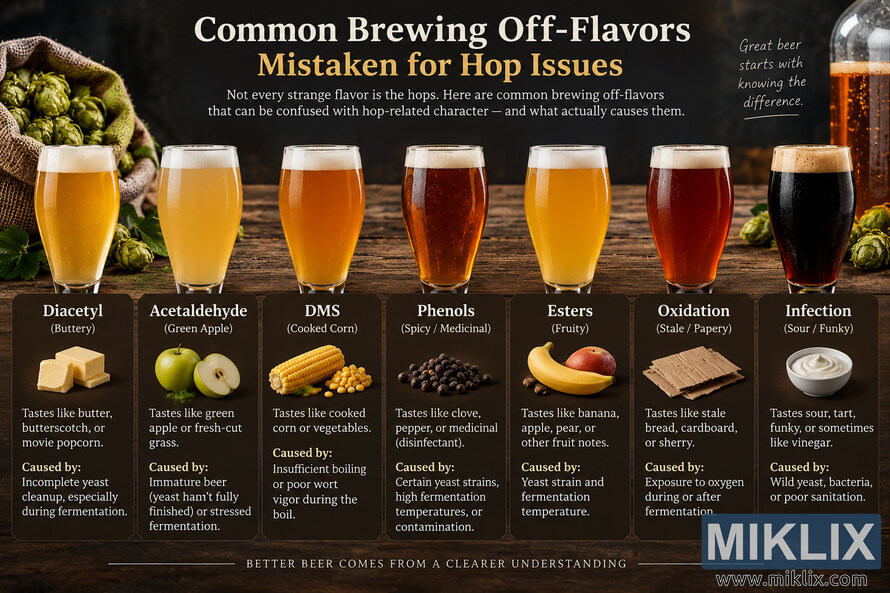
A wide, landscape-format educational brewing graphic presents a rustic, photographic scene explaining common beer off-flavors that can be mistaken for problems associated with hops. The composition is arranged like a polished brewing reference poster, with a dark charcoal-to-black background, a weathered wooden tabletop, warm amber lighting, realistic glasses of beer, brewing ingredients, and seven informational panels. No commercial branding, logos, product names, or identifiable brand elements are visible anywhere in the image.
Across the upper center of the image, a large cream-colored serif headline reads “Common Brewing Off-Flavors.” Immediately underneath, a second line in warm golden lettering reads “Mistaken for Hop Issues.” Below the headline is a short explanatory statement noting that not every strange flavor comes from hops and introducing common brewing off-flavors that may be confused with hop-related character, along with their actual causes. In the upper-right area, a handwritten-style note reads “Great beer starts with knowing the difference,” reinforcing the educational theme.
The background resembles a dark brewery, tasting room, or brewing workshop. The surface running across the lower portion of the scene consists of aged wooden planks with visible grain, scratches, knots, and warm brown tones. On the far left, behind the first beer glass, an open burlap sack is filled with green hop cones. Several loose hop cones and green leaves are scattered around the tabletop. On the far right, additional hop cones and greenery frame the scene. A tall, partially cropped glass containing amber beer appears near the upper-right edge. These brewing elements provide visual context without suggesting that hops themselves are necessarily responsible for the flavors discussed.
Seven realistic beer glasses are arranged in a horizontal row across the middle of the composition. Each glass corresponds to a separate off-flavor category shown in an informational panel directly beneath it. The beers vary considerably in appearance, ranging from pale hazy yellow and golden orange through copper, reddish brown, and nearly opaque dark brown. Each glass has a light foam head, and the changing beer colors help visually distinguish the categories while giving the poster the appearance of a professional sensory-analysis or brewer-training reference.
The first panel is labeled “Diacetyl” with the descriptor “Buttery.” Its accompanying visual is a small arrangement of pale yellow butter pieces. The text explains that this off-flavor can taste like butter, butterscotch, or movie popcorn. The cause is described as incomplete yeast cleanup, especially during fermentation. The pale golden beer above the panel visually complements the butter illustration.
The second panel is labeled “Acetaldehyde” with the descriptor “Green Apple.” A green apple, including a cut section showing its pale interior, illustrates the sensory association. The text describes flavors reminiscent of green apple or freshly cut grass. The cause is associated with immature beer, in which yeast has not fully finished its work, or with stressed fermentation. A hazy, light golden beer sits above this section.
The third panel is labeled “DMS” and includes the descriptor “Cooked Corn.” A bright yellow ear of corn and loose corn kernels appear below the label. The flavor is described as resembling cooked corn or vegetables. The listed cause refers to insufficient boiling or poor wort vigor during the boil. The beer above this panel is a deeper golden-orange shade than the preceding examples.
The fourth panel is labeled “Phenols” with the descriptor “Spicy / Medicinal.” Its illustrative ingredient is a pile of dark, peppercorn-like spices. The sensory description mentions clove, pepper, or medicinal and disinfectant-like characteristics. The cause section associates these flavors with certain yeast strains, high fermentation temperatures, or contamination. Above the panel is a clear copper-to-amber beer with visible highlights and a thin pale foam cap.
The fifth panel is labeled “Esters” with the descriptor “Fruity.” A curved yellow banana and a reddish apple provide immediate visual references for fruit-like aromas and flavors. The text mentions banana, apple, pear, and other fruit notes. The cause is linked to yeast strain and fermentation temperature. The corresponding beer is bright golden yellow with a soft white head.
The sixth panel is labeled “Oxidation” and carries the descriptor “Stale / Papery.” Instead of fresh food, the illustration shows several pieces of brown corrugated cardboard, visually representing the characteristic papery or stale sensory impression. The text describes stale bread, cardboard, or sherry-like flavors. The cause is identified as exposure to oxygen during or after fermentation. A reddish-brown beer appears above the panel, contrasting strongly with the brighter golden beers elsewhere in the row.
The seventh and final panel is labeled “Infection” with the descriptor “Sour / Funky.” A small white bowl containing a creamy, pale substance is used as the accompanying visual cue. The text describes sour, tart, funky, or sometimes vinegar-like flavors. The listed causes include wild yeast, bacteria, or poor sanitation. Above this section is the darkest beer in the lineup, nearly black with deep reddish highlights and a tan foam head.
All seven information cards use a consistent dark brown design with thin borders, cream or off-white typography, and warm gold accents for emphasis. The repeated structure makes it easy to compare each off-flavor, its sensory character, and its likely brewing cause. The visual hierarchy moves naturally from the headline and explanatory introduction to the beer glasses, then to the flavor panels and their ingredient illustrations.
Along the bottom center of the image, a spaced uppercase statement reads “BETTER BEER COMES FROM A CLEARER UNDERSTANDING,” framed by thin horizontal lines. The overall aesthetic combines realistic beer photography with an elegant educational infographic. Warm amber, brown, cream, green, and black tones create a traditional craft-brewing atmosphere. The image communicates that flavors a brewer or drinker might initially blame on hops can instead originate from fermentation, yeast behavior, boiling practices, oxygen exposure, contamination, sanitation, or other parts of the brewing process. It is designed as a visually accessible reference for brewers, beer enthusiasts, sensory training, brewing education, or an article discussing troubleshooting of apparent hop-related flavor problems.
The image is related to: Hops in Beer Brewing: Northern Brewer