
Hops in Beer Brewing: Nugget
Published: March 16, 2026 at 10:57:29 PM UTC
Nugget is a U.S.-bred, dual-purpose hop known for its reliable bittering and unique herbal-pine resin aroma. It's a favorite among brewers for its clean bitterness, essential for big beers like IPAs, stouts, and barleywines. The consistent Nugget alpha acids and straightforward profile make it a great choice for late-aroma additions.
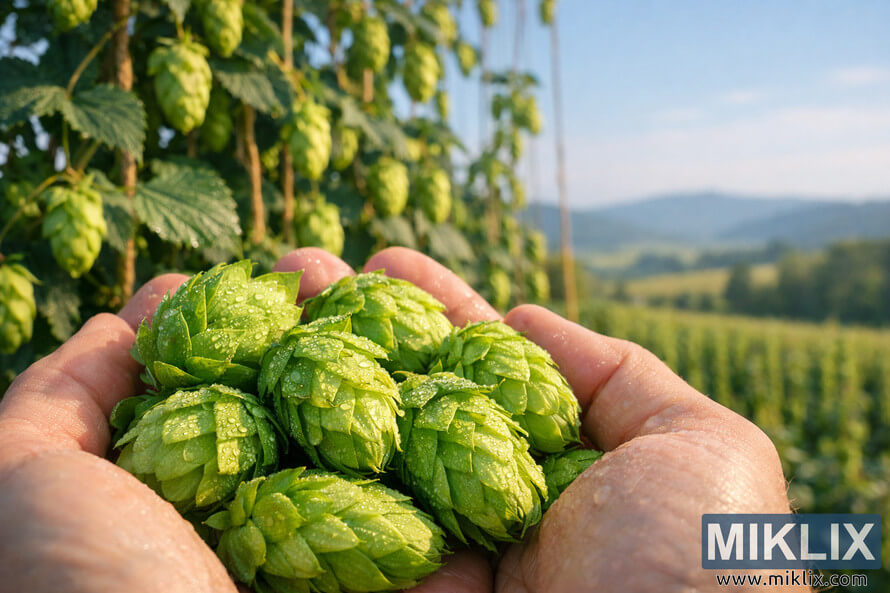
Click or tap the image for more information and higher resolutions.
Available from various suppliers and online retailers, Nugget hop brewing is favored by both commercial and home brewers. The cultivar (USDA code 7005-194) is found in bulk and retail packages across different crop years. Forum reports highlight woody, herbal, and subtle peach-tea notes when used heavily in late additions or dry hopping.
This section introduces the Nugget aroma, its role as a bittering workhorse, and why many brewers consider it a secret weapon. It adds structure and depth to beers. Later sections will delve into oil composition, alpha and beta acid ranges, and practical recipe placements to enhance your use of Nugget.
Key Takeaways
- Nugget hops provide clean, reliable bittering for big beer styles.
- The Nugget hop profile emphasizes herbal and pine-resin notes with subtle late-hop character.
- Nugget alpha acids make it a go-to for bittering in IPAs and stouts.
- Available from multiple suppliers, Nugget is sold in various package sizes and crop years.
- Homebrewers often pair Nugget with Mosaic, Cascade, and Crystal for balanced results.
Overview of Nugget Hops
Nugget hops are celebrated for their robust bitterness and aromatic potential. They are a favorite among brewers for their ability to balance bold flavors in ales and lagers. This overview delves into the plant's origins, the institutions behind its creation, and its status as a cornerstone among dual-purpose hops.
Origin and breeding history
The Nugget hop's lineage stems from a cross between Brewers Gold and a high alpha-acid male. The goal was to merge high yield with concentrated alpha acids. Through meticulous selection, breeders achieved consistent cone sizes and disease resistance, making it ideal for commercial cultivation. This breeding history highlights why Nugget has become a staple for both craft and large-scale breweries. It offers a reliable bittering hop with aromatic qualities when used in later stages of brewing or dry hopping.
Release year and breeder (USDA)
The USDA played a pivotal role in Nugget's development, with most records pointing to an early 1980s release. Some catalogs from Yakima Valley Hops list 1984, while others, including USDA records, pinpoint 1983. This release marked the beginning of widespread commercial propagation and distribution across the United States.
Primary uses in brewing (dual-purpose)
- Nugget is widely used for bittering due to its high alpha acids and consistent performance.
- It also finds use in late additions and whirlpool hops for a firm, herbal backbone.
- Brewers consider Nugget a dual-purpose hop, suitable for IPAs, stouts, and big ales where both structural bitterness and resinous character are essential.
Click or tap the image for more information and higher resolutions.
Flavor and aroma profile of Nugget hops
Nugget hops deliver a robust flavor profile, balancing bitterness and aroma. They bring a woody, herbal character to beers, enhancing their structure. This allows for bright accents when used later in the brewing process. The aroma is often described as savory, with a dense core that supports various hop blends and single-hop tests.
Herbal, pine resin, and spicy-herbal characteristics
Initially, Nugget hops exhibit classic herbal traits: fresh herb, greenness, and a dry, tannic backbone. They also offer pine resin notes, adding a woodsy bite to beers. In higher concentrations, a spicy-herbal kick emerges, enhancing the beer's complexity.
Citrus and fruit notes: grapefruit, pineapple, stone fruit
Underneath the herbal notes, citrus highlights shine through. Grapefruit zest hops are often praised for their sharp citrus lift. Tropical touches, such as pineapple, and soft stone fruit impressions appear with large late additions or dry hops.
Common descriptors from brewers and suppliers
- Herbal and woody: common in forum notes and supplier tags.
- Resinous and spicy: cited by commercial brewers for structural bitterness.
- Fruity lift: grapefruit zest hops and occasional peach-tea or pineapple hints.
Brewers emphasize the importance of using Nugget hops for aroma, noting that subtle late-hop character requires generous rates. In small doses, Nugget blends into the background with mild, pleasant herbal aroma notes. However, in heavy loads, it can develop a pronounced woody-fruity profile, similar to some Mosaic varieties.
Click or tap the image for more information and higher resolutions.
Alpha and beta acids: Nugget hop chemistry
Nugget hops offer consistent chemistry, crucial for brewers aiming to balance bitterness and aroma. This section delves into alpha and beta acid ranges, typical averages, and cohumulone levels. It aids in planning IBU targets and flavor outcomes.
Alpha acid content in Nugget hops ranges from 9.5% to 16%, with an average of 12.8%. These figures are key for calculating IBUs in bittering additions. Nugget's consistent alpha acid profile makes it a reliable choice for both large-scale and homebrew recipes.
Beta acids in Nugget hops fall between 3.0% and 5.8%, averaging 4.4%. Although beta acids contribute less to bitterness, they are vital for aroma stability and late-stage character. Monitoring Nugget beta acids is essential for predicting hop aroma evolution during conditioning and storage.
Cohumulone, a component of Nugget's alpha acids, ranges from 22% to 30%, with many reports around 26%. This cohumulone fraction can impact the beer's perceived bitterness. Higher percentages may result in a more assertive edge in the final product.
- Alpha range: 9.5–16% (typical ~12.8%)
- Beta range: 3.0–5.8% (typical ~4.4%)
- Cohumulone: 22–30% of alpha acids
When planning, consider alpha-beta ratios, usually between 2:1 and 5:1, with a historical average of 3:1. Storage conditions and the Hop Storage Index can alter effective alpha values over time. Expect changes in Nugget bitterness as alpha acids decline and beta acids oxidize.
Always use lab numbers from your supplier when available. Adjust bitterness calculations based on reported Nugget alpha acids and consider cohumulone percentages for a softer or sharper finish. Monitoring Nugget beta acids is crucial for preserving aroma intentions in late additions and dry hopping.
Click or tap the image for more information and higher resolutions.
Essential oils and aroma compounds in Nugget
Nugget hops exhibit significant variation in oil content and profile across different crop years and suppliers. This variation impacts how the variety performs in the brewing process. Understanding the typical oil breakdown is crucial for selecting the right addition times to enhance desired aromas.
The total oil content in Nugget hops ranges from 0.9 to 3.3 mL per 100 g. Most sources report an average of 2.1 mL/100 g. However, some suppliers provide narrower ranges, highlighting the importance of crop-year data and lab certificates when purchasing hops.
Myrcene is the dominant component of Nugget oil, making up 48–59% of the total oil on average. Another supplier reports a range of 27–42%, showcasing the variability. High myrcene levels contribute to the beer's resinous, citrus, and fruity notes, which are volatile during boiling.
Humulene, though present in smaller amounts, is crucial for balance. It ranges from 12–22% in one source and 16–19% in another, averaging around 17%. Humulene adds woody, herbal, and spicy notes, enhancing the beer's depth when added late or used in dry hops.
Caryophyllene, present at 7–10% of the oil, contributes peppery and spicy layers. Farnesene, averaging under 1%, adds subtle green or floral nuances. Minor compounds like β-pinene, linalool, geraniol, and selinene can total 8–33%, adding complexity to the beer.
- Boil additions: much of Nugget myrcene boils off, so early additions emphasize bittering and less aroma.
- Late whirlpool: retains more humulene and caryophyllene for woody and herbal character.
- Dry hopping: captures the volatile Nugget myrcene to preserve citrus and resin notes.
Practical brewers use these patterns to shape their beers. For a bold bitterness and structural backbone, make larger early additions. To highlight resinous citrus or pine, favor late additions and dry hopping to preserve Nugget myrcene. For layered herbal or spicy complexity, emphasize whirlpool contact and moderate dry-hop rates to showcase Nugget humulene and caryophyllene.
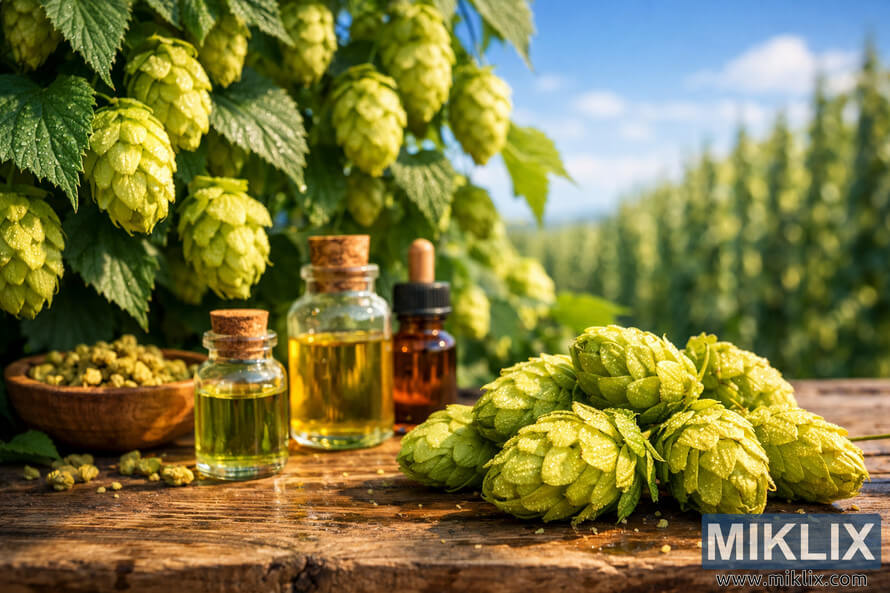
Click or tap the image for more information and higher resolutions.
Brewing values and practical additions for Nugget
Nugget is a reliable hop for brewers. It's chosen for its solid bittering and the flexibility to add late for resinous and herbal flavors. Its high alpha acids ensure efficient bittering in both small and large batches.
Bittering versus late roles
For maximum bittering, add Nugget early in the boil. This method optimizes alpha acid isomerization and achieves target IBUs with minimal hop weight. For aroma, consider heavier late additions or large dry-hop loads. This approach allows brewers to balance bitterness and resinous character in their recipes.
Boil timing and expected outcomes
- 60–90 minute additions: strongest Nugget bittering and stable IBU contribution; good for stouts, barleywines, and ales that need backbone.
- 15–30 minute additions: moderate bitterness plus some late oil retention; useful when you want a touch of herbal spice without full aroma.
- Whirlpool and dry hop: prioritize aroma extraction—expect herbal, pine, and subtle fruit notes when used cold or at low post-boil temperatures.
Storage and hop freshness
To preserve Nugget's chemistry, minimize oxygen and heat exposure. Vacuum-sealed packaging stored in a cool environment slows down the degradation of alpha acids and oils. Monitor Nugget HSI to gauge freshness; an HSI of 0.2–0.3 indicates good condition, while rising numbers signal potency loss.
Be prepared for potency decline: about 25% loss after six months at room temperature. Adjust early bittering additions if storage conditions have been less than ideal. Increase late additions for a stronger aroma focus.
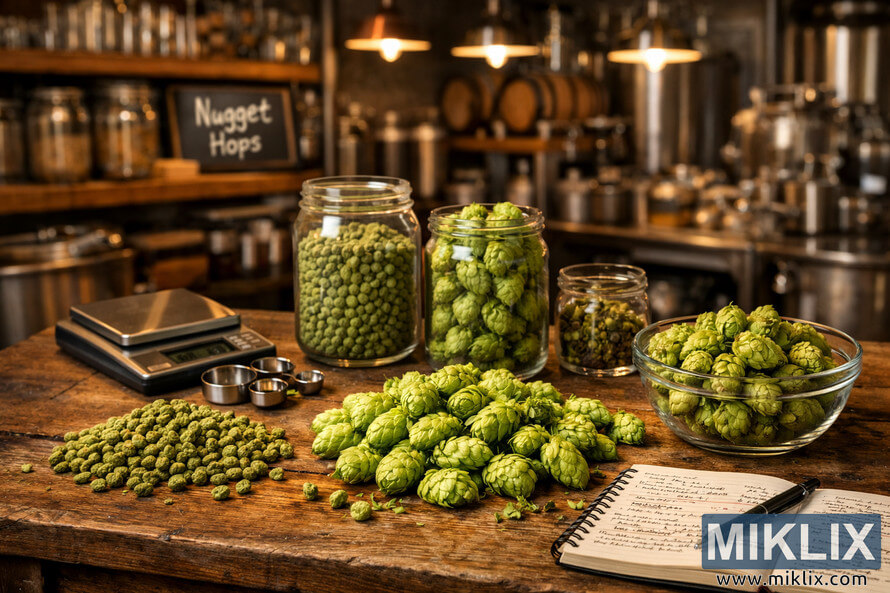
Click or tap the image for more information and higher resolutions.
Nugget hops in beer styles and recipe roles
Nugget hops are versatile, used in a variety of beer styles where clean bitterness is key. They are chosen for their ability to enhance malt character without overpowering it. This versatility makes them suitable for both simple ales and complex, high-gravity brews.
- Common styles that use Nugget include American ale, IPA, stout, barleywine, saison, and biere de garde. Each style benefits from Nugget’s resinous bitterness and herbal notes.
- In Nugget IPA, Nugget serves as the base bittering hop, providing a solid foundation for late-addition hops like Citra or Mosaic.
- Nugget stout benefits from its clean bitterness, which balances the roasty malts in imperial and American stouts.
- Nugget barleywine gains structural depth; it helps control sweetness while preserving complex malt and aged flavors.
Nugget is crucial in supporting big beers, offering firm, persistent bitterness and mid-palate structure. This quality ensures high-ABV ales remain balanced, without introducing astringency. It's often chosen to anchor bold malt profiles, allowing late-aroma hops to take center stage.
- Bittering: Early boil additions provide predictable IBUs and a clean, neutral bitterness, ideal for IPA and barleywine.
- Whirlpool/mid additions: Nugget in the whirlpool extracts resinous and herbal notes, enhancing mouthfeel and hop backbone.
- Dry hop: Heavy dry-hop loads or late additions reveal subtle grapefruit, stone fruit, or peach-tea-like facets. However, many brewers complement these with co-paired aroma hops for prominent fruit tones.
Homebrewers often use Nugget as the primary bittering hop in their recipes. For an IPA or strong ale, add Nugget early for steady bitterness. Then, add a whirlpool charge for resinous flavors. Finish with bright late hops for fruit-forward aroma without losing structure.
Nugget hop pairings and complementary varieties
Nugget is essential in recipes needing a robust, resinous foundation. It's often used for bittering, allowing brighter late-aroma hops to enhance the top notes. This method ensures the malt and structural bitterness are clear, while fruity and citrus flavors take center stage.
Common pairing partners for Nugget include Citra, Centennial, Cascade, Chinook, Summit, Simcoe, and Crystal. Each variety complements Nugget's herbal, resinous character. When paired thoughtfully, Nugget smooths out bitter edges and adds depth, enhancing aroma hops without overpowering them.
- Nugget with Citra: Use Nugget for bittering and add Citra late and in dry-hop for a bright tropical and citrus lift. A 3:1 bittering-to-late ratio preserves structure while delivering citrus top notes.
- Nugget and Cascade: This pairing achieves classic American hop balance. Nugget provides firm bitterness and herbal resin, while Cascade adds grapefruit and floral highlights in whirlpool or dry-hop additions.
- Nugget with Centennial or Simcoe: Opt for these when seeking pine and floral complexity with citrus bite. Late additions of Centennial or Simcoe add complexity without losing Nugget's backbone.
- Nugget with Crystal: For brown ales and darker beers, blend Nugget with Crystal to emphasize stone fruit and caramel notes. Nugget keeps the finish dry and structured.
Flavor synergy often follows a simple rule: use Nugget for bittering and structure, then pick a late-aroma hop family for the top notes. Fruity varieties like Mosaic or Citra provide tropical lift, while resinous hops such as Chinook or Summit enhance pine and spice.
- Recipe idea: Bitter with Nugget (60 min), whirlpool Citra (15 min), dry-hop Citra + Mosaic. Expect tropical and citrus aroma over a firm resinous base.
- Recipe idea: Bitter with Nugget, late additions of Cascade at 10 minutes and in dry-hop. Aim for grapefruit-forward American ale with clean bitterness.
- Recipe idea: Bitter with Nugget, late and dry-hop Crystal for a brown ale. This yields dried fruit and caramel notes with a supportive herbal backbone.
These combinations showcase Nugget's strengths while allowing late-aroma varieties to express themselves. Experiment with ratios and timing to achieve the desired balance of bitterness, resin, and aroma.
Substitutions for Nugget hops
Nugget hops are essential for bittering and adding structure to beer. If Nugget is unavailable or a brewer seeks a unique twist, several alternatives are available. The choice depends on whether the focus is on bittering or aroma.
- Galena — strong bittering power with a more assertive secondary aroma; good when you need clear bitterness without exotic fruit.
- Magnum — cleaner, neutral bittering; ideal when you want to preserve other late-aroma hops in the blend.
- Columbus, Tomahawk, Zeus (often grouped as CTZ) — bring resinous, piney, and sulfuric edges; use these for punchy, resin-forward beers.
Galena offers a sharper flavor compared to Nugget. CTZ substitution provides a similar resinous bite but can introduce harsher notes if used excessively.
When substituting, adjust recipes to match target IBUs. Use the alpha-acid ratio to calculate the IBU change: weight_new = weight_old × (AA_old / AA_new). For instance, if Nugget is 13% AA and Magnum is 10% AA, increase Magnum weight by about 30% to achieve the same bittering level.
- For bittering, any listed Nugget replacement works after adjusting for alpha acids.
- If Nugget's herbal-resin nuance is crucial, avoid direct swaps. Instead, tweak late additions or blend a milder bittering hop with a small Nugget-like aroma hop.
- In whirlpool and dry hop roles, favor Magnum for neutrality or CTZ for resinous lift, based on desired aroma.
Forum experiences often highlight Columbus as a practical Nugget replacement for IBUs and backbone. Substitutions are useful for maintaining production flow. Alter hop character only when the recipe specifically requires Nugget's unique herbal profile.
Storage, freshness, and handling of Nugget hops
Proper handling is key to maintaining alpha acids and oils. Brewers must plan storage to preserve bitterness and aroma. Small steps in packaging and temperature control significantly impact Nugget hop storage and quality.
Optimal storage conditions to preserve alpha acids and oils
Store pellets or leaf in vacuum-sealed or nitrogen-flushed bags to limit oxygen exposure. Cold storage hops perform best; refrigeration slows oil loss and freezer storage gives the longest shelf life.
Keep temperatures steady. Frequent warm-cold cycles accelerate degradation. Use airtight containers and handle packages quickly to prevent warming during transfers.
Interpreting Hop Storage Index (HSI) and freshness indicators
Hop Storage Index measures alpha and beta acid loss after six months at room temperature (68°F/20°C). Typical HSI values around 0.2–0.3 often correlate with about 25% loss and are labeled as good by some suppliers.
Check product listings for Nugget HSI, crop year, and supplier alpha specs. These details help assess remaining potency and guide whether hops are best for bittering or for late additions and dry hopping.
Vacuum-sealed, cold storage, and best-before considerations
Vacuum-sealed packs extend usable life by reducing oxygen contact. When vacuum sealing is not available, use oxygen-barrier bags and purge with nitrogen. For commercial purchases, favor suppliers who offer nitrogen-flushed packaging.
Follow best-before dates but pair them with Nugget HSI and crop year data. Reserve the freshest Nugget hops for aroma and dry-hop uses. Older stock still works well for bittering additions where volatile oils are less critical.
- Minimize oxygen exposure during handling and transfers.
- Store hops cold: refrigerator for short term, freezer for long term.
- Use fresh Nugget hops for late additions and dry hopping; use older hops for bittering.
Using Nugget hops in homebrewing: tips from brewers
Nugget is a favorite among homebrewers for its reliable bitterness and structure. Its clean, stable alpha acids make it ideal for early additions. Many recommend pairing it with brighter late hops for added complexity. Below are common Nugget homebrew tips and practical approaches from various sources.
Bittering strategies favored by brewers
Many homebrewers rely on Nugget for 60-minute additions in IPAs and American stouts. This approach provides a firm, rounded bitterness, perfect for big beers.
For calculating IBUs, target Nugget for predictable extraction. Drop cascade or Citra into later additions for aroma. This method reflects core Nugget bittering tips from experienced brewers.
Late-addition and dry-hop experiences from homebrew forums
Reports on Nugget in late additions vary. Some brewers find limited aromatic lift unless using large late or dry-hop masses. Others report success with Nugget-heavy late additions in New England–style IPAs, especially when paired with fruit-forward varieties.
For woody or tea-like undertones, try a Nugget dry hop at moderate rates. Pairing Nugget with Mosaic or Citra in the dry hop adds layered fruit and resin, while Nugget provides backbone.
Recipe suggestions: dark beers, NE IPAs, and pilsner blends with Nugget
- Dark beers: Use Nugget at 60 minutes for a clean bitter backbone in stouts and porter recipes. Add small late hops for roast balance.
- NE IPAs: Start with Nugget for bittering, then load heavy late and dry hops with Mosaic, Citra, or Galaxy. Alternatively, use larger Nugget dry-hop amounts for subtle peach-tea character beneath fruity hops.
- Pilsner and Vienna blends: Add small Nugget charges to provide structure while keeping noble or Saaz hops as primary aroma contributors.
For brewers refining Nugget recipes, keep records of crop year and supplier alpha values. Adjust quantities rather than technique when alpha shifts. These practical Nugget homebrew tips help maintain consistency across batches.
Technical considerations: alpha-acid conversions and recipe calculations
Accurate hop math is crucial for brewers aiming to achieve the desired bitterness in their beers. It's important to use the reported alpha ranges for Nugget hops when planning your additions. Choose a standard IBU formula, such as Tinseth, Rager, or Garetz, to calculate the bitterness contributions based on boil time and wort gravity. Ensure that the alpha number you use matches the crop year to avoid any surprises.
How to calculate IBUs using Nugget’s alpha levels
Begin by referencing the alpha-acid percent listed on the Nugget product page. For example, it might be 12.8% typical or fall between 11.5% and 14.0% as stated by the supplier. Insert this alpha value into your chosen formula. For Tinseth, convert the ounces and gallons to metric units or use the standard equation form. Then, apply the utilization factor based on the boil minutes.
For a quick adjustment, scale the hop weight linearly with alpha. If a 12% alpha Nugget charge requires 1 oz, and you're using 15% alpha Nugget, reduce the weight to 0.8 oz to maintain the same IBU target.
Adjusting for variability between crop years and suppliers
Alpha-acid content can vary significantly between crop years and suppliers. Always record the alpha on the bag and recalculate the IBUs when a new lot arrives. If you're switching suppliers, it's best to recalculate rather than assuming an average. Small changes in alpha can lead to proportional changes in bitterness. Therefore, adjust the hop weights before brew day.
For large-scale brews, consider using a spreadsheet with fields for weight, alpha, boil time, and gravity. Update the entries when you receive lab results from suppliers like Yakima Chief or John I. Haas to ensure accurate Nugget alpha calculations.
Accounting for cohumulone and perceived bitterness in formulations
Nugget cohumulone levels typically range from 22–30%. Higher cohumulone can impart a sharper bite. If you prefer a smoother finish, aim for a slightly lower numeric IBU or adjust the timing of bitterness additions to soften the perception.
When the lot shows high cohumulone, reduce the total IBUs by a small percentage. Note the Nugget cohumulone impact during tasting panels. Use this information to tweak future Nugget IBU calculation inputs to achieve the desired mouthfeel.
- Record supplier alpha and cohumulone for every lot.
- Use consistent IBU formula across batches for comparability.
- Scale hop weights when substituting to maintain target IBUs.
Innovations and limitations: Nugget and lupulin products
Nugget is a staple hop for bittering and structural support in brewing. Craft and commercial brewers often inquire about concentrated forms like lupulin powders for Nugget. They wonder about the practical differences these products would offer compared to traditional pellets.
- Currently, major processors like Yakima Chief Hops, Hopsteiner, and B.A.S. Hops have introduced Cryo and Lupomax lines for aroma-forward hops. However, there is no commercially available Nugget cryo or Nugget Lupomax product from these suppliers. Nugget is mainly sold as pellets and sometimes as whole cone leaf.
- Lupulin concentrates focus on lupulin glands, removing much of the vegetative material found in pellets. This change enhances aroma extraction per gram and minimizes vegetal carryover in whirlpool and dry-hop. Brewers comparing Nugget pellet vs lupulin can expect cleaner extraction and a stronger late-aroma impact from a true lupulin product, if one were made.
- Practical impact for brewers: Concentrated lupulin typically reduces sediment and vegetal flavor, allowing resinous and herbal notes to shine through more efficiently. For Nugget, a lupulin format could enhance resin and pine character while reducing grassy impressions that pellets sometimes impart.
- Watchlist and future prospects: Processor interest hinges on demand. If craft brewers demand a Nugget lupulin offering, firms that make Cryo and Lupomax might adapt their processes. Brewers should keep an eye on announcements from Yakima Chief Hops, Hopsteiner, and B.A.S. for any development of Nugget cryo or Nugget Lupomax products.
Regional and seasonal notes for Nugget hops in the USA
Nugget's role in American brewing is deeply connected to timing and terroir. Brewers and suppliers closely monitor Nugget harvest windows, regional yields, and annual quality. This planning is crucial for scheduling bittering and aroma additions in seasonal releases.
Typically, US harvest for aroma varieties occurs in mid-to-late August. This timing influences when fresh Nugget hops transition from bine to processing. Brewers use these dates to determine whether to employ fresh or stored hops for late additions and dry-hop processes.
Hop production varies by region across the United States. The Pacific Northwest is a hub for Nugget US production, where USDA-bred genetics thrive. Commercial farms and craft brewers in Washington and Oregon maintain steady acreage for Nugget. This variety is prized for its reliability as a high-alpha option.
Details about the crop year are essential. Supplier pages list Nugget batches as 2024, 2025, or other harvests. These labels enable brewers to compare alpha acid values and oil totals before purchasing for a specific brew.
- Monitor Nugget harvest notices to align buy dates with recipe plans.
- Check Nugget US production reports to see regional availability and pricing trends.
- Review Nugget crop year specs for alpha and oil shifts that affect IBUs and aroma.
Year-to-year variability significantly impacts brewing outcomes. Alpha acids, total oils, and myrcene-to-humulene ratios fluctuate with weather and soil conditions. A Nugget crop year with higher alpha will enhance bitterness, while richer oils will boost late-aroma character.
Practical steps for brewers include verifying supplier alpha and oil specs per batch. Tasting small pilot brews when feasible is also beneficial. Adjusting boil additions to match the Nugget seasonal profile helps maintain consistency across different crop years.
Conclusion
Nugget hops summary: Introduced in the early 1980s, Nugget is a USDA-developed, dual-purpose American hop. It is celebrated for its clean, high-alpha bittering and a resinous, spicy-herbal aroma. This aroma includes citrus and stone-fruit hints. Brewers appreciate its steady alpha acids for predictable IBUs.
For those seeking more pine, grapefruit, and light tropical tones, late additions and dry hopping are key. However, these nuances depend on the crop year's quality. Nugget's versatility makes it a favorite in IPAs, stouts, barleywines, and other big beers needing a firm backbone.
When aiming for aroma, pairing Nugget with bright varieties like Citra or Centennial is recommended. Use these in whirlpool or dry-hop additions. If Nugget is not available, Galena, Magnum, or Columbus/CTZ-family hops can serve as substitutes. Just remember to recalculate IBUs for alpha differences and expect subtle shifts in character.
Nugget brewing tips: Opt for Nugget by crop year and from trusted suppliers like Yakima Valley Hops listings. Choose packaging sizes that align with your brew volume. Store hops vacuum-sealed and cold to preserve their quality.
Keep an eye on the Hop Storage Index and supplier specifications. This ensures the preservation of alpha acids and oils. Such care maintains bitterness and aroma reliability across batches.
FAQ
What is Nugget and where did it come from?
Nugget is a dual-purpose American hop variety. It was bred by the USDA as a cross of Brewers Gold and a high-alpha male. Released in the early 1980s, it's prized for its reliable bittering and useful aroma character.
What are the primary uses of Nugget in brewing?
Nugget is mainly used for bittering in big beer styles like IPAs and stouts. It's also used in late additions or dry-hop loads for herbal and resinous notes.
What flavor and aroma notes does Nugget contribute?
Nugget is described as spicy-herbal and resinous. It offers herbal, pine, and earthy notes. It can also show citrus facets like grapefruit zest and fruit hints such as pineapple or stone fruit.
How do brewers typically describe Nugget’s late-hop character?
Many homebrewers find Nugget's late-hop character subtle unless used heavily. When used in large quantities, it delivers woody, herbal, and faint stone-fruit or peach-tea notes.
What are Nugget’s alpha and beta acid ranges?
Nugget's alpha acids range about 9.5–16% with a typical average near 12.8%. Beta acids range roughly 3.0–5.8% with an average around 4.4%. Use crop-year supplier specs for precise calculations.
What is the cohumulone percentage and why does it matter?
Nugget's cohumulone typically falls between 22–30% of alpha acids. This can influence the sharpness of bitterness. Brewers may adjust target IBUs if seeking a softer profile.
What is the total oil content and typical oil breakdown for Nugget?
Total oil content varies by crop and supplier, historically about 0.9–3.3 mL/100g (averaging ~2.1 mL/100g). Oil breakdown commonly shows a high myrcene share, humulene 12–22%, caryophyllene ~7–10%, and trace farnesene. Exact ratios shift by year and source.
How do essential oils affect how I should add Nugget?
Myrcene is volatile and drives citrus/resinous aroma but boils off quickly. Late additions and dry-hopping capture aroma best. Humulene and caryophyllene are less volatile and contribute woody, spicy, and herbal character.
When should I use Nugget for bittering versus aroma?
Use Nugget early in the boil for efficient, clean bittering. For aroma, increase late additions, whirlpool contact, or use heavy dry-hop loads. Expect that aroma impact is sometimes subtle unless used heavily.
How should I calculate IBUs with Nugget?
Use the alpha-acid percentage listed on your supplier’s crop-year product page when calculating IBUs. Because alpha values vary by year, match recipe math to the batch-specific alpha and adjust hop weights accordingly when substituting.
What are practical boil times and expected bitterness from Nugget?
Longer boil times fully isomerize alpha acids for maximum IBUs. Early 60–90 minute additions are standard for bittering. Mid/whirlpool additions give some bitterness plus extraction of less volatile oils. Late 5–0 minute additions and dry hopping emphasize aroma over bitterness.
Which beer styles commonly use Nugget?
Nugget is popular in IPAs, American stouts, barleywines, saisons, and big ales such as Biere de Garde. It’s valued for providing a firm bittering backbone and structural depth in high-gravity, hop-forward beers.
What hops pair well with Nugget?
Nugget pairs effectively with fruity and bright late-aroma hops like Citra, Mosaic, and Cascade. It also pairs well with classic American bittering/aroma varieties like Centennial, Chinook, Summit, Simcoe, and Crystal. Nugget supplies a resinous herbal backbone that complements tropical and citrus top notes.
Can you give recipe pairing ideas with Nugget?
A common tactic is Nugget for the early bittering base, then late additions and dry-hop with Citra or Mosaic for tropical and citrus layers. For classic American ales pair Nugget bittering with Cascade late. For darker beers blend Nugget with Crystal for a caramel/hop balance.
What are suitable substitutes for Nugget?
Close substitutes include Galena, Magnum, Columbus, Tomahawk, Zeus, and the CTZ group. These work well when bittering is the priority. Adjust hop weights to match alpha acids and be aware each substitute brings its own secondary aroma.
How should I adjust a recipe when substituting Nugget?
Match the target IBU by recalculating weights using the substitute’s alpha percentage. Also consider flavor differences; if Nugget’s herbal/resin nuance matters, choose a substitute with similar secondary character or accept a change in aroma profile.
Where can I buy Nugget and what should I check when purchasing?
Nugget is sold by multiple US suppliers and retail marketplaces, including Yakima Valley Hops and other hop merchants—also available on Amazon in various pack sizes. Check crop year, alpha specs, packaging size (from ounces to 11‑lb bulk), and HSI or freshness indicators before buying.
How does price and packaging vary for Nugget?
Prices vary by supplier, package size, and crop year; retail options range from small vacuum-sealed packs to 11‑lb bulk sacks for commercial use. Unit pricing and availability change with crop years (e.g., 2024, 2025 listings), so compare SKUs and seller alpha specs.
How should I store Nugget hops to preserve potency?
Store pellets or leaf vacuum-sealed, cold (freezer is best) and minimize oxygen exposure. Refrigeration helps short-term, but long-term cold, vacuum, or nitrogen-flushed packaging preserves alpha acids and volatile oils. Use older hops for bittering and freshest hops for late additions.
What is Hop Storage Index (HSI) and how does it apply to Nugget?
HSI estimates degradation of hop compounds over time (example values for Nugget show HSI ~0.2–0.3 with ~25% loss after six months at room temperature). Lower HSI indicates fresher hops; use HSI and crop-year data to evaluate remaining potency for aroma-sensitive additions.
Is there a Nugget lupulin or Cryo/Lupomax product available?
Currently, there are no widely released Nugget-specific lupulin concentrates (Cryo, Lupomax, LupuLN2) from major processors. Nugget is generally available as pellets or leaf. Brewers should monitor processors like Yakima Chief Hops, Hopsteiner, and B.A.S. for possible future concentrated formats.
How does crop-year variability affect Nugget performance?
Alpha acids, total oil content, and oil composition change by crop year and supplier. These variations affect IBUs and aroma intensity. Always use the supplier’s crop-year alpha and oil specs in recipe calculations to compensate for year-to-year differences.
What practical tips do homebrewers share for using Nugget?
Homebrewers recommend using Nugget primarily for early bittering, pairing it with bright late hops like Mosaic or Citra. Reserve heavy late additions or big dry-hop loads for its herbal/woody nuances. For NE IPAs, pair Nugget bittering with massive late/dry hopping for softness and complexity.
Are there regional or seasonal notes for Nugget in the U.S.?
Nugget is grown in the U.S., with typical harvest timing for aroma varieties mid-to-late August. Regional yields and seasonal weather affect alpha and oil profiles; consult supplier crop-year details to plan purchases and recipe tweaks.
How do myrcene and humulene levels influence my hop additions?
High myrcene contributes citrus/resinous aroma but is volatile—favor late additions and dry-hopping to capture it. Humulene and caryophyllene are less volatile and provide woody and spicy notes that contribute to depth in whirlpool and mid/late additions. Adjust addition timing based on the profile you want to emphasize.
When should I avoid substituting Nugget?
Avoid substituting when Nugget’s specific herbal-resinous nuance is critical to the recipe. If that nuance matters, source Nugget or a very similar profile; otherwise substitute for bittering-only needs and recalc IBUs for alpha differences.
Further Reading
If you enjoyed this post, you may also like these suggestions: