
Image: Dry Hop Addition in a Glass Beer Fermentation Vessel
Published: October 20, 2026 at 5:48:45 PM UTC
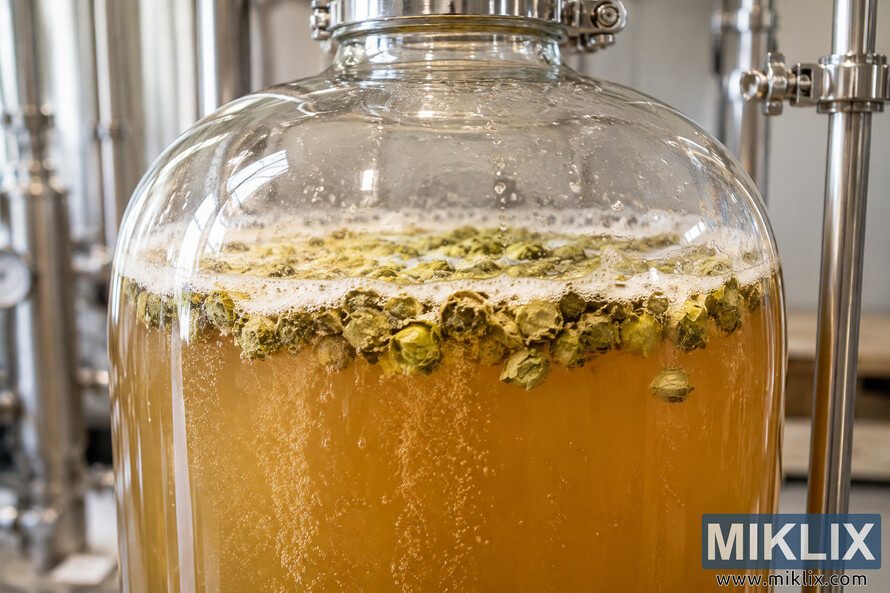
Photorealistic close-up of dry hops floating in actively fermenting amber beer inside a clear glass vessel, surrounded by stainless-steel brewery equipment.
Available versions of this image
The image files available for download below are less compressed and higher resolution - and as a result of that, higher quality - than the images embedded in articles and pages on this website, which are more optimized for file size in order to reduce bandwidth consumption.
Regular size (1,536 x 1,024)
Large size (3,072 x 2,048)
Very large size (4,608 x 3,072)
Extra large size (6,144 x 4,096)
Comically large size (1,048,576 x 699,051)
- Still uploading... ;-)
Image description
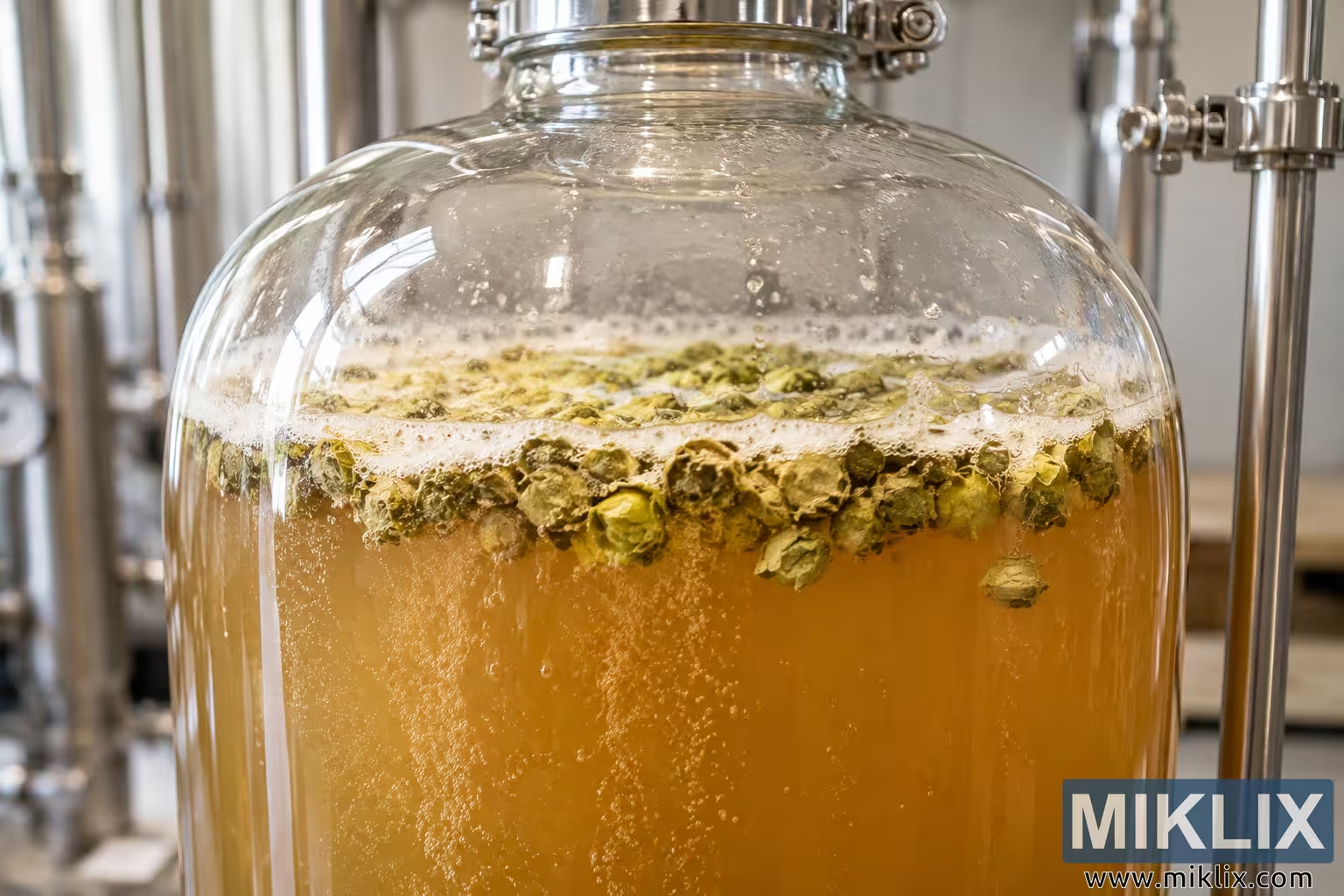
A high-resolution, landscape-oriented photorealistic image presents a close-up view of a large transparent glass fermentation vessel filled with actively fermenting amber-colored beer. The fermentation vessel occupies almost the entire frame and is photographed from a straight-on perspective, allowing the viewer to clearly observe the liquid, foam, bubbles, and dry hop material inside. The vessel has a broad cylindrical body with rounded shoulders that curve inward toward a narrower neck at the top. Its thick, clear glass surface is highly reflective, displaying soft highlights from windows and overhead illumination as well as subtle distortions created by the curvature of the glass. Small droplets and traces of condensation are visible across portions of the interior and exterior surface, reinforcing the impression of an active brewing environment.
The beer inside the vessel has a rich golden-orange to amber appearance. It is somewhat hazy rather than completely transparent, suggesting that fermentation is still underway and that yeast and other suspended material remain in the liquid. Numerous tiny bubbles can be seen rising through the beer, particularly in the central and lower portions of the visible liquid. These fine streams of carbonation and fermentation gas give the otherwise still photograph a strong sense of activity. Some bubbles appear as isolated bright points, while others form loose vertical trails that travel upward toward the surface. The illumination passing through the vessel gives the beer a warm, luminous quality, with brighter golden tones toward the left side and deeper orange tones toward the center and right.
At the upper surface of the beer is a clearly visible dry hop addition. A substantial layer of green and olive-colored hop cones and leafy hop material floats directly on top of the fermenting liquid. The hops vary in shape and size, with some pieces appearing as compact, rounded cones and others as irregular fragments of leaves and petals. Their muted green, yellow-green, and brown-green colors contrast strongly with the warm amber beer beneath them. Several hop cones are partially submerged, while others sit higher on the surface. A few pieces appear to hang just below the main floating layer, suggesting that the hop material is gradually becoming saturated with beer. The irregular arrangement makes the dry hop addition look natural rather than staged.
A narrow layer of pale cream-colored foam surrounds and partially covers the floating hops. The foam forms a broken ring near the liquid surface and consists of countless small bubbles. In some areas it is thin and delicate, while in others it collects into thicker patches around the hop material. Additional bubbles cling to the glass near the liquid line. The combination of foam, suspended bubbles, hazy beer, and floating hops visually communicates an active fermentation process and specifically emphasizes the dry hopping stage of beer production.
The upper portion of the fermentation vessel remains largely empty of liquid, providing a visible headspace between the beer and the neck of the container. This transparent area contains scattered condensation droplets and subtle moisture marks on the glass. Bright reflections from the surrounding room curve across the rounded shoulders of the vessel. At the very top of the image, the glass neck is secured beneath polished stainless-steel brewing hardware. A broad metallic clamp encircles the opening, with bolts and fastening components visible along its edge. The stainless steel has a clean, brushed and polished appearance and reflects the bright ambient light.
The background depicts a professional or small-scale craft brewing environment but is intentionally rendered out of focus because of the shallow depth of field. Stainless-steel pipes, cylindrical tanks, valves, clamps, and other brewing equipment are visible behind and beside the glass fermenter. On the right side of the frame, a vertical stainless-steel pipe runs from near the bottom to the top of the composition. It includes a polished junction and valve assembly near the upper-right area. More metallic brewing equipment is visible in the left background, including blurred cylindrical forms and fittings. The softly blurred machinery provides clear environmental context without competing with the fermentation vessel as the principal subject.
The lighting is bright, naturalistic, and clean. Large, soft reflections on the glass suggest daylight entering through windows or broad diffused light sources within the brewery. The highlights are strongest across the upper shoulders of the vessel and along the curved glass edges. These reflections help define the thickness and rounded geometry of the transparent container. The stainless-steel equipment catches sharper highlights, creating a visual contrast between the smooth reflective metal, transparent glass, textured hops, foamy surface, and cloudy liquid.
The composition is tightly cropped around the fermenter, emphasizing the ingredients and physical changes taking place inside rather than presenting a wide view of the brewery. The vessel is centrally positioned and visually symmetrical, while the floating hop layer creates a strong horizontal band across the upper third of the beer. The warm amber liquid occupies most of the lower two-thirds of the image, creating a large field of color beneath the more detailed hop and foam layer. The background remains neutral and subdued, consisting primarily of silver stainless steel, soft gray tones, and bright highlights.
No people are present in the image, and there are no labels, logos, packages, trademarks, readable text, or identifiable commercial brands. The visual focus is entirely on the brewing process and equipment. The image communicates the concept of dry hopping during active beer fermentation: aromatic hop material has been added directly to fermenting beer inside a transparent vessel, where it floats at the surface while fermentation bubbles continue to rise through the liquid. The overall aesthetic is clean, technically detailed, realistic, and suitable for illustrating brewing, fermentation, craft beverage production, hop additions, brewing education, or an article explaining how dry hopping is performed.
The image is related to: Hops in Beer Brewing: Palisade