
Image: Vacuum-Sealed Palisade Hops Stored in a Freezer
Published: October 20, 2026 at 5:48:45 PM UTC
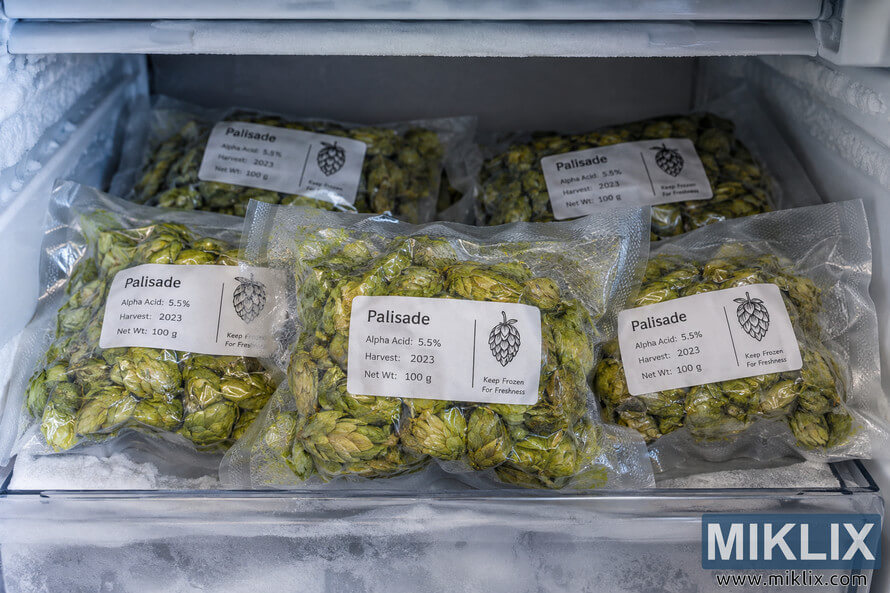
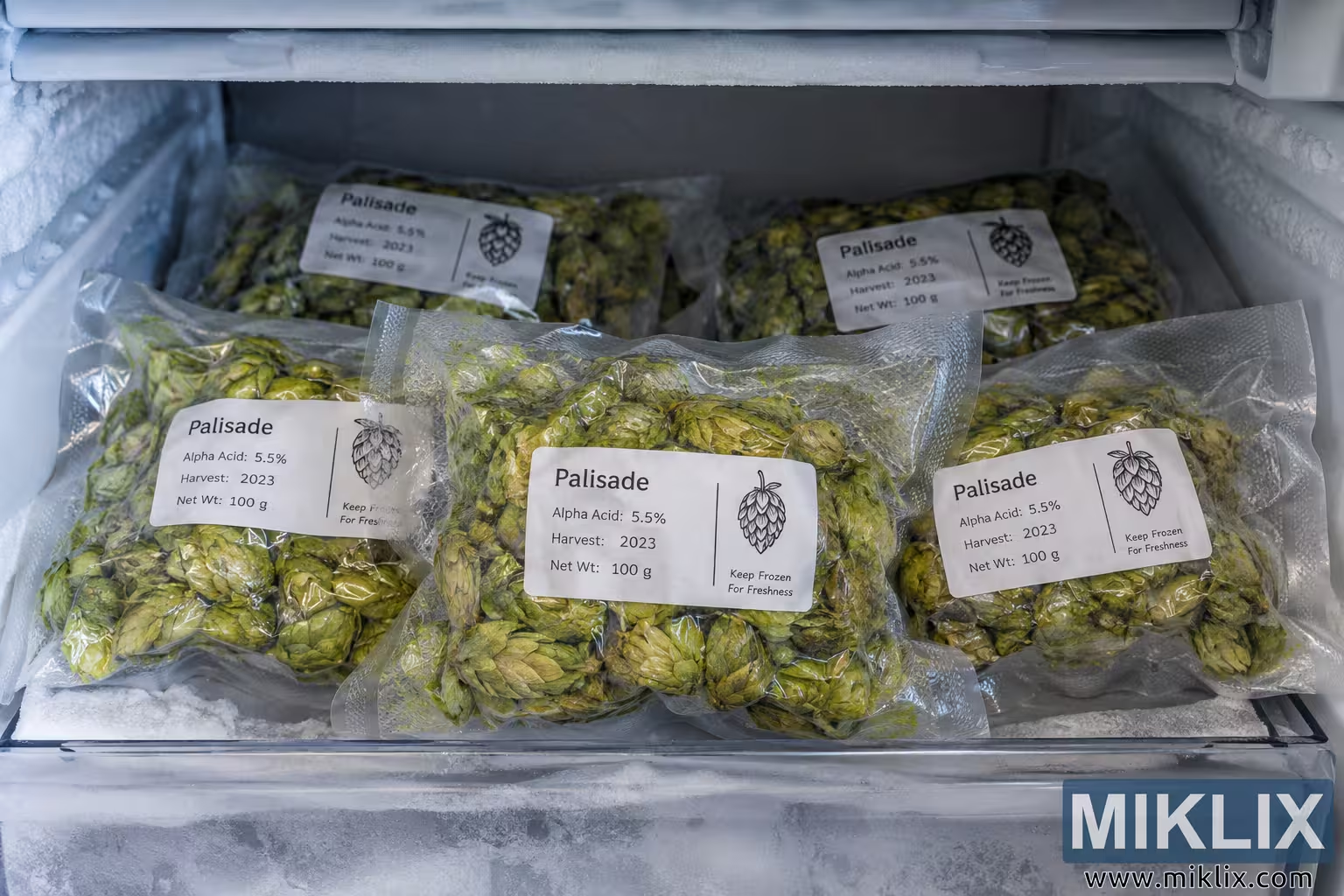
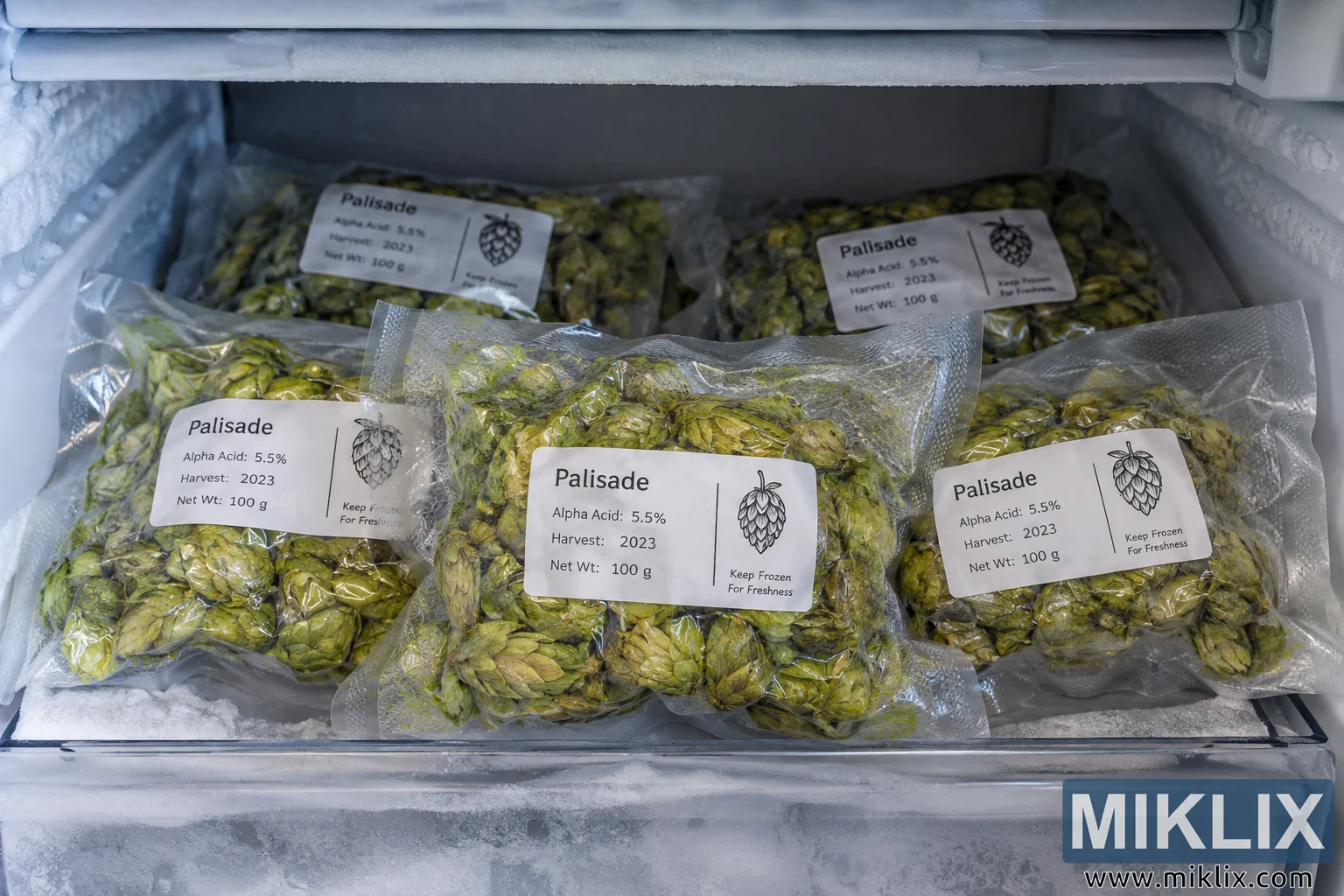
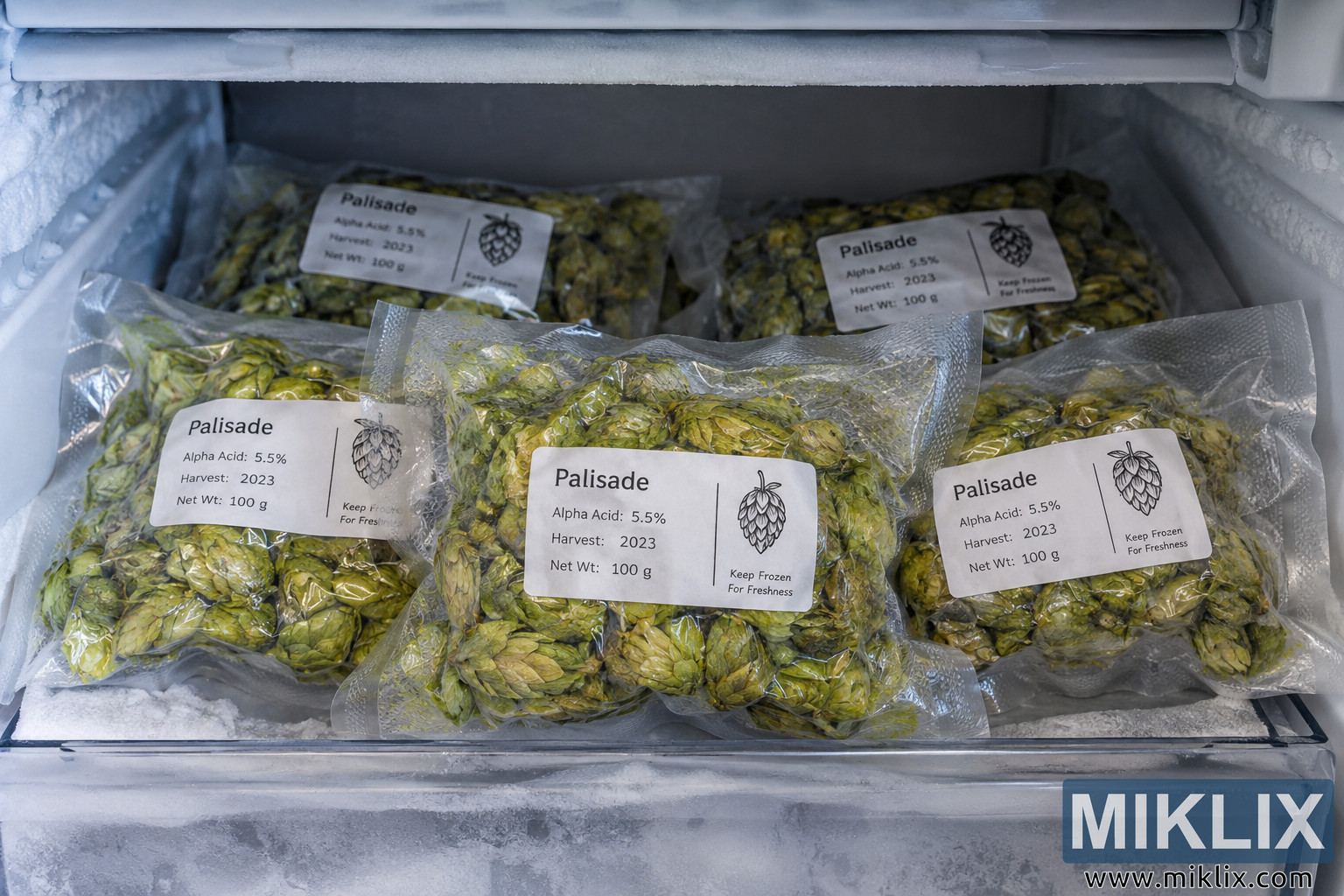
Photorealistic view of vacuum-sealed Palisade hops stored in a frosty freezer compartment, showing tightly packed green hop cones in clear, generically labeled bags.
Available versions of this image
The image files available for download below are less compressed and higher resolution - and as a result of that, higher quality - than the images embedded in articles and pages on this website, which are more optimized for file size in order to reduce bandwidth consumption.
Regular size (1,536 x 1,024)
Large size (3,072 x 2,048)
Very large size (4,608 x 3,072)
Extra large size (6,144 x 4,096)
Comically large size (1,048,576 x 699,051)
- Still uploading... ;-)
Image description
A landscape-oriented, photorealistic image shows the interior of a heavily chilled freezer compartment filled with multiple vacuum-sealed packages of green Palisade hops. The viewpoint is positioned directly in front of the open freezer drawer, creating the impression that the viewer has just pulled the compartment open and is looking straight at its contents. Five clearly visible packages occupy most of the available space, with three larger bags arranged prominently across the foreground and two additional packages positioned farther back. The transparent vacuum packaging has been drawn tightly around the hops, compressing the plant material into dense, irregularly shaped bundles. The plastic surfaces are glossy and slightly wrinkled, with numerous creases, sealed edges, and small reflections that emphasize the airtight packaging. Through the clear plastic, individual hop cones and fragments of leafy hop material can be seen in considerable detail. Their colors range from muted yellow-green and olive to deeper natural green, with subtle brownish and golden tones appearing in some of the compressed plant material. The central foreground package is the most visually dominant object in the composition. It extends across much of the middle of the image and contains numerous clearly recognizable hop cones pressed against the transparent plastic. A rectangular white label is attached near the center of this package. The label identifies the contents as Palisade and includes additional product-style information such as an alpha acid percentage, a harvest year, a net weight, and an instruction to keep the contents frozen for freshness. A simple black line illustration of a hop cone appears on the right side of the label. The typography and graphic treatment are restrained and generic, with no commercial brand identity or recognizable company logo. Similar white labels are attached to the other packages. The bag on the left side of the foreground is positioned at a slight diagonal and appears broad and relatively flat because of the vacuum seal. Its label is angled gently toward the viewer and remains easy to distinguish against the green hops beneath it. On the right, another large package fills much of the lower-right quadrant. Its label is also clearly visible and carries the same general Palisade identification and storage information. Behind these foreground packages, two additional sealed bags rest against the rear portion of the freezer compartment. Their labels are visible but appear somewhat smaller because of their greater distance from the camera. This layered arrangement creates a convincing sense of depth while simultaneously suggesting that the freezer is well stocked with hops intended for long-term cold storage. The freezer itself is predominantly white and pale gray, providing a cool neutral setting that contrasts with the organic green and yellow-green colors of the hops. Thick frost and accumulated ice are visible along the left and right interior walls, across the upper ledge, and around the lower edges of the drawer. The frost has an uneven, crystalline texture, with some areas appearing powdery and others forming thicker opaque deposits. A particularly noticeable layer of ice runs along the upper horizontal edge of the compartment, reinforcing the impression of sustained subzero storage. More frost is visible beneath and around the packages at the bottom of the drawer, where the white frozen surfaces frame the bags. The lower portion of the image includes the translucent or frosted front wall of the freezer drawer. This surface has a cloudy, icy appearance, with irregular patches of frost and condensation-like texture. Its horizontal geometry provides a strong visual base for the composition. The upper edge of the image is similarly defined by the freezer's interior structure, including a white shelf or housing that stretches horizontally across the frame. Together, these architectural elements surround the packages and make the location immediately recognizable as a domestic or small-scale storage freezer rather than a room-temperature pantry. The lighting is cool, soft, and directional, resembling the illumination from a freezer's interior lamp combined with ambient light entering through the open door. Highlights appear on the shiny vacuum-sealed plastic, especially along folds and raised areas where the packaging conforms to individual hop cones. The brightest portions of the scene are the white labels, frost, and freezer surfaces, while the spaces behind the packages recede into darker gray-blue shadow. This tonal variation gives the scene dimensionality without becoming dramatic or theatrical. The overall color palette is dominated by icy whites, pale grays, cool blue-gray shadows, and natural botanical greens. The subtle warmth of the yellow-green hops prevents the image from appearing completely monochromatic and draws attention toward the stored ingredients. The focus is sharpest across the foreground and central packages, allowing the viewer to appreciate the texture of the hop cones, the wrinkles of the plastic, and the printed labels. Objects toward the rear remain sufficiently detailed to be identifiable while contributing to the natural depth of the scene. The image communicates careful preservation of a brewing ingredient: the hops have been portioned into airtight packages, labeled, and placed in a frozen environment to help maintain their condition. There are no people, brewing vessels, bottles, glasses, or other unrelated objects in view. The composition is entirely centered on the freezer storage arrangement and the vacuum-packed hops. No actual commercial branding is present; the packaging uses generic informational labels rather than branded retail designs. The repeated Palisade name functions as identification of the hop variety represented in the scene. Overall, the photograph has the practical, documentary appearance of an organized ingredient-storage setup, while the visible frost, tightly compressed packaging, detailed hop cones, and cold illumination strongly reinforce the concept of vacuum-sealed Palisade hops being preserved inside a freezer compartment.
The image is related to: Hops in Beer Brewing: Palisade