
Image: Progress Hop Substitution Varieties Comparison Chart
Published: October 22, 2026 at 11:11:22 PM UTC
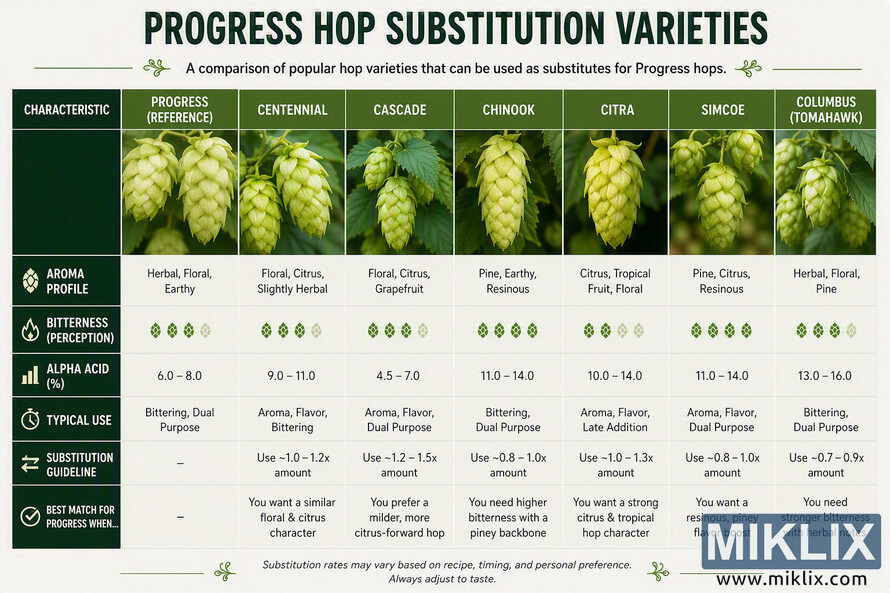
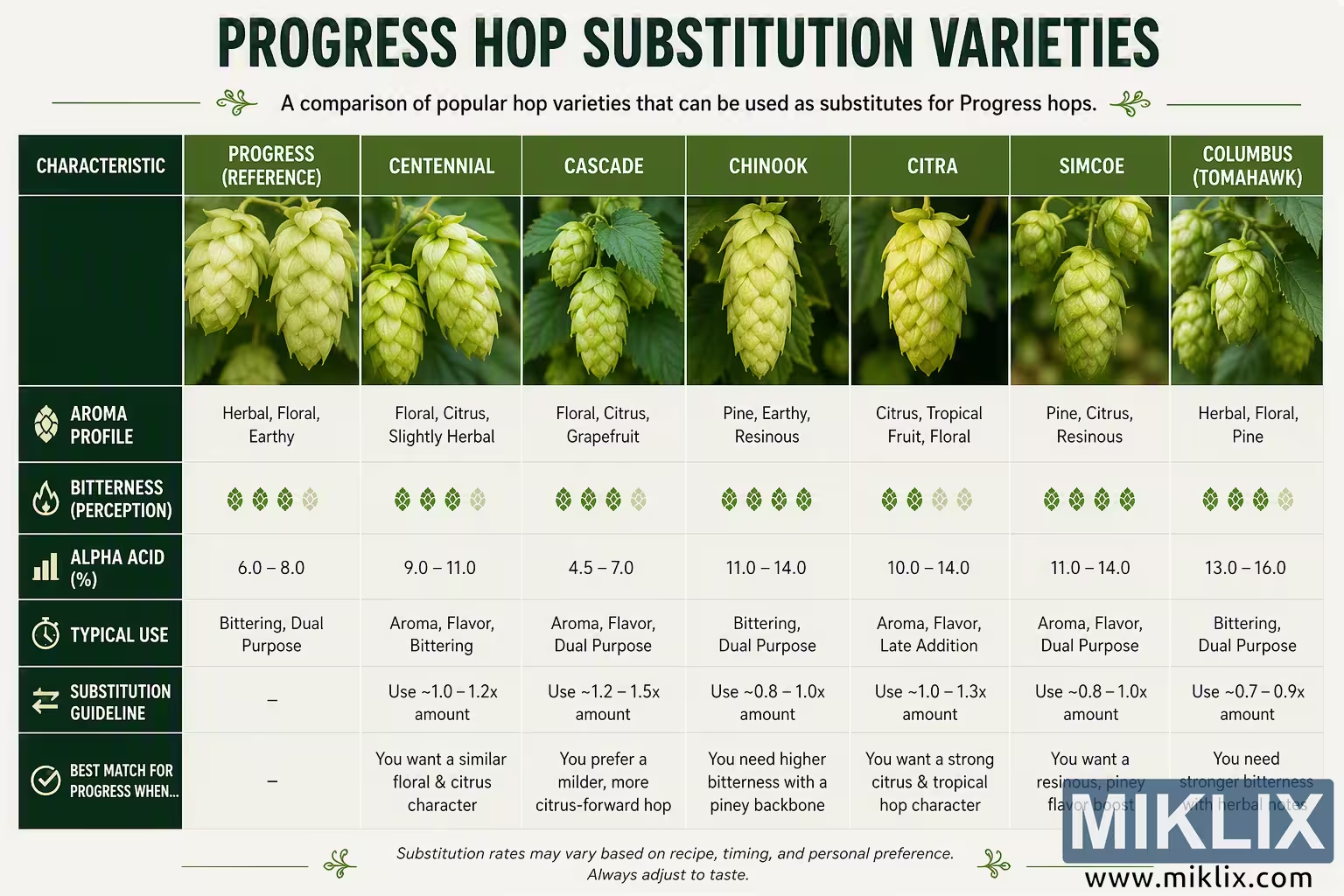
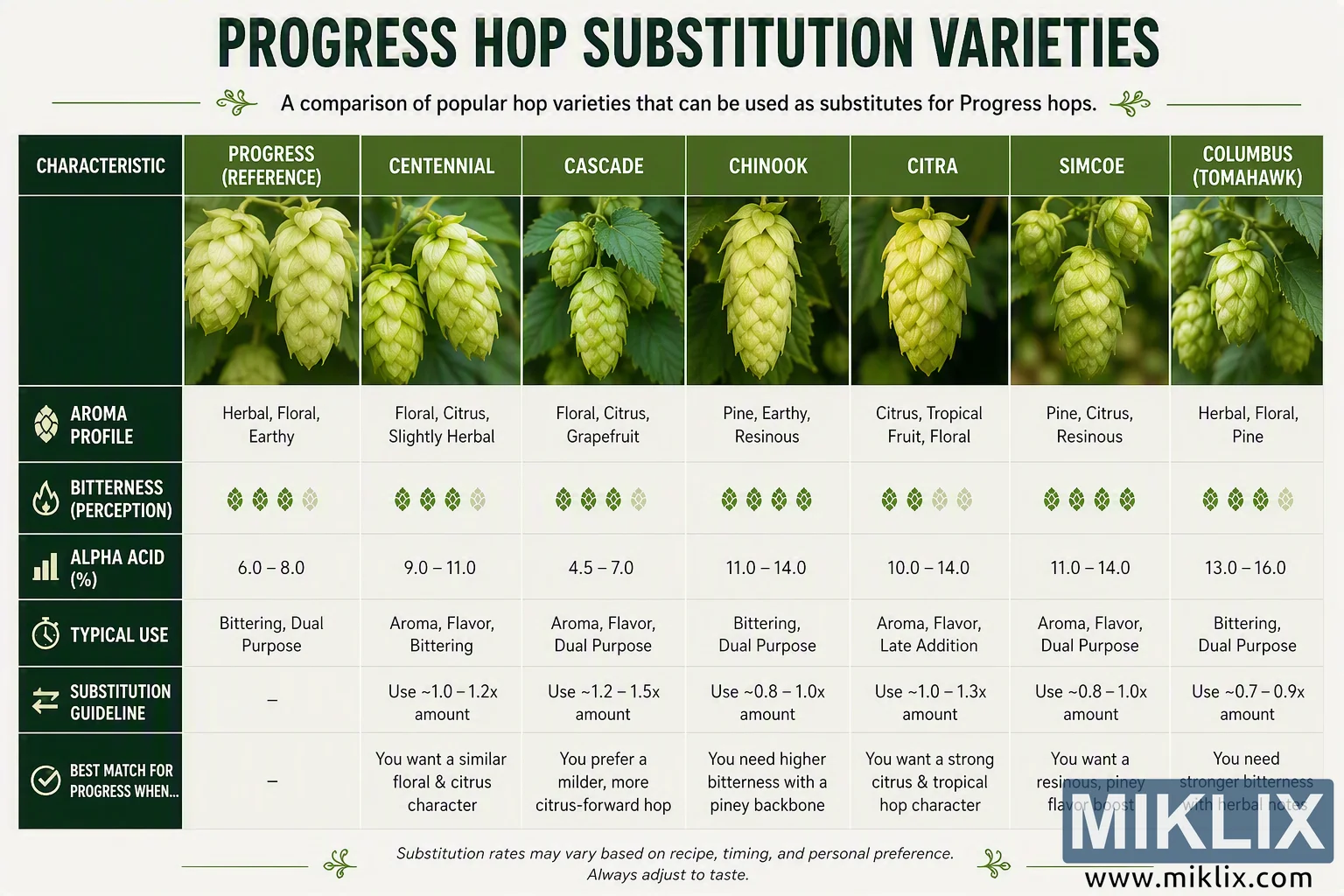
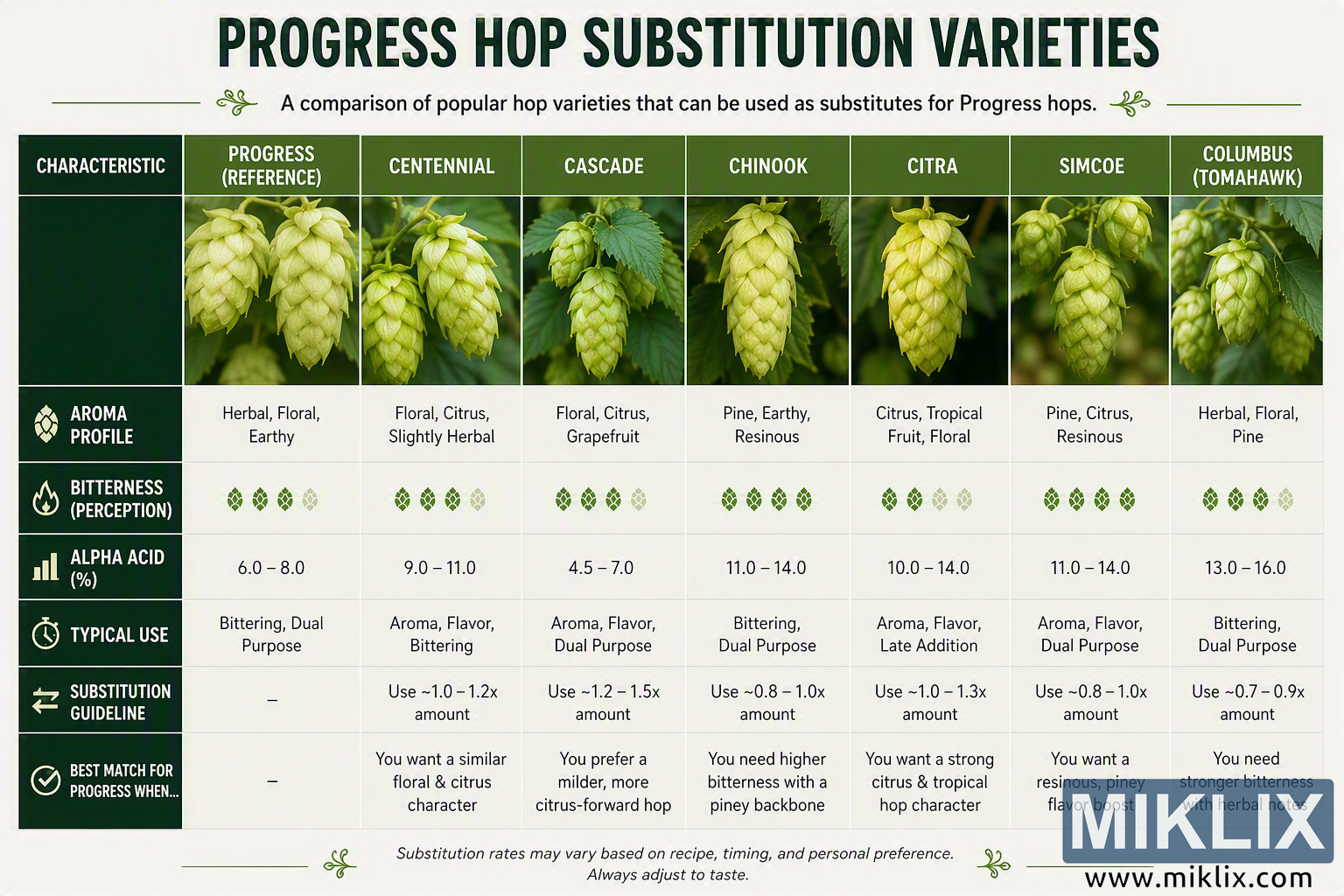
Comprehensive comparison chart of Progress hop substitution varieties for brewing. Compare Centennial, Cascade, Chinook, Citra, Simcoe, and Columbus hops by aroma profile, bitterness, alpha acid percentage, brewing applications, and recommended substitution rates.
Available versions of this image
The image files available for download below are less compressed and higher resolution - and as a result of that, higher quality - than the images embedded in articles and pages on this website, which are more optimized for file size in order to reduce bandwidth consumption.
Regular size (1,536 x 1,024)
Large size (3,072 x 2,048)
Very large size (4,608 x 3,072)
Extra large size (6,144 x 4,096)
Comically large size (1,048,576 x 699,051)
- Still uploading... ;-)
Image description
This image is a professionally designed landscape-oriented comparison infographic titled "PROGRESS HOP SUBSTITUTION VARIETIES." The overall design uses a green and cream color palette associated with hops, brewing, agriculture, and botanical subjects. The title appears prominently across the top of the image in large dark green capital letters against a light background. Directly beneath the title is a subtitle stating that the infographic presents a comparison of popular hop varieties that can be used as substitutes for Progress hops. Decorative botanical flourishes appear alongside the subtitle and at the bottom of the infographic, reinforcing the agricultural theme.
The infographic is organized as a multi-column comparison table. The leftmost column is labeled "Characteristic" and contains category names used to compare the hop varieties. To the right are seven vertical columns representing individual hop varieties. The first variety serves as the reference variety and is labeled "Progress (Reference)." The remaining columns are labeled "Centennial," "Cascade," "Chinook," "Citra," "Simcoe," and "Columbus (Tomahawk)."
At the top of each hop variety column is a large color photograph showing clusters of hop cones attached to hop vines. The photographs depict light green hop cones with layered bracts and surrounding green leaves. Although all images show hops, each variety is represented by a separate image, creating visual differentiation between the columns. The photographs occupy a substantial portion of the top half of the chart and provide an immediate visual reference for each variety.
Below the photographs, the first comparison row is labeled "Aroma Profile." The Progress reference column lists the aroma characteristics as herbal, floral, and earthy. Centennial is described as floral, citrus, and slightly herbal. Cascade is described as floral, citrus, and grapefruit. Chinook is characterized as pine, earthy, and resinous. Citra is described as citrus, tropical fruit, and floral. Simcoe is characterized as pine, citrus, and resinous. Columbus (Tomahawk) is described as herbal, floral, and pine.
The second comparison category is labeled "Bitterness (Perception)." This row uses small hop-cone icons to indicate perceived bitterness levels. The icons function as a visual rating system. Progress shows a moderate bitterness rating. Centennial and Cascade display comparable moderate bitterness indicators. Chinook and Simcoe show stronger bitterness ratings with more highlighted hop icons. Citra appears somewhat lower or more balanced in perceived bitterness compared with the highest-rated varieties. Columbus (Tomahawk) shows a relatively strong bitterness rating, though not necessarily identical to every other variety in the table.
The next category is "Alpha Acid (%)." This row provides numerical alpha acid ranges for each hop variety. Progress is listed at 6.0 to 8.0 percent. Centennial is listed at 9.0 to 11.0 percent. Cascade is listed at 4.5 to 7.0 percent. Chinook is listed at 11.0 to 14.0 percent. Citra is listed at 10.0 to 14.0 percent. Simcoe is listed at 11.0 to 14.0 percent. Columbus (Tomahawk) is listed at 13.0 to 16.0 percent. These values provide a quantitative comparison of bittering potential among the different hops.
The following category is labeled "Typical Use." Progress is identified as suitable for bittering and dual-purpose applications. Centennial is described as useful for aroma, flavor, and bittering. Cascade is designated for aroma, flavor, and dual-purpose uses. Chinook is listed for bittering and dual-purpose use. Citra is associated with aroma, flavor, and late-addition applications. Simcoe is listed as suitable for aroma, flavor, and dual-purpose brewing. Columbus (Tomahawk) is identified as useful for bittering and dual-purpose brewing.
Another category is labeled "Substitution Guideline." The Progress reference column displays a dash because it functions as the baseline comparison variety. Centennial recommends approximately 1.0 to 1.2 times the amount. Cascade recommends approximately 1.2 to 1.5 times the amount. Chinook recommends approximately 0.8 to 1.0 times the amount. Citra recommends approximately 1.0 to 1.3 times the amount. Simcoe recommends approximately 0.8 to 1.0 times the amount. Columbus (Tomahawk) recommends approximately 0.7 to 0.9 times the amount. These guideline entries help brewers estimate equivalent substitutions when replacing Progress hops.
The final category row is labeled "Best Match for Progress When..." The Progress reference column contains a dash because it represents the original variety. Centennial is recommended when a brewer wants a similar floral and citrus character. Cascade is recommended when a brewer prefers a milder, more citrus-forward hop. Chinook is recommended when higher bitterness with a piney backbone is desired. Citra is recommended when a strong citrus and tropical hop character is wanted. Simcoe is recommended when a resinous, piney flavor boost is desired. Columbus (Tomahawk) is recommended when stronger bitterness combined with herbal notes is needed.
The leftmost characteristic column includes custom icons accompanying each category heading. The aroma section uses a hop-related symbol. The bitterness section uses a flame-style icon. The alpha-acid section uses a bar-chart icon. The typical-use category uses a stopwatch-like symbol. The substitution-guideline category uses a directional arrow icon. The best-match category uses a checkmark inside a circle. These graphical elements help users quickly identify each comparison dimension.
The overall layout is highly structured, featuring green header panels, white and cream table cells, thin dividing lines, aligned typography, and consistent spacing. The design resembles a brewing reference guide, educational poster, or technical comparison sheet intended for brewers evaluating alternative hop varieties. At the bottom of the infographic a note states that substitution rates may vary based on recipe, timing, and personal preference and advises users to adjust to taste. The image contains no visible company logos, commercial brand marks, or advertising elements. The emphasis remains entirely on comparative brewing information relating to Progress hop substitutions.
The image is related to: Hops in Beer Brewing: Progress