
Image: Hop Blend Samples in Labeled Glass Containers
Published: October 24, 2026 at 12:23:02 AM UTC
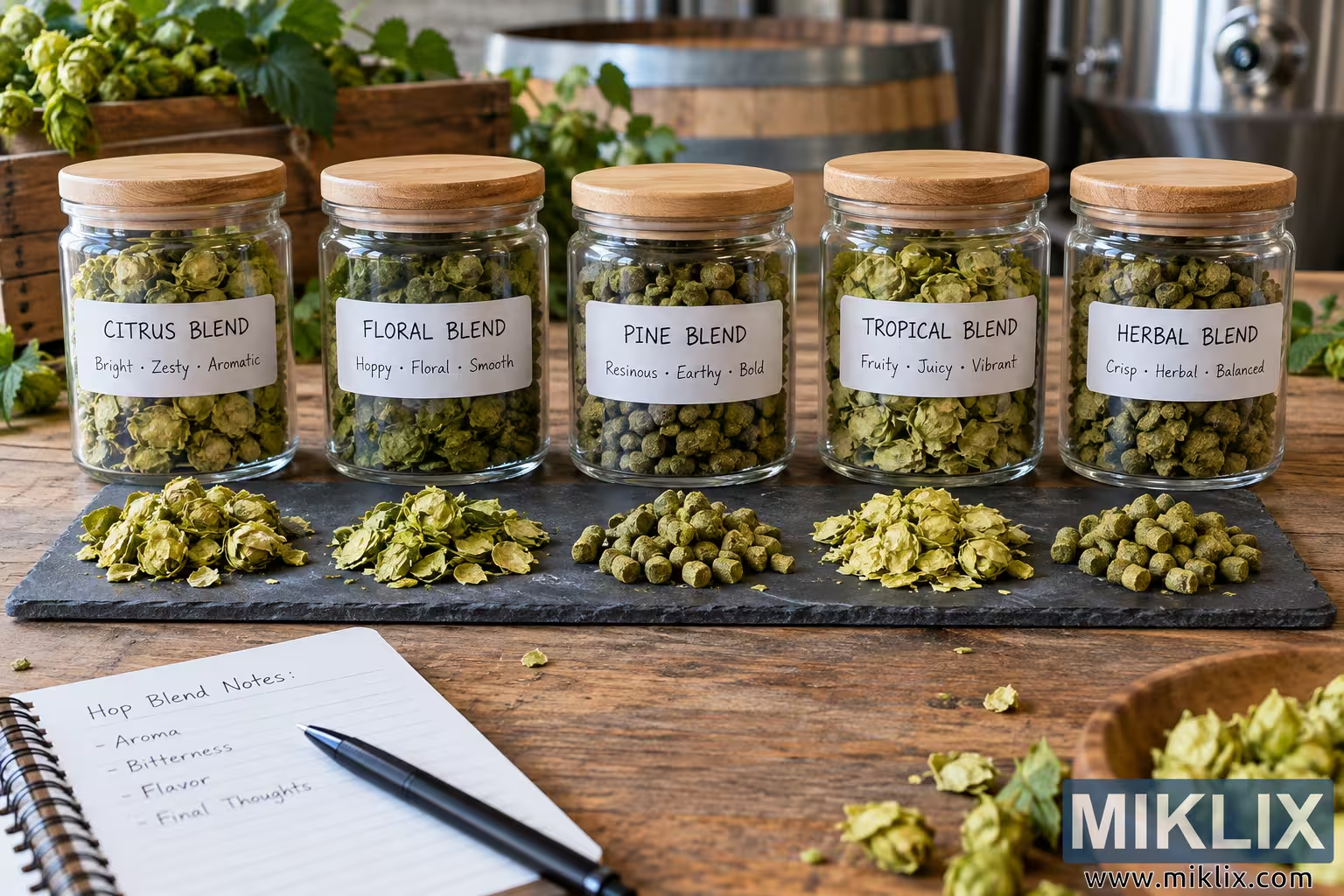
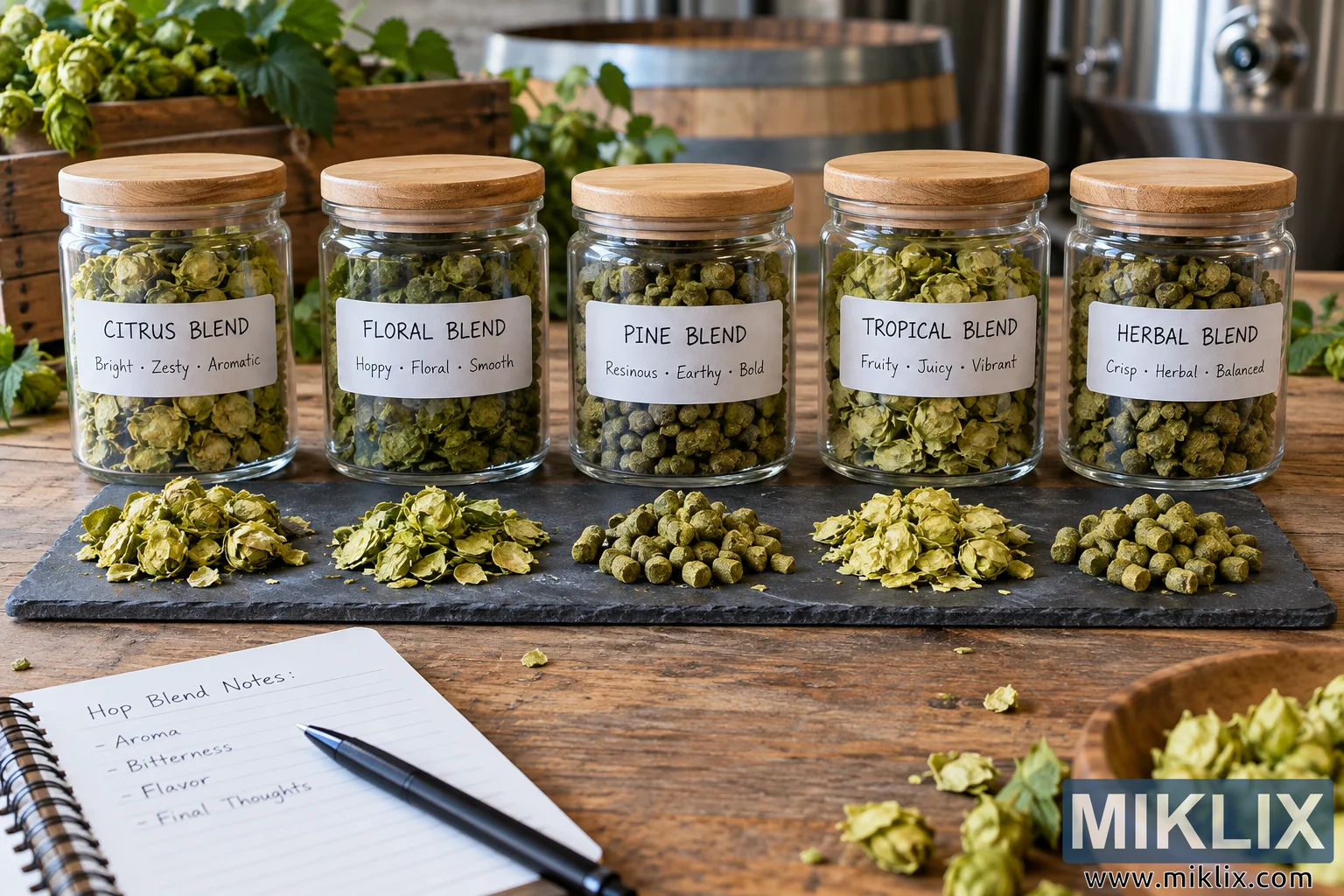
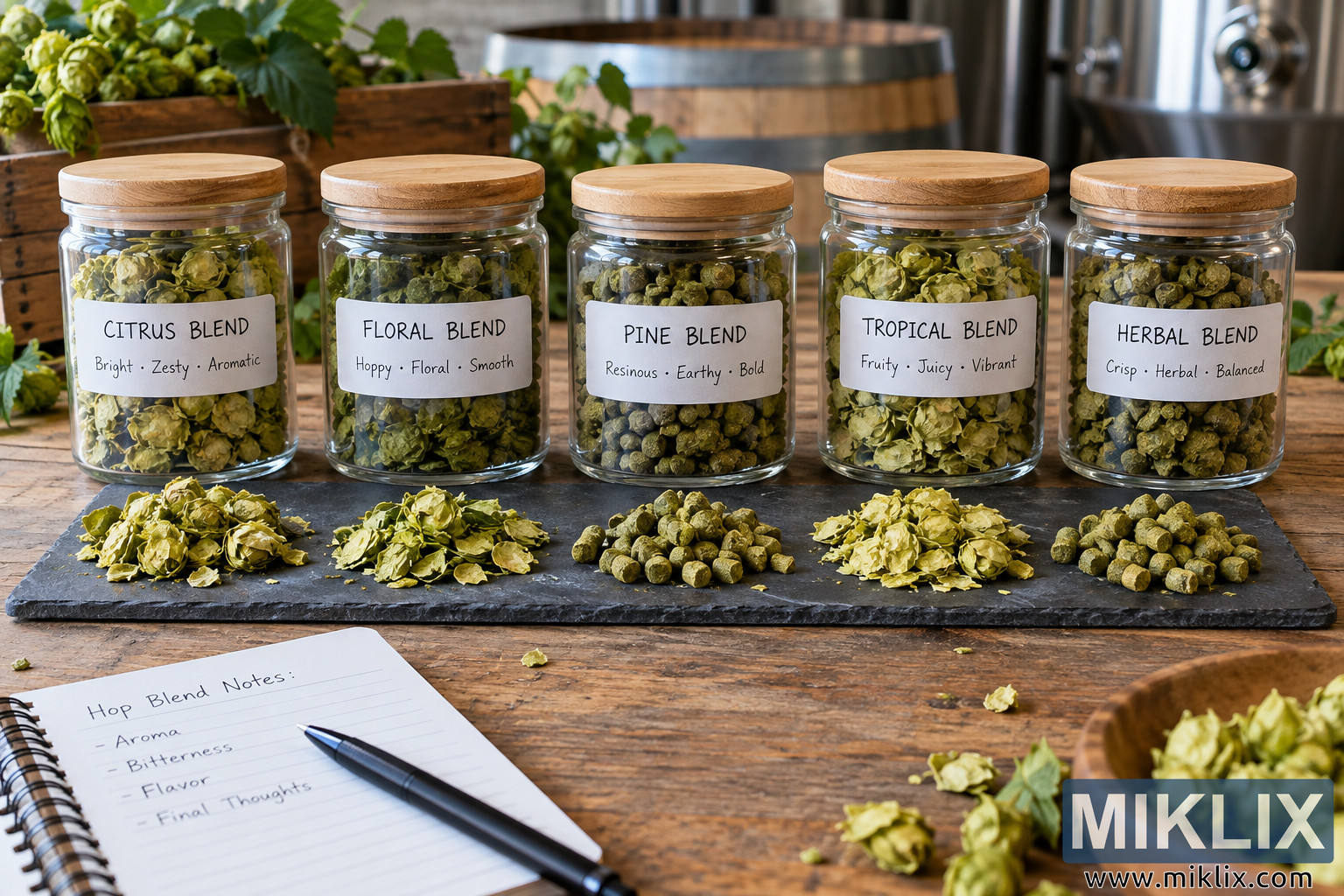
Landscape photograph of five unbranded hop blend samples in labeled glass jars, with hop cones and pellets displayed on a rustic brewery workbench for tasting, comparison, and recipe development.
Available versions of this image
The image files available for download below are less compressed and higher resolution - and as a result of that, higher quality - than the images embedded in articles and pages on this website, which are more optimized for file size in order to reduce bandwidth consumption.
Regular size (1,536 x 1,024)
Large size (3,072 x 2,048)
Very large size (4,608 x 3,072)
Extra large size (6,144 x 4,096)
Comically large size (1,048,576 x 699,051)
- Still uploading... ;-)
Image description
A wide, landscape-oriented photograph presents an organized collection of hop blend samples arranged on a rustic wooden workbench in a brewery-inspired setting. The composition is centered on five clear cylindrical glass jars positioned in a neat horizontal row across the middle of the frame. Each jar has a natural light-brown wooden lid and a simple white rectangular paper label with dark handwritten-style lettering. From left to right, the jars are labeled "CITRUS BLEND," "FLORAL BLEND," "PINE BLEND," "TROPICAL BLEND," and "HERBAL BLEND." Smaller descriptive words appear beneath the main names. The Citrus Blend is described as "Bright · Zesty · Aromatic," the Floral Blend as "Hoppy · Floral · Smooth," the Pine Blend as "Resinous · Earthy · Bold," the Tropical Blend as "Fruity · Juicy · Vibrant," and the Herbal Blend as "Crisp · Herbal · Balanced." There are no commercial logos, trademarks, branded packages, or other identifiable brand elements anywhere in the scene. The transparent jars allow the individual hop samples to remain clearly visible. Some contain loose dried hop cones and leafy hop material in muted yellow-green and olive tones, while others contain compact green hop pellets. The different textures give each sample a distinctive visual character while maintaining a consistent natural color palette. Directly in front of the five containers is a long, rectangular dark slate serving board extending almost the full width of the image. Five corresponding portions of hops have been placed on this slate, approximately aligned with the jars behind them. The first portion consists of pale green dried hop leaves and cones, followed by another loose pile of green hop material. The central sample is a compact mound of cylindrical green hop pellets. The fourth sample returns to loose, papery hop cones and flakes, while the fifth is another pile of pellets. Small fragments and crumbs scattered around the samples make the arrangement feel tactile and authentic rather than excessively pristine. In the lower-left foreground, an open spiral-bound notebook rests diagonally on the wooden tabletop. Its visible page is headed "Hop Blend Notes:" and includes handwritten prompts such as "Aroma," "Bitterness," "Flavor," and "Final Thoughts." A dark pen lies diagonally across the notebook, suggesting that someone has been evaluating the samples or is preparing to record sensory observations. The notebook is partially cropped by the lower edge of the frame, which gives the scene the natural appearance of an active working table rather than a formal product display. In the lower-right foreground, a round wooden bowl filled with additional pale green hop cones enters the frame and is also partially cropped. Several loose hop cones, leaves, flakes, and small pieces are scattered between the notebook, bowl, slate, and jars. The wooden work surface has pronounced grain, knots, scratches, and tonal variations, reinforcing the handcrafted and agricultural character of the subject. The background is softly out of focus because of a shallow depth of field. On the left, a rustic wooden crate contains fresh-looking green hop vines, leaves, and clusters of hop cones. More green foliage appears behind and between the sample jars. Farther back, a large wooden barrel with metal hoops occupies the central background, while stainless-steel brewing equipment is visible toward the right. These elements establish a small brewery, hop laboratory, tasting room, or craft production environment without introducing any specific company identity. Warm natural-looking illumination falls across the jars and tabletop, producing bright highlights on the curved glass, gentle reflections on the metal equipment, and soft shadows beneath the containers and samples. The light emphasizes the translucent glass, fibrous dried hop cones, compressed pellets, slate texture, and weathered grain of the workbench. The overall palette is dominated by earthy greens, warm browns, charcoal gray, cream-white labels, and restrained metallic silver. The camera is positioned approximately at tabletop height but slightly elevated, allowing both the fronts of the labeled jars and the samples arranged on the slate to be seen clearly. The five jars create a strong horizontal rhythm and serve as the primary focal point, while the notebook and bowl provide foreground depth and the blurred barrel and brewing equipment add contextual depth behind them. The scene communicates hop selection, sensory evaluation, recipe development, brewing experimentation, and ingredient comparison. Its visual style combines polished commercial photography with an approachable artisanal workshop atmosphere. Everything appears carefully organized for comparison while retaining enough loose plant material and working notes to suggest a genuine hands-on sampling session. No people are visible. No beer bottles, cans, branded glasses, logos, or recognizable commercial products are present. The emphasis remains entirely on the generic hop blends, their physical differences, their descriptive labels, and the practical environment in which a brewer or product developer might examine and compare aromatic ingredients.
The image is related to: Hops in Beer Brewing: Rakau