
Image: Close-Up of Green Hops Growing in a European Hop Yard
Published: October 24, 2026 at 6:16:59 PM UTC
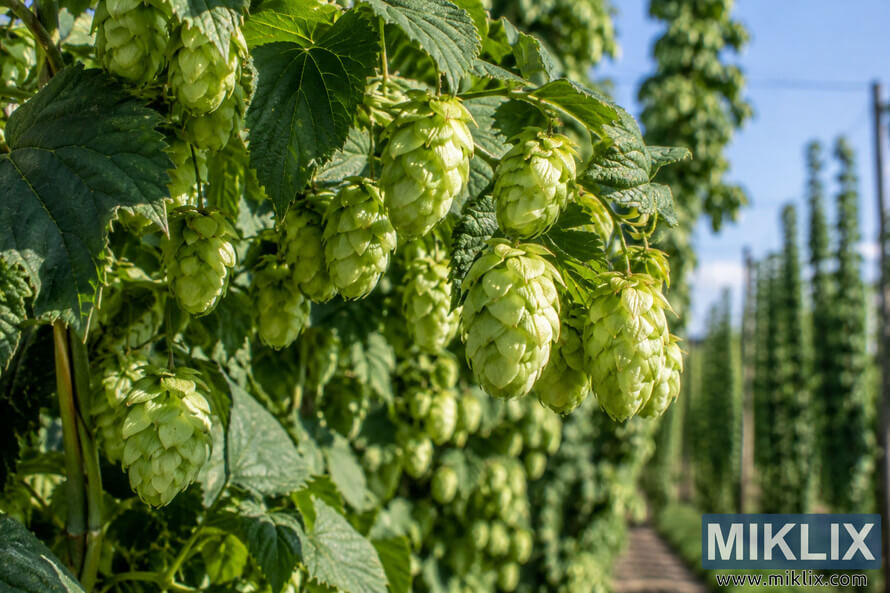
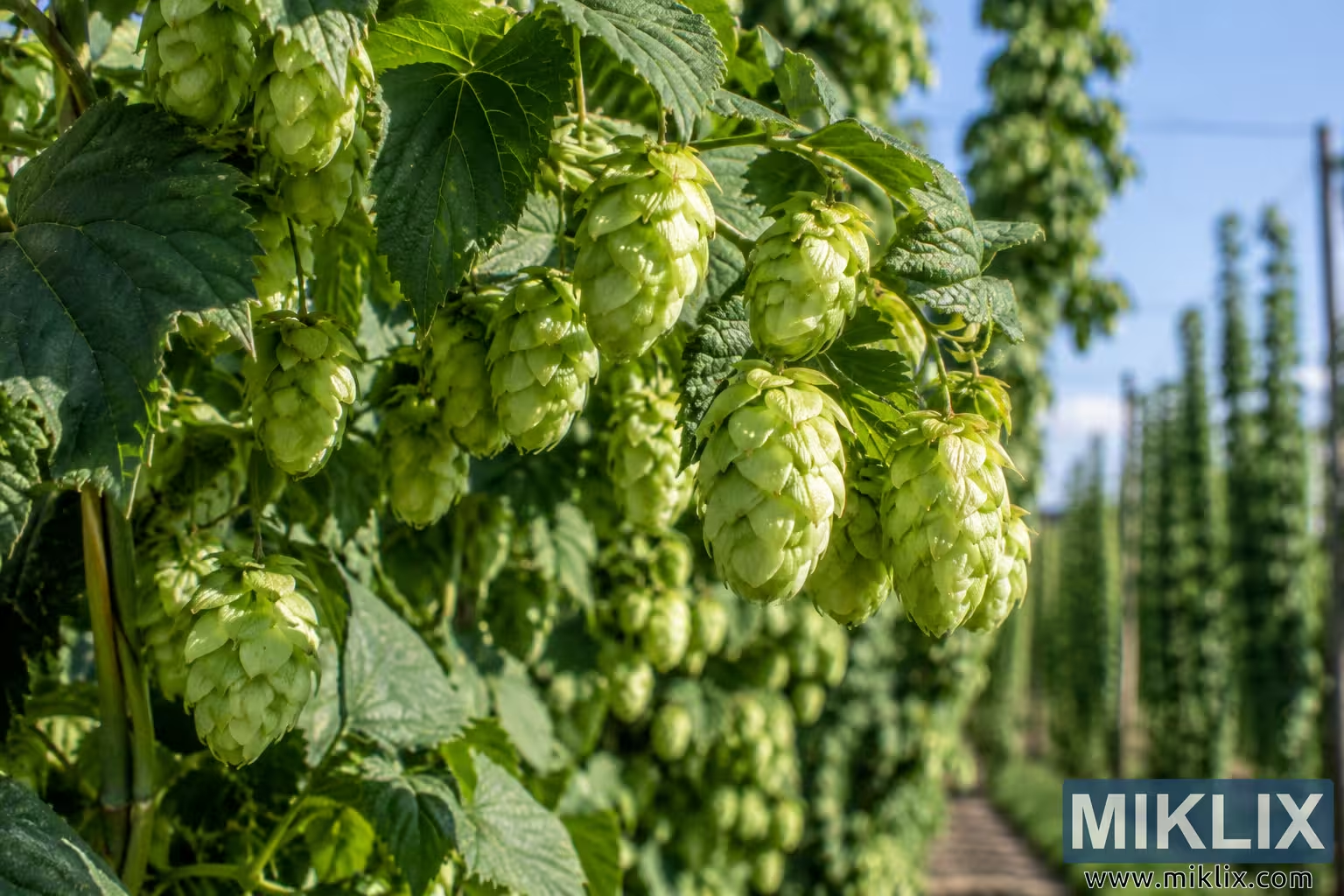
Close-up photograph of fresh green hop cones growing on leafy bines in a sunny European hop yard, with trellised rows and a rural pathway in the background.
Available versions of this image
The image files available for download below are less compressed and higher resolution - and as a result of that, higher quality - than the images embedded in articles and pages on this website, which are more optimized for file size in order to reduce bandwidth consumption.
Regular size (1,536 x 1,024)
Large size (3,072 x 2,048)
Very large size (4,608 x 3,072)
Extra large size (6,144 x 4,096)
Comically large size (1,048,576 x 699,051)
- Still uploading... ;-)
Image description
A wide, landscape-oriented close-up photograph shows lush green hop plants growing in a cultivated European hop yard on a bright, clear day. The composition is dominated by numerous mature hop cones hanging naturally from vigorous climbing bines and leafy stems in the foreground. The cones are pale to medium green and have the distinctive overlapping, scale-like bracts associated with hops. Their layered surfaces are rendered with fine detail, allowing individual bracts, delicate edges, subtle folds, and variations in green coloration to be clearly distinguished. Strong natural sunlight illuminates many of the cones from above and from the side, creating bright highlights on their outer surfaces while leaving gentle shadows between the overlapping bracts. This interplay of light and shadow gives the hop cones a pronounced three-dimensional appearance and emphasizes their characteristic compact, tapered forms. Several prominent clusters hang near the center and upper-left portions of the image, while additional cones appear at different depths throughout the foreground vegetation. Large, healthy hop leaves surround the cones. The leaves are deep green and have serrated edges, pointed lobes, and clearly visible networks of veins. Some leaves face directly toward the camera and display their textured surfaces in sharp detail, while others turn away from the light or overlap neighboring foliage, producing darker shaded areas. Thick green stems and climbing bines can also be seen weaving vertically and diagonally through the vegetation. Together, the cones, leaves, stems, and bines create a dense wall of vigorous plant growth that fills much of the left half and central area of the frame. The camera is positioned very close to the plants, giving the viewer the impression of standing directly beside a row of hops and inspecting the crop at close range. A relatively shallow depth of field keeps the nearest hop cones and leaves sharply defined while progressively softening the scenery farther into the hop yard. In the background, long, orderly rows of hop plants extend into the distance. Tall vertical supports and trained columns of vegetation indicate the characteristic trellis system used for commercial hop cultivation. The repeating upright forms become increasingly blurred as they recede, producing a strong sense of depth and agricultural scale without distracting attention from the detailed foreground cones. A narrow earthen track or pathway runs between the rows from the lower central portion of the photograph toward the distant background. Its converging perspective naturally guides the eye deeper into the plantation and reinforces the impression of long, carefully maintained planting rows. The ground beside the path is edged with green vegetation and appears dry and firm under the sunny conditions. Above the plants, portions of a clear pale-blue sky are visible, especially toward the upper-right side of the image. Fine horizontal lines from the hop-yard support system can be faintly seen crossing the distant sky, while upright poles punctuate the rows at regular intervals. The bright blue sky contrasts with the abundant green foliage and contributes to the fresh, summery atmosphere of the scene. Lighting throughout the photograph is warm, direct, and natural, suggesting a sunny period during the growing or ripening season. The foreground foliage displays a broad range of green tones, from yellow-green highlights on sunlit hop cones to rich forest-green shadows beneath the leaves. There are also subtle natural variations in the stems and plant surfaces, preventing the vegetation from appearing uniform or artificial. The overall visual emphasis is clearly on the hop cones themselves: they are abundant, healthy-looking, and presented as the principal agricultural subject. Their placement close to the lens makes their physical structure especially prominent, while the extensive rows visible behind them provide environmental context and establish that they are growing in a working hop yard rather than an isolated garden. The image contains no people, machinery, packaging, signage, logos, labels, text, or recognizable commercial branding. Nothing interrupts the natural agricultural setting. The scene therefore functions as a clean, realistic representation of hop cultivation, with particular attention to the appearance of fresh hop cones growing directly on their bines. The combination of crisp foreground detail, softly blurred background rows, natural sunlight, blue sky, and strong linear perspective creates the visual character of professional agricultural photography. The photograph conveys the density and vertical growth typical of a mature hop yard while retaining an intimate close-up perspective on the crop. It balances botanical detail with a broader sense of place: individual cones and leaves can be studied at close range, yet the repeating trellised plants and receding pathway make the scale of the cultivated field immediately apparent. The resulting scene is verdant, orderly, and distinctly rural, presenting fresh hops in their natural growing environment before harvest.
The image is related to: Hops in Beer Brewing: Record