
Image: Macro View of Fresh Hops with Golden Lupulin Glands and Aromatic Oils
Published: October 24, 2026 at 6:16:59 PM UTC
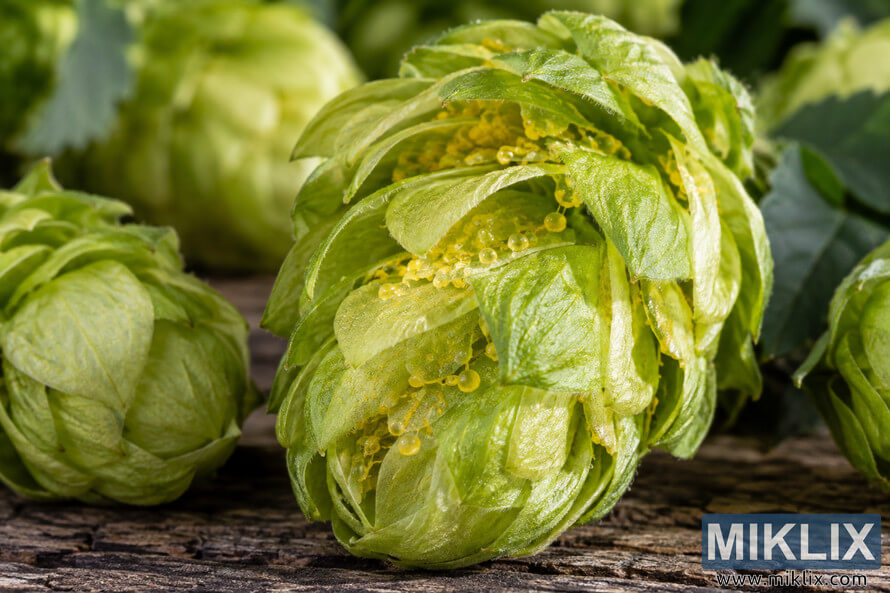
Detailed macro photograph of fresh green hops revealing golden lupulin glands and glistening aromatic oils, photographed on rustic weathered wood.
Available versions of this image
The image files available for download below are less compressed and higher resolution - and as a result of that, higher quality - than the images embedded in articles and pages on this website, which are more optimized for file size in order to reduce bandwidth consumption.
Regular size (1,536 x 1,024)
Large size (3,072 x 2,048)
Very large size (4,608 x 3,072)
Extra large size (6,144 x 4,096)
Comically large size (1,048,576 x 699,051)
- Still uploading... ;-)
Image description
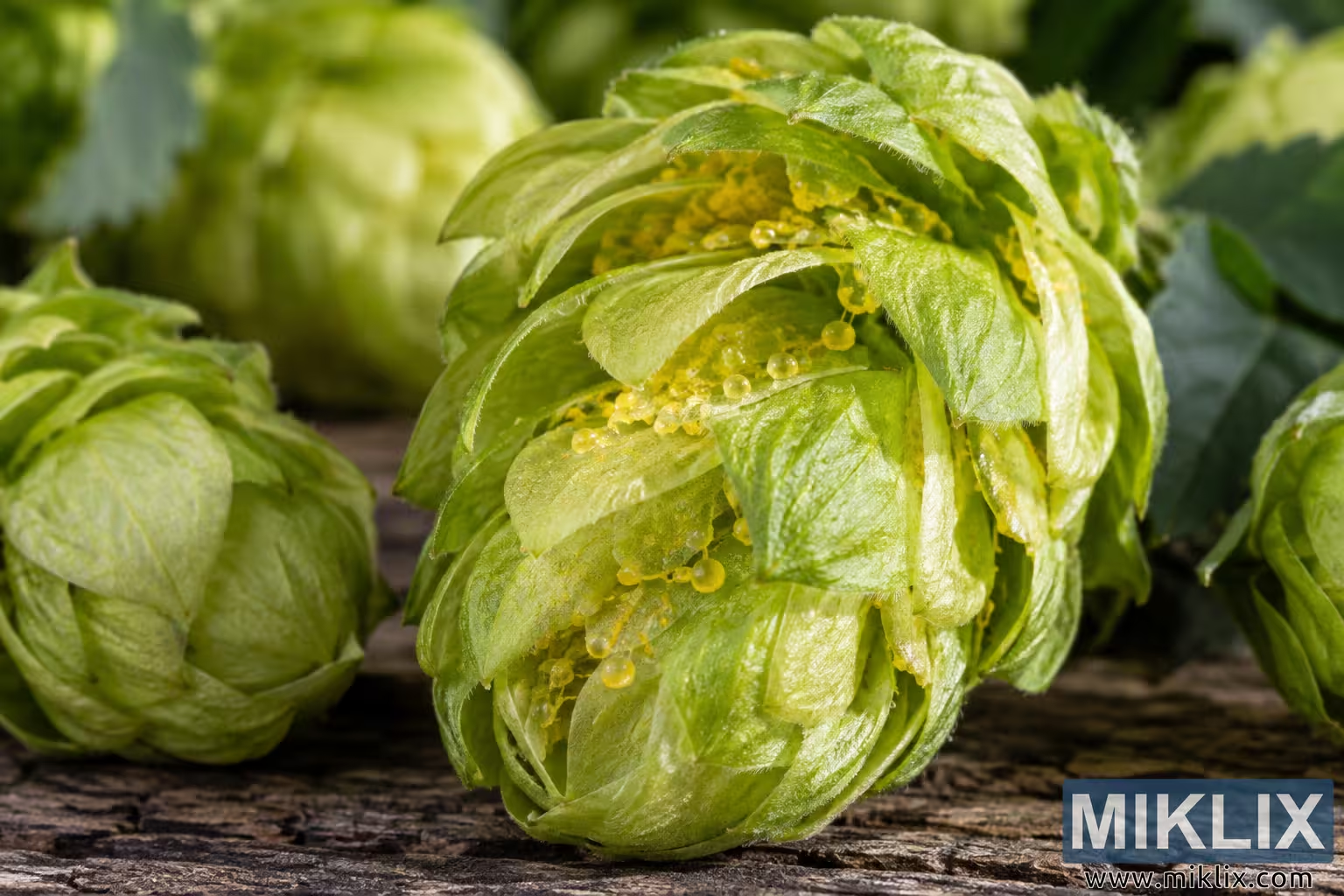
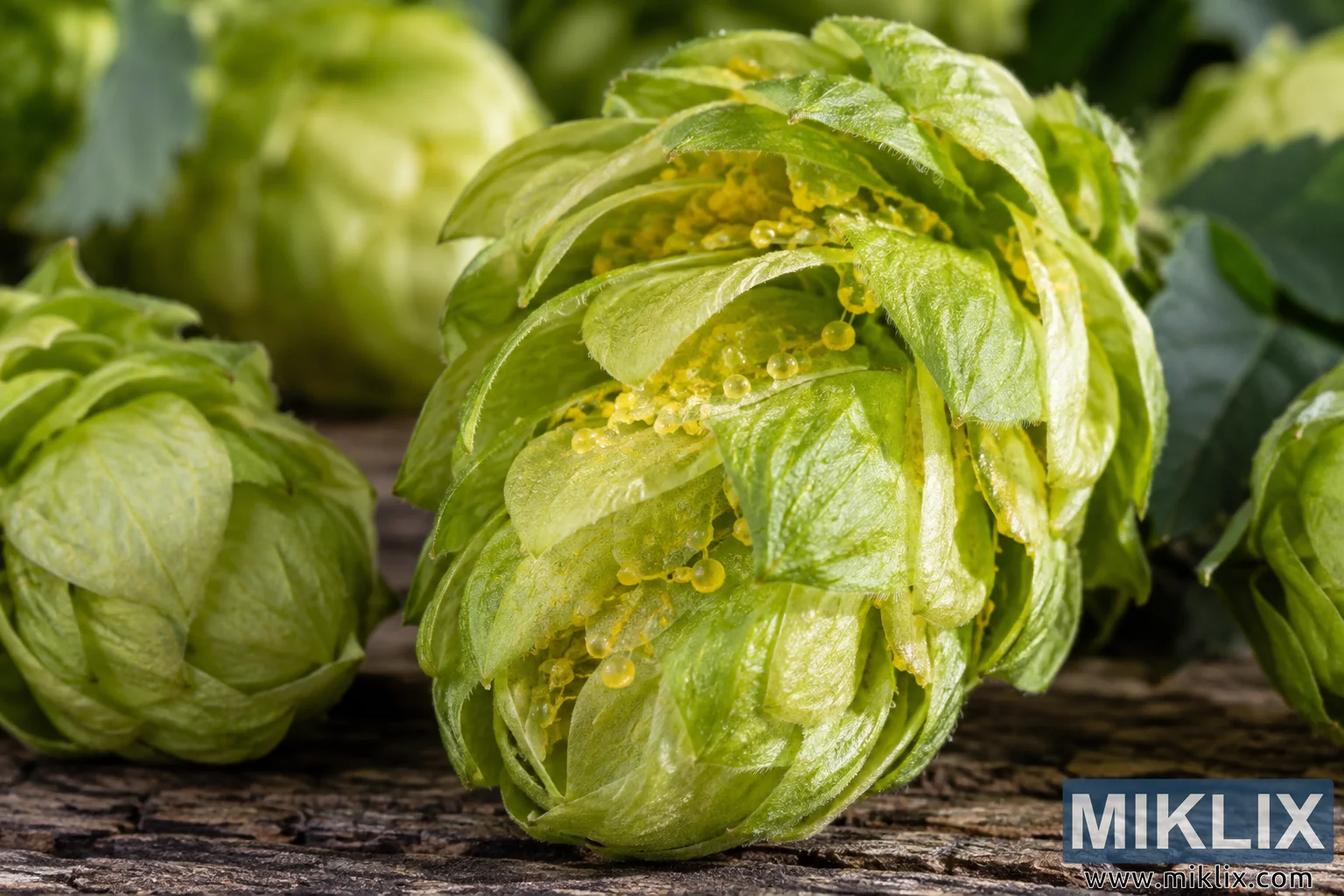
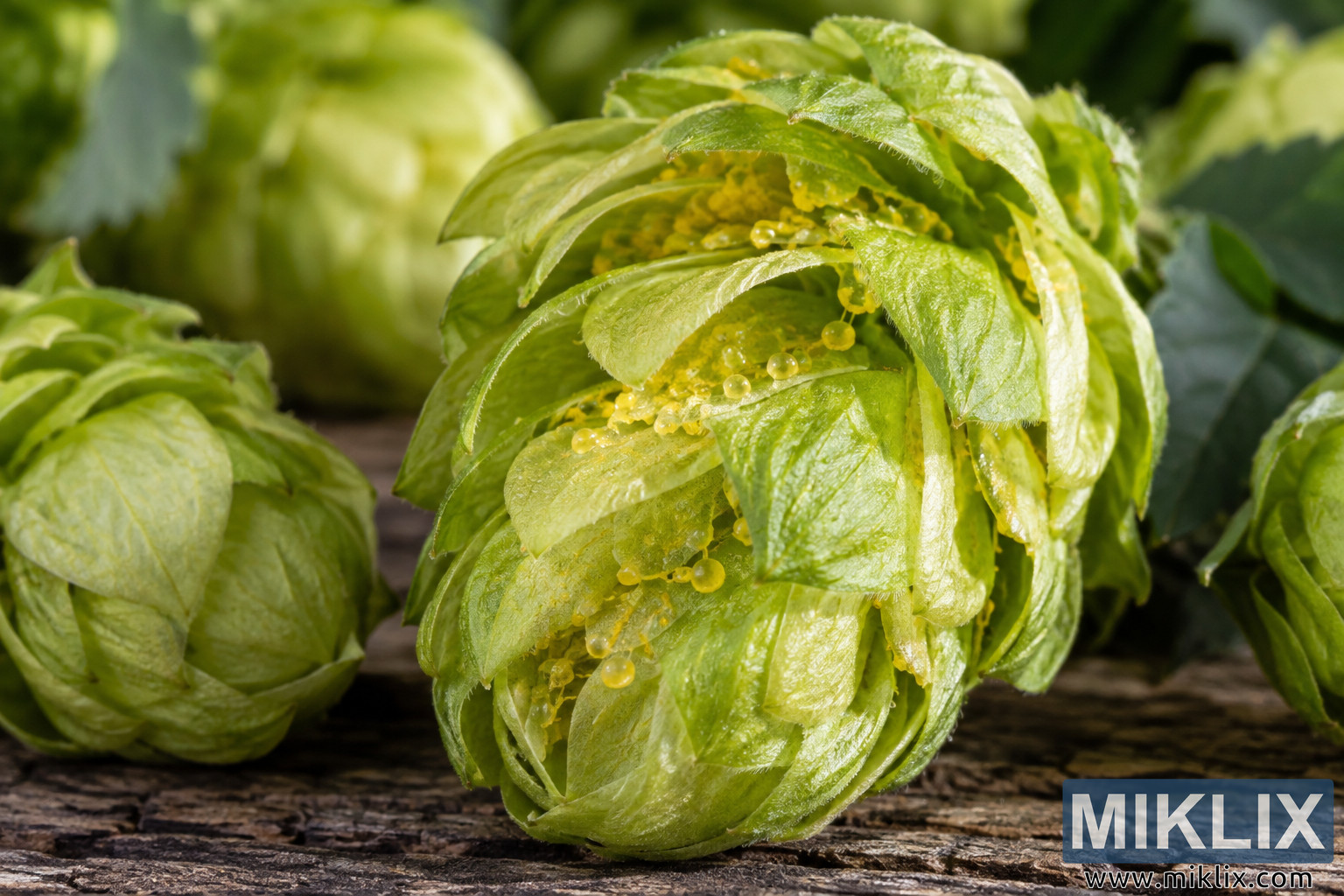
A high-resolution, landscape-oriented macro photograph presents fresh green hop cones in an intimate botanical composition, with the central hop dominating the frame and revealing the intricate structures normally hidden between its overlapping bracts. The main cone sits slightly right of center on a dark, heavily textured piece of weathered wood. Its layered, leaf-like scales open naturally toward the camera, exposing vivid golden-yellow lupulin glands within the cone. Numerous small, glossy droplets are visible among the lupulin-rich surfaces. These translucent golden droplets resemble concentrated aromatic oils and catch the incoming light, creating tiny highlights that emphasize the resinous, essential-oil-rich character associated with fresh hops. The close perspective makes these details particularly prominent, transforming the hop from a familiar brewing ingredient into an almost microscopic study of plant texture, resin, and aromatic compounds.
The primary hop cone is rendered with exceptional visual detail. Individual bracts display delicate veins, gently wrinkled surfaces, fine hairs along some edges, and subtle variations in green ranging from pale yellow-green to richer, saturated leaf tones. Several bracts curl outward or lift away from the body of the cone, allowing the viewer to see deeper into its structure. Beneath them, yellow lupulin material appears as clusters, dust-like deposits, and rounded resinous droplets. The droplets vary in size: some are extremely small and scattered across the plant tissue, while others form larger, nearly spherical beads. Their glossy surfaces reflect bright points of light and give the impression of aromatic oils collecting naturally on the lupulin glands. The warm yellow-gold of this material contrasts strongly with the surrounding fresh green plant tissue and visually communicates the concentration of aromatic compounds inside the hop cone.
Strong natural-looking illumination enters from above and slightly from the side, creating luminous highlights across the central hop. The light passes through some of the thinner bracts, making them appear partially translucent and revealing their fine botanical structure. Areas directly facing the light become bright yellow-green, while folded or overlapping sections transition into deeper green shadows. This interplay of light and shade gives the cone considerable dimensionality and makes its layered construction easy to perceive. Tiny hairs and surface irregularities catch the light along the edges, further reinforcing the macro-photographic character of the image. The exposed lupulin and oil-like droplets are among the brightest details, drawing attention toward the aromatic interior of the plant.
A second hop cone occupies the lower-left portion of the composition. It is positioned closer to the edge of the frame and appears somewhat softer than the principal subject because of the shallow depth of field. Its bracts remain clearly recognizable, but the reduced sharpness ensures that it supports rather than competes with the central cone. Behind the main subject, another large hop is visible toward the upper-left background. This cone is considerably more blurred, becoming a soft mass of pale green shapes. Additional green hop material and broad leaves extend through the right and upper portions of the background. These elements dissolve progressively into soft focus, producing a natural botanical environment without distracting from the detailed foreground.
The shallow depth of field is a major element of the visual style. Focus is concentrated on the central hop and particularly on the exposed inner bracts, lupulin glands, and glossy droplets. Details gradually become softer toward the foreground edges and background, creating a strong sense of depth. The blurred hops and foliage form a green backdrop with gentle tonal transitions rather than distinct outlines. Darker areas between the leaves provide visual separation around the brightly illuminated central subject, helping the hop cone stand out clearly. There are no labels, packages, logos, trademarks, typography, containers, or recognizable commercial branding anywhere in the scene; the photograph is entirely focused on the natural ingredient itself.
The hops rest on an aged wooden surface whose rough texture provides an earthy counterpoint to the delicate plant material. The wood is dark brown with irregular cracks, ridges, grooves, and weathered patches running horizontally through the lower part of the photograph. Its muted brown and charcoal tones contrast with the bright greens and yellows of the hops. Because the central cone touches the surface, a subtle contact shadow forms beneath it, visually anchoring the subject and reinforcing the realistic photographic appearance. The rustic wood also evokes agricultural harvesting, traditional ingredient handling, and natural raw materials without introducing any specific brand or commercial identity.
The overall color palette is dominated by vibrant botanical greens, golden-yellow lupulin, warm highlights, and deep earthy browns. The central hop has a fresh, almost luminous quality, while the yellow resinous details provide concentrated points of warmth. The background remains predominantly green and dark, allowing the brighter subject to command attention. The photograph balances scientific detail with an appetizing, sensory presentation: the visible glands and droplets suggest the aromatic intensity of hops, while the fresh cones, leaves, and rustic setting communicate natural origin and recently harvested plant material.
Compositionally, the image uses the large central hop as its unmistakable focal point. The secondary cone on the left and partially visible plant material around the edges create visual rhythm and establish context, while the shallow-focus background prevents the frame from becoming cluttered. The central subject fills a substantial portion of the landscape frame, making the image particularly effective as an illustrative photograph for content about hop aroma, lupulin, essential oils, brewing ingredients, hop cultivation, botanical characteristics, or the sensory properties of fresh hops. The combination of extreme close-up detail, visible golden glands, glistening oil-like droplets, vivid natural color, rustic wood, and softly blurred surrounding cones creates a tactile and aromatic impression. Although scent cannot literally be conveyed visually, the image strongly suggests fragrance through the emphasis on the exposed resin-bearing structures of the hop. The final result is a crisp, richly textured macro photograph that celebrates the botanical complexity of hops and places special visual emphasis on the golden lupulin glands and their aromatic, essential-oil-rich resin.
The image is related to: Hops in Beer Brewing: Record