
Image: Record Hops Essential Oil Compounds – Molecular Structure Infographic
Published: October 24, 2026 at 6:16:59 PM UTC
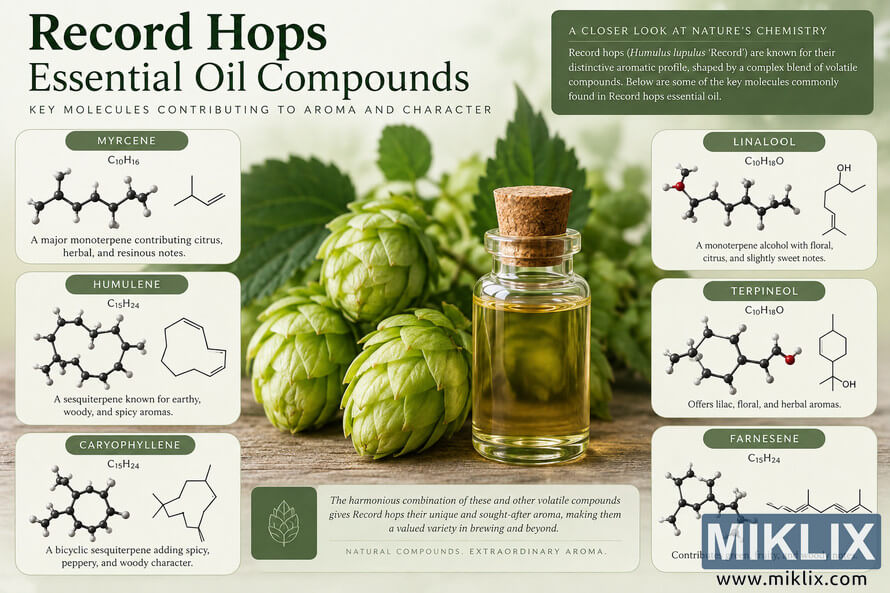
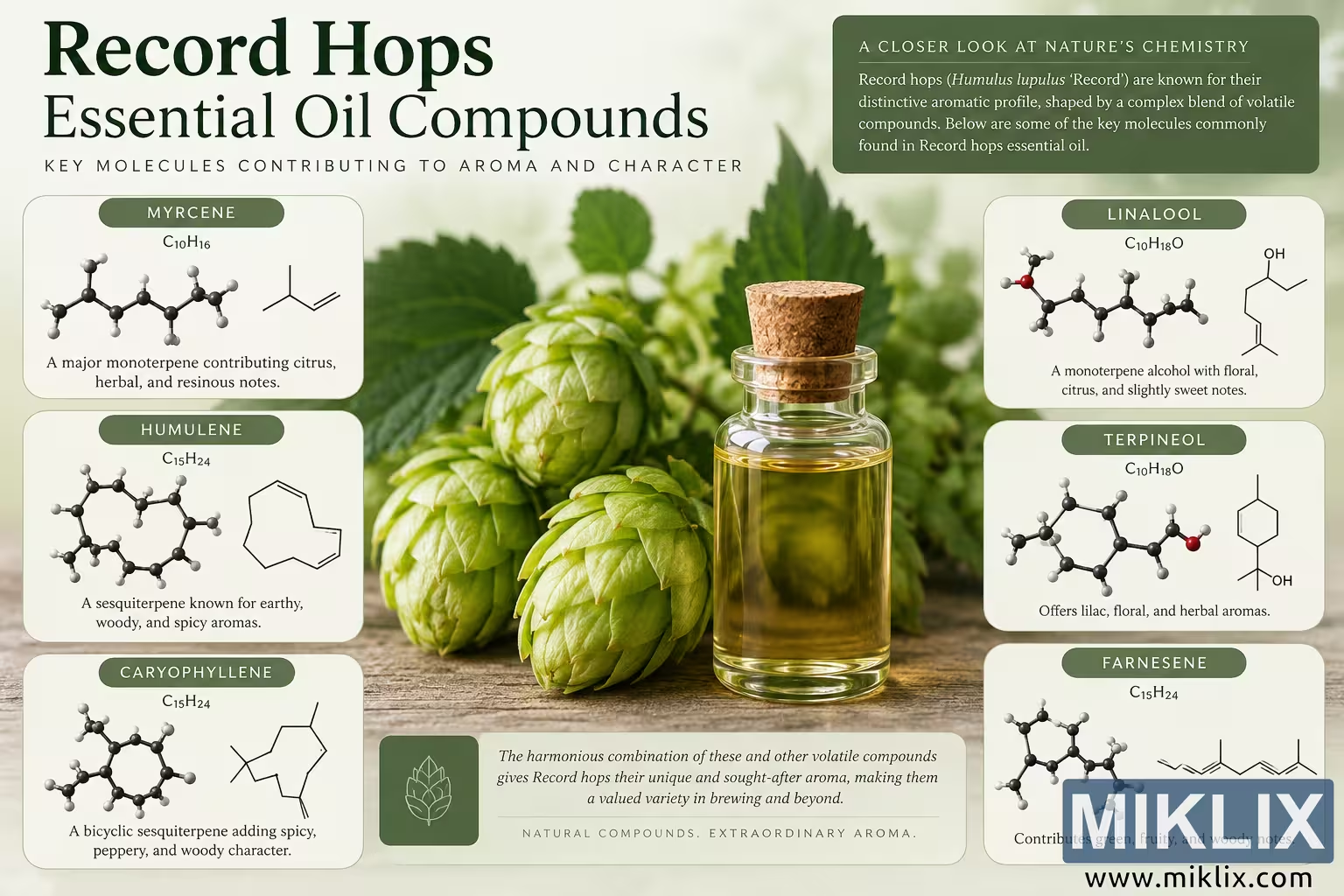
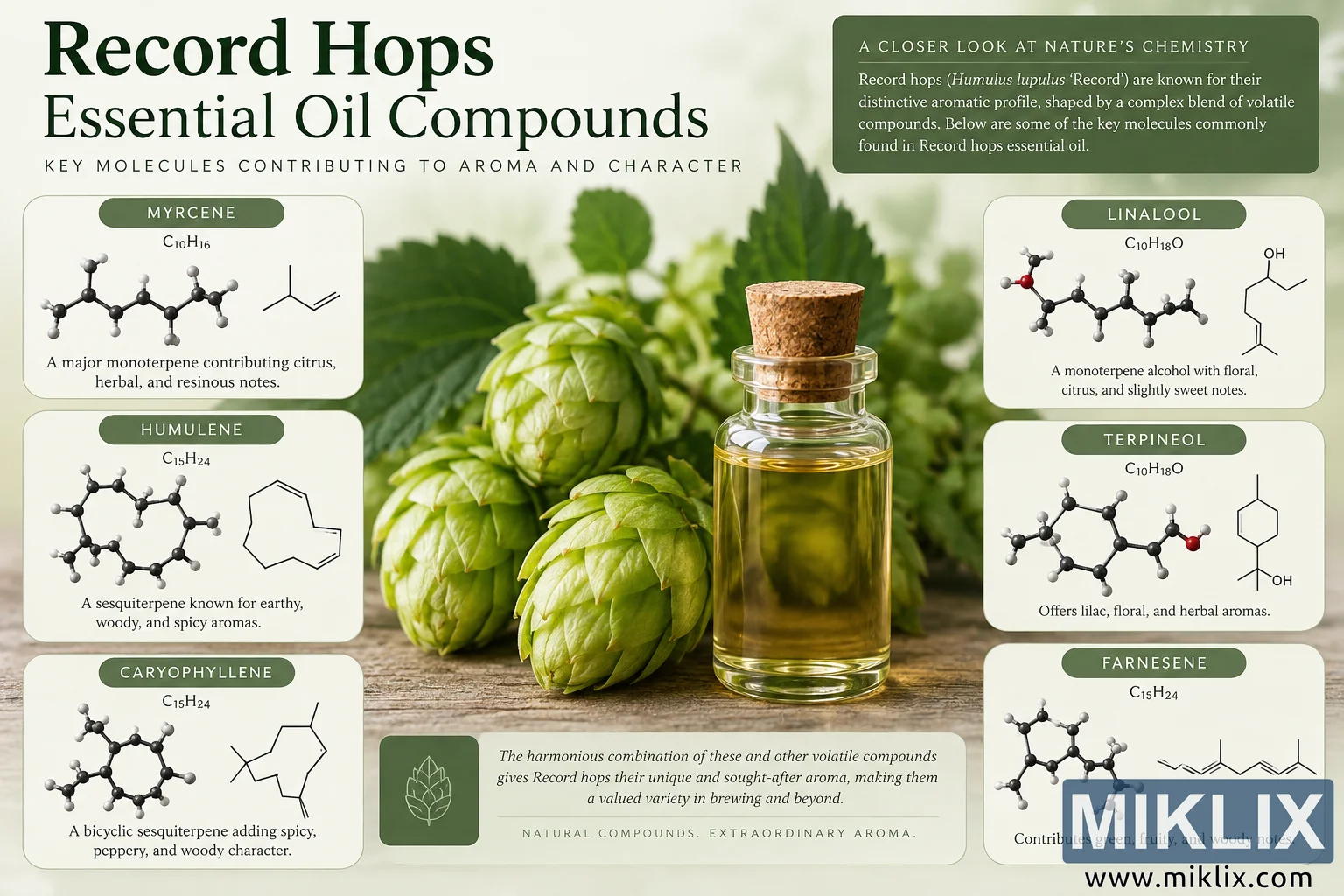
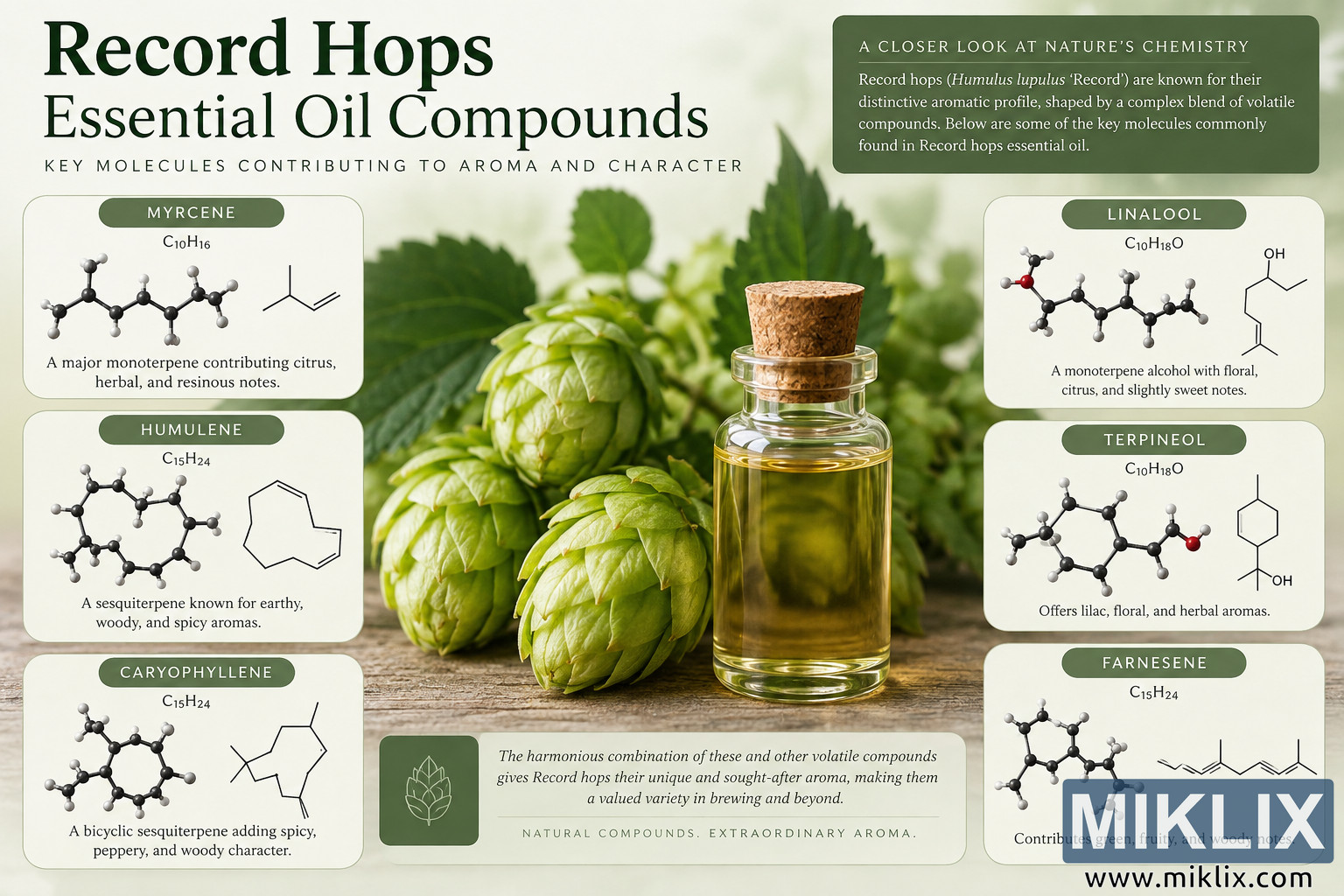
Scientific botanical infographic exploring essential-oil compounds in Record hops, with molecular diagrams for myrcene, humulene, caryophyllene, linalool, terpineol, and farnesene alongside fresh hops and essential oil.
Available versions of this image
The image files available for download below are less compressed and higher resolution - and as a result of that, higher quality - than the images embedded in articles and pages on this website, which are more optimized for file size in order to reduce bandwidth consumption.
Regular size (1,536 x 1,024)
Large size (3,072 x 2,048)
Very large size (4,608 x 3,072)
Extra large size (6,144 x 4,096)
Comically large size (1,048,576 x 699,051)
- Still uploading... ;-)
Image description
A wide, landscape-oriented scientific infographic presents the essential-oil compounds associated with Record hops in a polished botanical and educational style. The composition combines realistic photography of fresh green hop cones and an amber-colored essential-oil sample with simplified scientific molecular illustrations. The overall palette is dominated by natural hop greens, warm cream and ivory backgrounds, muted olive tones, transparent glass, golden-yellow oil, and dark green typography. The visual treatment is clean and premium, resembling a botanical reference poster or an editorial science graphic rather than commercial packaging, and no visible brand logos or commercial trademarks appear.
Across the upper-left portion of the image is a large dark-green serif headline reading “Record Hops Essential Oil Compounds.” Directly beneath it, a smaller, widely spaced uppercase subtitle reads “Key Molecules Contributing to Aroma and Character.” The typography establishes a botanical, academic tone while remaining visually integrated with the photographic background. In the upper-right corner, a dark olive-green information panel carries the heading “A Closer Look at Nature’s Chemistry.” Its accompanying paragraph explains that Record hops, identified botanically as Humulus lupulus ‘Record’, have a distinctive aromatic profile shaped by a complex mixture of volatile compounds and introduces the molecular examples displayed throughout the infographic.
The center of the composition is dominated by a realistic cluster of fresh hop cones. The cones are bright yellow-green to medium green, with clearly visible overlapping bracts and natural highlights that emphasize their layered, papery texture. Large hop leaves extend upward and outward behind the cones, creating a lush botanical background. The depth of field becomes progressively softer toward the rear, allowing the foreground hop cones and scientific information panels to remain visually prominent. The hops rest on a rustic wooden surface with subtle grain and warm brown-gray coloration.
Immediately to the right of the central hop cluster stands a clear cylindrical glass bottle containing translucent golden-green essential oil. The bottle has thick transparent glass walls, a short neck, and a natural cork stopper. Light passing through the bottle creates warm yellow and olive reflections, reinforcing the connection between the fresh botanical material and the extracted aromatic oil. The bottle and hop cones serve as the photographic focal point around which the molecular information is organized.
Three rounded rectangular information cards are arranged vertically along the left side. The top card is labeled “MYRCENE” in a green pill-shaped heading. Beneath the heading is the molecular formula C10H16, followed by a ball-and-stick molecular model and a simplified two-dimensional structural formula. A short caption describes myrcene as a major monoterpene contributing citrus, herbal, and resinous notes. The second card is labeled “HUMULENE” and shows the formula C15H24. Its molecular representations include a three-dimensional ball-and-stick model and a ring-like skeletal structure. The caption identifies humulene as a sesquiterpene associated with earthy, woody, and spicy aromas. The third card is labeled “CARYOPHYLLENE,” also with the formula C15H24. Its molecular model and angular skeletal structure are accompanied by text describing a bicyclic sesquiterpene that contributes spicy, peppery, and woody character.
Three corresponding cards appear vertically on the right side. The upper card is labeled “LINALOOL” and gives the formula C10H18O. The ball-and-stick representation includes a red oxygen atom, while the adjacent structural drawing shows an OH functional group. The caption characterizes linalool as a monoterpene alcohol with floral, citrus, and slightly sweet notes. The middle-right card is labeled “TERPINEOL,” also displaying C10H18O. Its molecular graphics again emphasize the oxygen-containing alcohol group, and the caption associates the compound with lilac, floral, and herbal aromas. The lower-right card is labeled “FARNESENE” and displays C15H24. A three-dimensional molecular model is paired with an elongated skeletal hydrocarbon structure, while the caption describes green, fruity, and woody aromatic contributions.
Each molecular card uses a warm off-white background, thin muted borders, rounded corners, and dark text. The green capsule-shaped labels provide visual consistency and make the compound names easy to scan. The three-dimensional molecular models use conventional atom-like spheres connected by bonds, primarily dark carbon atoms and pale hydrogen atoms, with red used for oxygen where relevant. Beside them, clean black line diagrams provide simplified structural representations. This pairing makes the image function both as a visually engaging botanical poster and as an accessible chemistry overview.
Near the lower center, beneath the bottle and hop cones, a horizontal cream-colored panel contains a small stylized hop icon on a dark-green square at the left. The main italicized statement explains that the harmonious combination of these and other volatile compounds gives Record hops their distinctive and sought-after aroma and makes the variety valuable in brewing and related applications. A small uppercase line along the bottom reinforces the natural-compounds and aroma theme.
The visual hierarchy moves from the oversized title to the central photographic hops and oil bottle, then outward to the six compound cards. Soft natural lighting, shallow background focus, botanical greens, and restrained scientific graphics give the image an approachable yet authoritative character. The result is a landscape scientific infographic illustrating how individual volatile molecules such as myrcene, humulene, caryophyllene, linalool, terpineol, and farnesene can be associated with different aromatic characteristics in Record hops essential oil.
The image is related to: Hops in Beer Brewing: Record