
Image: Side-by-Side Comparison of Record and Other Hop Varieties
Published: October 24, 2026 at 6:16:59 PM UTC
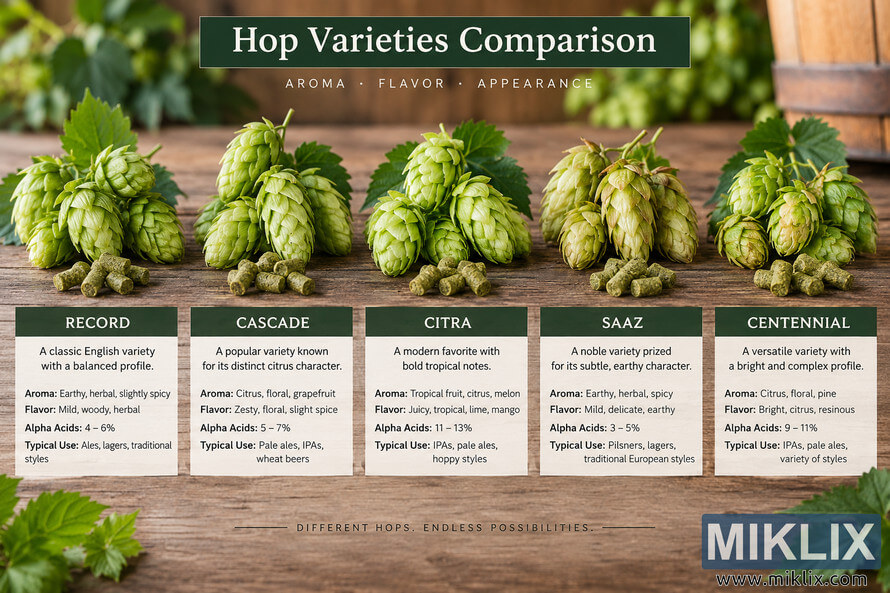
Explore a visual side-by-side comparison of Record, Cascade, Citra, Saaz, and Centennial hops, including their aroma, flavor, alpha-acid ranges, and typical brewing uses.
Available versions of this image
The image files available for download below are less compressed and higher resolution - and as a result of that, higher quality - than the images embedded in articles and pages on this website, which are more optimized for file size in order to reduce bandwidth consumption.
Regular size (1,536 x 1,024)
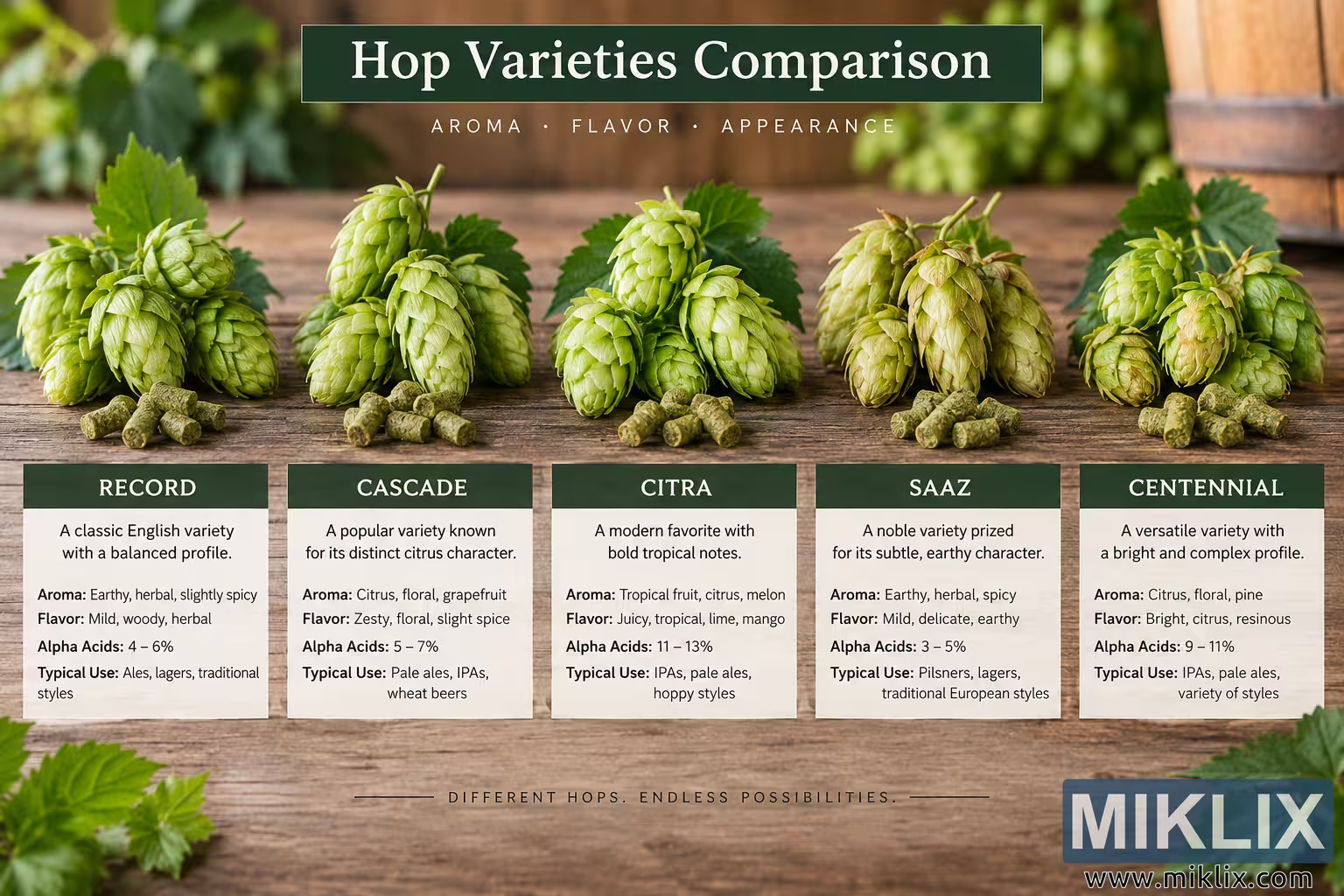
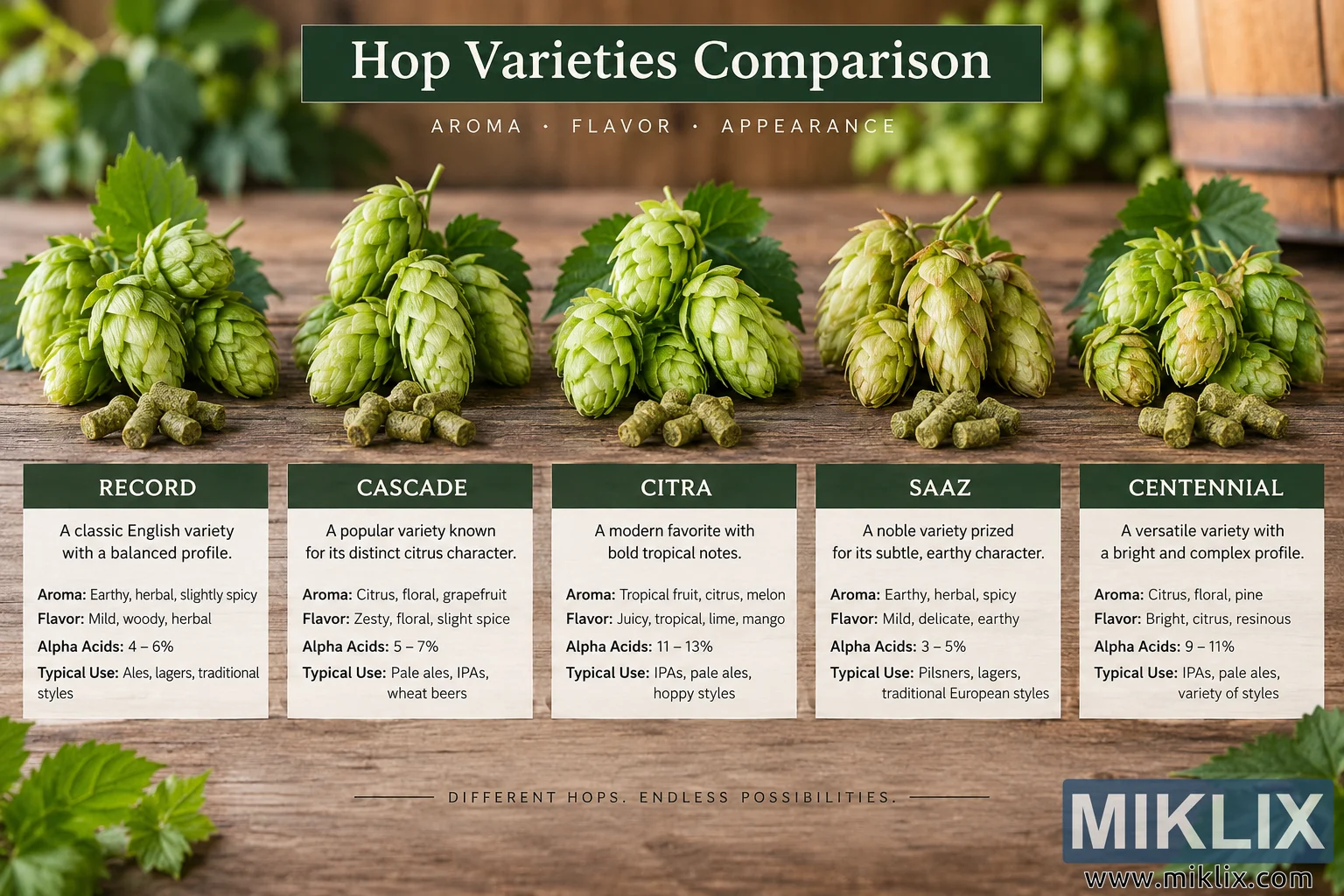
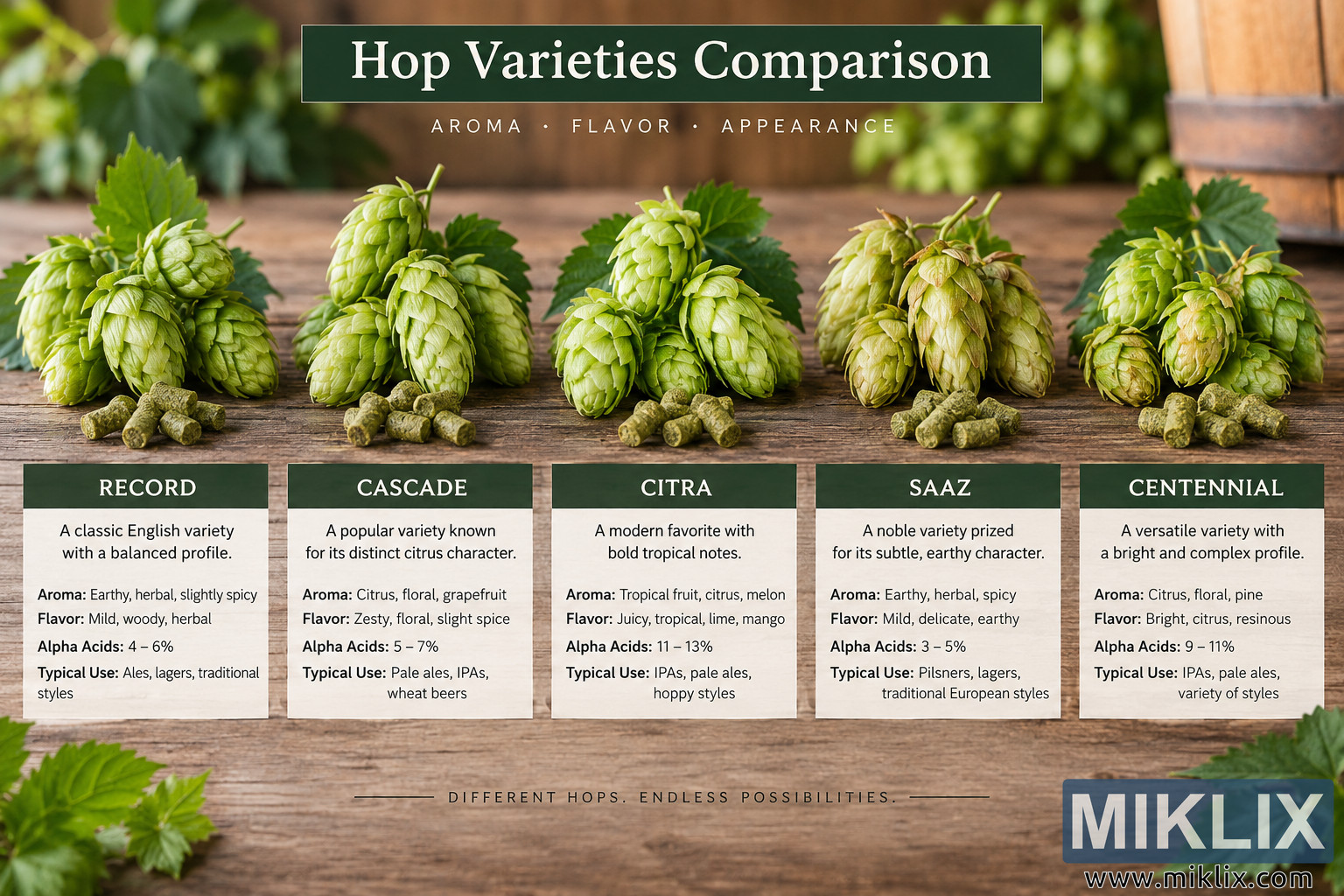
Large size (3,072 x 2,048)
Very large size (4,608 x 3,072)
Extra large size (6,144 x 4,096)
Comically large size (1,048,576 x 699,051)
- Still uploading... ;-)
Image description
A wide, landscape-oriented infographic-style photograph presents a side-by-side comparison of five hop varieties on a rustic wooden tabletop. The composition combines realistic botanical and brewing imagery with neatly organized informational panels, creating the appearance of an educational reference graphic for brewers, beer enthusiasts, or anyone interested in comparing hop characteristics. The overall palette is natural and earthy, dominated by fresh greens, warm brown wood tones, creamy off-white information cards, and deep forest-green headings. Soft, warm illumination gives the hops a fresh, tactile appearance while maintaining enough clarity for the individual cones, leaves, pellets, and printed information to remain visually distinct.
Across the upper center of the image is a large rectangular dark-green banner with a fine light border. In prominent white serif lettering it reads “Hop Varieties Comparison.” Directly beneath the banner is a smaller uppercase subtitle reading “AROMA · FLAVOR · APPEARANCE,” with generous spacing between the letters and centered dot separators. This heading establishes the image as a comparative visual guide rather than a conventional still-life photograph.
Five groups of hops are arranged horizontally across the middle of the composition. Each group consists primarily of several fresh hop cones accompanied by green hop leaves. The cones have overlapping, scale-like bracts and range from bright yellow-green to somewhat deeper olive tones. Their subtle differences in shape, color, and arrangement help distinguish the varieties visually while maintaining a cohesive presentation. Small piles of compressed green hop pellets are positioned in front of the fresh cones, reinforcing the brewing context and showing another familiar form in which hops are used. Behind the hop groups, additional foliage is softly blurred, producing shallow depth of field and a natural agricultural atmosphere. A portion of a wooden barrel is visible near the upper-right edge, providing another understated reference to brewing without displaying any brand names, logos, trademarks, packaging, or commercial products.
The leftmost group is labeled “RECORD.” It features a dense cluster of green hop cones with broad green leaves rising behind them and a small collection of hop pellets in the foreground. The information panel beneath describes Record as a classic English variety with a balanced profile. The listed aroma is earthy, herbal, and slightly spicy, while the flavor is described as mild, woody, and herbal. The panel gives an alpha-acid range of 4–6% and associates the variety with ales, lagers, and traditional styles.
Immediately to the right is the “CASCADE” section. Its hop cones are arranged in a slightly taller grouping, with multiple cones hanging or resting together above a pile of pellets. The accompanying card describes Cascade as a popular variety known for its distinct citrus character. Its aroma is listed as citrus, floral, and grapefruit, and its flavor as zesty and floral with slight spice. The alpha-acid range shown is 5–7%, and the typical uses listed include pale ales, IPAs, and wheat beers.
At the center of the image is the “CITRA” group, positioned prominently beneath the main heading. Several plump, bright-green hop cones form the focal cluster, framed by leafy greenery and accompanied by pellets. Its information panel characterizes Citra as a modern favorite with bold tropical notes. The aroma is described as tropical fruit, citrus, and melon, while the flavor includes juicy tropical qualities, lime, and mango. The displayed alpha-acid range is 11–13%, and typical uses include IPAs, pale ales, and other hop-forward styles.
The fourth section is labeled “SAAZ.” Compared with the especially vivid green cones in the center, this group contains somewhat more yellow-green and olive-toned cones, giving it a subtly different visual identity. Pellets sit directly in front of the cones. The information panel calls Saaz a noble variety prized for its subtle, earthy character. Its aroma is described as earthy, herbal, and spicy, and its flavor as mild, delicate, and earthy. The alpha-acid range is given as 3–5%, while typical uses include pilsners, lagers, and traditional European styles.
The rightmost section is labeled “CENTENNIAL.” It contains another abundant grouping of fresh green hop cones, with large leaves forming a textured backdrop and a small pile of pellets at the front. The accompanying text describes Centennial as a versatile variety with a bright and complex profile. Its aroma is listed as citrus, floral, and pine, while its flavor is characterized as bright, citrusy, and resinous. The panel displays an alpha-acid range of 9–11% and identifies IPAs, pale ales, and a variety of other styles as typical applications.
All five information panels share the same visual structure. Each has a dark-green header containing the hop variety name in uppercase white lettering, followed by a pale cream body containing a short introductory sentence and labeled lines for aroma, flavor, alpha acids, and typical use. This repeated design makes the five columns easy to compare horizontally. The panels are aligned in a single row and occupy much of the lower-middle portion of the composition, while the fresh hop specimens immediately above them provide a direct visual counterpart to the written descriptions.
The tabletop extends across the entire image and shows pronounced horizontal wood grain, knots, scratches, and natural variations in tone, giving the otherwise polished infographic a rustic, handcrafted character. Out-of-focus greenery along the upper background and leafy hop elements entering from the lower corners frame the comparison without overwhelming the central content. At the bottom center, a final line in widely spaced uppercase lettering reads “DIFFERENT HOPS. ENDLESS POSSIBILITIES.” Thin horizontal decorative rules appear on either side of this closing phrase. The balanced symmetry, realistic hop photography, natural materials, restrained typography, and consistent information-card layout produce an informative brewing-themed comparison graphic. No actual commercial brands, company logos, branded beer labels, or recognizable product packaging are visible anywhere in the image.
The image is related to: Hops in Beer Brewing: Record